
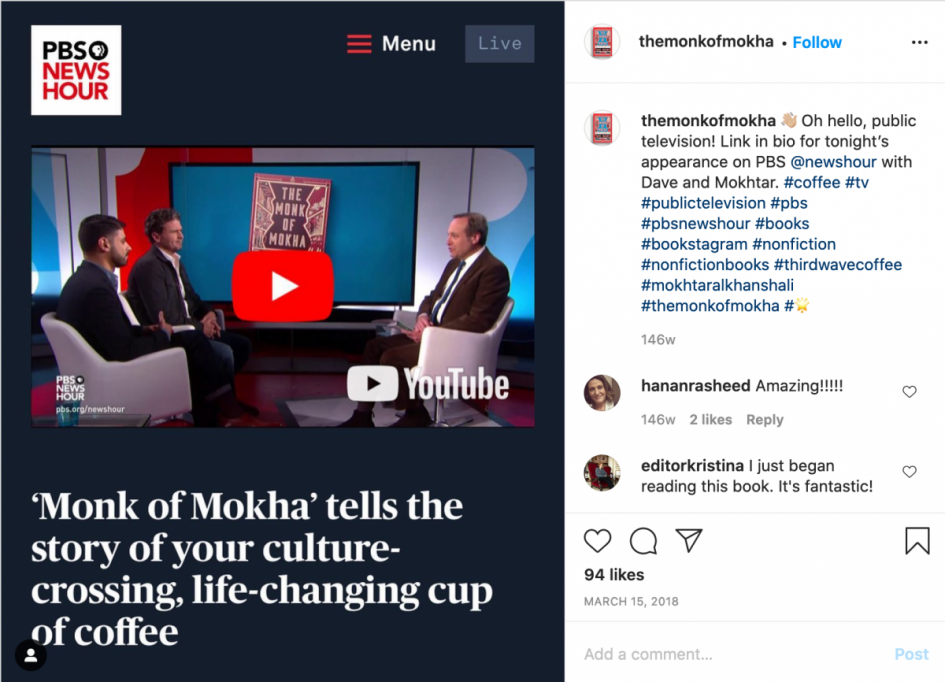
Food Media/Memoir: Mokhtar, Dave and The Monk of Mokha (photo credit: Eggars on Instagram and PBS News Hour )
Here’s where our Tasting Research with Foodoir curriculum lives as components: d) Case Study Tasting Research; e) Stuckey’s Taste Experiments; and h) Foodoir: Your Story of Tasting Place. However, following the integrative week 10 presentation assignment from fall quarter, during winter quarter you’ll create an integrative post every two weeks for each case study. Integrative posts should include appropriate highlights from your work in these components: a) Film Series; b) (un)Natural Histories; c) Regenerative Agriculture; f) Sustainable Entrepreneurship; g) Climate Justice and Resilience Events; i) Bibliography. The word “appropriate” invites each student to engage in components according to availability as well as student interest. The breadth and depth of your highlights for each component will vary depending on that case study’s curriculum and corresponding campus events as well as student interest. A thorough and curated case study of your choice is due week 10 when you present it as a cumulative winter quarter project.
Struggling with WordPress or the curriculum? Discuss with faculty the option of Plan B for focusing on weekly case studies and a single final cumulative using PowerPoint.
Note: #3.5 Tea is a special event focused on an Oolong Tea Tasting as part of Evergreen’s Lunar New Year Celebration. No integrative post is required but participating students are encouraged to document their tasting experience.
#3a: Film Series: Program Questions in Scenes and Overview
Have you watched the film(s) required for this week of our case study and turned in your film assignment through Canvas? This quarter the film assignment asks you to choose a scene that you found compelling and tell a story about it in relation to one of our program questions. Note: Each week you are required to copy and paste your current week’s assignment to the top of your Film Series Cumulative Document so that you have a single file with each of your weekly assignments–including faculty comments–to turn in week 5 on canvas and to post week 10 on your wordpress website with your final integrative case study.
Wk 5: Coffee
- ‘Monk of Mokha’ tells the story of your culture-crossing, life-changing cup of coffee, PBS New Hour (6 min)
- Black Coffee, Point of Origin podcast #28 (Stephen Satterfield, 40 min) plus browse related links at this website while listening to the Black Coffee podcast
- Black Gold. Website with reviews and film on campus library streaming service Kanopy. (Directors Marc and Nick Francis, 2006, 77 min).
Wk 6: Coffee
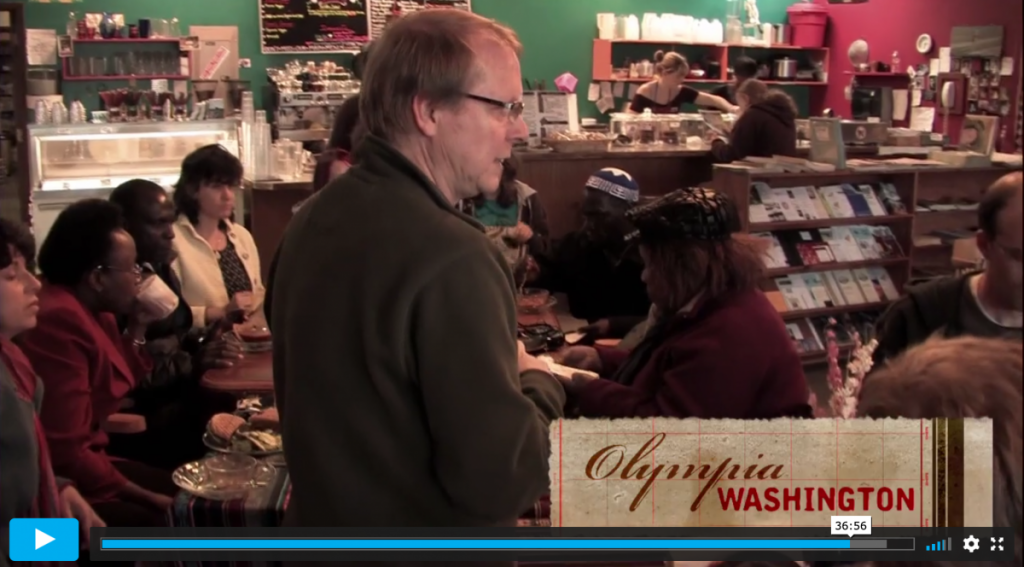
- Olympia Coffee (website to browse with assorted short videos, 30 min)
- Black Coffee Northwest (website plus google for related news items)
- Love, Coffee, Yemen: A Story of Hope, fueled by coffee by Mokhtar Alkhanshali | Nuqat 2019 (36 min)
- Top 8 Coffee Documentaries to Watch Online for Free (8 min)
- Recommended: Delicious Peace Grows in a Ugandan Coffee Bean (2010, 40 min)
#3b: (un)Natural Histories
#3c: Regenerative Agriculture
#3d: Case Study Tasting Research: Coffee
Coffee Cupping with Bob Benck of Batdorf and Bronson
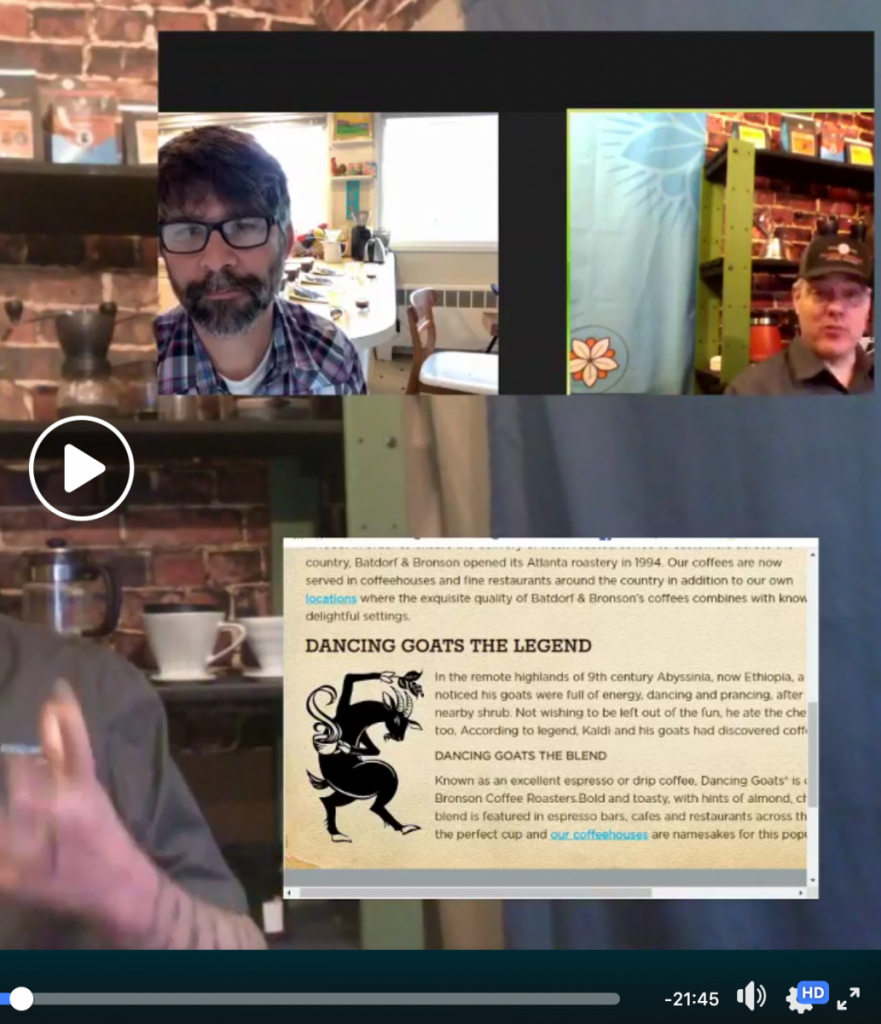
Download, complete, and then copy and paste your completed handout and forms into your #3d Coffee Tasting Research website component. Do NOT upload as a file. These are .doc files.
Here are the original PDF forms. In theory you won’t be able to type your responses on these PDF files, but you will be able to read them and compare and contrast with potentially messed up formatting on the .doc file versions (above). Goal: Have both versions of these files available in a “read” format and figure out a way to fill them out and share your data from the coffee cupping. Check out your peers’ #1 WINE and #2 GRAINS websites for ideas and inspiration (see student URLs in menu above).
#3e: Stuckey’s Taste Book Experiments
Hello again – your favorite Terroir/Meroir TA here! To commemorate all of us surpassing the midway point of the winter quarter I thought we could all sit down on Wednesday (2/10) morning, gather ’round some of our favorite snacks and drinks, and talk about the what we have learned thus far, and maybe learn a bit more.
The workshop/lab that I have planned for you this week revolves around how sounds and colors pop! and paint a picture of flavor, influencing our own perception of the foods we eat. Imagine grabbing a bag of potato chips that has been packed in a t-shirt rather than the loud and crackly plastic bag, or biting into one of those potato chips and not experiencing that all too cathartic *crunch* that we have all associated with tearing into a bag of chips; would you notice any difference or is the chip a mere medium for a powdered coating?
week 6 experiment materials:
- Snacks! Please bring to class an assortment of your favorite snacks, try and have some differing textures (almonds, berries, apple, cereal, chips etc)
- Drinks! Please be creative with this, the thought is that we are going to try and alter the colors of the drinks with food dye before tasting them and seeing if this throws us off a bit. (lemonade, white-grape juice, grapefruit juice, seltzer water, etc.)
- Food Dye (red, green, yellow) – You all should have received some little baggies of food dye, we will use these to change the colors of the drinks.
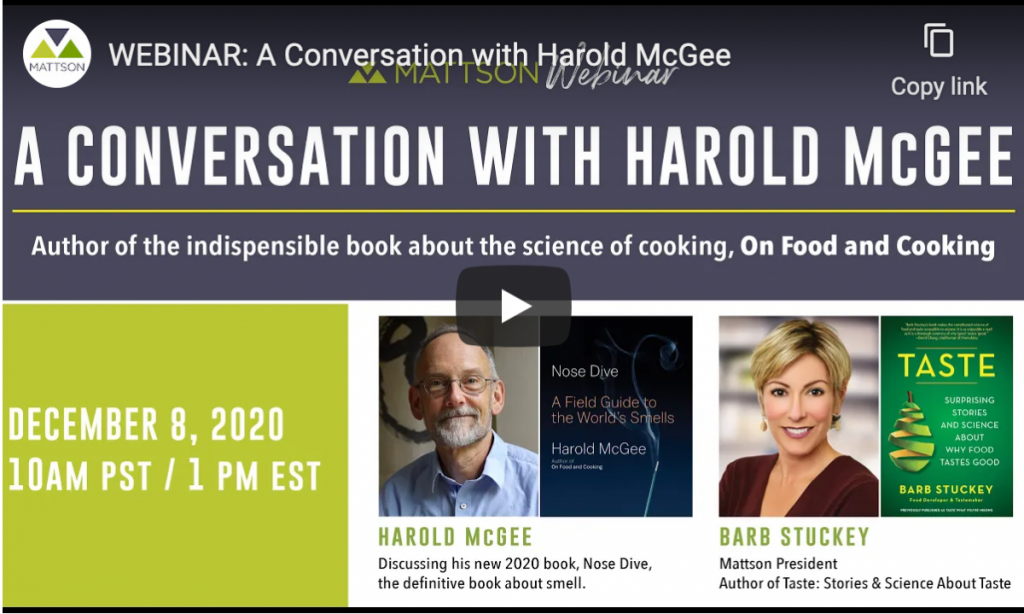
In preparation for the workshops I ask you to read the Sight chapter (pg 102-116) and the Sound chapter (pg 117-130) from Barb Stuckey’s Taste book. Also, check out the webinar starring Barb Stuckey and Harold Mcgee! These two chapters are a quick read and have some very interesting thoughts about the sight and sound of food influencing our habits! We will be going through 2 separate experiments: “Can color color taste?” pp114 & “Hear your favorite foods” pp131. I will post photos of these pages below.
See you on Wednesday!
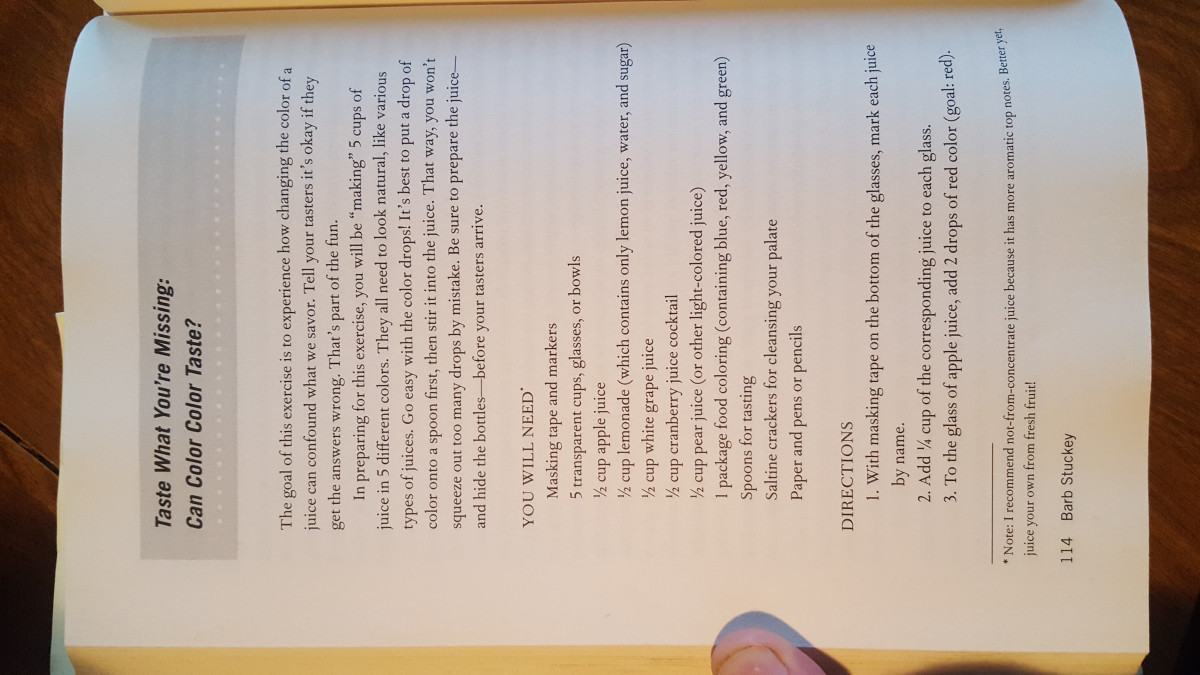
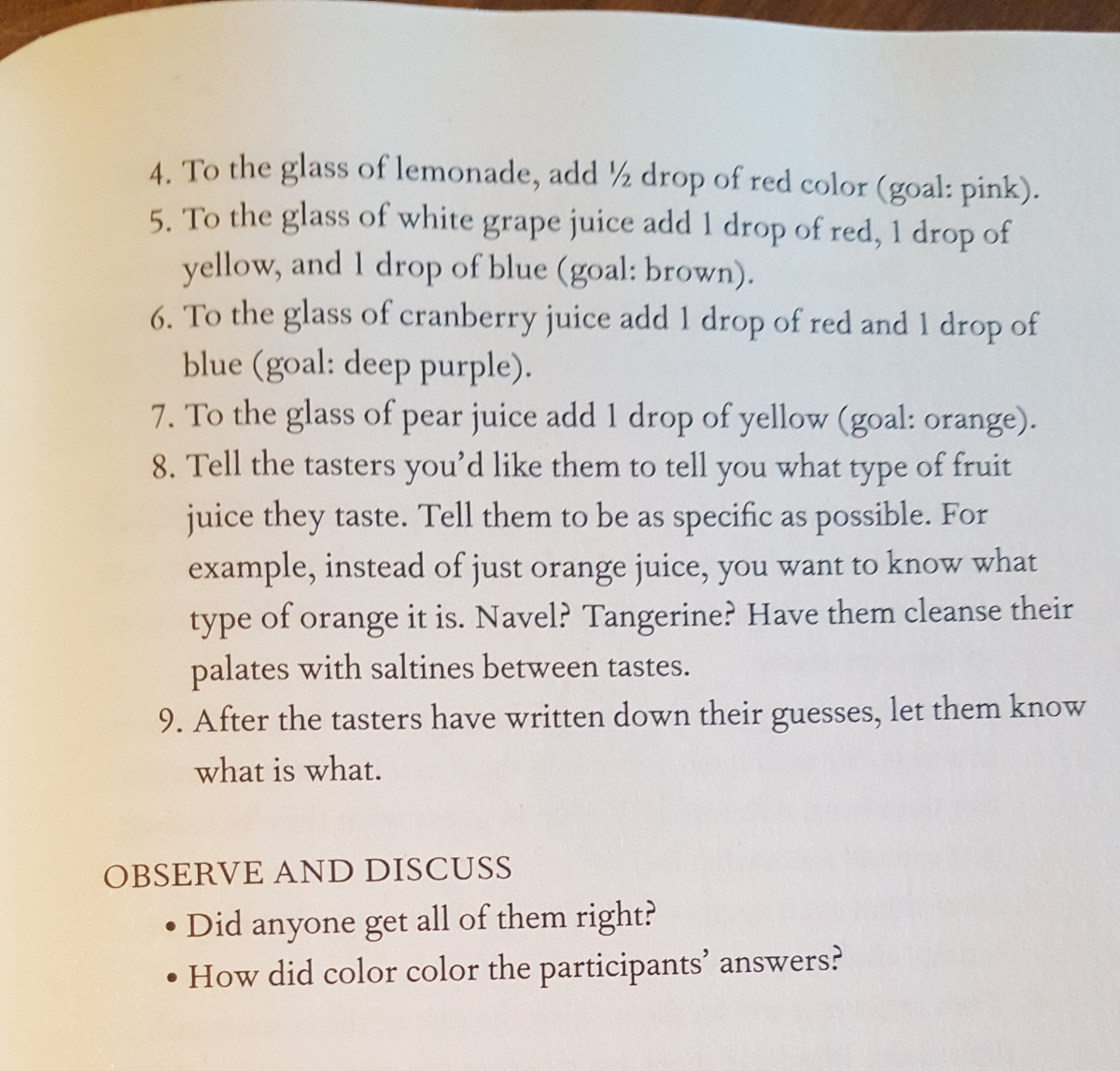
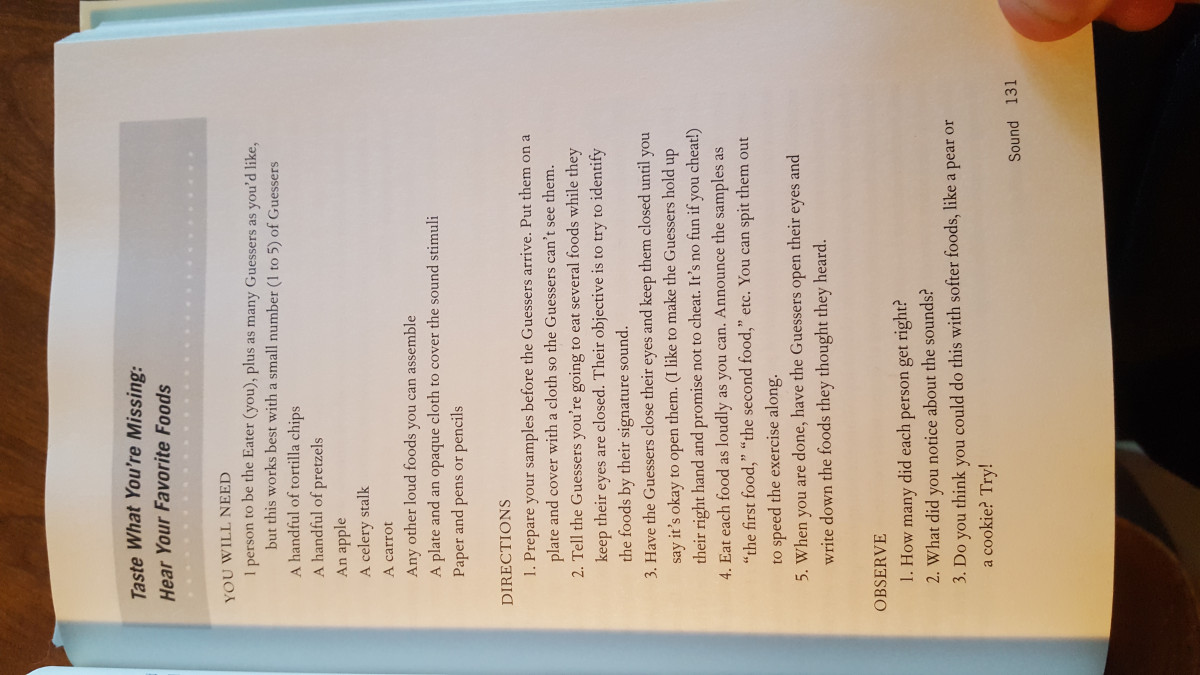
Taste Experiment Guide and Question Form:
#3f: Sustainable Entrepreneurship
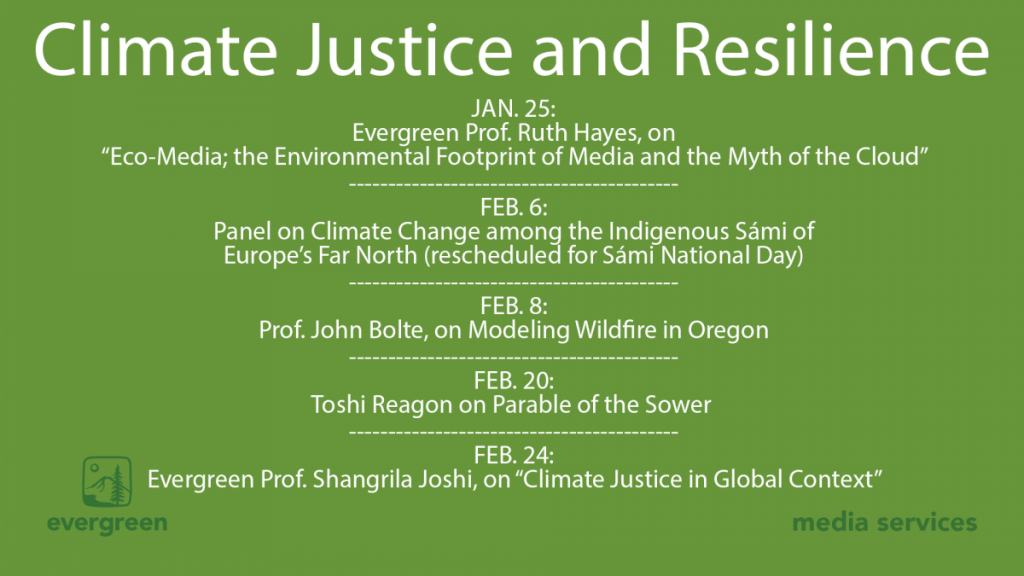
#3g: Climate and Resilience Event Series/Seminar
Click here for the link to the winter quarter Climate Justice and Resilience Event Series with details:
#3h: Foodoir: Your Story of Tasting Place
- Which ONE foodoir from this list (also provided on the TM syllabus) have your chosen?
Farming While Black by Leah Penniman, The Rise: Black Cooks and The Soul of American Cooking or Yes, Chef: A Memoir by Marcus Samuelsson, The Flavor Equation by Nik Sharma, The Gastronomical Me by M.F.K. Fisher, The Sioux Chef’s Indigenous Kitchen by Sean Sherman, or if new to T/M winter quarter Micheal Twitty’s The Cooking Gene.
- Have you created a reading schedule to read approx. 1/9 of the book each week?
- Use the COMMENT section below (post bottom) to share your name and the title of the foodoir you’re reading!
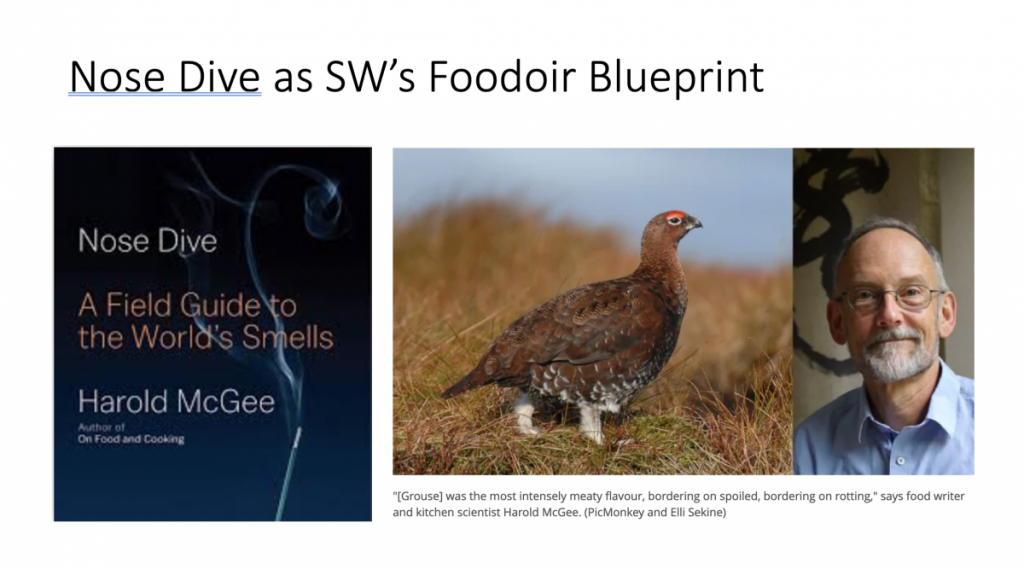
The usual cultural touchstone for connecting flavor with emotion is the morsel of madeleine cake that Marcel Proust’s narrator dunks into a cup of linden-blossom tea in the first volume of his novel A la recherche de temps perdu, or In Search of Lost Time. … My shudders weren’t exactly pleasurable: they seemed more likely to be instinctive warnings. The grouse was so strong and funky that it might have been spoiled; [the smell of my] cauterized tongue probably evoked the misery of my tonsillectomy twenty years before. But was that all they meant? (xiii)
Harold McGee, Nose Dive
Here’s where you write (draw, cook, scan, photograph, document) your engagement with the foodoir of your choice. Always begin by providing 1-3 sentences of a key quote from your foodoir (with author, title, page #) that you’ll be responding to by creating your own story of taste and place. Create a reading schedule week one in order to read approx. 1/9 of the book each week. Choose your foodoir from list provided on the TM syllabus. If you’re new to TM winter quarter another option is to read the fall TM foodoir, Michael Twitty’s The Cooking Gene following the prompts provided on the fall quarter website. SW will be providing a prompt from the TM list of possible foodoirs and as time allows a multi-week shallow but focused dive into Harold McGee’s Nose Dive, which students can choose to juxtapose with their foodoir quote, or not. Nose Dive locates the human sense of taste in relation to the evolution of plant earth. It also provides a blueprint for doing taste research, beginning and ending with McGee’s story of tasting grouse. All students will be supported to develop your own independent research projects for 4-12 credits during the spring quarter, or sooner as your interests take shape.
[H]ow we register and name and think about smells depends on where we’ve happened to encounter them first.’ We may think that the Amazonian ant tastes of lemon grass and ginger, but to the native Amazonian, lemon grass and ginger taste of ant.
Harold McGee, Nose Dive
As you read your chosen author’s story of her/his/their identity as an eater, consider your own story of self, food, and place.
- In what ways does (and doesn’t) your chosen author’s writing provide a blueprint for yours?
- What do you choose to eat and why? Who cooked you and who cooked for you?
- How has that cooking—and its history–shaped your taste preferences and experiences?
- As you experiment with crafting words to communicate your taste experiences be sure to include that process in your story: what characterizes your experience of the relationship between your mouth as an organ of ingestion and an organ of disgestion?
- How do your hands relate to your mouth and to your keyboard?
- Where, when, and how is your thinking embodied?
The final part of your Tasting Lab post each week should include writing toward your own foodoir. Ground/anchor your writing in relation to a specific quote (or series of quotes) from each week’s sequential chapters from your choice of a foodoir.
- Like his book, Twitty’s WordPress website, Afroculinaria, is award-winning. Does the author of your foodoir also have a website or use other social media? What about the foodoir and social media inspire you?
Suggested Length: 100-200 words.
#3i: Bibliography
Your are required to learn and use a standard reference style such as APA or MLA as demonstrated here at the Online Writing Lab (OWL).
February 3, 2021 at 4:11 am
Val – The Gastronomical Me by M.F.K. Fisher
February 4, 2021 at 9:11 pm
Marrion – The Gastronomical Me by M.F.K. Fisher
February 4, 2021 at 9:11 pm
Grace – The Gastronomical Me
February 4, 2021 at 9:11 pm
The Sioux Chef’s Indigenous Kitchen By Sean Sherman with Beth Dooley.
February 4, 2021 at 9:12 pm
Sarah D. – The Gastronomical Me
February 4, 2021 at 9:12 pm
Ashley – Farming While Black by Leah Penniman
February 4, 2021 at 9:12 pm
Farming While Black by Leah Penniman
February 4, 2021 at 9:13 pm
Zoe – The Flavor Equation by Nik Sharma
February 4, 2021 at 9:15 pm
Chanarin: The Sioux Chef’s Indigenous Kitchen by Sean Sherman
February 17, 2021 at 1:51 am
The Sioux Chef’s Indigenous Kitchen, Sean Sherman with Beth Dooley