
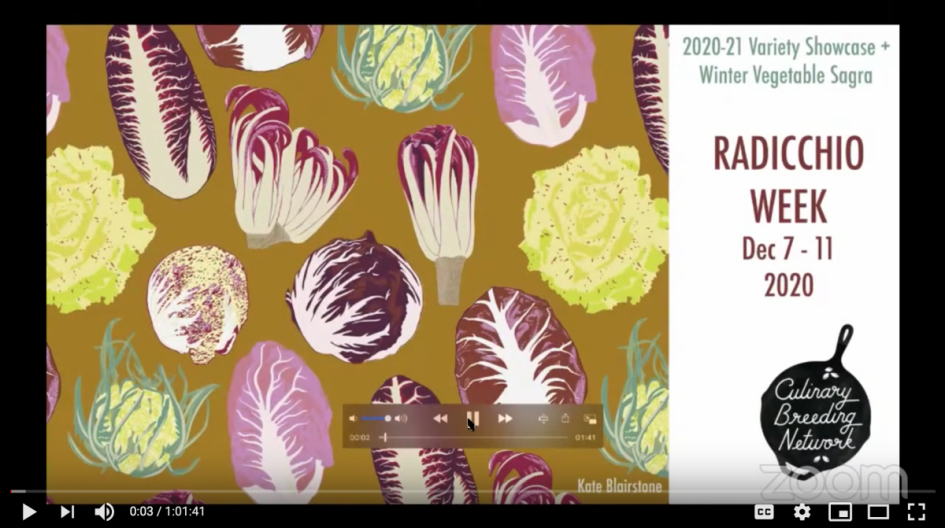
Culinary Breeding Network’s Radicchio Week (photo credit: CBN)
Here’s where our Tasting Research with Foodoir curriculum lives as components: d) Case Study Tasting Research; e) Stuckey’s Taste Experiments; and h) Foodoir: Your Story of Tasting Place. However, following the integrative week 10 presentation assignment from fall quarter, during winter quarter you’ll create an integrative post every two weeks for each case study. Integrative posts should include appropriate highlights from your work in these components: a) Film Series; b) (un)Natural Histories; c) Regenerative Agriculture; f) Sustainable Entrepreneurship; g) Climate Justice and Resilience Events; i) Bibliography. The word “appropriate” invites each student to engage in components according to availability as well as student interest. The breadth and depth of your highlights for each component will vary depending on that case study’s curriculum and corresponding campus events as well as student interest. A thorough and curated case study of your choice is due week 10 when you present it as a cumulative winter quarter project.
Struggling with WordPress or the curriculum? Discuss with faculty the option of Plan B for focusing on weekly case studies and a single final cumulative using PowerPoint.
Note: #3.5 Tea is a special event focused on an Oolong Tea Tasting as part of Evergreen’s Lunar New Year Celebration. No integrative post is required but participating students are encouraged to document their tasting experience.
#5a: Film Series: Program Questions in Scenes and Overview
Have you watched the film(s) required for this week of our case study and turned in your film assignment through Canvas? This quarter the film assignment asks you to choose a scene that you found compelling and tell a story about it in relation to one of our program questions. Note: Each week you are required to copy and paste your current week’s assignment to the top of your Film Series Cumulative Document so that you have a single file with each of your weekly assignments–including faculty comments–to turn in week 5 on canvas and to post week 10 on your wordpress website with your final integrative case study.
WK 9: Radicchio
All videos from the 2020-21 Culinary Breeding Network’s Variety Showcase + Winter Vegetable Sagra. Choose any 2 (or more)!
- HISTORY of radicchio with Andrea Ghedina of Smarties.bio (68 min)
- FORCING TECHNIQUES with Uprising Seeds / Wild Roots / Local Roots (79 min)
- COOKING with Italian farmer Davide Zimolo and his nonna (70 min)
- COOKING Radicchio di Treviso Marinato and Radicchio Pizza with Cathy Whims of Nostrana (68 min)
- LATE SEASON VARIETY TRIALS with Linda Fenstermaker of Osborne Quality Seeds and radicchio growers Matthew & Giana of The Crow’s Farm (60 min)
Bonus Option: If you’re interested in radicchio farming in the USA, specifically the endive you’ll taste in Wednesday’s lab, enjoy the following.
- The Future of Agriculture podcast with Tim Hammerich: Episode #184 (Dec 18, 2019): Finding a Niche in Endive Farming with Rich Collins (30 min). Future of Farming Website (Links to an external site.), Apple Podcast FoF (Links to an external site.) website or wherever you get your podcasts.
#5b: (un)Natural Histories
#5c: Regenerative Agriculture
#5d: Case Study Tasting Research: Radicchio
Hello Everyone! Caleb here:
I am excited to see you all in class on Wednesday morning, and I’m excited to taste some pretty awesome and diverse types of chicories – locally grown, leafy vegetables in the middle of February, how cool!
For those of you that were able to come to the supplies pick up, all you will need for the tasting are the radicchio that were given to you. If you are studying more remotely and weren’t able to make it to the pick up, any type of radicchio (or even some other leafy vegetable) that you are able to get your hands on would work just fine for the week 9 radicchio tasting.
I will post the tasting form below, this will be the sheet that you will use to follow throughout the tasting.
If you would like some more information about the different types of chicory and radicchio, feel free to check out this radicchio fact sheet that I put together last quarter:
#5f: Sustainable Entrepreneurship
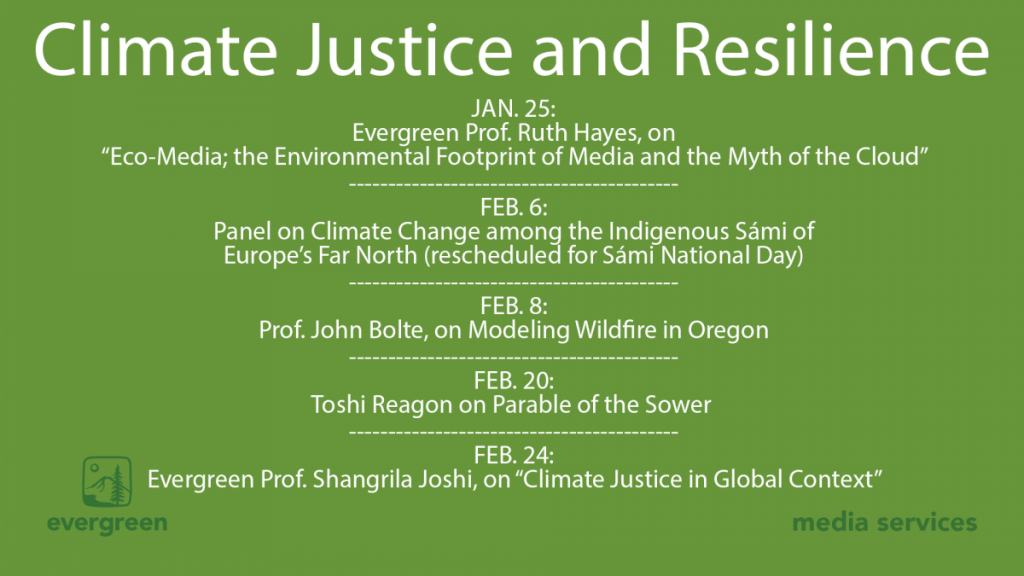
#5g: Climate and Resilience Event Series/Seminar
Click here for the link to the winter quarter Climate Justice and Resilience Event Series with details:
#5h: Foodoir: Your Story of Tasting Place
Here’s where you write (draw, cook, scan, photograph, document) your engagement with the foodoir of your choice. Always begin by providing 1-3 sentences of a key quote from your foodoir (with author, title, page #) that you’ll be responding to by creating your own story of taste and place. Create a reading schedule week one in order to read approx. 1/9 of the book each week. Choose your foodoir from list provided on the TM syllabus. If you’re new to TM winter quarter another option is to read the fall TM foodoir, Michael Twitty’s The Cooking Gene following the prompts provided on the fall quarter website. SW will be providing a prompt from the TM list of possible foodoirs and as time allows a multi-week shallow but focused dive into Harold McGee’s Nose Dive, which students can choose to juxtapose with their foodoir quote, or not. Nose Dive locates the human sense of taste in relation to the evolution of plant earth. It also provides a blueprint for doing taste research, beginning and ending with McGee’s story of tasting grouse. All students will be supported to develop your own independent research projects for 4-12 credits during the spring quarter, or sooner as your interests take shape. FOODOIR OPTIONS FOR #s 4 or 5: Use the hypothes.is loaded file from Nose Dive available under the Week 10 Module Wed AM Tasting Research component, to respond to the 7 prompts SW has placed in the text using hypothes.is. I really really look forward to reading your annotations! This option can replace or supplement your case study #4 or #5 foodoir work. Additional option for #5: engage with and respond to the following selections from Nose Dive.
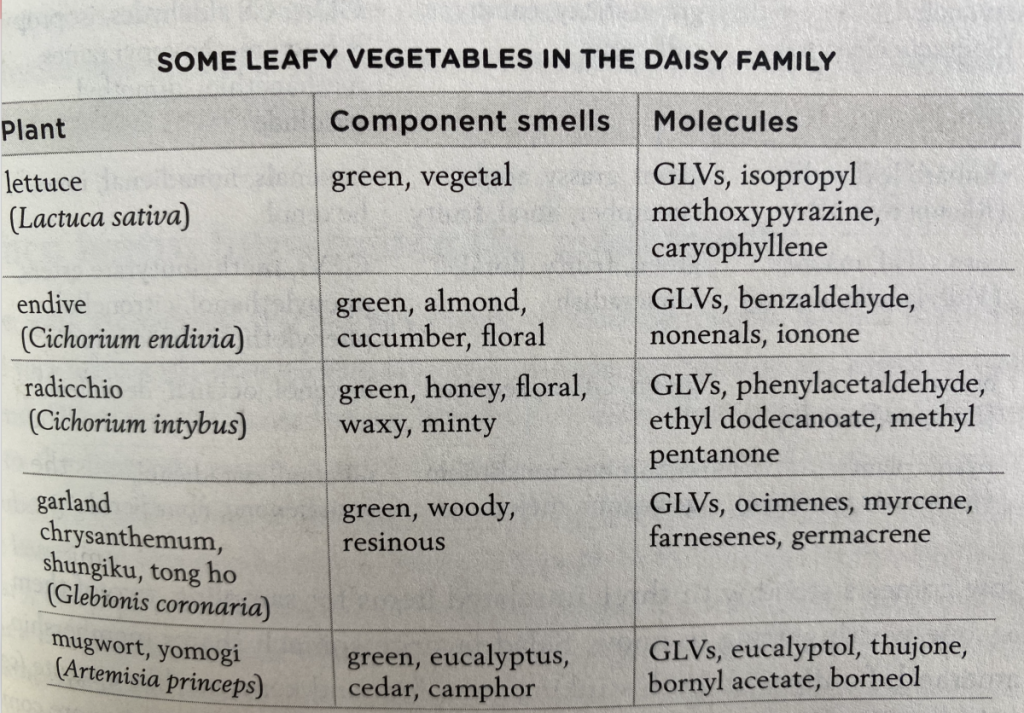
Endive and radicchio are sister species to each other and are more complex than lettuce, valued in part for the bitter counterpoint they can bring to a salad. Endive is touched with almond, cucumber, and flowery notes; radicchio, with consonant honey, waxy, flowery, and sometimes minty notes.
Harold McGee, Nose Dive (245)
As you read your chosen author’s story of her/his/their identity as an eater, consider your own story of self, food, and place.
- In what ways does (and doesn’t) your chosen author’s writing provide a blueprint for yours?
- What do you choose to eat and why? Who cooked you and who cooked for you?
- How has that cooking—and its history–shaped your taste preferences and experiences?
- As you experiment with crafting words to communicate your taste experiences be sure to include that process in your story: what characterizes your experience of the relationship between your mouth as an organ of ingestion and an organ of disgestion?
- How do your hands relate to your mouth and to your keyboard?
- Where, when, and how is your thinking embodied?
The final part of your Tasting Lab post each week should include writing toward your own foodoir. Ground/anchor your writing in relation to a specific quote (or series of quotes) from each week’s sequential chapters from your choice of a foodoir.
Like his book, Twitty’s WordPress website, Afroculinaria, is award-winning. Does the author of your foodoir also have a website or use other social media? What about the foodoir, website and/or social media inspire you? Final bonus: Two videos featuring Michael Twitty!
- Michael Twitty, Author, History and Significance of Colladrds in the South (65 min)
- Michael Twitty, Author, Discusses The Cooking Gene (82 min)
Suggested Length: 100-200 words.
#5i: Bibliography
You are required to learn and use a standard reference style such as APA or MLA as demonstrated here at the Online Writing Lab (OWL).
Leave a Reply