
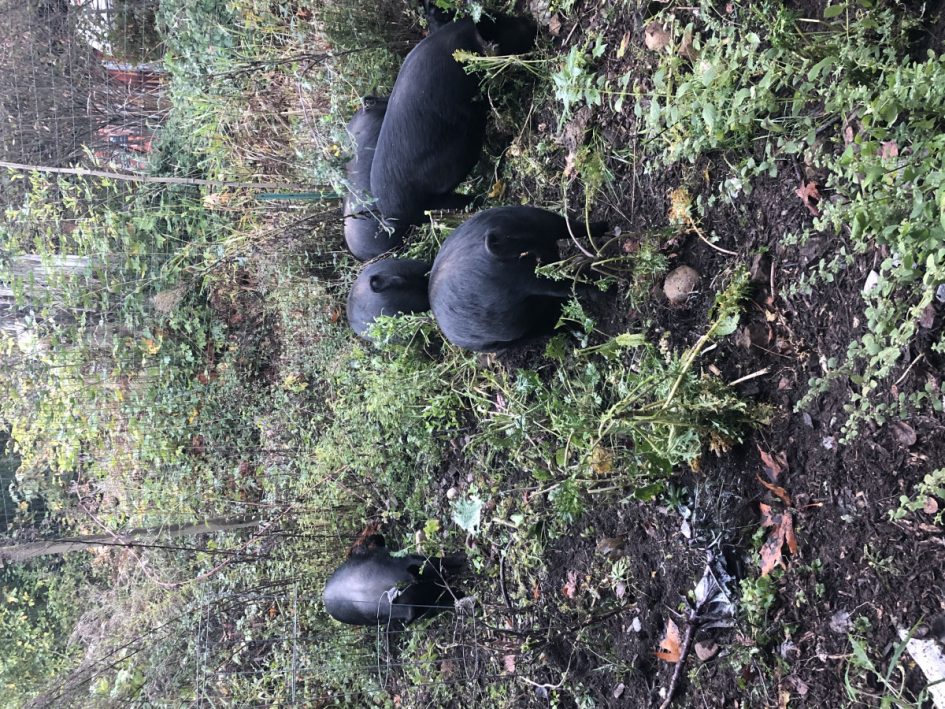
“One of the powerful things about heritage animals is that they were able to survive and thrive in a time when we didn’t have a lot of vets and chemical dewormers and vaccinations” (34).
“ A core requirement of this breed is that when times are hard and people are struggling to survive and find food, this breed will be there to help people when times are hard” (35).
“Just some grazing and a few scraps to survive and thrive. That is the one role that Guinea Hogs provide better than any other pig” (35).
Kirk Fackrell, Saving the guinea hogs
Hog killing was a very intricate ritual no matter where in the South you lived
A new archetype has emerged of the nurturing omnivore both petting and stroking something he (it’s usually a he) hopes will later make the perfect ethnical, compassionate entrée.
Michael twitty, The cooking Gene
The Guinea Hog has been known by many names: Forest Guinea Hog, Guinea Forest Hog, African Guinea Hog, Miniature African Pig, Pineywoods Guinea, and since 2006, American Guinea Hog. They are smaller hogs with noses that can range from short to long. They have dark pigmented skin to protect them from sunburns. They usually reach 125lb to 250lb and can yield 71lb to 144lb of meat. Their calm temperament and flavorful meat and luxurious amount of fat are just a few of the things that make them special.
Guinea Hogs are among the rarest heritage breeds. Guinea Hogs are a landrace breed. Landraces are sometimes called local breeds, natural breeds or primitive breeds. According to Sponenberg, “Landrace breeds represents an early stage of breed development… Landraces are characterized by consistency of biological and adaptation traits, and not necessarily by uniformity of physical appearance” (13). Landrace breeds are special due to there ability to survive with little input. They have a certain resistance to diseases and parasites without the help of humans, which makes them very important in the case of disaster occurring in modern commercial hogs. They have a genetic diversity that makes it important for preserving this breed.
They were a common pig prior to the civil war in the South. After the Chinese and European origin of the “improved” and “standardized” breeds were introduced, Guinea Hogs became less desirable and known as “poor mans hog”. Standardized breeds were faster growing and cheaper market prices than the Guinea Hogs.
Industrial farming was one of the biggest reasons for the almost disappearance of the Guinea Hog. Demand for less fatty and leaner meat, which sacrificed much of the flavor of pork in general, was another reason. The pet pig craze contributed as well.
A major factor that contributed to the rise of industrialized farming were certain government policies that halted smaller family farms that practiced diversity and promoted large scale monoculture farming as well as removed animals from pasture and put them into CAFO’s (confined animal feeding operations). Diversity decreased, chemical and intensive farming increased and it created a whole host of problems that we are still dealing with today.
In the book Pig Tales: An Omnivores Quest for Sustainable Meat by Barry Estabrook (same author of Tomatoland), he states that 97 percent of pork consumed in the US is now grown in CAFOs… millions of hogs are raised and slaughtered and never touch the dirt or grass in their life, are in extremely close proximity, get their teeth removed, tails removed, and are castrated without anesthesia, as well as fed antibiotics constantly due to the poor conditions creating sickness. There is reason to believe that the rise of Superbugs, antibiotic resistant bacteria, is due to the antibiotics constantly being fed to the hogs.
Thankfully, starting in 1990, people started creating organizations and registries to help recover the dwindling AGH breed from extinction. In 2006, “there were fifty five Guinea Hogs alive that we knew of in the United States. Of those, 26 of them were viable animals that could be bred” (65). Now as of January of 2019, there are more than 9,000 Guinea Hogs that have been registered through the American Guinea Hog Association.
There is now a niche market for the American Guinea Hog due to the flavor, aroma, and texture of the pork. “Breeders, consumers, and chefs report a difference in taste when Guinea Hogs meat is compared to breeds of hogs — even those also raised on the same land and fed the same diet” (18). In 2006, the American Guinea Hog was nominated to into the Slow Food, USA’s Ark of Taste.
Guinea Hogs are lard hogs, which means they get fat really easily and are more fatty than most other breeds. The lard can be used for cooking, making soap and candles, making biscuits, confit, pancetta, and much more. They have different metabolisms that other hogs that make it better for them to graze. Grazing is necessary due to how fast they can put on fat and become morbidly obese. They take longer to grow, but that is noted to make their meat and fat more flavorful. They can thrive on a quarter of the commercial feed that “improved” breeds need. They forage more than other hogs breeds and have a very gentle, friendly, and easy to manage temperament that makes them perfect for a small homestead family with kids and a first time pig farmer.
The Guinea Hog was a common pig in the South, with possible origins from Africa. In Michael Twitty’s book The Cooking Gene, he shares Southern practices with the hog. Assuming a lot of those hogs were Guinea Hogs, he says, “Appalachian people usually did their hog killing between Thanksgiving and Christmas before mountain snows made each hill and holler its own island. In the Deep South, hog killing time may not occur until the very dead of winter…In the days before refrigeration was common, an extended cold snap was a necessary element for the fall and winter killing time”. Hog killing time was dependent on the temperatures outside. The prime temperatures to hang a carcass to let enzymes begin to denature the rigor mortis tight protein binds, the temps should be around 33-41 degrees Fahrenheit. You want it cold like a fridge but not freezing.
The details Michael Twitty shared in his book aligned with how we approached our slaughter. We went with a more traditional hog killing approach, unlike most medium-large scale industrial sized slaughter houses. Twitty states “Hog killing was a very intricate ritual no matter where in the South you lived…. with a small feast for all those gathered to do the work of slaughtering; bleeding; singeing and boiling to remove the hair; scraping the hog; hanging it up by the flap of flesh behind the feet; making the cut from the bung to the throat; catching and cleaning the guts; tending the head and then finally processing the meat and lard into distinct portions” (308). The only difference I can note is that we didn’t hang them by the flap of flesh behind the feet, we hung them by the tendons within the feet. The flap of flesh would break making the whole experience of scalding and scraping 50x more difficult. The parallels within his book and our hog killing and processing was so great to read, especially with wrapping up this quarter as my last quarter and things being more interconnected than I realized.
Estabrook, Barry. Pig Tales: an Omnivore’s Quest for Sustainable Meat. W.W. Norton, 2016.
Payne, Cathy R. Saving the Guinea Hogs: the Recovery of an American Homestead Breed. Cedar Springs Garden Enterprises, 2019.
Leave a Reply