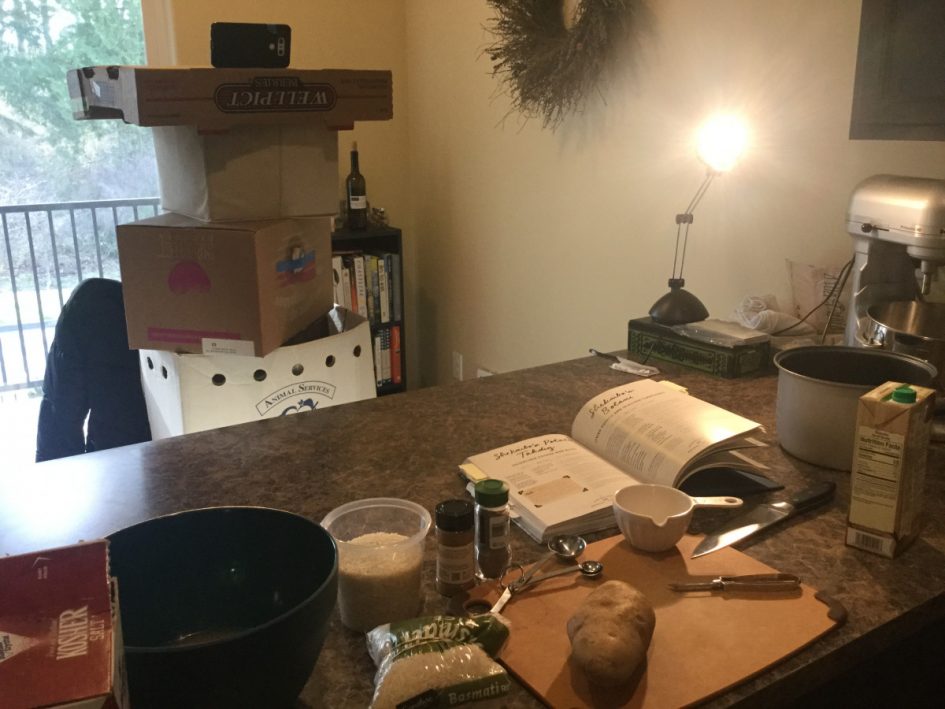
The first step of this recipe is to assemble the marinade, which should be done 48 hours ahead of time if using pork, and 24 hours ahead of time if using chicken. I used chicken thighs this week–chicken adobo is something my mom made a lot when I was a kid, so I’m looking forward to the burst of nostalgia that’ll come from opening up the pot when this is all done.
The marinade ingredients are as follows:
- 2 lbs. chicken thighs (I used bone-in, but you don’t have to)
- 2 bay leaves
- 8 garlic cloves, peeled
- 1/2 medium onion, sliced
- 1/2 cup high-quality soy sauce
- 1/4 cup sweet soy sauce
- 1 tsp each salt & black pepper
- 1/2 cup white vinegar
Once you’ve marinated your protein, the rest of the preparations flow really easily and simply. This week, our main kitchen skill that’ll be exercised is patience–patience in waiting for the marinating process, patience in waiting for the slow-cooking of the adobo, patience in waiting for the rice to cook. And, possibly, patience in through what might turn out to be an imperfect product.
Difficulty level: Elementary
Oh, and…
For many of us, already minimal sources of income have been cut off, and so it’s more important than ever to consider how to maximize the ingredients in your kitchen. How do we use what might be considered scraps?
A real good place to start, and something I do with everything I cook, is save the vegetable ends and peels for stock. Things that make sense, anyway–onion ends, carrot peels, edges of celery, herb stems, things like that. I put them in freezer bags, freeze ’em, and once I’ve got a few full I dump them in a pot, fill that sucker with water and a few hours later, like magic, I’ve got a boatload of vegetable stock.
Anyway, back to our regularly scheduled programming.
For those of you at home: Don’t pronounce the ‘D’ in Maillard.
Should I or should I not wash rice?
That thing I was saying about meat? *Not always true* Sometimes true, not always. Maybe not even in this case.
Always err on the side of just cooking small, meaty cuts like these. By this I mean bringing it right up to the temperature it needs to be cooked, and taking it promptly off heat.
Things like brisket, or shanks, work well with long cooking times because their physical makeup is different. We’ll let the experts talk about that.
So, there we have it: the first cooking fail. At least, a failure in terms of pulling off that scorched, crunchy texture that we were shooting for. Some of you may have made this before, and know just how to do it. As we can see, I didn’t.
I made it again in a pot the next morning, with very similar results. But, I have theories…
Theories that I’d like to test out, in order to come to my own conclusions, because I’m stubborn and like to mess up until I figure things out myself. For those of you that like to just have someone show you the right way, check this out.
Unfortunately, I became so hungry during this process that I immediately devoured the bowl and forgot to record the tasting process.
Despite the fact that the final product wasn’t what I was going for, it tasted amazing. I might cut back the salt in the rice, because there’s so much salt inherent in the soy sauce for the adobo. My partner Antoinette made the spot-on comment that these are two powerfully flavored dishes, and that eating them together, while delicious, can be a little overwhelming.
Although I love being punched in the mouth by flavor, I do have to agree: this wants something like fresh peas mixed into the rice, to cut the big flavor and give a welcome dose of freshness to a rich dish.
Other than the saltiness, need for something fresh, and the abject failure of the tahdig, these recipes were super easy to make, and delicious.
Leave a Reply