
by Abie Baumheckel
Ever so quietly in the distance, I can hear the sizzling of bacon in the pan. I stir between asleep and awake and take a deep inhale, letting the blissful aroma awaken my senses. Clumsily, I’d get out of bed and teeter down the hall to the kitchen. My dad would say “there’s my girl!” and give me a hug, proud of the daughter that was quick to arise from bed at the beckoning of bacon. Bacon was my first food love. My family called me a bacon head, and all things bacon instantly reminded them of me. Camping one summer, my parents asked me what I wanted for my birthday; my response was bacon. The morning of the 16th, I was flabbergasted, and utterly delighted, when I was told that the beautiful mounted plate of bacon was all for me. Not a piece remained when I was done.

This is my family. My father is German, French, and Scottish-Irish. He was born and raised on the sunny beaches of California. Whenever he talks about it, I see the bright eyes of him as a boy shine through the face of a man in his 50s. My mother is half Thai and half Laotian, although we never count the Laotian half because my mother only met her father a couple of times in her youth. My mother was born and raised in Sattahip, Thailand, a military town on the ocean. She grew up eating lots of fresh fruit, spicy sauces, rice, meat and seafood. Both of my parents were raised in very different climates from the Pacific NorthWest. However, the origins that have compelled me the most have always been those of my mother.
Being born and raised in the U.S., having Thai dishes growing up was something different from the kids that I knew, although I didn’t know that at the time. Growing up, we would go to Thai temple markets and eat all of the delicious foods that the vendors had to offer; it was the closest atmosphere we had akin to Thailand. I remember going down to California and separating fresh flat rice noodles for my Yai (Grandma), to make lad na. Thai food is always a comfort for me, it makes me feel close to my family. When I eat curry, or lad na, or drink Thai iced tea, or Thai iced coffee, it is a transportive soothing of the soul. It makes me feel grounded, connected. The world slows for a bit, and I am gradually connected to the memories of my family. Then further still, connected to my family that lives in Thailand, to the place that is foreign to me.
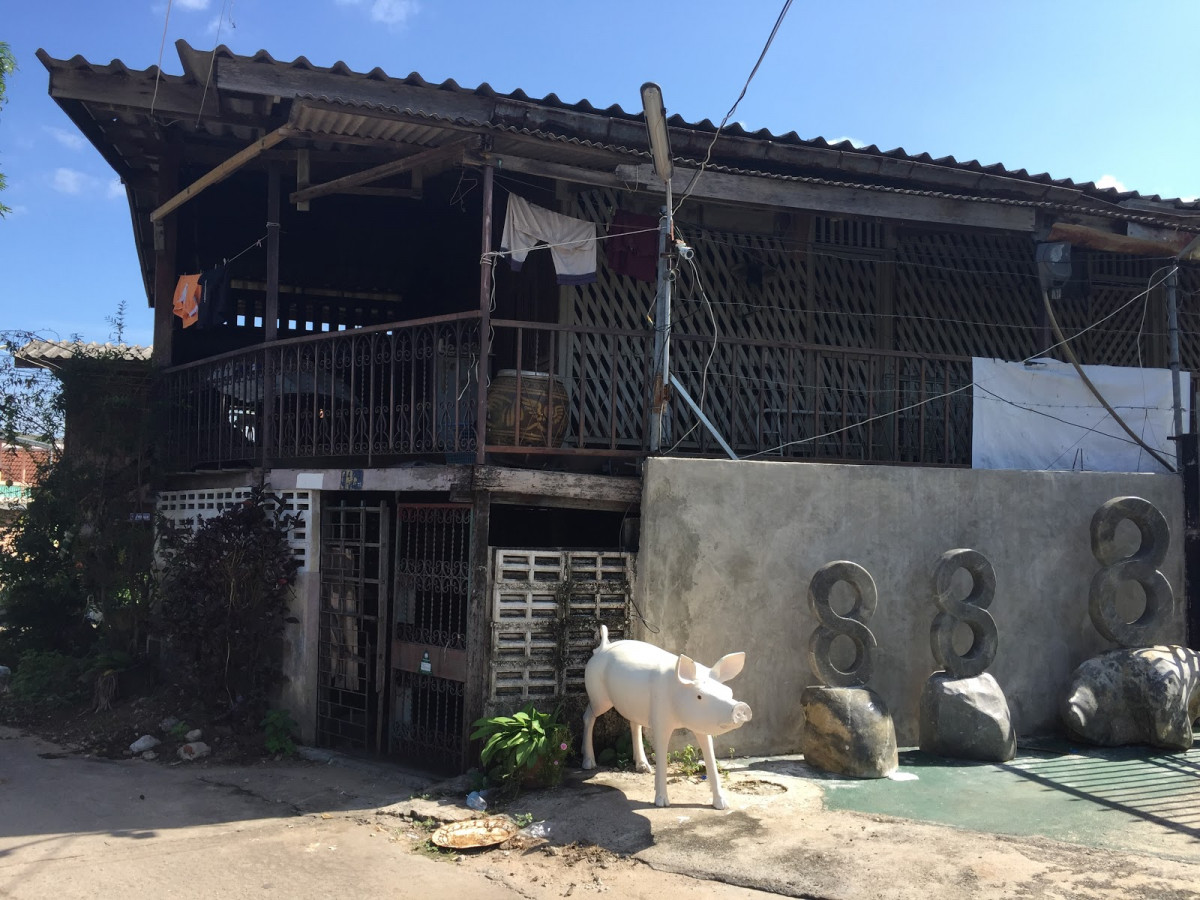
This is the home where my mother grew up. Seeing it in person was unexpected, and a bit of a shock. My mom had vivid memories that she portrayed to us. One was of her falling down the stairs at a young age and getting hurt. I had visions of light shining through the slats and my mother being a toddler. Imagining different stories she has told me through the years of her eating fresh fruit, and taking the petals from flowers and placing them on her and her sister’s fingernails, pulling them so that it was like nail polish upon their fingers.
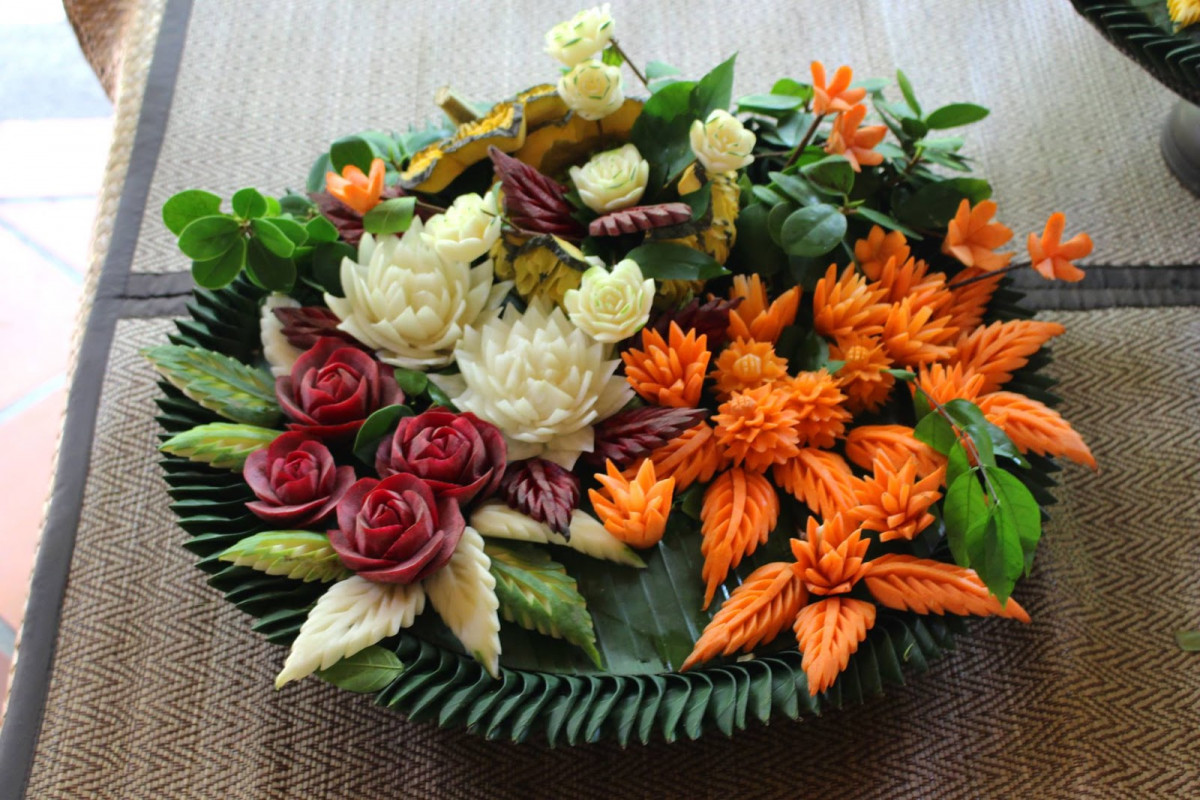
When we visited it was foreign. My sister and I felt so out of place. We couldn’t speak or read the language; we couldn’t communicate well with our family members. And I couldn’t eat, which increased the separation. Much of what we ate did not agree with my stomach, which was torture because the food was delicious. Having my Thai heritage is beautiful, much like this work of edible art that my sister took a picture of. It is something I have tasted, and I have not tasted. It is home, and it isn’t. It is me and it is away from me. It is tasted and untasted.
I have always loved food. I cherish the memories that I have around it, memories with friends, and family near and far. Food gathers people and bonds them together through the experience of eating in community: people saying what they like best, asking what each person ordered, and sharing each other’s dishes. Being taken into that specific place, moment, memory, culture, and community is what helps one go from being alive to truly living.
Six years ago, I spent five months in Kazakhstan. I still have cravings from this chapter in my life. Being so far from home, in a country where I couldn’t read or speak Russian, or Kazakh, food became even more precious to me. I felt like a toddler. In the home where I opared, the mom of the children I was caring for, Diana, became my mentor. Whenever she would let me, I would help Diana prepare dinner. We would have three meals a day, and snacks. All eaten together. To this day, that is the only time in my life where I had such a beautiful meal time rhythm. It was wonderful. Diana would try to cook meals from home (the States) with the available ingredients. The dinner I remember best was her duck. You couldn’t get large quantities of chicken wings/legs, so she bought duck. She used orange juice in the recipe. I was skeptical at first, but boy did I change my tune when I ate it!
When I landed in Kazakhstan, it was -28 degrees Fahrenheit, and we lived at the base of the mountain. When it started to warm up a bit, Curt (Diana’s husband) would bring home fresh round loaves, and I was able to explore more local foods and shops. Getting greens was a challenge, so Diana said that she started using sauerkraut as salad; it was so fresh and delicious! Kazakhstan had delightful pickled vegetables. Another side that became a favorite of mine was thinly sliced pickled carrots. My favorite local dish was Laghman. As far as ingredients go, there were thick freshly made noodles, and homemade pickled vegetables. There was more to it than that, but that is what I remember. It looked nothing like any other dish I had seen, so naturally I was skeptical. I cannot convey how amazing that dish was. I retain whispering memories of the textures and mouthfeels of the dish. The thrill and excitement it gave me remains strong in my mind, but somehow it has to strain to recall the tastes.
What stood above all else, was the tea. I fell in love with Kazakh tea culture. When I entered our neighbor, Nazym’s home for the first time, she welcomed me into her kitchen and asked me if I would like tea. I very happily said yes! The water was hot and waiting. She served me a cup of black tea, asking me if I would like milk or sugar, and how much. It is customary to have milk in your tea there. She explained to me the different customs for tea. Whenever guests came over, it was expected for the hostess to have hot tea and snacks at the ready. Regardless of the number of guests, either the woman of the house, or the eldest daughter would prepare each individual’s tea. She must know how each person takes their tea, or she doesn’t love them. If the tea isn’t hot, she doesn’t love them. It is customary to fill the little bowl halfway, as to encourage the desire for more tea, and to lengthen your stay and conversation. If, by contrast, the teacup is filled to the full, then it translates as “drink quickly and leave.”
In Kazakhstan, when you visited and had tea you would do so for hours. Drinking cup after cup, eating cookies, cakes, and other sweets. When conversations were really long, you’d even have meals. But! Then you would have more tea. They had a saying that when you are full with tea to your collarbone, you drink one more cup so that you are full to your jaw. This is when the company was lively and good. I adored every moment of this. To me, it is one of life’s most precious gifts to gather around a table, around warm delicious tea, yummy snacks, and talk for hours on end. Deep, real conversations with tea fuel my very soul. This chapter of my life was a big piece of what brought me to my dream today; the dream to have my own tea shop.
Leave a Reply