by Eligh Kindall
(A.N.) The following is a series of excerpts from Eligh’s Foodways During COVID-19 WordPress website. If you’d like to see the rest of their work, check out their site!
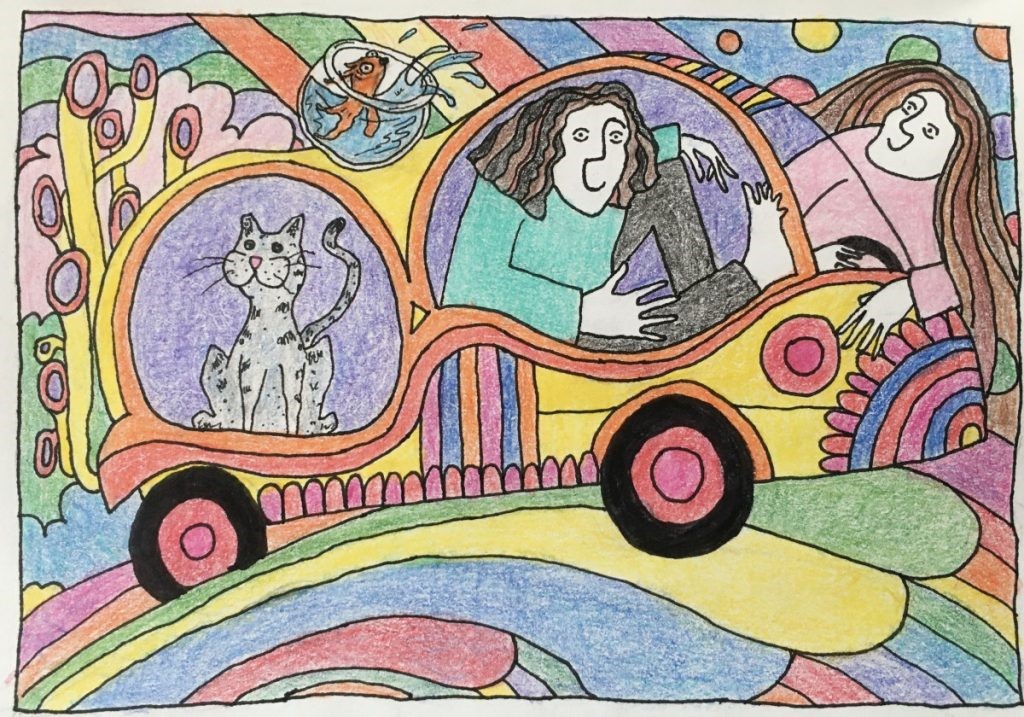
The beginning of spring quarter at The Evergreen State College was the beginning of many firsts for me. Though I was originally supposed to head back to Washington at the end of spring break, I was now staying at my mother’s house in Boise Idaho for the foreseeable future and starting my first quarter of online school ever. The COVID-19 pandemic had become a national emergency, and schools and businesses were closing. Above is an illustration of my me, my girlfriend, our cat, and our fish on our trip from Olympia to Boise at the beginning of spring break, unaware that when break was over, we would not be coming back. I was also beginning a cooking class- something I had also never done before and that sounded rather interesting to attempt in a remote-learning environment.
The first assignment I had as a student new to this program spring quarter was a big pivot for the students continuing from winter quarter. Not only had their study abroad trips to China, Greece, and Italy been cancelled, but so too were case studies of immigrant foodways involving travel. And, what for me seemed a natural focus in our key program text–the chapter on the 2003 coronavirus outbreak in China, was precisely the part of Fuchsia Dunlop’s eating memoir that prior to spring quarter no one except the faculty had read. Here’s the “choice cut” from Dunlop’s chapter nine around which Comparative Eurasian Foodways: Immigrant Experiences pivoted spring quarter.
Choice cut from Dunlop: ch 9, p 150
“It was February 2003. I’d just arrived in China to start researching my second book, a collection of recipes from Hunan Province, and now I was in the midst of a major health panic. Hordes of frightened migrant workers were fleeing the centre of the growing epidemic in Guangdong Province, and many of them were returning to Hunan, which is precisely. where I was planning to spend the next four months. And, of course, most of that time would be spent in the company of chefs, now pinpointed as the main human vectors of the epidemic.” (Dunlop and Wilson 150)
This quote was followed by these writing prompts for the week one eating memoir assignment of spring quarter’s Foodways During COVID-19 project.
Begin your post with an image of your own creation, one that illustrates how you determine the value of food. During WA State’s lockdown and social distancing what did you eat, why, and with whom? Upload a photo. Do NOT follow the faculty example as your goal is to demonstrate your own work, not to develop and illustrate an online curriculum for CEF: IE. The image included above was chosen to illustrate how Fuchsia Dunlop illustrated the value of food. What does this image say about Dunlop being a professional food writer in China and spending her time with chefs during the SARS outbreak?Bats, civet cats, pangolins? What might you like to know about human-animal eating relationships–zoonoses–and evolutionary forces that have shaped diseases? (Here are two resources: Scott’s “Zoonoses a Perfect Epidemiological Storm” and Zhan’s Civet Cats, Fried Grasshoppers, and David Beckham’s Pajamas: Unruly Bodies after SARS.”) Who are you as an eater and how has your eating been shaped by your travel experiences? Who in your family lineage of immigrants most shaped your eating? What historical factors shaped their migration? What connections can you make to news in the world around you and the relationship between social distancing in the time of COVID-19 and contemporary immigrant foodways?
Following these prompts my faculty included this note: “I’m writing this on 3.24 and here’s the New York Times’ headline: “Yelled At, Attacked: Chinese-Americans Fear for Their Safety.” And according to a Food Navigator website headline our appetites are ethnically effected: “Coronavirus: ‘Dramatic Decline’ in Taste for Chinese and Italian Cuisines.”
I did not know it, but this period of my life would become a period of immense growth for me. After a few weeks, I had established a clear learning path: I would illustrate my images that went with my eating memoirs as a way to draw a bridge between art, food, and culture within the context of the program. A lot changed over this period of time. I got an iPad with my stimulus check because I had no reliable way to attend classes or turn in work online. by week 6, I had my iPad, and was able to start integrating in some digital drawings. In this collection you will be able to see the transition between different mediums (watercolor, colored pencil, pen, and digital) and the progress that I made within them.
Eating With My Eyes: An Illustrated Eating Memoir
Week 5
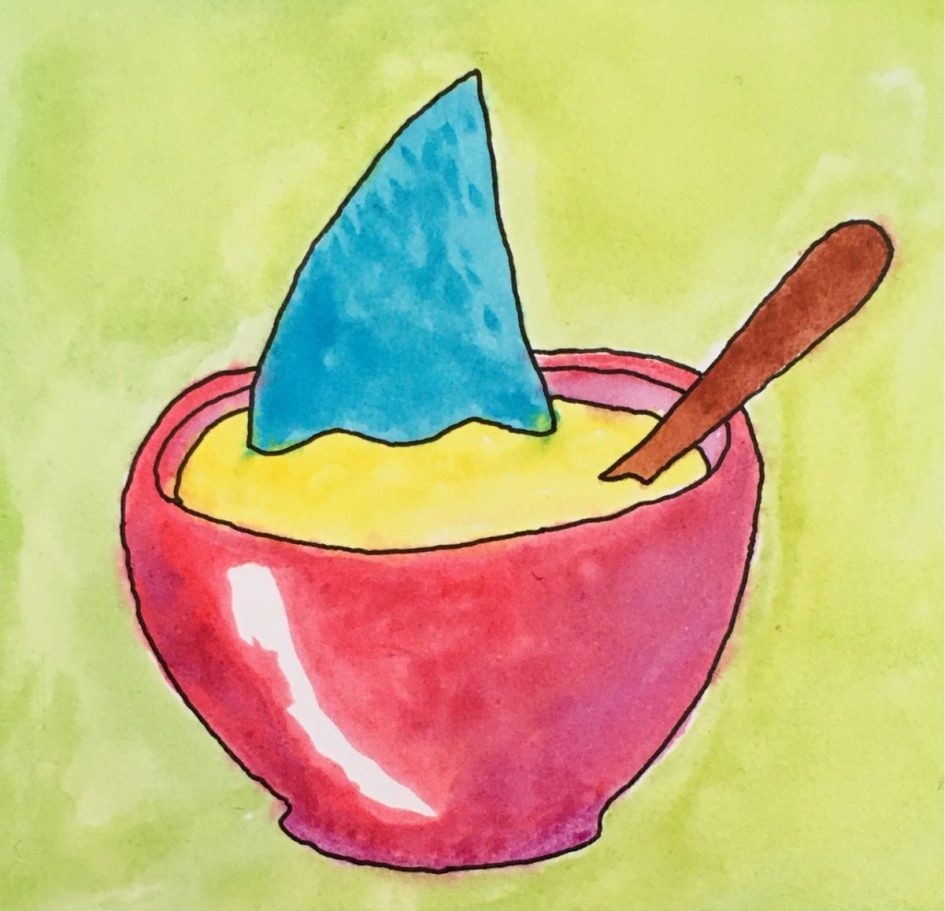
“People want to eat delicacies like shark’s fin just because they are rare and expensive, and because they are the kind of thing emperors used to eat” (Dunlop and Wilson 262)!
I decided to illustrate my own interpretation of shark’s fin soup, not just because it is a dish of relevance throughout the entire book, Shark’s Fin and Sichuan Pepper: A Sweet Sour Memoir of Eating in China (heck, it’s right there in the title), but also because chapter 16 describes the dish as a luxurious delicacy with quite a bit of “snob value” (Dunlop and Wilson 261). This class-defining dish eaten by the rich is clear evidence that food can be, and has been used as a way to define people as “in” or “out.”
It is very clear that just as our food is defined by us, many people have been defined by it. People have historically used food to identify who is in, who is out, who is the same, and who is the other. When visiting Uyghur, Dunlop writes, “For the Chinese, of course, this was always a Barbarian land” (Dunlop and Wilson 239). The label of “barbarian” or “savage” has long been used to dehumanize people and justify discrimination against them. “While the Uyghurs drink tea… they show their nomadic heritage in their liking for yoghurt and other Dairy foods” (Dunlop and Wilson 239). Stereotyping is a harmful form of discrimination, and this shows how it even affects the culinary world.
Another example of food stereotyping is mentioned in Choice Cuts: A Savory Selection of Food Writing From Around the World and Throughout History, by Mark Kurlansky. It is a writing by French Larousse Gastronomique on American food in 1938. It is explained that “many are the people, here in France, who think, even write, that American cooking is barbaric, and that, in general, Americans do not know how to eat or drink” (Kurlansky 409). This is a reminder that every group of people has their own version of the barbarian. As shown in Astoria: Astor and Jefferson’s Lost Pacific Empire, for the settlers in America, it was those native to America who were the barbarians. That narrative in many ways has remained to this day. However, many white Americans never experience being the “other” or the “barbarian.” This writing is an alternative narrative to most that are distributed in America in that it provides that perspective.
Another reason I chose to illustrate Shark’s fin soup, is that there aren’t very many signs of danger that are as jarring as a dorsal fin poking out of the water. I wanted to depict the danger of food as fuel for prejudice and show what a looming threat (just like a shark’s fin in the water) it is. Food can either fuel oppression, or it can fuel resistance to it. It has great power to break down barriers and bring people together. Larousse goes on to write that American food “is different than ours, but that does not necessarily mean that it is bad” (Kurlansky 409). Even though food can be an identifier of our differences, it should not identify those things as good or bad. Narratives produced in the media are often used to divide people by their differences, and to make the words “different” and “bad” synonymous. If food is used alternatively to celebrate differences, then maybe, one day even shark and man will be able to sit down together at the dinner table as equals.
Food Lab
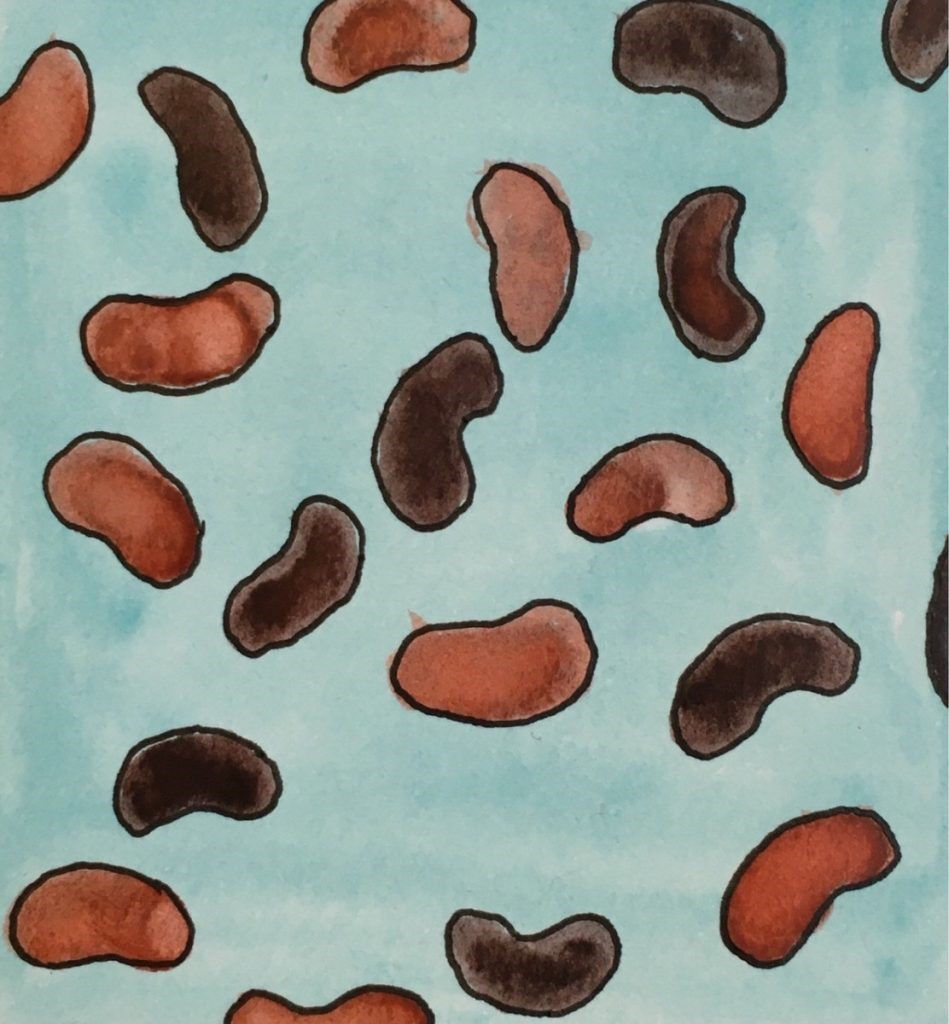
For the week 3 food lab, I cooked both options a and b so didn’t have a new recipe to follows for this week. I decided to make a recipe for quinoa chili that my girlfriend and I love to make. Black bean soup was one of the famous American dishes listed in Larousse Gastronomique on American Food, and though it isn’t black bean soup, black beans are a central ingredient. Also, because black beans were a star ingredient in week 3’s cooking lab, it seemed close enough to what I could have been making this week. This dish is also relevant because the recipe calls for both salt and sugar, and as mentioned in Choice cuts, the French “criticize Americans… for their habit of mixing salt with sugar” (Kurlansky 409). This chili is an incredible vegan dish, especially during the COVID 19 pandemic, as it is a wonderful meal when you are stuck inside, and beans are a long lasting food that is very nutritious. I recommend serving it with cilantro and avocado.
The ingredients:
• 1 tablespoon olive oil
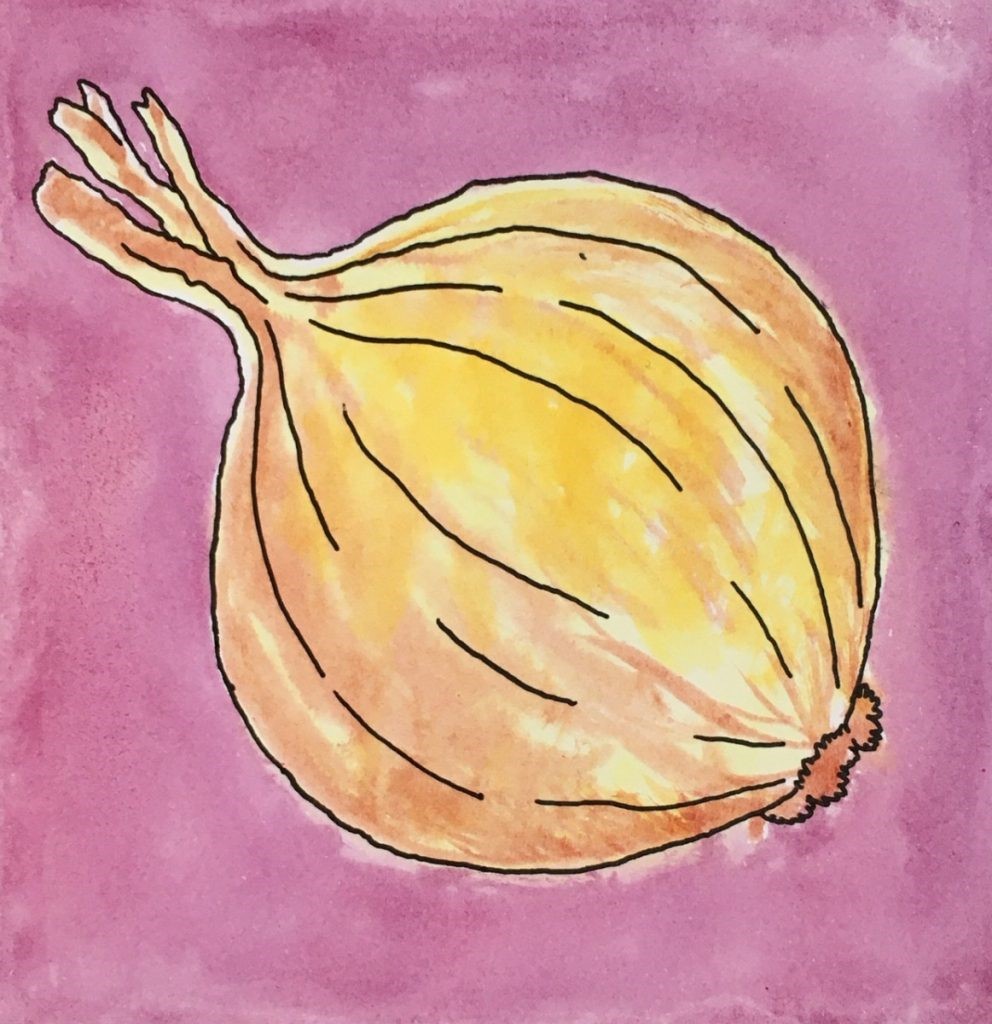
• 1 medium yellow onion
• 4 cloves of garlic
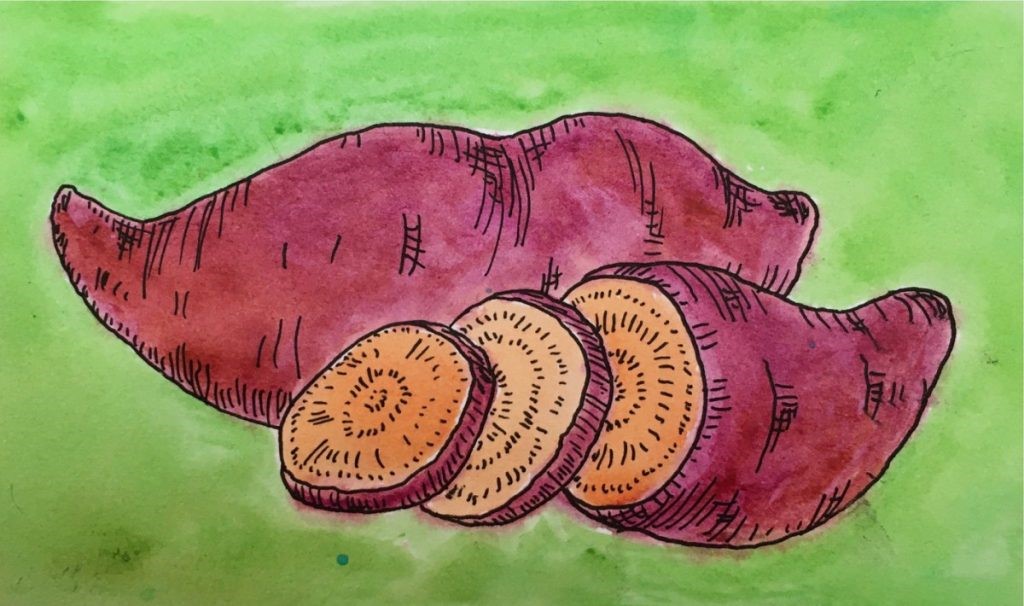
• 2 medium sweet potatoes
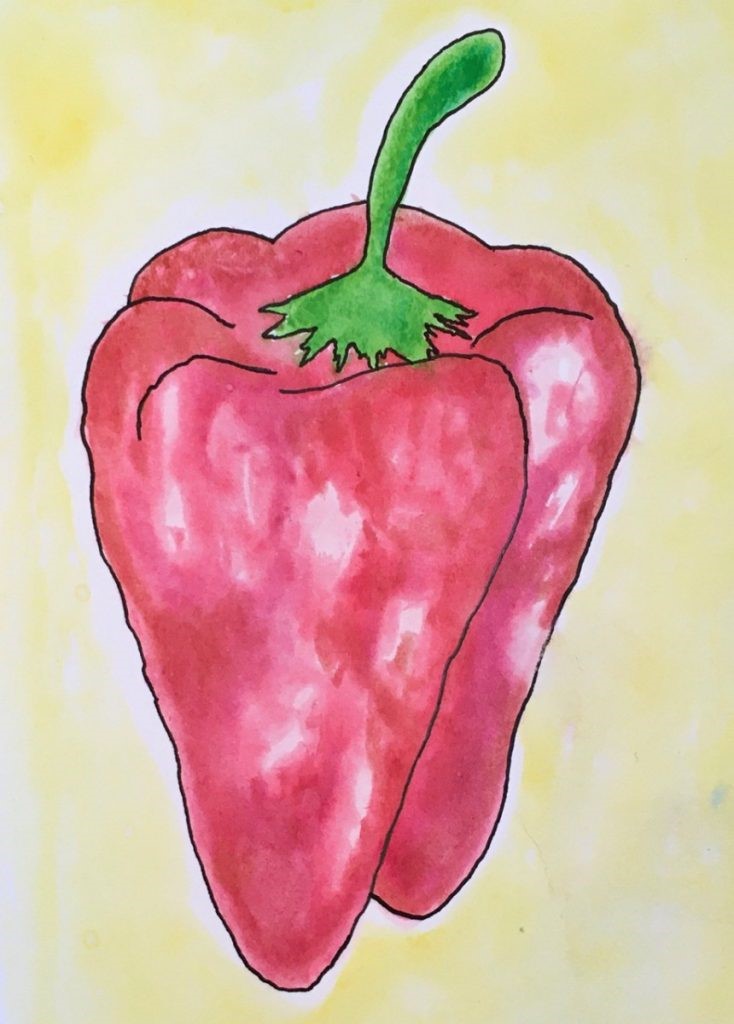
• 2 medium red bell peppers
• 1 tablespoon chili powder
• 1 table spoon chipotle chili powder
• 1 teaspoon ground cumin
• 1 1/4 teaspoon kosher salt
• 2 1/2 cups low-sodium vegetable broth
• 1 (8-ounce can) low-sodium tomato sauce
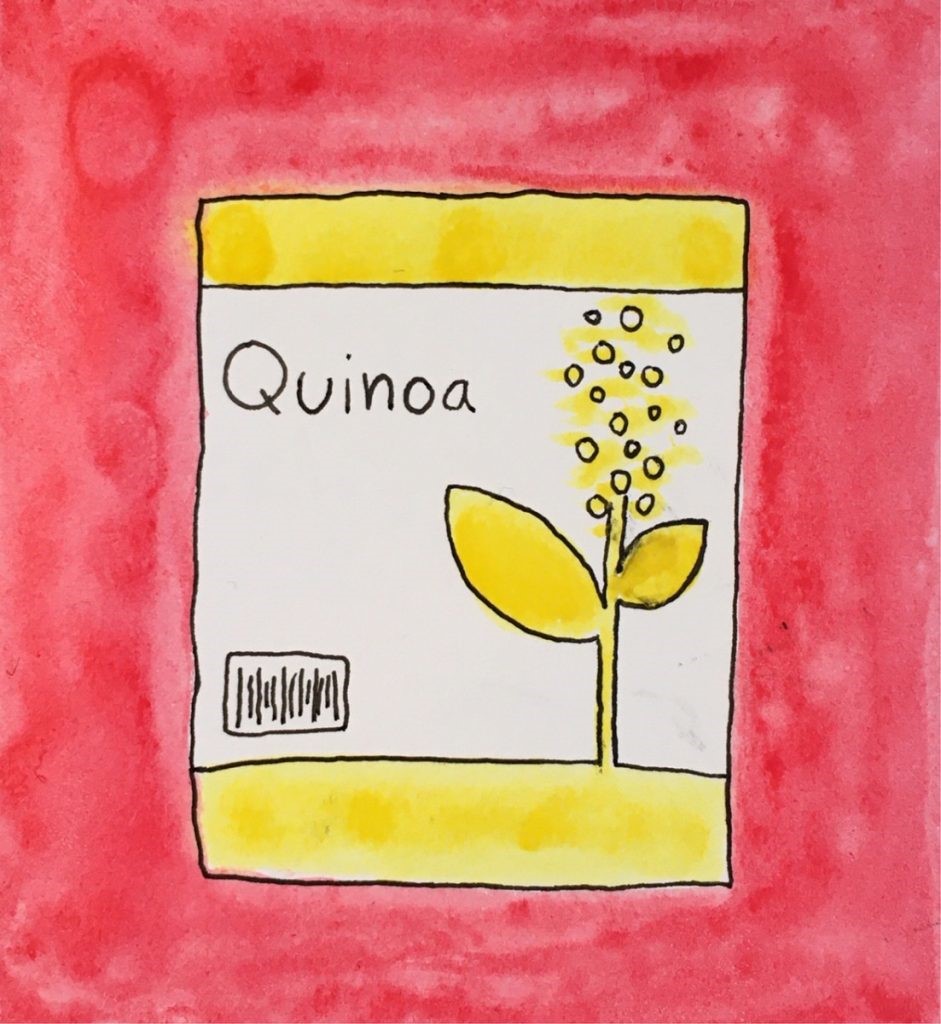
• 1/2 cup uncooked quinoa
• 1 (15-ounce) can black beans
• 1 (15-ounce) can red kidney beans
•1/2 teaspoon granulated sugar.
Drawing Food
My artistic decisions were guided by the content and themes of the reading, as explained above. I’m trying to switch up the medium I use for my illustrations each week as a way to ensure that I have to draw something new even if an ingredient is repeated in a future lab. I chose to use water color as my medium for this week because a shark is an aquatic animal and it made sense to use water for a picture of one. I don’t paint very often and saw this as a good learning opportunity. As I try new things with food, I also want to try new things with art. It was a little challenging but I was overall pretty satisfied with how the illustrations turned out. I want to focus less on illustrations of produce next week, to make sure that I get in some drawings of spices, sauce, etc.
Gluttony and Dumplings
Week 4
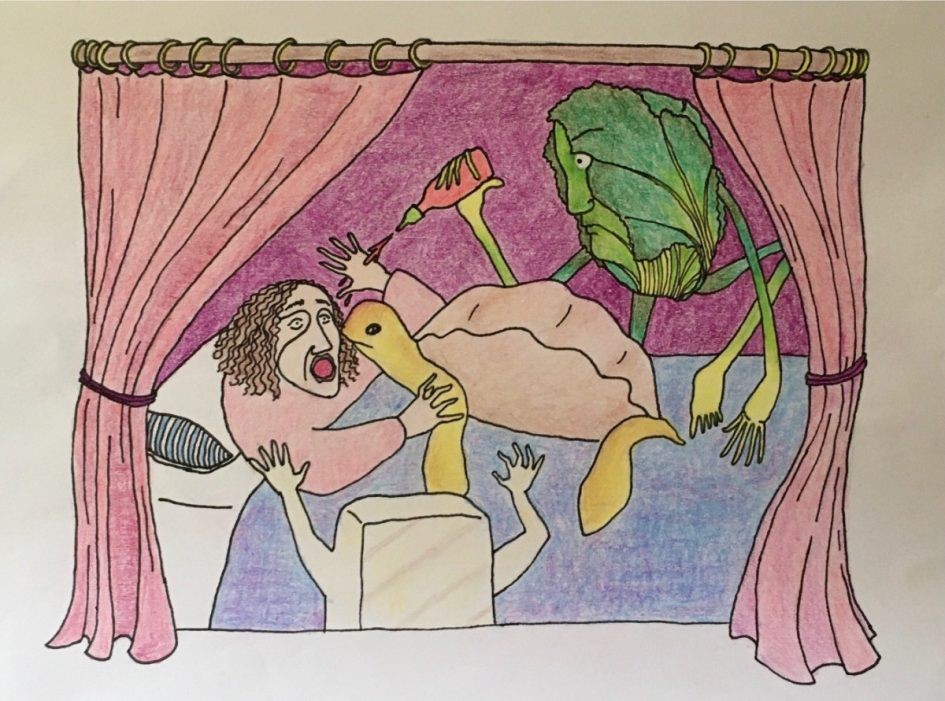
“The only way to recover my wanton old appetite is to draw a deliberate blind over all the evidence, to switch off my brain, and to eat without thinking” (Dunlop and Wilson 281).
Though there are many differences (as well as similarities) between different cultures and their cuisines, one thing many cultures surely have in common, is the gluttonous corruption of the food industry. Unethical sourcing of food such as factory farming has taken over many aspects of the food industry. Many people across various cultures are aware of the effects of the food industry; contributing to global warming, depleting important resources, etc., and find that the only way to get through their meals is to eat without thinking. Many people can’t confront what they are putting in their bodies these days, and while there are many people who do not have a choice, blindness to these issues only empowers them to continue. The corruption of food is all over, and it silences everybody it touches.
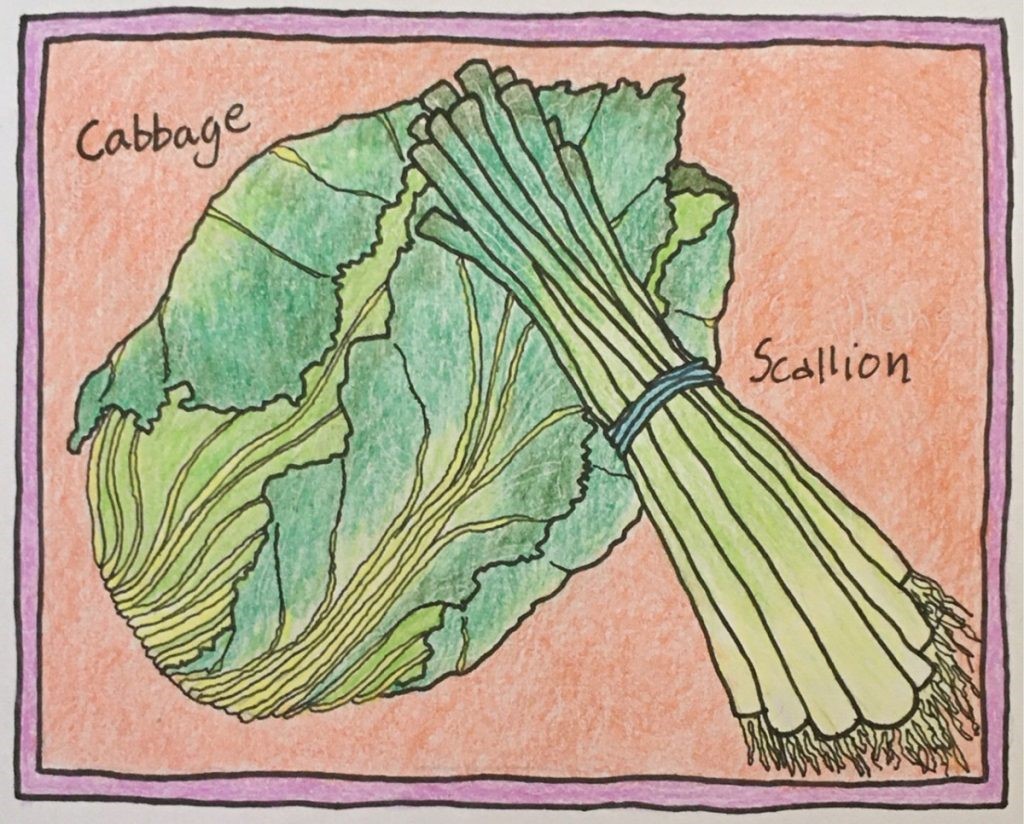
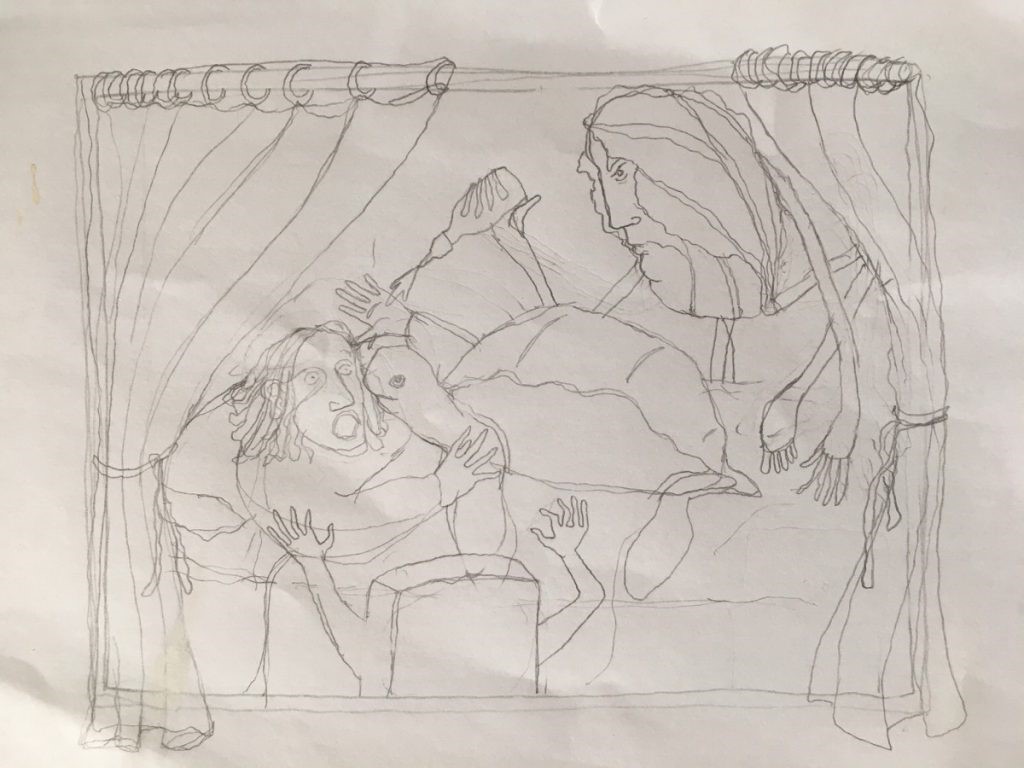
I chose to illustrate myself in my own rendition of the engraving “Fatal Effects of Gluttony: A Lord Mayor’s Day Nightmare” (Whalen) (Williams and Garfield Week 4), as a way to acknowledge the ways that I have contributed to the gluttonous corruption of the production and consumption of food. The turtle straddling my chest in the painting has a dumpling shell, and a cabbage man points a sriracha bottle at me with hands made of scallions as a tofu monster jumps at me in the foreground. In a way, this is a pleasant reminder to me of some of the mindfulness that I have had when making my food choices. The plant-based beings attacking me are representative of a meatless meal and my vegan diet. Though it isn’t for everybody, my diet is one of the ways that I am mindful when I eat. Though my illustration is a confession that like Lord Mayor and Fuchsia “I have been reckless in my omnivorousness” (Dunlop and Wilson 286), it is also a reminder of how I have contributed to progress. After referring to the engraving, Dunlop explains that it makes her think of something her friend once told her: that “All the animals I’d eaten in the course of my life would sit in judgement over me after I was dead” (Dunlop and Wilson 284). If this is true, I certainly would not want to have eaten shark. Should people only eat what they could fight off with their hands? For me, that leaves only plants.
In many ways, food itself can be the very thing to heal the harmful effects of the corruption of food. As food brings people together and breaks down barriers, it naturally encourages thoughtfulness. It is the people who have corrupted it. But as long as there are cultures to identify with food and share it, there will be hope for resistance against reckless consumption. Dunlop explains on the subject of trying new foods, that “of course, once eaten, the deed is done, the taboo broken, and it’s really not so bad after all” (Dunlop and Wilson 310). In the right hands, food can be a tool for breaking taboos and resisting manipulation. This is more important than ever today. Our awareness is under attack as the media runs rampant with narratives obscuring the truth and justifying doing so. As Immigrants are being shut out of the US, it seems very possibly that we are approaching a nail in the coffin for the deceased, so called “information age.” And though narratives in the media may say otherwise, we have lost touch with our food, and it isn’t natural to be that way.
Food Lab
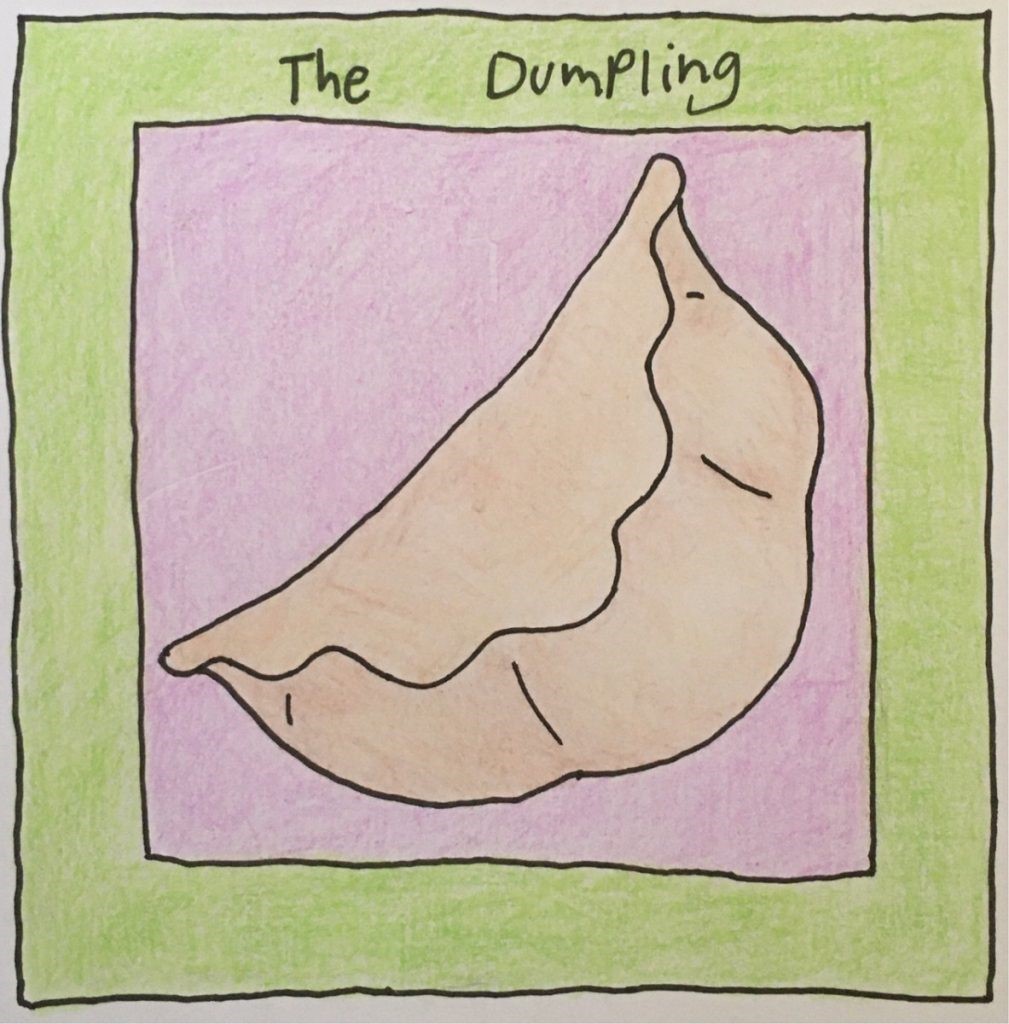
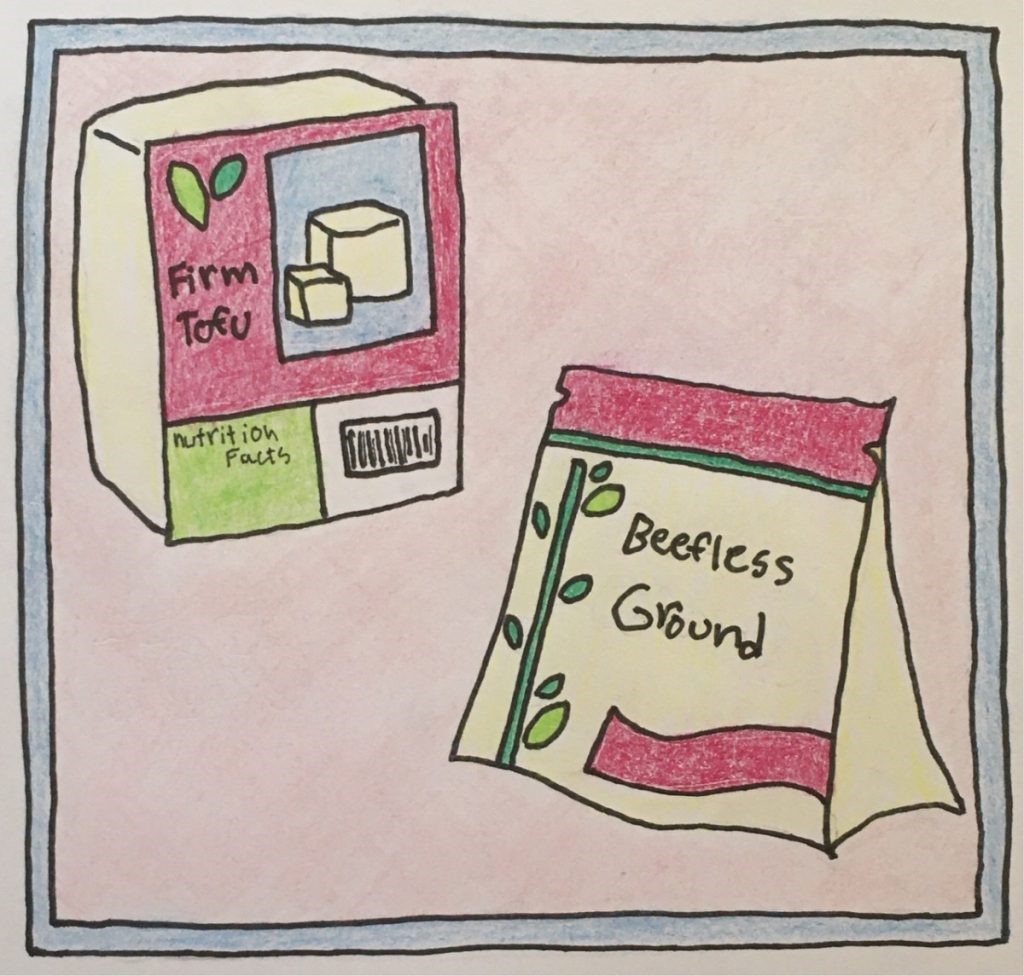
I love dumplings, so I was very excited for this week’s food lab. Stephen, our chef-TA, made Tina Hsia Yao’s Chinese New Year Dumplings from our text Heirloom Kitchen. I had never made them before, and I was eager to learn and become a little more culinarily informed. They tasted incredible, but didn’t turn out looking like the perfectly shaped dumplings that I had pictured, and that I have pictured below. Yes, that technically means that I myself am guilty of obscuring the truth, but it’s one little drawing of a dumpling and my pride is on the line. I followed the recipe exactly, but substituted meat with beefless grounds and tofu. Though they didn’t look perfect, it was still very rewarding to accomplish this meal, and I am excited to be able to in the future.
Recipe for Chinese New Year Dumplings
FOR THE DOUGH:
4 cups (500 g) all-purpose flour, plus more for dusting
1 cup warm water.
FOR THE FILLING:
1 head Napa cabbage
1 lb ground pork
1/4 cup (60 g) minced soft tofu
2 tbsp minced ginger
2 scallions, thinly sliced
1 tbsp soy sauce, plus more for serving
2 tbsp white wine
FOR SERVING:
Soy sauce
Hot chili oil*
Stippling Beans and Food Banks During COVID
Week 6
(Wheeler and Sundean Thurston County Food Bank)
“Food insecurity is a characteristic of our food system, one that has been amplified, not created by the COVID pandemic” (Williams and Garfield Pandemic Academy)
During the presentation “Eating During COVID-19: Food Banks and Cooking With Food Insecurity” on May 5th, Robert Coit, of the Thurston County Food-bank explained “people without enough income don’t have access to enough food, the right food, or just food in general” (Coit). Many people experience food insecurity, and as Sarah Williams explained, these issues have not been created by the COVID-19 Pandemic. The pandemic has simply brought pre existing insecurities of the food system to people’s attention.
The systemic inequalities in our food system are a big issue right now, but it is also important to remember that it has been that way for a long time. This is just one example of the inequalities that the COVID-19 pandemic has brought to light. In class, we have talked a lot about the social implications of the pandemic, and none of them are new. They were created by people, But amplified by the pandemic. The people who get sick are the same people who go hungry. The attention that the pandemic has brought to the insecurities of our food system is very important, but it is also important that these issues remain relevant not only in a state of crisis, but also in day to day life.
Robert Coit seems to be very hopeful that this will be the case. He explains, “what I hope is that when things return to normal, there is more of that continuing sense of wellbeing and community… These crises bring out the best in people” (Coit). Robert Coit isn’t the only one who recognizes the ways the Pandemic has been a catalyst for some positive change. On Soul Fire Farm’s COVID-19 response, it says “This outbreak reveals the interconnectedness of our world… It is showing, conclusively, that the health and well being of one is intimately bound to the health and well being of all” (Soul Fire Farm). The Food Bank, and Soul Fire Farm are just two organizations working to end inequality in our food system, and their optimism in the face of two separate yet connected health crises, is something we could all use. It is a testament that there are forces working against the oppressive nature of the society we live in. Even in everyday life, the health of one is bound to the health of all. If people are able to maintain that perspective as we ride out COVID-19, then perhaps equality in our food system will be attainable.
Cooking Lab
This week’s food lab was chili, which is what I cooked last week. However, this chili was very different from the chili that I made for the last cooking lab, and as I explained last week, chili is a perfect food to eat during a pandemic. This Chili was much sweeter than the one I made last week, and it contained Mixed vegetables, which I have actually never had in Chili. I followed the recipe exactly, except I used meatless crumbles instead of turkey. It fed my whole family, and though we did polish off the entire pot, we were stuffed. The bread in the broth was another thing that I’ve never tried, but I loved it. It thickened up the chili really well, and it was delightful to come across small chunks of bread in the broth from time to time.
The Recipe:
2 large yellow onions + 2 tbsp cooking oil, caramelized
2 tbsp extra-virgin olive oil
1/2 tsp red chili flake
1/4 tsp cinnamon
1/2 tsp freshly ground black pepper
1 tsp cumin
1 tsp coriander
1/2 tsp paprika
1/4 tsp ground Pasilla chili powder
1/2 tsp ground California chili powder
2 cloves garlic, minced fine
1 tbsp tomato paste
1 15-oz. can mixed vegetables
3 15-oz. can kidney beans
1 28-oz. can diced tomatoes
About 3-4 cups vegetable stock
2 slices plain white bread, torn into small pieces, for thickening
Drawing Lab
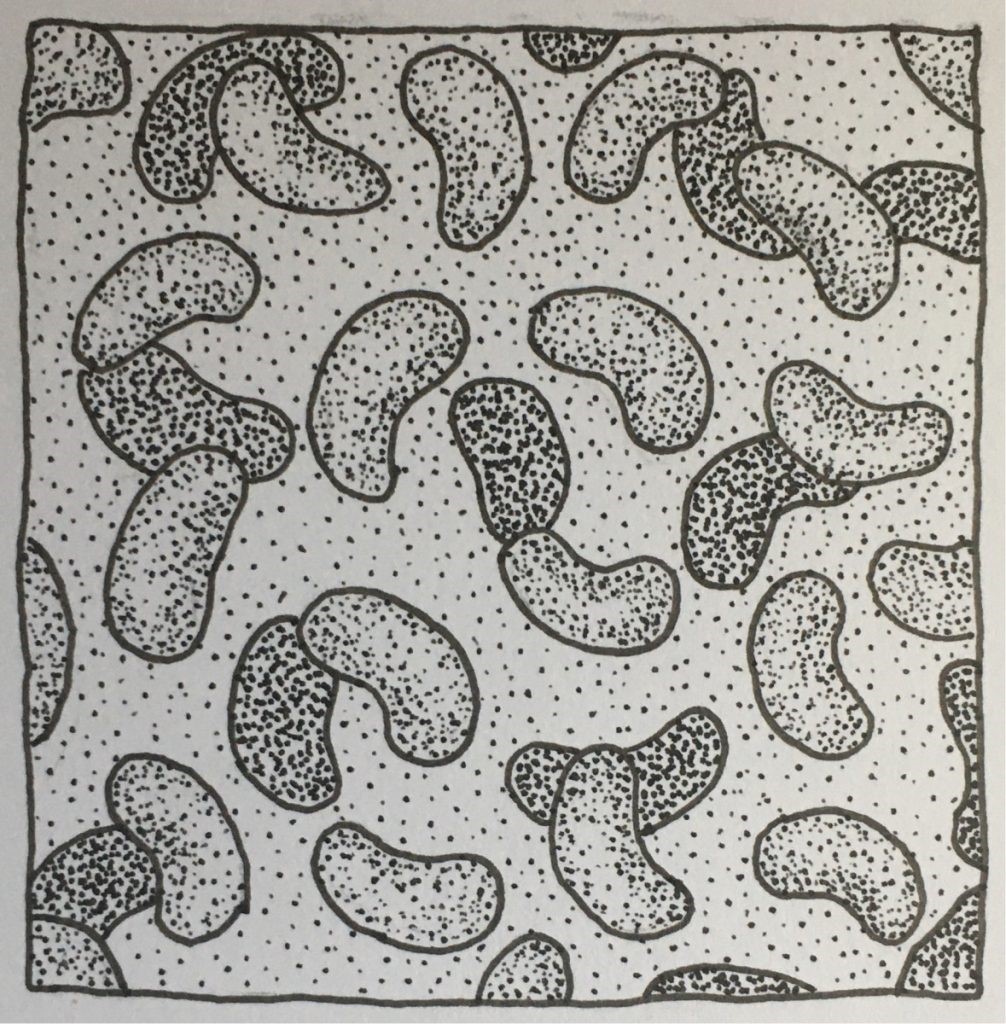
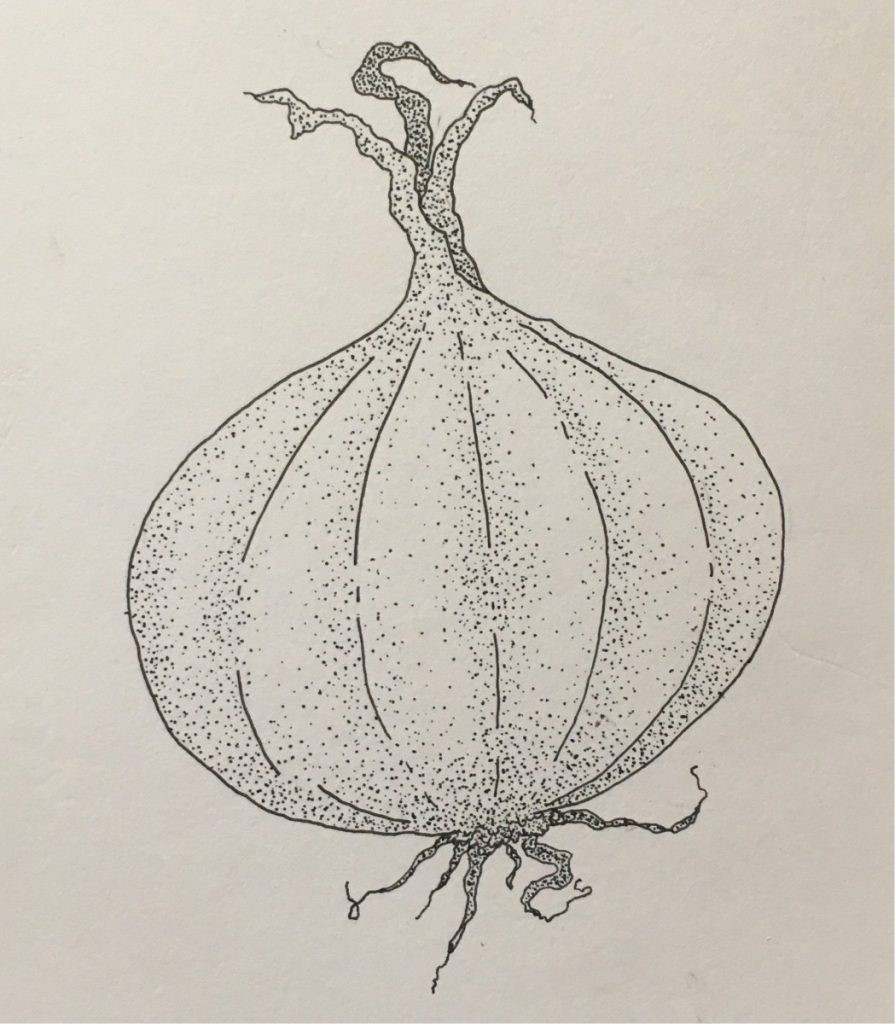
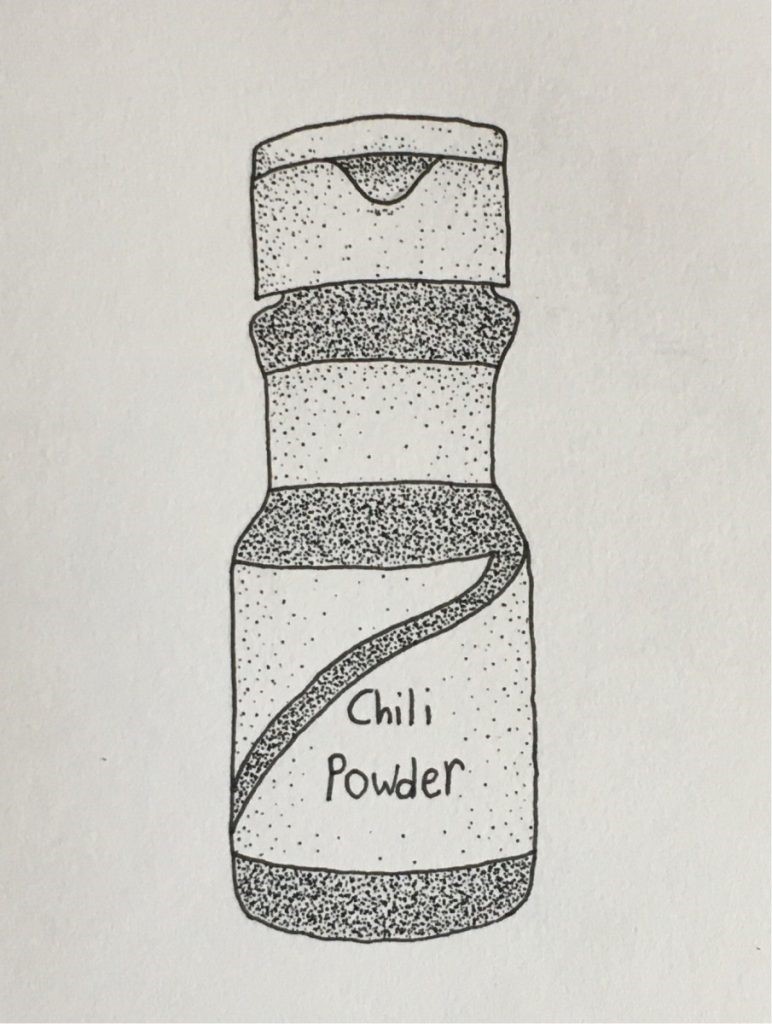
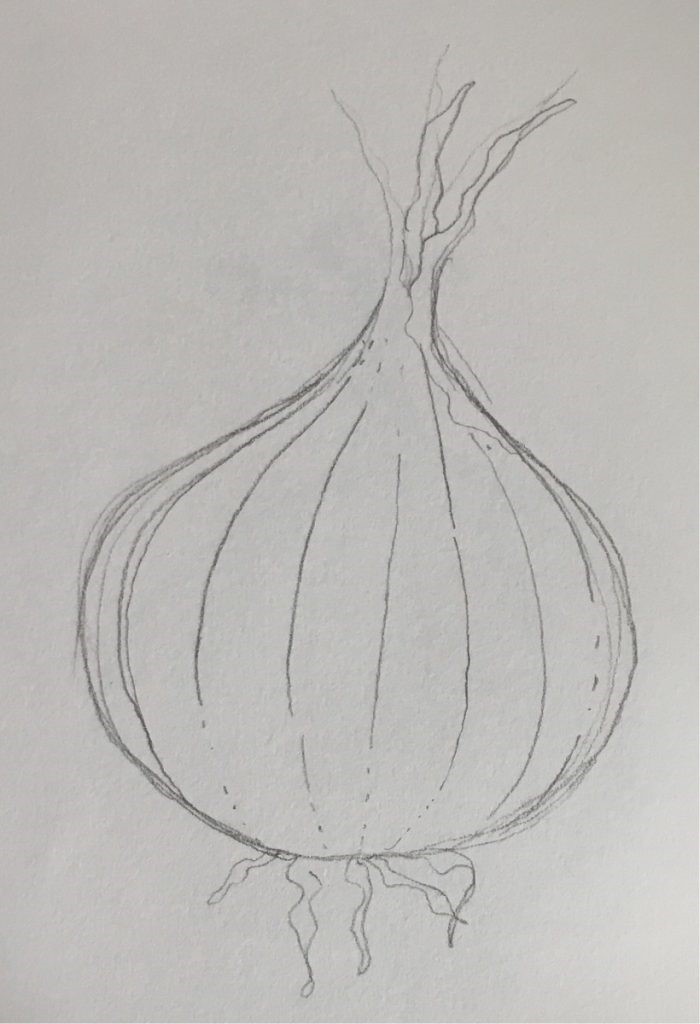
For my recipe illustrations this week, I decided to do stippled ink drawings. I’m trying to make sure that I never use the same medium for two consecutive weeks as a way to ensure that if I ever have an ingredient repeated, I still have to draw it. For the most part, it should actually be possible to avoid ever having to redraw an ingredient, but this week I chose to draw an onion (even though I already drew one last week) as a way to show how two different mediums can wildly change the same image. I also chose to stipple-shade instead of coloring the illustrations, because the way the individual dots come together to create an image seemed symbolic of the concept of the individual being tied to the collective.
I also drew beans again despite having drawn them last week, but that’s just because beans happen to be the essential ingredient for both recipes. This is a good example of why switching mediums was a good idea! These drawings were definitely the most time-consuming ones I have completed so far, but I really enjoyed the process and I was pretty happy with the way the drawings turned out. Drawing food is getting a little bit easier each week. That being said, if I ever have to draw beans again I might cry.
In the book Salt, Fat, Acid, Heat: Mastering the Elements of Good Cooking, Samin Nosrat writes, “the choice to embellish this book with illustrations rather than photographs was deliberate. Let it liberate you from the feeling that there’s only one perfect version of every dish. Let it encourage you to improvise, and judge what good food looks like on your own terms” (12). This is how I feel about my illustrated cooking labs. Also, it liberates me to illustrate, rather than photograph the process because if my food does turn out looking objectively bad, nobody needs to know.
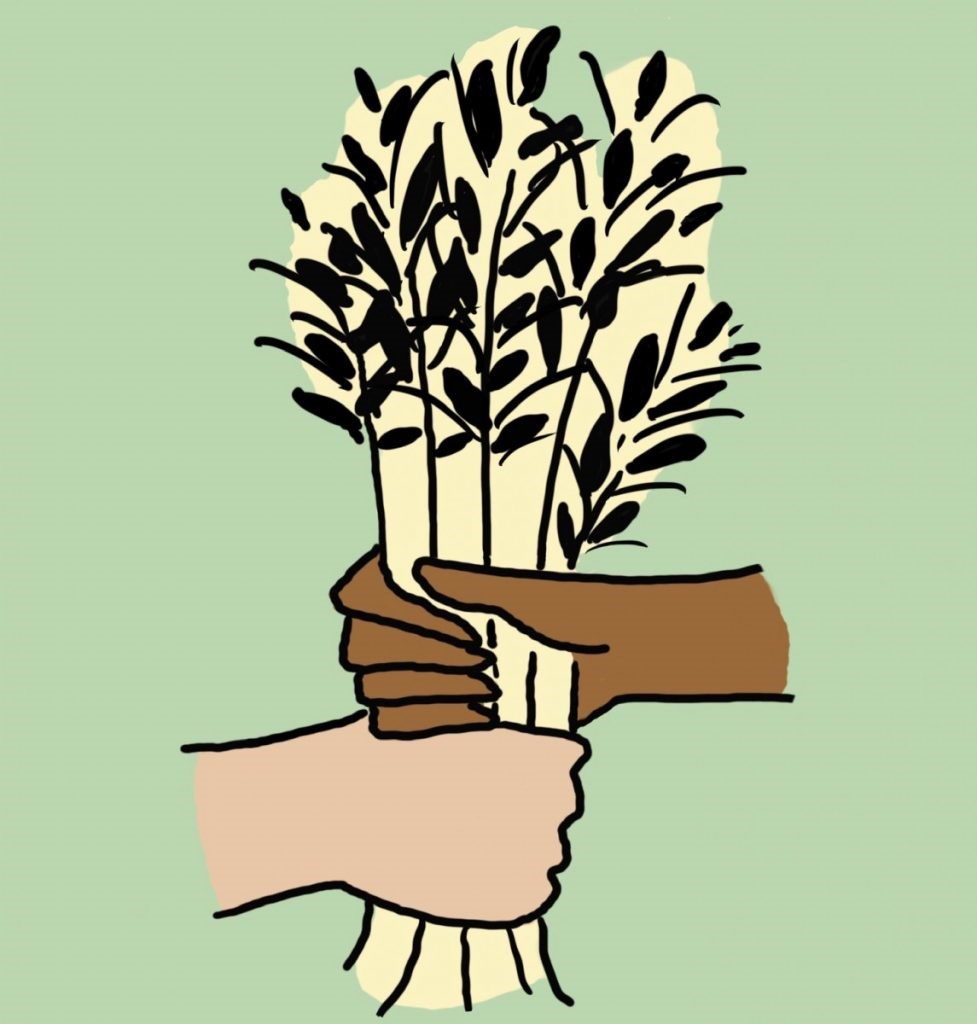
For the illustration at the top of my eating memoir, I chose to illustrate the logo of the Thurston County Food-bank. I just got an iPad for school and for art, and this is the first digital drawing that I have done for this project. It was a pretty quick drawing, but already, I am extremely excited to explore the limitless possibilities of digital illustration in future weeks, and as I illustrate past eating memoirs. I chose to do a colored image of the logo, as I have only seen images of it in black and white, and wanted to provide my own interpretation. The food bank’s mission is to “eliminate hunger in the community, in the spirit of neighbor helping neighbor” (Wheeler and Sundean). This includes eliminating access barriers, and prioritizing health, through partnership and collaboration. I chose to color the two hands different colors to represent food being shared between cultures. Like I said earlier, this was my first digital drawing, and I’m excited to explore the possibilities with digital art as I proceed with this program.
Commensality- Eating together at the Same Table (Remotely)
Week 8
A beautiful thing happens when people sit around a table together for a meal. This naturally social event causes interaction on a very human level over something that is so common yet personal for everybody. Food, by its very nature, provides an intersection for all sorts of perspectives and experiences. Fuchsia Dunlop Illustrates how different these perspectives can be in “Chinese Food, Culture, and Travel: Conversation with Tyler.” She explains, “When you talk about Chinese Cuisine you always have to take it with a pinch of salt and remember, as I always do, that Chinese people talk about something called ‘Sheitan’ (Western food) and make outrageous generalizations about it too. And you know, of course, from a Chinese point of view it makes sense to talk about Western food being different from Chinese. But from a Western point of view, you see all the distinctions” (Cowen and Dunlop).
Everybody eats, but nobody does it in the exact same way. One thing many cultures do have in common, is that eating food is often an inherently social activity. You can learn a lot about people’s different points of view over dinner. Here in America, there is this culture of dinner as a social time for a family to come together toward the end of the day to talk and eat together. Coworkers may eat together on their lunch break. Two friends might go out to eat together after having not seen each other for some time. A couple might go to dinner for a date. Whatever it may be, at the center of all of these human interactions, is the table. And as it can bring likeminded individuals together, it so can unite people of different backgrounds from anywhere in the world. It is very important that people share the food of their cultures with others. This spreading of ideas and tastes and the meanings behind them has the ability to bring people together. It shows us that nobody is really that different. There are commonalities that any two people could find in the way they eat food.
With technological advancement furthering the industrialization of food, this cultural value of food is threatened more and more. Though there are many positive sides to the advancement of technology, the industrialization of food coupled with the changes in what social interaction means (due to social media) are drastically changing the culture of food throughout the world. The image of what dinner was for the American middle class family in 1960s sitcoms, is not what it is today. With many families having dual income households, busy schedules, smartphones, and access to ready-prepared food, a home cooked meal and a conversation are just ‘off the table’ for some. Right now, during the COVID-19 pandemic, the meaning of the table is changing even more from day to day. In the restaurants that are open, every other table is turned upside down to ensure that people keep a safe distance from each other. At ‘Fish Tales Bar and Grill’ in Ocean City, Maryland, they have invented what they call “bumper tables” (Koppelman). In this scenario, people do not sit around a table at all. Rather, the table sits around them. A person stands in the middle of a donut-shaped table on wheels with Inner-tube edges as a way to ensure a physical barrier to keep people at a distance from each other.
Whether for better or worse, food is changing. Dunlop explains how this change has translated in China. She states, “people lead hectic lives and are increasingly eating more ready prepared food. I think you can see that China is going down the same sad path as the rest of us in some ways. But the thing that gives me hope is that in China, food is understood so deeply as the foundation of health and happiness. It has been a culture that is so obsessed with food” (Cowen and Dunlop). One thing that cuisines, technological advancement, and bumper tables all show is that people are inventive and creative. People are passionate. Technology can change and people can change, but one thing stays the same: everybody needs food. As long as this is true, food will remain at the center of people’s lives and it will continue to inspire creation, innovation, and interaction. Change is as common as eating. And as social media has the ability to hinder people’s experience of food and culture, it also has the ability to enhance it on a level that we have never seen before. It is how I am sharing this post about food and culture right now.
Cooking Lab
Grilled Pizzettas
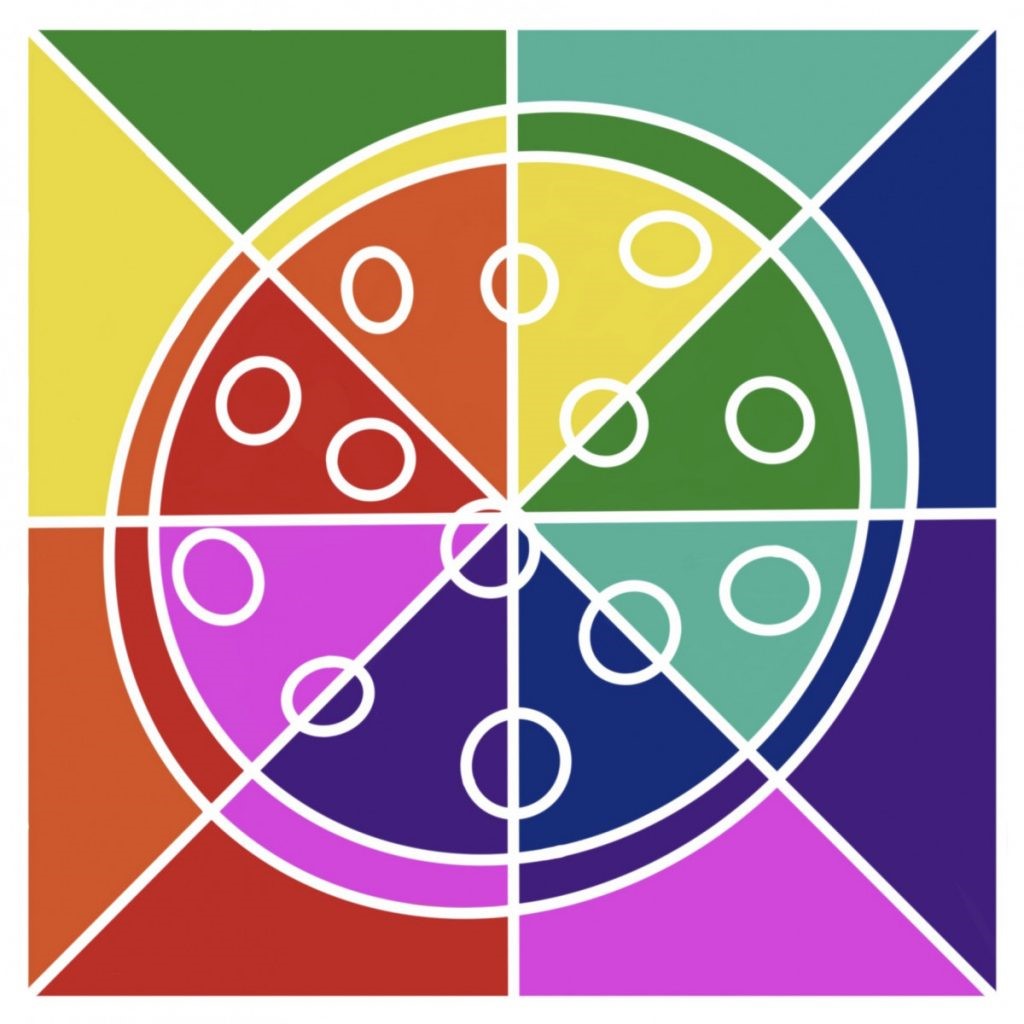
This cooking lab was tough for me, because I got to choose what to cook. I had a tough time coming up with what to make for a little bit, but ultimately, pizza was a no-brainer. My mom’s fiancé (Becky) is Italian and is from New York, so she has a lot to say about pizza. Pizza is also a great example of the cultural boundary-blurring nature of food. It has so many cultural influences, and is made so differently from place to place. There are countless different versions of pizza, which is really just toppings on flat bread. This is one of the most common ways that humans have developed to prepare food. Also, pizza is delicious. It’s a crowd favorite, and one of my personal favorites. I chose to make grilled pizzettas as a way to show an alternative take on the pizza. I also chose to make this recipe because it was one in which the crust had a big defining role, and I wanted to highlight the flatbread aspect of pizza. Becky makes these often, and they are delicious.
The Recipe
FOR THE SAUCE:
Sauté onions and garlic (a lot of garlic) with salt, crushed red pepper flakes, and black pepper in Extra virgin olive oil until translucent (don’t burn)— add two tbs of tomato paste, stir in, add 1 28 oz can of cento San Marzano peeled tomatoes and a little stock or water to achieve desired consistency, simmer until cooked through. Use immersion blender to purée, if desired, and season to taste
FOR THE DOUGH:
1 1/2 teaspoons active dry yeast
1/2 teaspoon sugar
1 1/2 cups all-purpose flour
1/2 teaspoon salt
2 tablespoons extra-virgin olive oil, plus more for brushing
FOR THE CRUST:
Fill a liquid measuring cup or small bowl with 1/2 cup warm (not hot) water. Add yeast and sugar and stir with a fork; let sit 15 minutes.
Combine flour and salt in a large bowl. Make a well in the center of the flour and pour in olive oil and yeast mixture.
Using a fork, gradually stir the flour into yeast mixture until mostly combined, then mix with your hands to bring the dough together. Turn out onto a clean surface.
Knead dough until smooth. Add flour as needed. Lightly oil a bowl. Add the dough, cover with plastic wrap and set aside in a warm place For one hour or until doubled in size.
Preheat a grill to medium high.
Turn dough out onto a floured surface and divide into 6 pieces. Roll each piece into a ball.
Use a rolling pin to roll out each ball into an oval. Add flour if needed.
Oil the grill and add a few pieces of dough.
Grill for about 2 minutes, until the top is bubbly and the bottom is marked.
Flip and grill until just marked on the other side. Remove from the grill and repeat with the remaining dough.
FINISHING THE PIZZETTA:
Add sauce and toppings.
Place back on grill for a couple minutes, until the pizzetta looks as desired.
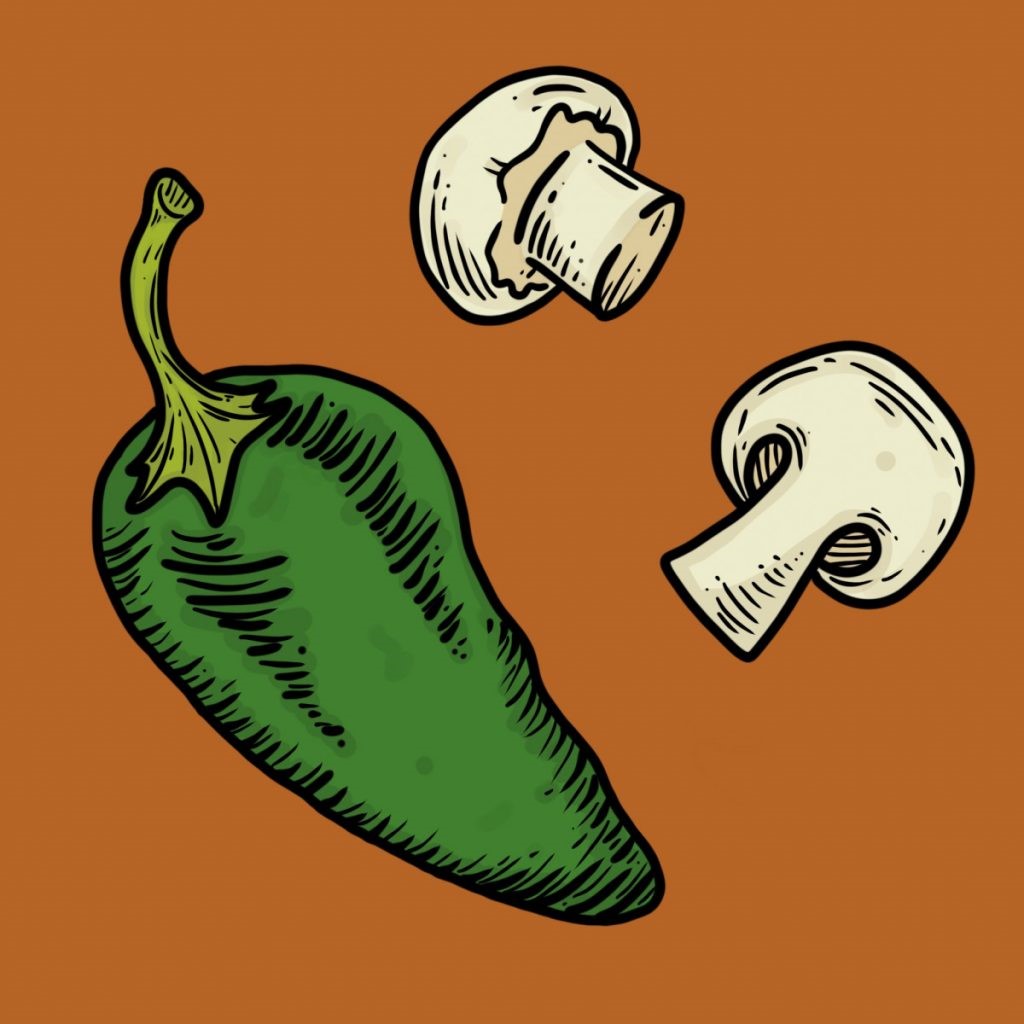
Drawing Lab
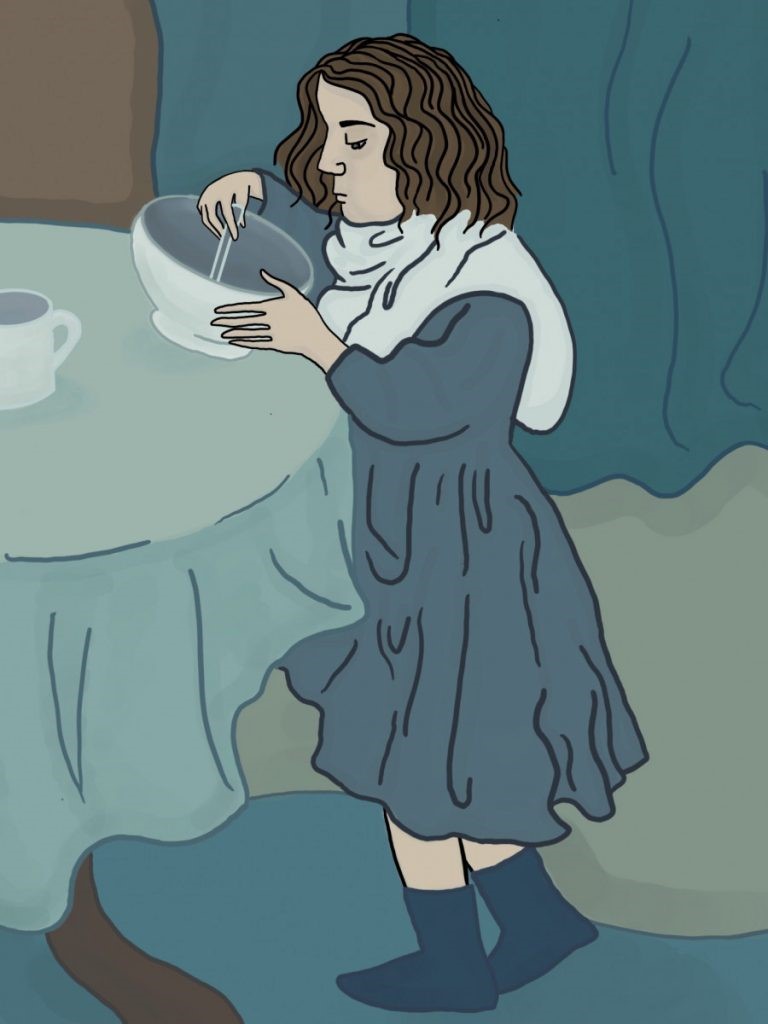
The following quotes from Art in the Lives of Immigrant Communities in the United States, by Paul DiMaggio Illustrate why food is art. Though the quotes are not on the subject of food at all, I chose them because it would still make sense If they were. For this reason, I argue that food is an art form, though some argue otherwise. All of these quotes also show how art has had the exact same role as food in uniting people of different backgrounds and influencing new creations. Food is just as much of an art as music, visual arts, or dance. In that sense, my illustrations of my meals are simply artistic representations of another preexisting work of art in just the same way that my depiction of Picasso’s “Le Gourmet” or my recreation of the engraving “Fatal Effects of Gluttony: A Lord Mayor’s Day Nightmare” were.
“Cultural forms… change As they cross boundaries, incorporating elements of host-country genres or creating true hybrids” (DiMaggio 10).
“Rather than abandon their old cultures, immigrants developed attachments to new styles while retaining their ties to the old, deploying both as signals of intrinsic satisfaction and as signals of identity” (DiMaggio 10).
“Just as immigrants can use art to interpret their own experience to themselves and their communities, so can institutions in the host society use art to interpret the immigrant experience to itself” (DiMaggio 63).
“Both in past and more recent immigration waves, expressive behaviors, including art, have constituted a potent instrument to maintain distinct identities salvage integrity, and negotiate inclusion… because collective self-definitions related to nationality, race, And ethnicity are not static, aesthetic production remains fluid as well, often giving voice to existential realities that are difficult to pinpoint through quotidian language. Art allows for a kind of freedom not found in other forms of communication. And, because the immigrant experience is often restrictive and fraught with danger in receiving areas, art enables immigrants to break across boundaries through the use their imagination” (DiMaggio 13).
“For nearly 35,000 years, the capacity to communicate through art has supplemented and enhanced spoken and written language” (DiMaggio 14).
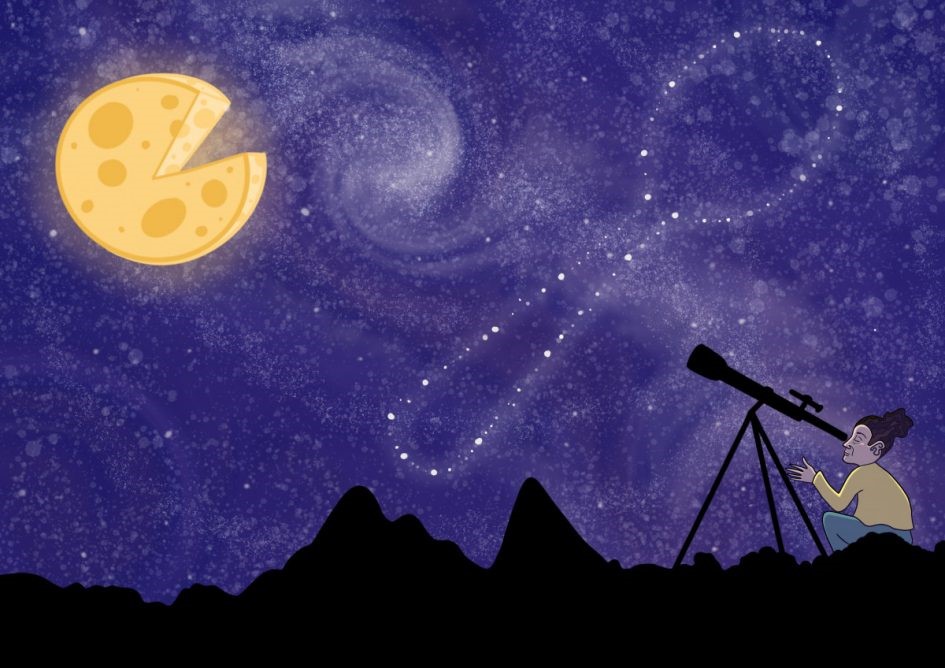
Because this eating memoir is my last, I wanted the illustrations to cover a wide range of different styles. I also wanted the illustrations to demonstrate my progress in digital art as this post will have the most up to date pieces on it. From my first digital image of the Thurston County Food Bank logo to this week’s featured image, I have learned a lot of new things. For the featured image of this post, I chose to illustrate a picture of myself looking through a telescope at a night sky of food. As gastronomy is the study of food and culture, I decided to call this drawing “The Gastronomer” to play on this astronomy-themed image of food.
For the food lab, I chose to illustrate a pizza in a sort of Andy Warhol-esque way with each slice of pizza being its own color. I felt like emphasizing the different sections of the pizza was a good way to depict the cultural boundary-blurring nature of pizza. The color of each section is influenced by the color of the sections next to it, while contrasting the color of the piece opposite to it. Each small piece comes together to make one whole image, representing the plethora of cultural influences on pizza. I also illustrated a picture of a jalapeño and two mushrooms, as these are my favorite pizza toppings. I think this image is my best digital representation of food yet.
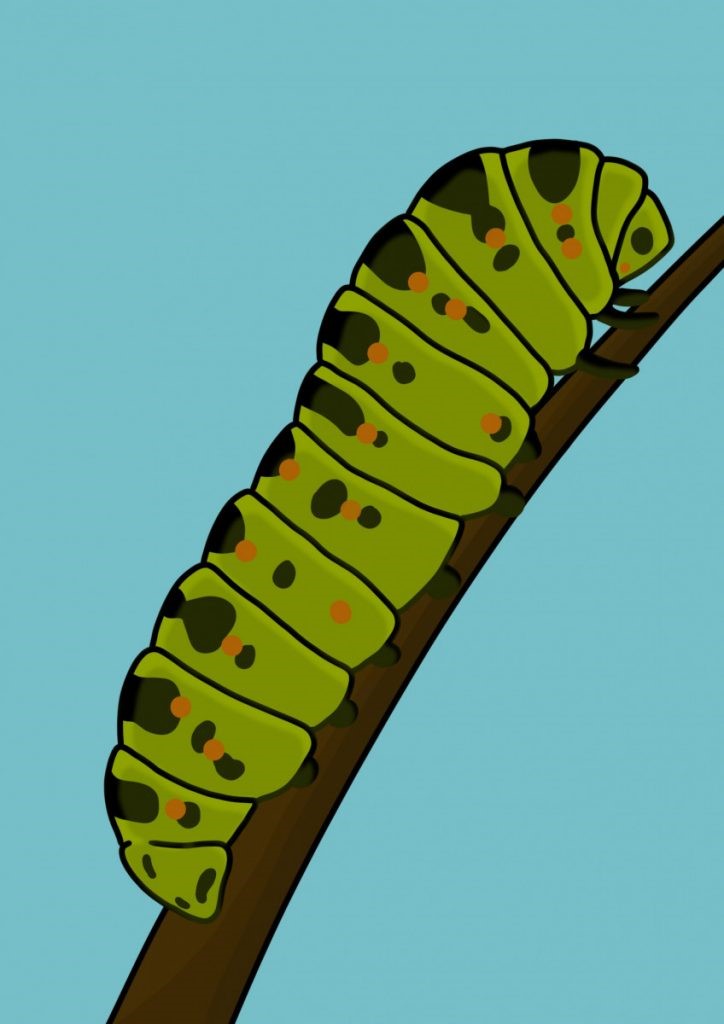
Finally, I chose to illustrate a caterpillar for my drawing lab. I did this because of the significance of the caterpillar in Shark’s Fin and Sichuan Pepper: A Sweet-Sour Memoir of Eating in China. Dunlop explains how the caterpillar was symbolic of her culinary and cultural growth in the epilogue of her book, when she writes “As I ran my eyes up and down the small green creature on my plate, I admitted to myself that, try as I might, I couldn’t really feel shocked at the idea of eating it… Living in China had profoundly changed me, and my tastes… Whether or not to eat the caterpillar was no longer a question of whether I dared to eat it, but of whether I dared to show so flagrantly that I really didn’t give a damn. You can probably guess what happened. Reader, I ate him” (Dunlop and Wilson 310).
The caterpillar also seemed like a good way to close my final post, as my first eating memoir, “Pots and Pan(demic)s” opened with an illustration I did of a butterfly. In that post, I quoted Dunlop from chapter 9 saying, “If you want a real encounter with another culture, you have to abandon your cocoon” (Dunlop and Wilson 152). While being cocooned at home During the pandemic, this class and these posts have provided a way for me to leave my cocoon and gain an experience of the world that transcends my small bubble.