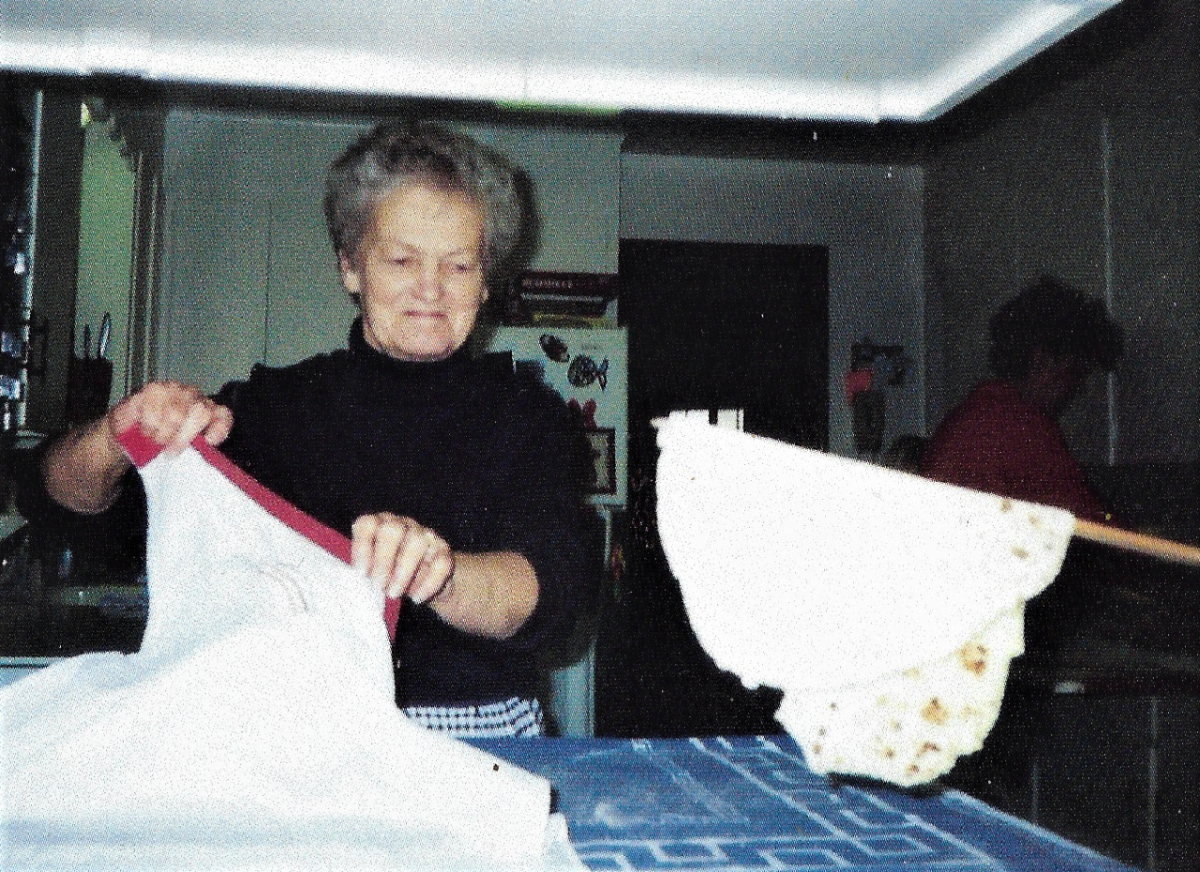
Eating is the essential part in my life. Eating is the happiest time for me. I love food and I am a big eater. My friend told me that she had never met the person who eats so much as I do in her life. I have loved food since I was a kid, so all my friends know me as a food lover. I am always thinking about what I eat for the next meal. I am not a picky eater, so I can eat all foods that are served to me. I can eat coriander, but it is not my taste. When I was a kid, I could not eat wasabi and mustard because kids are sensitive to those kinds of spicy tastes and I had images that they were adults’ tastes. The reason why I love food so much and I am not a picky eater is that my parents told me the joy of eating. We often eat together since I was a kid. When I was a kid, we went out to have dinner on weekend and this was a kind of my family’s habit. We often went to Chinese or Western food restaurants, not Japanese because we could eat Japanese food at home. However, since my brother started living by himself for going to university a little bit far from my home, we did not have many chances to eat out. And he rarely went back to my home, so we ate out together just once a year, New Year’s Day. New Year’s Day is the most important day in Japan, so people in Japan often spend time together with family members. Even if we eat at home, eating with my family feels so happy for me still now. Eating is not only just tasting food, but also it is a part of communication. Of course, I love food and eating, but another reason why I love eating is that eating and talking with someone makes me comfortable. Compared eating foods by myself, I feel much happier about eating with someone; my family members, my relatives, and my friends. Since I came to here, I have many opportunities that I eat by myself. I love eating with my family, eating and cooking by myself make me so sad. Then, I realized eating and talking with people was so precious and important thing for me. So, I have felt that eating and drinking with my friends in here are not common thing, and I appreciate to the opportunities. My brother eats well and he is not also picky eater, so I can say like this.
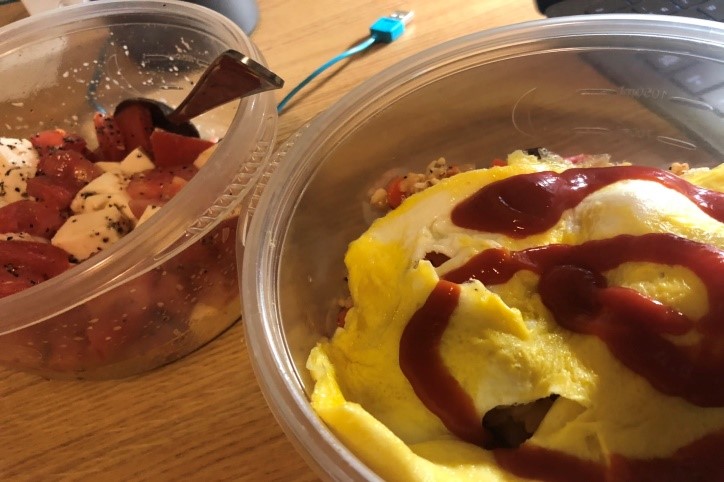
My latest cooking (omelet rice and caprese salad)
I am from Japan and I had never stayed at foreign places for a long time until I came to the United States, so I grow up with Japanese food. I prefer eating to cooking, so my mother mostly cooks for me. My mother cooks every day to my family, so now, I struggle with cooking by myself. When I asked her how to learn cooking, she said she learned from her mother. At that time, I remembered my grandmother also cooked very well. When I go back to Japan, I am going to study cooking. Cooking Japanese food takes too much time for me, so now I often eat pizza, pasta, and bagel. I have tried to cook Japanese food since I came to here, but it hasdnever succeeded. I cooked stir-fried noodles, Niku-Jyaga (potato and meat stew), miso soup, Ton-Jiru (pork soup). I have never topped my mother’s taste and I have to appreciate to my mother’s hard working. Dashi (broth) is essential for Japanese food. Dashi has a lot of varieties; bonito, other fishes, kombu (kelp), shiitake mushroom and so on. We often use bonito and kombu. The taste makes me always comfortable and it must be my comfort taste. We as Japanese mainly use dashi when we cook soup and boiled dishes. My family’s meals include at least one dashi dish anytime. Dashi dishes were the food that I missed the most since I came to here. I did not realize dashi was an essential taste in my eating life until staying in here.
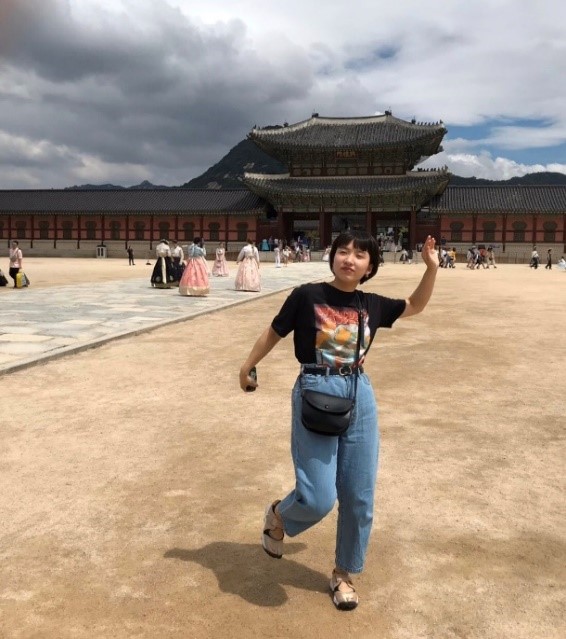
Me in Gyeongbokgung Palace, South Korea
I love eating not only Japanese food, but also international food. I love traveling and I have been to abroad more than ten times. I have been to South Korea five times, China twice, Canada twice, United States twice, Vietnam, Cambodia, Taiwan. The biggest purpose of traveling for me is tasting local food in real local places and learning the culture. The international foods I taste in Japan are not real local tastes, and their tastes are adjusted for Japanese. For example, when I went to South Korea for the first time, I was very surprised that Korean kimchi was much spicier than I had expected. I am a big fan of kimchi, but at that time, I noticed that real kimchi taste was this, and until that time, the kimchi that I had eaten in Japan was not real kimchi that local Korean people ate normally. When I go to local place, I can eat the real tastes everywhere. I am fascinated with local tastes, so I do not hesitate trying local food. One of the impressive memories of traveling to abroad was being in the United States when I was a high school student in Osaka, Japan. At that time, I was surprised the portion of food in restaurants and I felt I could not eat all. At that time, I ate too much grilled salmon, and macaroni and cheese. In Japan, we have a culture that we have to finish eating all in restaurants, and we do not have a culture that we go back to home to bring leftovers. So, serving too much portion in here always reminds me of that time. Food teaches me unique culture like this experience.
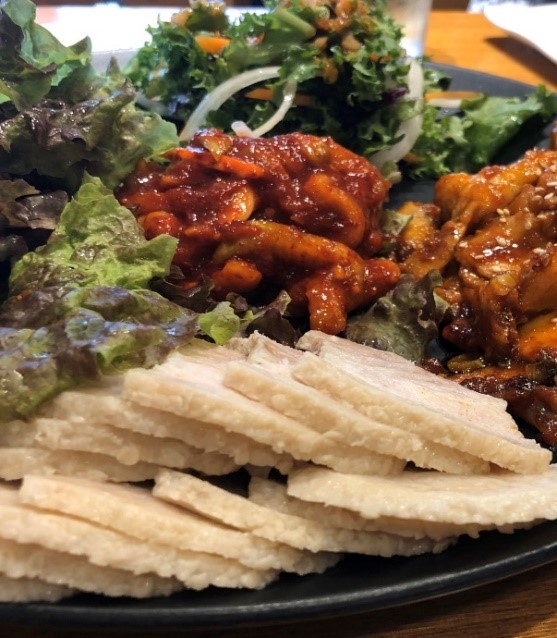
Bossam (pork belly)
Since I came to the United States, I tasted a
lot of foods that I had never eaten before, and they made my view to food
richer. One of the things that I felt so was Variety Showcase at The Redd on
Salmon, Portland, Oregon. We went to there as a required field trip and it was
an amazing experience for me. In there, we could so many small bites of foods. At
very first, I tasted Caramelized and black leek tatin with pickled leek top
powder and fresh leek fromage blank. In brief, it was the food that
caramelized big sliced leek was on pastry like small pie and it was my most
favorite food in the showcase. I personally do not like big and long sliced
leek since I was a kid, but I can eat small sliced leek. We use big sliced leek
when my family cooks hot pot in winter season because everyone except for me
love big sliced leek. The reason why I do not like big sliced leek is that the
taste is very strong, the texture is spongy, and the smell is stinky. I tried
to avoid eating the leek pastry. However, the leek pastry was really amazing
because leek was very sweet and the texture was easy for me to eat. The texture
was not disgusting like leek for hot pot. The combination of crispy pastry and
melty texture leek was awesome. I would have liked to eat it more. I had two
foods that I felt my homeland, Japan. One of the foods was Purple Peruvian
potato, fish velouté fermented, guajillo chili, rose monarda. The reason
why I felt Japan was the fish sauce. We have food for New Year’s Day named Ougon-Ika
(golden squid), the ingredients are sliced-thin squid, herring roe, caplin
eggs, soy sauce, fermented seasoning, and salt. I love the food and it is the
food that I feel the combination with rice is the best more than any other
food. it is a little bit expensive and the food for New Year’s Day, So, it is
hard to discover in normal supermarkets, but if you go to department stores,
you can get easily. I often requested my mother to buy Ougon-Ika. The
potato food reminded me of the memory in Japan. Another food that reminded me
of Japan was corn miso made by Three Sisters Nixtamal. They were the
people who came to Cascadia Grains Conference. Miso is an essential food for
Japanese people because we love miso soup. My mother often cooks miso soup for
us. We have a traditional culture of Japanese food. It is called Washoku in
Japanese. Basically, there are soup, rice, one main dish, and two small side
dishes. We often drink miso soup as one soup, so miso is an important food for
our lives. The miso I tasted in the showcase was very sweet and I loved the
taste so much. I felt that we could not use the miso for miso soup because of
too sweet taste, but I think that dipping vegetables is the best way to use the
miso because the taste is strong but mild, so it can make the most of the
original taste of fresh ingredients like local vegetables. However, it was not
normal miso because it included corn, so the texture was interesting. Only one
food that I felt mystery was Chilled indigo noodles, kimchi, pickled
veggies, benne seed, chili-soy dressing. I personally like spicy food, so I
looked forward to eating it. However, the taste made me very confused because
the flavors that I felt was too many, so I did not know what things I tasted. I
was curious two things about the food. One thing was kimchi and chili were
spicy tastes, so I did not know which spicy tastes I felt. And one more thing
was the color of noodles because blue color tends to reduce people’s appetites.
So, I was curious about why they chose indigo color for noodles.
I suppose that my comfort food is formed by
what food I ate when I was a kid. My comfort food is Japanese food; broth of
dried bonito and kelp, miso, tea and so on. Even if I stay in the United States
for a long time, my comfort food would not change because I have grown with the
tastes of Japanese food, and they occupy most of my food memories with my
family and friends.
When I was young,
no matter the occasion, Mexican mothers almost always talked about one thing at
least once; they always talked about the price of limes. The price of limes
always meant something more. It always indicated to some extent the current
social and political climate, the economy, and how people were faring in day to
day life. After all, everyone needs limes.
For as long as I have been alive the lime has been a reminder of my Mexican roots. I have eaten them for what seems like most of my life, and it’s always been an apparent fact that every Mexican household has at least two or three limes on hand. Used for all kinds of dishes, like seviche, where it’s used to cure raw shrimp, or squeezed onto a chili-powder covered tostada for a spicy and tangy mid-summer snack. Mexican cuisine is filled with all sorts of dishes that leaving your mouth tantalizing for just a little more: fresh goat, beef and pork stews with meat so tender and juicy that it melts into your mouth with every savory bite, lollipops covered in thin layers of hot spices and sour salts that would make your mouth shrink faster than cursing in church. There are a huge variety of conchas, a type a sweetbread caked in powdered sugar, and tres leches cakes sold at every local corner panaderia. Every dish holds its place in history and tradition with recipes rarely being written down but instead passed on verbally from generation to generation.
My eating history
begins not with me, but with my parents. Both coming from low-income families
living in rural Mexico in the state of Michoacán, food and money had always
been tight for them growing up. Most of their meals consisted of pinto beans
and rice. Seasonal crops as well as a wide assortment of fresh fruits like
starfruit, tamarind, guava and so many more that I honestly can’t recall their
names, filled out their diet. Meats like goat and beef were also common during
times of celebrations and whenever they could afford it. They grew up with
enough to eat, but still, it wasn’t easy.
I have never been
a particularly “picky eater”. I will eat almost anything that is put
in front of regardless of how it tastes or what it looks like. Growing up, my
parents never liked seeing food go to waste, so they always asked us to eat
what we can and not to worry about what we couldn’t or didn’t want to. But us
not wanting to disappoint our parents, we always ate everything. To this day, despite
always having enough with every meal, I still eat everything regardless of how
full I feel or how the food may taste. Even now, I finish my food and try to eat
every bit. It’s interesting to see that the lessons that my parents taught us
about food are still with me with every meal.
Some of the
earliest memories I have associated with food unsurprisingly come from my
grandfather. I can remember drinking coffee under my grandfather’s chair when I
was young; he would sneak us a little bit once in a while when my grandmother
wasn’t looking. She would scold him saying that coffee wasn’t for kids, but he
would give it to us anyway since he knew that we liked the taste of it. The
coffee itself wasn’t anything special, it was the local brand instant coffee
that everyone and their mother drank. We drank the coffee with two tablespoons
of sugar, and a piece of freshly baked birote, a type of bread with a
hard exterior similar to that of a French baguette, but inside was sweet, soft,
and fluffy. These two always paired nicely for starting the daily morning
routine; it was simple, but nonetheless good.
My grandfather by trade was a salesman. He owned his warehouse where he sold and distributed a wide assortment of spices, and herbs, like oregano, parsley, cayenne pepper; you name it he sold it. Spices happened to be one of the things we never lacked around the house. To the benefit of the children of the family, herbs weren’t the only things he sold; he also distributed candy!
In 2004, shortly
after I turned six, my grandfather passed away. He was the only one holding my
mother’s family together. My parents decided that it was time for us to come to
America; after all, America was a place of opportunity. If it were up to him,
we would have never left Mexico.
Coming to America
was a huge culture shock in terms of food. I had a Burger King whopper for the
first time, twice the size of any burger I had ever seen in my life,
accompanied by a tall cup of Pepsi and a heaping portion of fries to match. I
was blown away by the huge amounts of food that stores like WinCo and Walmart
had in stock. It was strange to see such large stores dedicated to food, and
almost all of it was alien to us, except my father who had spent some time
living in Washington working in the fields before we came. But I still felt that
he didn’t know the foods that he ate. I never really tried to understand it all
anyway. In our home, we ate very closely to the way we ate in Mexico, with
traditional foods. Coming to America also introduced us to the amazing world of
cheap snacks! Of course, there were snacks in Mexico, but the extent that
America had to offer was insane: sugar aisles as far as the eye could see, and chip
bags with so many different flavors that we couldn’t ever really keep track of
which ones we had tasted. Sugary cereals of all sorts come to mind. A new world
opened up for us that was full of delicious junk foods to consume.
Entering school
pushed me into the world of American cuisine. School lunches were made up of
all sorts of foods. I ate all sorts of things for the first time like corndogs,
strange burritos, lasagnas and ribs. Things that are commonplace now but back
then were literally foreign to me. Gone were the days of beans and tortillas.
Somehow, even with
the alien foods at her disposal, my mother still figured out how to create the
same foods we ate in Mexico. She cooked foods like posle which is a type
of stew containing hominy and beef chunks, and menudo which was a stew
that was made from cows’ stomach as well as other foods like tacos, enchiladas,
and from time to time carne asada.
She cooked a lot
of different recipes throughout the years but one of my favorites by far was
enchiladas. Hers were nothing like the cheese-covered burritos they served to
us in school lunches that they called enchiladas, no, these were the real deal.
The enchiladas my mother made were called enchiladas dulces. She would
heat tortillas in vegetable oil, then, while still warm, would dip them in a
sauce made from a type of pepper named chilaquiles. For the sweetness,
she would then add a bit of dark chocolate. The sauce added an element of
savory sweetness with a hint of spice. On the inside was a combination of peas,
ground beef, and diced carrots. The sweet sauce these enchiladas were covered
in still holds a place in my heart to this day. Someday soon I’ll be able to
recreate them for myself.
Leaving home and
coming to college also meant that I was leaving behind home-cooked Mexican
meals, and my eating habits have changed; I feel that I no longer have the same
connections to the foods that I used to eat. Life taught us that things like sugary
sweets only lead to diabetes and other health ailments for us. The food I eat
now are nothing like the food of my past. Of course, I have since had a chance
to experience wonderfully tasteful foods, but none compare in taste or
nostalgia to that of Mexican cuisine.
Since the beginning of Comparative Eurasian Foodways, the image I have had in my head as to what food is and what it can be has changed drastically. If I am being honest, I never really thought of much about food until I started the program. All I knew was that noodles came in a box, and meat came from farms.
In the beginning weeks of the class, we spoke about the role that food played in early cultures. All of this history was foreign to me. It may have been the fact that I had a spiritual connection with my food and not understanding the reasoning behind it. Looking at my food as a part of a cycle instead of just as an object that had no inherent life after it passed through me really struck me. I realized that we as a society have given up our connection to the food that we once ate. It was quite disappointing to learn that there has always been that connection with our foods until just recently in history. I question the reason as to why; I think it may have to do with the fact that we no longer have a reason to think of our food as part of the system of nature, and instead think of food more as a means of continuation in this society of excess and deficiency. Food, in a way, has taken the role of batteries: we plug it into ourselves to later discard without a second thought.
Cooking has never been exactly my strong suit, at least that’s what I believed; in actuality cooking has a lot more to do with repetition and trial and error than actually being “good”. I realized after the pasta cooking lab that with simple directions you can make something fantastic. I never thought that creating pasta from scratch could be as easy and delectable as it was. I truly did not understand the work and patience that goes into creating a satisfying meal. Being introduced to Chinese cooking blew me away; again I was being introduced to a new philosophy of food. The flavors in Chinese food come from a balance of the ingredients and the spices; the texture of the belt noodles was thick and chewy while the bok choy provided a slight saltiness with a taste I was not accustomed to of balanced greens. By far the most exciting portion of the dish was the sauce! The combination of red pepper, garlic, salt, and Chinese soy sauce added something that completely changed the composition of the dish. It was interesting for me because in a strange way it felt familiar; there is a parallel between the two cuisines in that Mexican food also heavily relies on the spices and the ingredients working together to create something greater than the sum of its parts. I found a cuisine that at least in principle matched my own.
The bitter greens
lab was also rather interesting, to say the least; again I was exposed to using
ingredients I was unfamiliar too. To me the most surprising ingredient was the
use of oyster sauce, a sauce full of savory umami I was unaccustomed to tasting;
it turned the already delicious baby bok choy into a dish worthy of recreating.
Again, the combination of the two stood out to me as a balance of flavors that
worked in tandem to create something great.
The Italian bitter
greens which were stewed in a bit of vinegar and then topped with lemon was a
dish that brought me back to my favorite tastes of tangy sourness accompanied
by a soft bland texture that I was so accustomed to. I enjoyed this dish in
particular because it reminded me much of my cuisine preference, specifically
of the limes of my childhood.
We created
meatballs using freshly ground meat. The flavor was much different than any
meatball I had ever tasted; these meatballs had deep earthy flavors with the
greater definition than any other meats that I had come across. The lamb
meatballs had a texture and taste that was at the same time overwhelming but
pleasant. As it turns out, unsurprisingly, there’s more than one way to create
a meatball; every culture has their own techniques and mixture of spices are
unique to them. The more times we run these labs, the more I realize that the
recipe is only part of the story when it comes to the taste of the actual dish.
The missing piece of the puzzle is the ingredients. The dish is only as great
as the sum of its parts, so we must take into consideration the quality and freshness
of the ingredients. For example, baby bok choy is softer and less bitter than
its adult counterpart. The fresh meats we used simply tasted better than the
mass-produced meats we eat regularly. It’s fascinating to me that I haven’t
thought about the importance of how the quality of the ingredients we use and
how that could affect the taste. I spoke to my mother recently and asked her
where the meat we used to eat in Mexico came from, and she responded and said
that it was the meat of the day. This meant that the meat was butchered that
morning and sold to customers that day. Looking back, it is unsurprising the
reason as to why authentic Mexican food tastes better: it’s simply that the
ingredients are far fresher than anything that can be found here in the United States.
This also extends to every single ingredient we have used in our own cooking
labs. It never crossed my mind that the food we eat daily comes from thousands
of miles away and was butchered or picked months prior to the day it enters our
mouths.
My hungry ghost is
fresh food. Even now, every time I eat my so-called favorite foods, I always
feel that something is missing. Eating here is not the same as eating there;
there just isn’t any way. Only do I feel satisfied when I have the chance to
eat something fresh and tasteful. In fresh food, there is a quality that simply
cannot be found in the foods we eat on a daily basis. Fresh food is simply not
available to us. Prior to eating the fresh meats we had during lab, I can only
recall one instance in recent years when I felt satisfied with the food that
entered my mouth. The summer before I came to Evergreen, I decided to try my
hand at gardening. The garden I created was pretty simple, with only peppers,
some parsley, and a huge abundance of tomatoes growing. Those fresh tomatoes I
ate that summer were some of the most delicious things I had tasted in a very long
time: small, juicy, and filled with the sour flavor I craved so much. Only then
in the garden did I satisfy the hunger for fresh food that I so badly wanted to
appease. Eating the fresh food of my childhood just isn’t possible.
During the
program, we had the chance to taste sugarcane in class. I watched my classmates
marvel as they ate sugar cane for the first time and enjoyed every bite. They
boasted at how sweet it was, but when I tasted it, I only tasted a tart
unsweetened piece of something that resembled sugarcane. I thought quietly to
myself that they didn’t know the true taste of sugar cane; they’ve never tasted
fresh sugar cane. The sweetness takes over your mouth like liquid honey, each
bite into the tender flesh releases more delicate sweetness into your mouth,
like the warmth of the morning sun, no they couldn’t know. It made me sad to
know that they did not know the joy of fresh sugar cane that I so craved.
This class has
taught me a lot about the food I eat: I have learned that it’s not as difficult
to recreate the foods that I want, it’s not difficult to create pasta from
scratch, time-consuming yes, but it is possible, and god is it worth it. I wish
to eat fresh foods. I’ve realized that it is possible to feed my hungry ghost,
but the difficulties are great and so are the costs. I’ve learned so far, that the
excess and deficiency of food is deeply cemented in our world: a product of the
system that we live in. Is it wrong to want fresh food? Is it possible for my
peers to experience the bliss that comes from something as simple as eating
fresh sugarcane? The excess and deficiency that we see are inherent truths of the
food we eat. Ask me if it’s possible to live in a world where fresh food is
available to everyone regardless of where they come from. I’ve learned that I
want to live in a system where that’s a possibility.
In conclusion,
food plays a much larger role then I could have ever expected. The food itself
is a symbol of life, it stands for much more than I thought possible. At its
core, food is part of an everlasting idea ingrained into us that ultimately
determines our survival in more than ways then we could have imagined. After
all, everyone needs to eat.
Who am I as an eater? As a Puerto Rican, my ancestors, African slaves, the indigenous people of the Caribbean, and Spanish conquistadors, all shaped my eating habits. When I went to Spain, I was amazed by all the foods we shared, the most impactful to me being tortillas. One of the dishes I grew up eating was tortilla Española, which would roughly translate to Spanish omelet. In Spain, the same dish, potato omelet was simply called just that, tortilla de papas. This is a far cry from what would normally be referred to as tortillas in the United States and Mexico, which are made of flour or corn, not eggs and potatoes. From the indigenous people, I think of so many of our fruits, like guanábana, pumpkins, and pineapples. I always knew it was my birthday because that’s the time when one of my favorite fruits, quenepas, are in season. And from the Africans, I think of coffee, which is such an integral part of not just my history, but the country’s, due to us being a major producer of coffee.
I would like to think I am a grateful eater. Though it may just be years of social conditioning, I can never sit down to eat (or watch anyone else eat for that matter) without unleashing a flurry of sincerely-felt statements. Whether it be a heartfelt thanks to the cook/s, an ode to those who made acquiring the ingredients possible, a hopeful expression to those I am to eat with, or all of the above, all of these form an integral part of the beauty of eating to me. And as for the act of eating in and of itself, I have no qualms about naming eating as one of my two favorite activities (the other being sleeping). I would like to think I am an adventurous eater. I will gleefully take any and every opportunity to eat anything I have never before had the pleasure of tasting. And thankfully, I’ve had the privilege of trying quite a lot.
When I first started writing about my food experiences, I was quite intimidated. The fork and the pen were never previously things I had held simultaneously. I was even more intimidated when I heard my peers so elegantly describe the flavors and textures of our meals with such apparent ease. But very early into the process, I discovered something that was rather surprising to me. The food I ate was… familiar. It first started during our tasting of shortbread cookies, each made of a different grain: toasted rye, spelt, corn, buckwheat, etc. Whilst I desperately tried to pick apart what made each of them unique, a singular thought lay at the back of my mind: why do I feel like I’m at my grandmother’s house? In my mind, I could feel the uncomfortable cushion that laid on each of the seats at my grandmother’s living room table. I could hear the telenovela wife’s melodramatic reaction at finding out her husband had cheated on her. I could smell the freshly bought bread from the nearby panadería. I could see the wilting flowers that were just a few days past their prime. And, perhaps most relevantly, I could taste three butter cookies I had frantically shoved in my mouth so that my aunt couldn’t take them away from me. After such a vivid experience, I decided to lean into the world of my wandering mind and go down memory lane whenever I could.
I believe no other experience was quite as vivid as the day I tried to get a Chinese visa in Seattle. As the travel agency who could procure the visa resided in Chinatown, I decided to eat there as well. My friend, who just so happened to be in Seattle that very day, suggested Dim sum, a Cantonese style of cooking consisting of small bite-sized portions of food served in small steamer baskets or on a small plate. I had never heard of it, so I readily agreed to try something new and offered to pay for both our meals. As we sat down, I patiently waited to be given a menu. And suddenly, a lady pushing a cart came next to our table and began pointing at food that was inside the cart, all on little plates. She seemed to be instructing us to point at the food, so we did, and the woman silently placed it on our table. I thought it was so nice of the restaurant to be giving us free food and so I kept pointing at even more dishes. It was only after a second cart came by that I realized that our bounty was not due to the restaurant’s unending generosity. They were expecting compensation for every one of those little dishes. My friend had already begun eating. There was no turning back. So, to the dismay of my wallet, we stayed and went considerably over-budget.
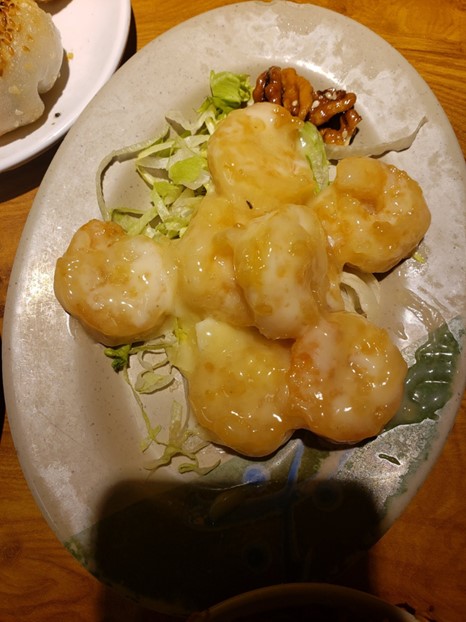
While our meal was very delicious, two dishes in particular stood out to me. The first was a plate of shrimp with walnuts, covered in a sauce that looked eerily similar to… well, bird poop. Shrimp has a special place in my heart. Growing up on the island of Puerto Rico shrimp, or camarones, are quite a common sight. From shrimp-filled mofongo, a dish consisting of mashed and later fried plantains, empanadillas de camarones, otherwise known as fried turnovers, to asopao de camarones, which is a particular kind of shrimp and rice stew. Though, on this occasion, the shrimp reminded me of honey-walnut shrimp, my all-time favorite dish at Panda Express. However, these shrimp were creamier, and I would argue, far better. They were my favorite dish of the evening.
Dim sum shrimp
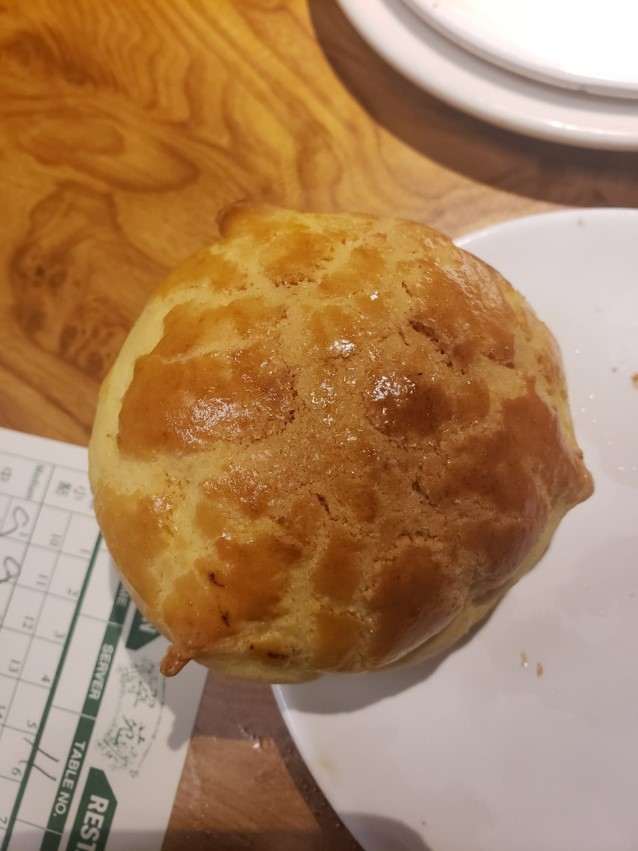
The second dish that made an impression was something I could only really describe as sweet bread. While I was not at all drawn to it when I first saw it, it was one of only two desserts. And I, as a person with an absolutely gargantuan sweet tooth, felt the need to partake in both. When I finally tasted it, I was met with quite the surprise. It tasted exactly like Mexican conchas. I had only ever had them once before. Last year, I went to a Día de los Muertos celebration. As I chewed the sweet bread, I could once again see the ofrenda as though I was still there, surrounded by people sharing stories of their loved ones. I chuckled, as I remembered someone telling me about their grandma and how much of a hard-core stoner she was. Meanwhile, I regaled her with a story of my grandmother and her bootleg alcohol operation. While the taste itself nothing to write home about, I will forever relive those lovely memories each time I eat breads like those again.
Dim sum sweet bread
People who know me well will be aware of the fact that my mom is an avid shopper. I, on the other hand, am not. Yet despite this clash of opinion, I had to accompany my mom through stores constantly. Whether this was because she wanted to spend time with me or if she needed someone to carry her plethora of bags and purses is still being discussed by scholars around the globe. One of the few places I did actually enjoy going was Costco. The large number of free samples, along with their huge selection of books (which I seldom bought), made it quite the enjoyable experience. So imagine my glee at finding out that our field trip to the Culinary Breeding Network Variety Showcase was like Costco sampling on steroids. I was ecstatic.
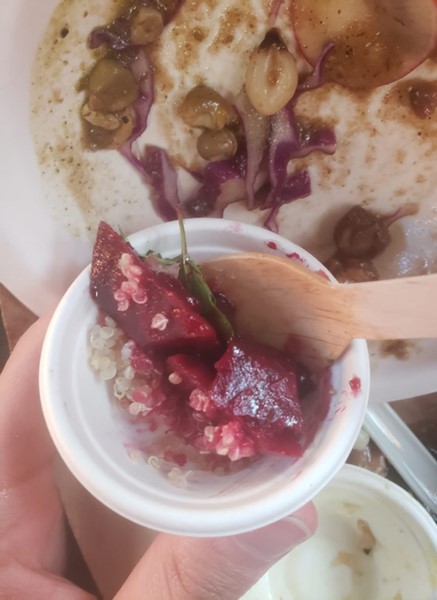
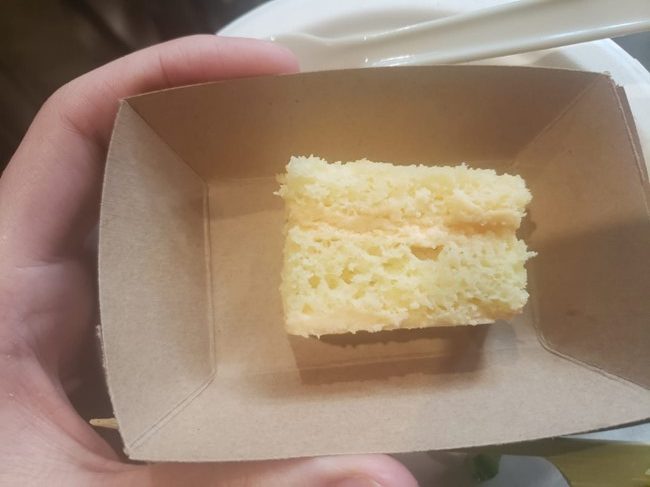
Among the many things I sampled that day was a cute, little square with an orange dollop on top that kind of looked like an orange. Since it looked like a sweet pastry, I immediately gravitated towards it. But when I finally put it in my mouth, I was exposed to a rather… unexpected flavor profile. To start, the orange dollop was not citrusy. It was pumpkin. And unfortunately, the taste very clearly reminded me of one of my mom’s many fad diets, as one of them involved cutting large chunks of grocery store pumpkin and only boiling them. On the same note, I also partook in a plate where beets were the star. This time, I was reminded of the horror that were my high school lunches. Almost every day we had the same meal: rice, beans, baked chicken, and beets. And while I’m not against those foods themselves, that particular combination certainly did not do it for me. And sadly, neither did that beet dish.
The beets
Some of the foods I ate that day were very tasty. The first dish that treated my massive penchant for sweets was one that looked very much like sandwichitos de mezcla. Growing up, these bite-sized sandwiches, filled with what I believe is some supposed cheese-like substance, were a staple at school potlucks. But this particular dish looked more cake-like than bread-like. When I tasted it, I realized the orange coloring was not “cheese”, but rather a sort of melon paste, and it immediately brought to mind a conversation I had so often had as a child. I was always vexed at why watermelon, cantaloupe, and honeydew, three different, albeit similarly shaped fruits, were all referred to as melón by many of my family members. I remember feeling so passionate about such a strange subject, almost as if this crusade for specificity would lead to world peace.
Melon madness
Perhaps my most pleasant surprise of the trip was that there were not one, not two, but five different kinds of ice cream present, undoubtedly the holy grail of desserts in my view. My favorite ice creams of the day were Yaupon Holly tea and passion fruit. While both of these were delicious, I have a deep connection to passion fruit ice cream, or rather, helado de parcha. As I ate the passion fruit ice cream, I was reminded of the little carts all across the Spanish colonial part of my capital city, San Juan, and the city of Ponce to the south of Puerto Rico. One of them even showed up in front of my high school from time to time. While the available flavors varied, passion fruit (as well as coconut) were always available. I felt, for a moment, as if I were at El Morro, an old, Spanish colonial defensive structure that is now a perfect destination to fly kites, with its large hill, open space, and constant wind due to it being right by the Atlantic Ocean. I could feel the breeze and the helado cooling me down and giving me some respite from the relentless tropical sun.
Living in the United States these last two and a half years, while I might have had the occasional craving, I don’t believe I had ever truly missed the food I grew up on. And after reminiscing about so many of the them, I still don’t think that’s the case. There’s no doubt that the world is filled with all sorts of different ingredients and different ways of cooking them, but they’re also so similar. So much of what we eat is reminiscent of something else, whether it be from the similarities in its creation and/or the life experiences we have that connect them. In a way, eating is something highly individual. Our experience eating the food is unique to our own special set of circumstances. Due to this, food can only be understood in context. And beyond matters of sourcing and accessibility to food, eating can be such an intensely social activity. I can only think of building friendships through food and how one of the rawest expressions of love is a person’s choice to cook specifically for you. If nothing else, transubstantiating my eating experiences into words on paper has served as a reminder to me of the power of food and how it’s shaped me. And for that, I am grateful
My family’s culture is like a jigsaw puzzle made of different ingredients taken from different recipes. Some of the pieces fit together perfectly, but others clash and bump edges, never having been meant to belong there. To be mixed is to be kimchi jjigae with too much gochugaru; to be mixed is to not have enough crushed tomatoes in the marinara sauce. But to be mixed is to also be perfectly cooked rice, perfectly cooked pasta, and just the right amount of garlic.
To be mixed is to be unknown and undefinable.
Eating and cooking, as for most people, has played a prominent role in my life. It has been my family’s tether to Motherlands that have long since been left and languages that were buried in foriegn lands. The puzzle pieces I received as a child were kimchi and rice, musubi and macaroni salad, baked ziti and spaghetti. My household was the ultimate fusion restaurant, and I was the studious chef’s apprentice. I would wait by the stove as my parents cooked, standing upon the tips of my toes to watch as they’d sprinkle in the various seasonings, a plethora of aromas wafting through the halls. It often felt like magic to me, as though my parents were cooking up age old spells. I would drag a little white stool over to the counter and have Mom and Dad instruct me on what to do. I am Korean on my Dad’s side and Italian (from Calabria) on my Mom’s side, but funnily enough it was my Dad that taught me how to cook spaghetti bolognese and my Mom who taught me how to make kimchi fried rice.
To be mixed is to be a contradiction.
As they taught me how to cook, my parents mixed their puzzle pieces in with mine and showed me how to make a mosaic. “You only put pork in your spaghetti sauce,” Mom told me, “Never beef. If there’s beef in the spaghetti sauce, it isn’t Italian.” Dad would explain, “There’s not a whole lot of measuring to be done, the way my mom cooked was by feel. By what tastes good.” Oh, how I held fast to those little bits of knowledge Mom and Dad would hand out. They were more like lessons on life and history disguised as a recipe book. Each new recipe they taught me felt like a reclamation of a cultural history that was lost to time.
To be mixed is to be a reconciliation.
Being a person of mixed race in America, I have always been in contention with the Great American Melting Pot, but I have learned to make peace with that struggle. I learned acceptance of myself through cooking. I learned how to cook rice and pasta to perfection. I learned what just enough garlic means. I learned how to measure sesame oil, fish sauce, soy sauce, and rice vinegar in perfect amounts without measuring cups. I learned how to make a delicious red sauce and an excellent, but unconventional, cream sauce. I learned to be both Italian red pepper flakes and gochugaru. I learned how to cook from my soul. Moreover, all these ingredients have shown me how to accept myself as one entity composed of multiple races. I have learned throughout my life and through my experience with cooking that I do not need to argue the validity of my existence to anyone. I am white, I am Polynesian, I am Asian — and nobody can take that away from me.
I began drinking coffee in earnest when I first started working in a kitchen, which, auspiciously, was when I started cooking. I didn’t particularly enjoy either one. Coffee was the key to slinging heavy garbage bags into the dumpster with any kind of vigor at 2 AM on a school night, and cooking was the key to earning enough money to pay for all the gas I used up cruising around our tiny island. I drank cup after cup after cup, year after year after year, and what at first felt like a necessary task became a pleasurable experience. Now, I go out of my way to only buy my favorite coffee, and I relish each sip, trying my best to use every sensation at my disposal to appreciate the experience. I developed the ability to appreciate on my own—or so I believed for a long time.
Now, this certainty has faded into…let’s say an awareness.
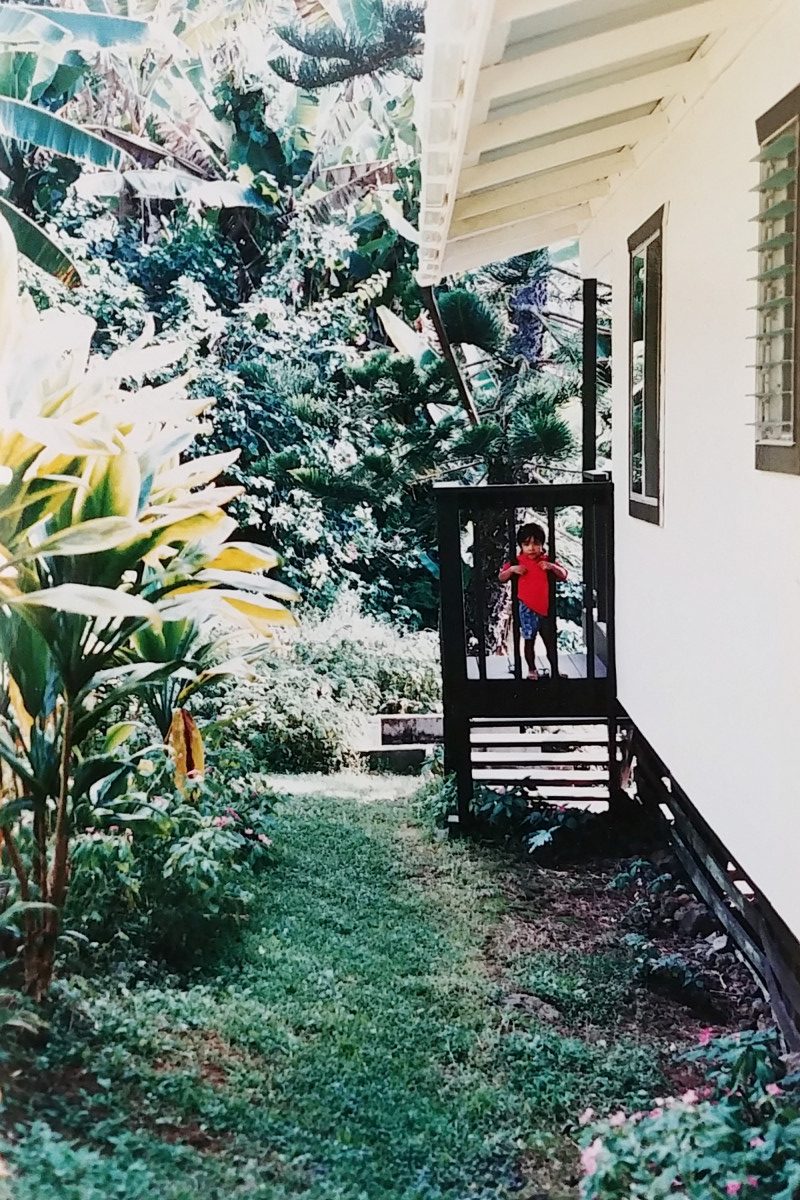
Little me, age three.
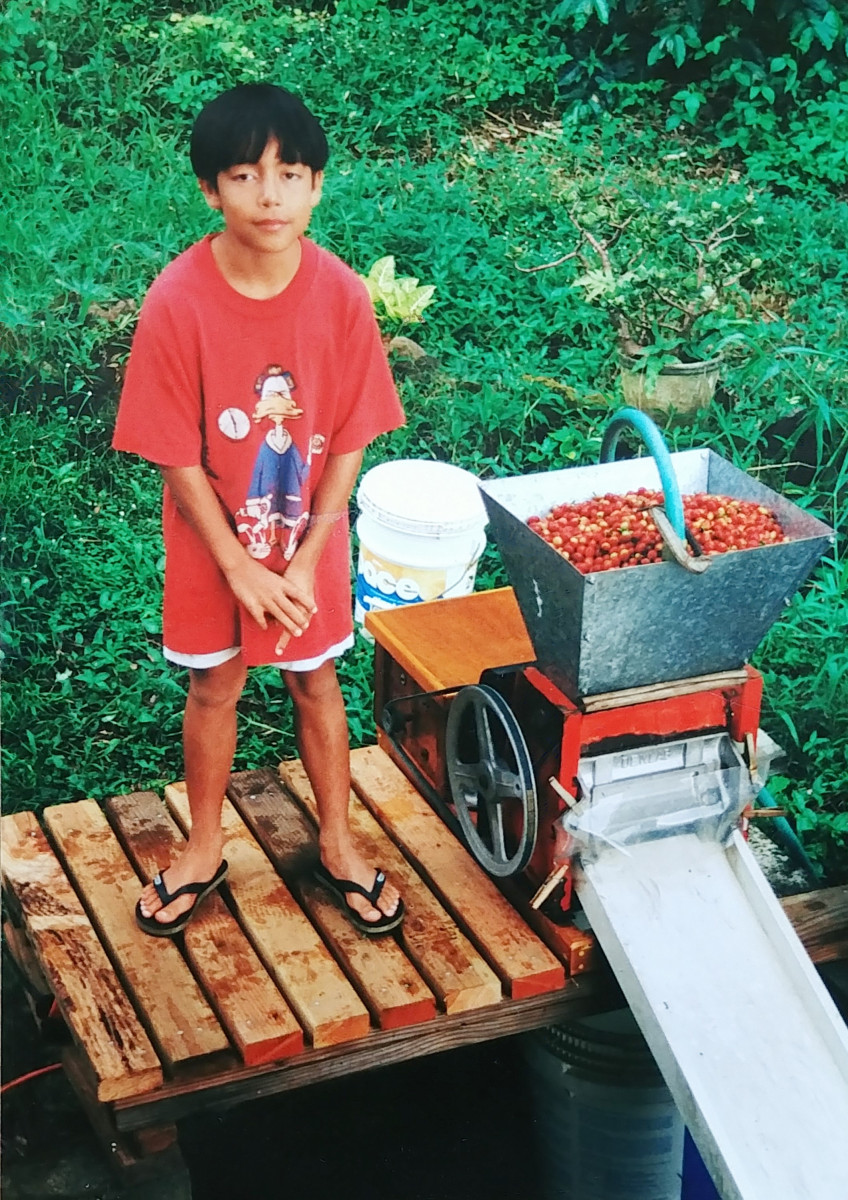
Between the ages of two and eleven I lived on the Big Island of Hawai’i, up the mountain from a small town called Honaunau, overlooking Kealakekua Bay. My father developed and operated a very small coffee farm, which he named after me: ‘Ano’i Farm. I grew up surrounded by coffee, but never drank it at that age, so I assumed that my preference for it didn’t come from childhood. I have always longed for the ability go back in time and appreciate a cup of my father’s homegrown product. And yet, though I may not have tasted the coffee as I could now, my very being was steeped deeply in the flavor of it.
Because
taste is a sense; flavor is a sensation.
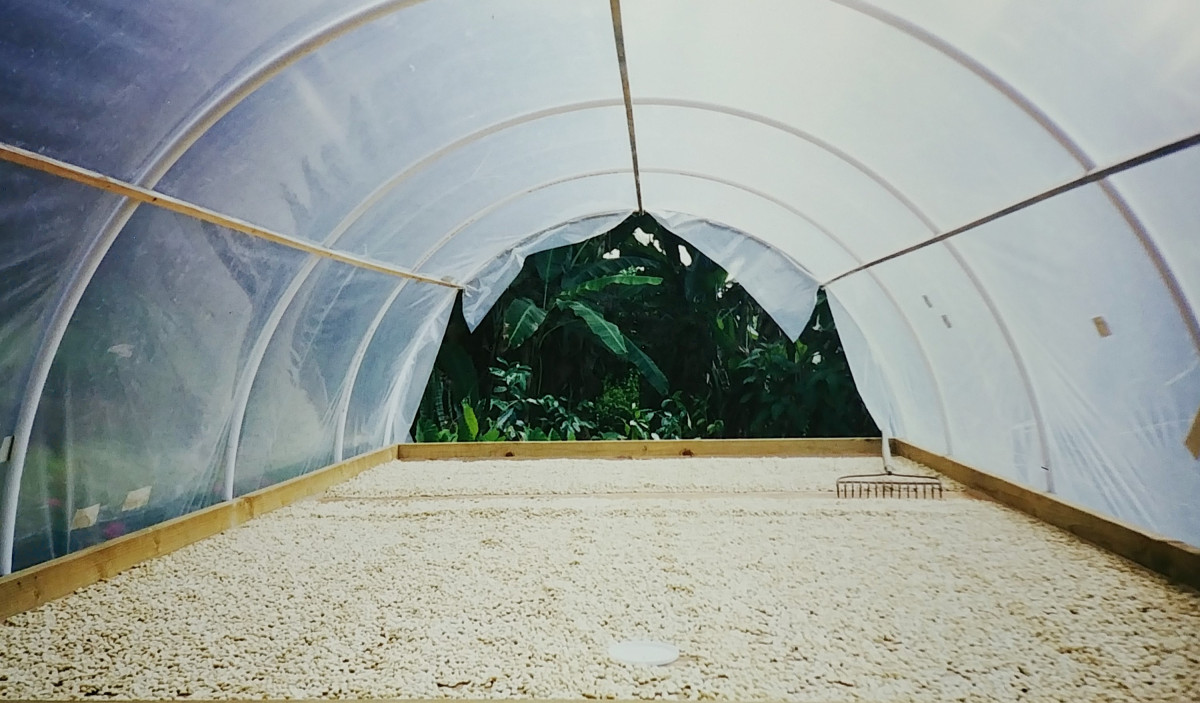
My father’s homemade drying table .
I can
recall with the utmost clarity the feeling of freshly pulped beans, soaking
slimy in buckets of water, the smell of those same beans drying in the sun on
our huge homemade table, the sound of the parchment flaking off as we husked
the dried beans, and the aromas of burlap bags and roasting rooms.
Pulping coffee cherries and loving it.
Similarly, though I never cooked as a child, I know that my mother would spend all day preparing recipes she had carried over in her mind and in her heart from another set of islands thousands of miles away, distant in geography and even more immeasurably so in culture. The smell of shrimp paste and dried cuttlefish, the horrifying appearance on my plate of chicken feet and fish eyes—these were not things I saw on TV ads: foods that beckoned with the allure of popularity. It took years for me to develop an affinity for these foods. But back then, they would be prepared and often brought to Filipino gatherings in which the tables overflowed with foreign bounties, and I would observe in wonder as the women seemed to shout at each other with words I couldn’t understand, crying and laughing in the same breaths.
At the
time, I never asked for coffee. I certainly never asked for fish’s eyes, for
which my mother never tired of ribbing me. She had spent her entire life in the
Philippines—where they’ll fight over the eyes—prior to giving birth to me, and
yet her one child only wanted chocolate milk, mac and cheese, hot dogs, and
cake. On very special occasions, I might even get all three at the same time.
Despite all of my heroic, thick-headed childhood efforts to avoid the tastes
all around me, I am more beholden to them than I ever liked to think.
Happy as always post-mac and cheese.
I
turned fifteen, and lost my mother to cancer. I turned sixteen, acquired the
ability to drive and with it the independence to be away from home as much as I
wished. Shortly after this, drinking coffee became part of my daily routine,
and I started working in a kitchen. Fourteen years later, I have come to
realize that what I had seen as leaps away from my past were really first steps
in my long journey back to the tastes and experiences that still sometimes
flash vivid in my mind.
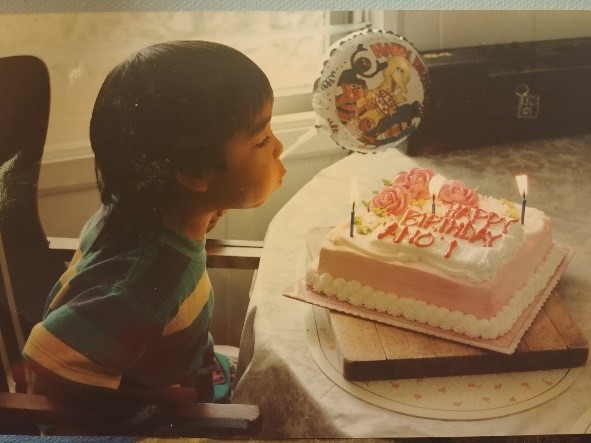
Excitedly blowing out birthday candles.
Because
I didn’t develop my love for coffee
on my own, and neither did my ability nor appreciation for cooking (and
inherently, eating) spring forth immaculately from the recesses of my virgin
mind. I’ve found that satiety comes not from a tearing apart but a coming
together. I’m not satisfied eating a meal alone; not when all the turbulent
emotions involved with the preparation and eating of a meal could be shared. I
have seen the power of commensality—I’ve shed tears over a meal, communicated
successfully, not with words, but with soft smiles and satisfied pats of bellies.
I believe I can continue the journey back to understanding the tastes of my childhood through the study of food beyond the hot line of a commercial kitchen. I’m looking forward to learning from the members of my community from whom I’ve fled much of my life. I’m looking forward to ingesting the same food that has passed through the bodies of my ancestors for generations past, and learning just how these foods serve to build and strengthen a community that thrives in pockets around the globe. The ability to conduct research, to eat new foods, and learn what is, in a way, my own history is a privilege for which I will never cease to be grateful.
___________________________
“Stephen,
how would you compare coconut aminos to soy sauce?”
Great question, Martha. Oh boy. Is my professor asking me to describe a flavor? I’m terrible at this! Think!
I
pondered for a second, standing there in the Sustainable Agriculture Lab (SAL)
as we prepared to put on one of our weekly cooking labs. I was about to teach
my vegan “lentil meatball” recipes to classmates in an academic setting—I’d
never done anything like it before. I was nervous, but I also knew that I had
spent days with these recipes. I had fine-tuned, deleted, sprinkled, smeared,
burned, balled, dropped, zested, picked, plucked, and peppered my way to what I
thought would be functional—and, hopefully, palatable—vegan versions of the
meatballs the other tables would be making that day. I tasted, tested, and
tasted again until I finally had presentable Greek, Italian, and Chinese
versions of the lentil-based, falafel-esque balls.
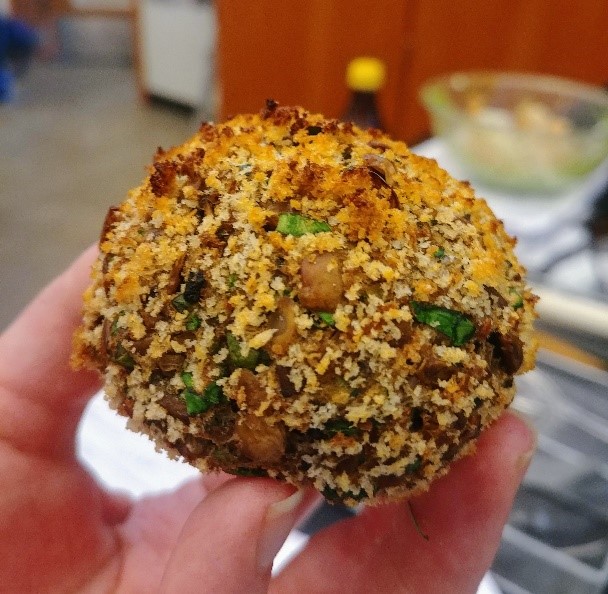
Italian lentil ball by peer Chefs Lauren, Katie, and Annie.
Fortunately,
I have done so much work with so many different foods that I wasn’t starting
this development process from scratch. I can taste lack, and I can taste
excess, and I’ve built an embodied knowledge that whispers to me while I
scratch my head wondering what to toss in to really tie it all together (pro
tip: it’s probably lemon zest).
We make it up as we go.
So
really, despite my deep-seated reflex to say, “I don’t know,” it didn’t take
much more than a pondered second to answer Martha:
“I’d
say, coconut aminos are definitely much less of a salty, umami-ey punch in the
mouth than soy sauce—and a little bit sweeter, too. If we’re talking about
cooking it into something, though, it can basically serve the same function.
The average eater probably won’t pick up that you substituted the soy sauce for
coconut aminos, although you might want to add a dash more salt to the recipe
than you otherwise might have.”
And
there it was, like that, a jolt from the blue: maybe, just maybe, I’ve got some
of it. That embodied knowledge I’ve heard so much about, what makes
grandmothers able to decipher Spartan ingredient lists and turn them into
sybaritic feasts. The fluid and rhythmic dance that seems to summon dishes from
my fingertips; clearing my mind, lulling it into a trusting vegetative state,
only to come alive again when someone takes an eager bite and says, “wow.”
Think less.
___________________________
Let’s talk about funk. Not like the emotional state I sink into when the rain hasn’t let up for three months, nor the Rick James, Curtis Mayfield, and Chaka Khan brand of danceable, elastic beats. I’m talking about funk—that strange, rich, sharp, musty, undefined, and usually fermented flavor that is either detested or adored the world over. It might be bright and tangy, like sauerkraut, or it might be deep and earthy, like the aroma of grated truffles. The United States has typically fallen on the “Oh, yuck! What is that!?” side of the funk chasm (aside from our intimate relationship with alcohol). However, recently we have been playing catch-up with much of the rest of the world, as we as a popular food culture have discovered “new” foods like kombucha, fermented hot sauces, or even funkier versions of familiar ferments, as in the proliferation of “farmhouse” ales and saisons.
I
bring all of this up because as I reflect on the last academic quarter of
eating, and try to recall which eating experiences have been my favorites, I keep
coming back to the flavor profiles and dishes that appear under that dank umbrella
that is funk.
In the
second lab of the quarter, I faced a dilemma. Emily and Gillian of Wildflower
Baking had come up from Portland for the Cascadia Grains Conference, and had
graciously agreed to give an enlightening presentation on the nature, quirks,
and benefits of baking with and growing alternative grains and flours. Their
presentation was both engaging and deeply informative—and yet, I was having
trouble focusing. How could I, when just inches away from my notebook was a
plateful of cookies? And not just any cookies, but ones that bore alluring
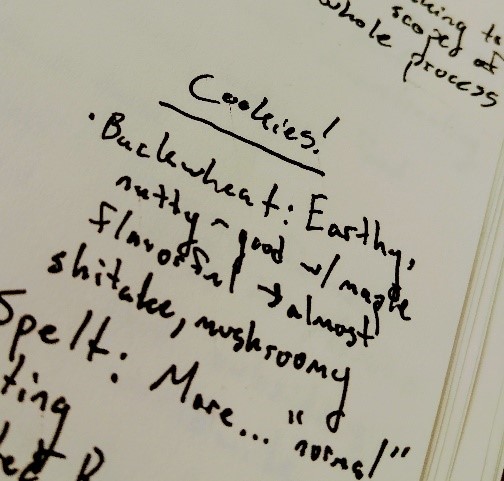
nametags like “toasted rye,” “spelt,” or “buckwheat.” I had gone into the day
knowing we would be making chocolate and buckwheat brownies, but what I was really curious about was what buckwheat
tasted like. I didn’t think I’d be able to taste much aside from chocolate in
the brownies (I was right), but here in front of me, in this array of
differently-floured cookies, I had the chance to not only eat cookies (one of
my favorite pastimes) but to actually taste a side-by-side comparison of
flours.
…or mushroom-esque?
I gave
in and directed my attention to the plate. I chose the regular flour one first,
of course, as this was a scientific cookie-eating experience, and I needed a
control. Then, the buckwheat. Whoa, what
was that? I took another bite: slowly, rocking the cookie bits from side to
side in my mouth, paying attention to my breath on its way in and on its way
out, feeling what set this apart from
the regular cookie. It was deep. Earthy…nutty? What does this remind me of? And then it came to me: mushrooms! It
reminded me of mushrooms, specifically the sort of big, savory, funky flavor of a shiitake. But, I liked
it. A lot. It turned out to be my favorite of the bunch, and the eating
experience that stood out to me most from that day.
But,
why?
___________________________
Fast-forward
a week, and instead of eating cookies and smoothing pans of brownie batter,
we’re slapping small ovals of pasta dough repeatedly on the counter until they
stretch—amazingly—to arm’s length “belts.” The leader in this little exercise,
prior to showing us how to make these belt noodles, had said, “Now we’ll make
the Chinese noodles. Much more simple
than Italian pasta.” Really? I had
always thought of Chinese cuisine as being much more complicated than your
basic cacio e pepe. I had just read a
book that discussed at length the intricate, consciously-applied complexities
of high Chinese cuisine, which told stories upon stories of Chinese art,
culture, and history with each bite. Simpler than linguine? We’ll see.
All the flavor you’ll ever need.
Of
course, she was right. It was shockingly easy, in fact. And once the noodles
were cooked, the procedure for making the sauce was also shockingly easy. Not
much more complicated than just throwing it all in a bowl. Simplicity all
throughout. Then, eager to see how my particular belt had turned out, I took my
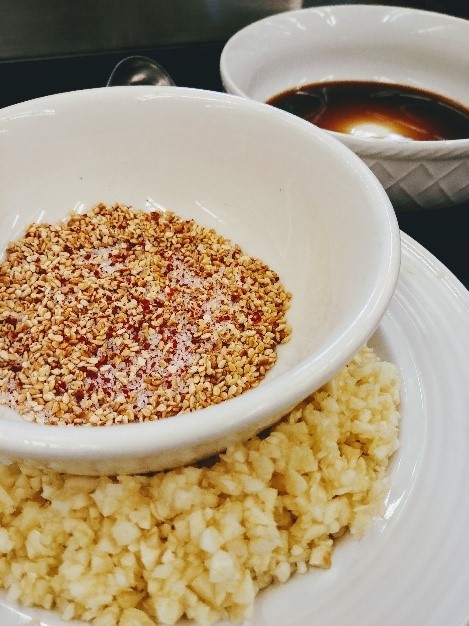
first bite, and forgot about the noodle entirely. Whoa. I looked over the ingredients again—garlic, chili powder, sesame,
soy sauce, vinegar. I knew these flavors, and I knew them well. The flavor
profile of what I cook at home is almost entirely drawn from this list, to the
point that I’m almost certain my partner must
be sick of it. But, what was I tasting? This was on another level; something was standing out, making this
bowl of simplicity a blindsiding, momentous experience. I looked over the
ingredients a third time, and hit on why this bite might prove to be
unforgettable. This was my first time tasting Zhenjiang vinegar, a condiment
that in its particular production process sets it apart from any other vinegar
that I had tried previously.
The
complexity of flavor in my little bowl of noodles felt like more than the sum
of its parts, as if I had taken a well-known road only to round the final bend
and discover a completely unfamiliar destination. It had to be that vinegar. So, I tasted it by itself. I expected that
familiar—and beloved—tang and tongue-tightening that always follows a sip of
vinegar. Something different, something entirely new confronted my palate
instead. It was thick, almost syrupy, with flavor notes cascading one after the
other, none of which made me think of vinegar, until at the very end: a
suggestion, a whisper of tangy acid. Deep, dark, rich—these were the words that
came to mind; and when I squeezed the bottle to get a smell of this magical
liquid on its own, raisins. I had
fallen in love.
But,
why?
___________________________
Moving
forward another three weeks, we come to Portland, Oregon and the Culinary
Breeding Network’s Variety Showcase. I had three hours to shuffle from table to
table, sampling the deliciously inventive dishes served up by combinations of
breeders, growers, and chefs—and to try to fit some semblance of conversation
in between bites, each seemingly more provocative than the last. It was a tall
order. Baroque arrangements of lumpy squashes, arrestingly kaleidoscopic
carrots, inexplicably beautiful cabbages, and blue turmeric roots littered the crowded space; a sensory overload
from which I had to fight the urge to turn and flee. Instead, I ate, and I
talked, my spirit buoyed by the excitement each table had to offer. This
continued for the full three hours, and at the end, my head swam trying to sort
out the experience.
“Which
was your favorite?”
“Did
you like one thing the best?”
“Come
on, if you had to pick just one…”
I
was asked this over and over, and I struggled to find a response, submitting a
different answer each time. The event sat with me for several days, turning
over in my mind like a washing machine in slow-motion, and still I struggled.
It wasn’t until I was going through the photographs I had taken during the
event—camera in one hand, bag and food in the other, focusing with my little
finger—that one experience in particular crystallized and set as the clear
favorite.
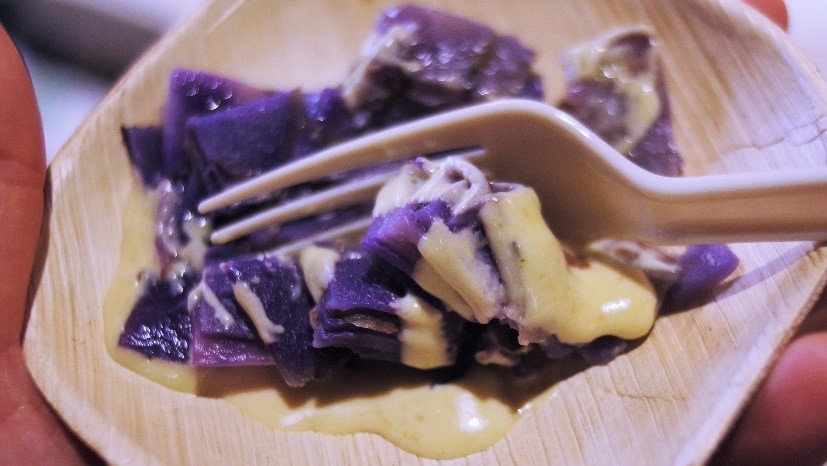
It was always you potato terrine.
It was
a purple potato terrine, layered sliver by sliver with obvious love, adorned
with a smooth, off-white, creamy-looking emulsified sauce and topped with a
single cured anchovy filet. It was a beautiful thing—both to the eyes and on
the tongue. It was texture defined, both in body and taste; silky, slippery,
each layer of potato sliding away on its briny sauce like little boats in a
harbor. This was the striking image that came to mind as I ate: that of gently
rocking sea-faring vessels, redolent of seaweed, fins, and salt. It was earth,
with its sweet starchiness, but more than that, it was the sea, somehow crystal clear and briny, fishy, and funky all at
once.
As
soon as I recalled the experience, I knew that of all the wonderful tastes that
day, this was the most transcendent for me, hands-down.
But,
why?
___________________________
“I wanted chocolate milk, mac and cheese, hot
dogs, and cake.”
Remember that? That was me, and my preferred flavor profile before I ventured out into the uncharted waters of the world of taste. So how could it be that not so many years later, I might instead say, “I want kimchi, fish sauce, and dried squid?” I think the answer to that question lies in my roots, in the flavors I internalized as a child. I am constantly learning—and every second I’m alive, I learn a little more about how much I have yet to learn. Instead of being daunting, it’s encouraging, giving me the motivation I need to always take the next step, because I’ll know that much more about the world around me.
On the other hand, recognizing what you already know has its place, too. When I look back at the experiences of this quarter—the eating experiences in particular—one of my most important pieces of progress has been acknowledging what I know. Like when I found myself answering Martha’s question about coconut aminos, or when I was able to answer all of my classmates’ questions regarding my lentil recipes, or when, in writing this very piece, I surprised myself with my description of eating a potato terrine. Having gotten the opportunity to eat so many different things, and to learn the historical, social, and environmental contexts in which each of those foods was situated has not only given me the gift of new information, but also put into perspective those things that I already know. I feel as though I trust myself a little more after having experienced the last two months, and that all the work I’ve put in over the years has imprinted not only on my mind, but on my body as well.
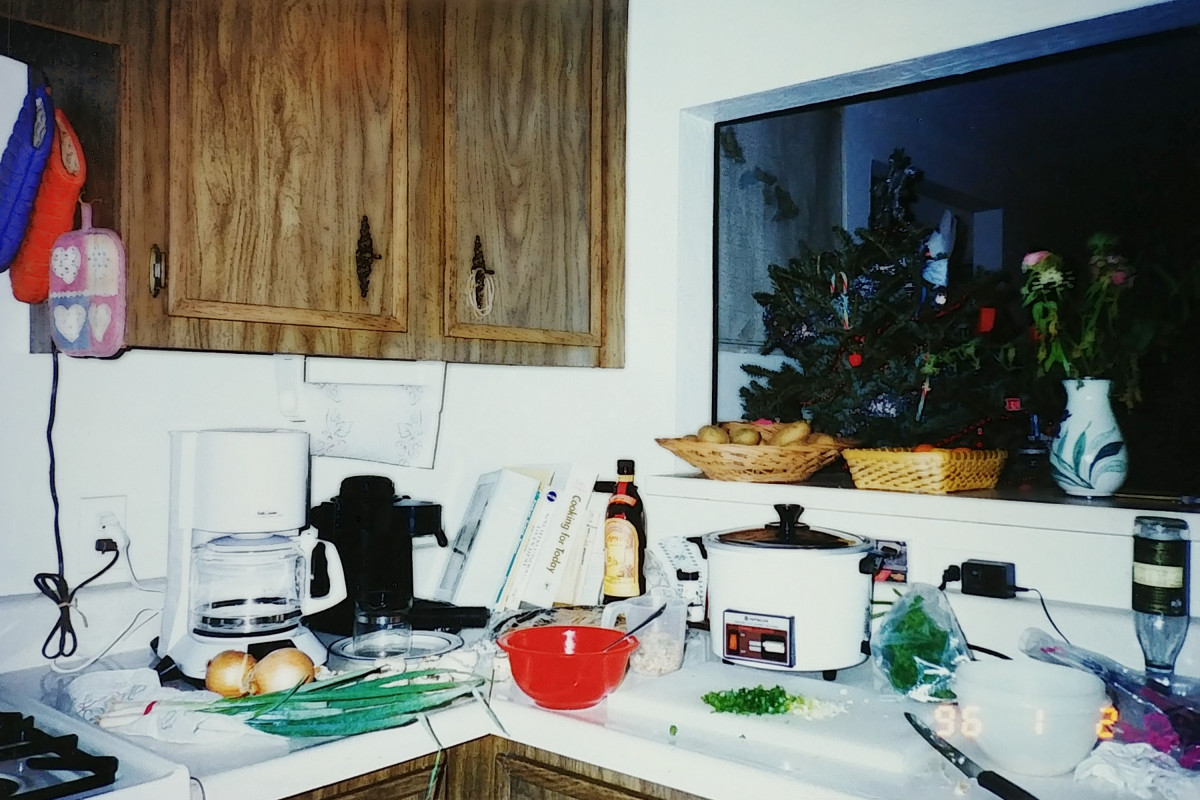
The kitchen in the midst of preparing a meal.
Those cognitive and embodied knowledges, like the greens of a carrot, only grow and develop as extensions of the subterranean taproot made up of my places and my people. The burlap sacks of coffee and the pungent aromas of dried fish are still with me, informing who I am, what I know, and how I taste. Why did I like that funky, almost savory buckwheat cookie so much? Well, it might have something to do with growing up in Hawai’i, inundated in sweet and savory, where I often devoured packages of Japanese teriyaki crackers with sugary icing. And I’m fairly certain my mother’s liberal use of patis (Filipino fish sauce) has wound its way, snakelike, through the years to give me an affinity for the complex flavors of aged Zhenjiang vinegar and the brininess of an anchovy.
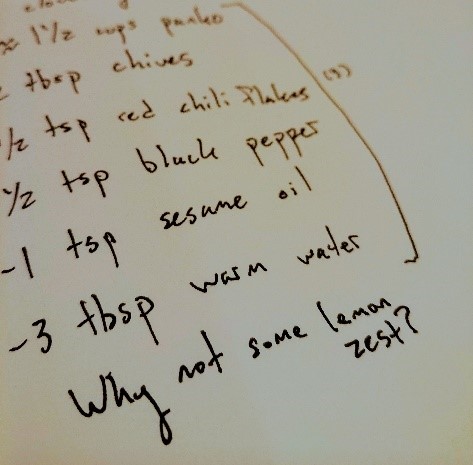
Not much to go on.
I’ve often thought of myself as being by myself. I thought I built a skill set in the kitchen on my own, and I thought I built a library of taste preferences and a vocabulary for describing those preferences on my own. But, how could that possibly be true? Who would I be without those who gave me my first tastes in life? Without the mentors who fed me and showed me how to hold a knife and how to tell stories about food, both on a plate and on a page? I thought of myself as an island, like those I grew up on, standing stolid in restless seas. As I’ve come to understand, that kind of isolationist thinking isn’t good for me. In fact, when it comes to myself, my skills, and my food, I have to try to remember one thing:
Ever so quietly in the distance, I can hear the sizzling of bacon in the pan. I stir between asleep and awake and take a deep inhale, letting the blissful aroma awaken my senses. Clumsily, I’d get out of bed and teeter down the hall to the kitchen. My dad would say “there’s my girl!” and give me a hug, proud of the daughter that was quick to arise from bed at the beckoning of bacon. Bacon was my first food love. My family called me a bacon head, and all things bacon instantly reminded them of me. Camping one summer, my parents asked me what I wanted for my birthday; my response was bacon. The morning of the 16th, I was flabbergasted, and utterly delighted, when I was told that the beautiful mounted plate of bacon was all for me. Not a piece remained when I was done.
This is my family. My father is German, French, and Scottish-Irish. He was born and raised on the sunny beaches of California. Whenever he talks about it, I see the bright eyes of him as a boy shine through the face of a man in his 50s. My mother is half Thai and half Laotian, although we never count the Laotian half because my mother only met her father a couple of times in her youth. My mother was born and raised in Sattahip, Thailand, a military town on the ocean. She grew up eating lots of fresh fruit, spicy sauces, rice, meat and seafood. Both of my parents were raised in very different climates from the Pacific NorthWest. However, the origins that have compelled me the most have always been those of my mother.
Being born and raised in the U.S., having Thai dishes growing up was something different from the kids that I knew, although I didn’t know that at the time. Growing up, we would go to Thai temple markets and eat all of the delicious foods that the vendors had to offer; it was the closest atmosphere we had akin to Thailand. I remember going down to California and separating fresh flat rice noodles for my Yai (Grandma), to make lad na. Thai food is always a comfort for me, it makes me feel close to my family. When I eat curry, or lad na, or drink Thai iced tea, or Thai iced coffee, it is a transportive soothing of the soul. It makes me feel grounded, connected. The world slows for a bit, and I am gradually connected to the memories of my family. Then further still, connected to my family that lives in Thailand, to the place that is foreign to me.
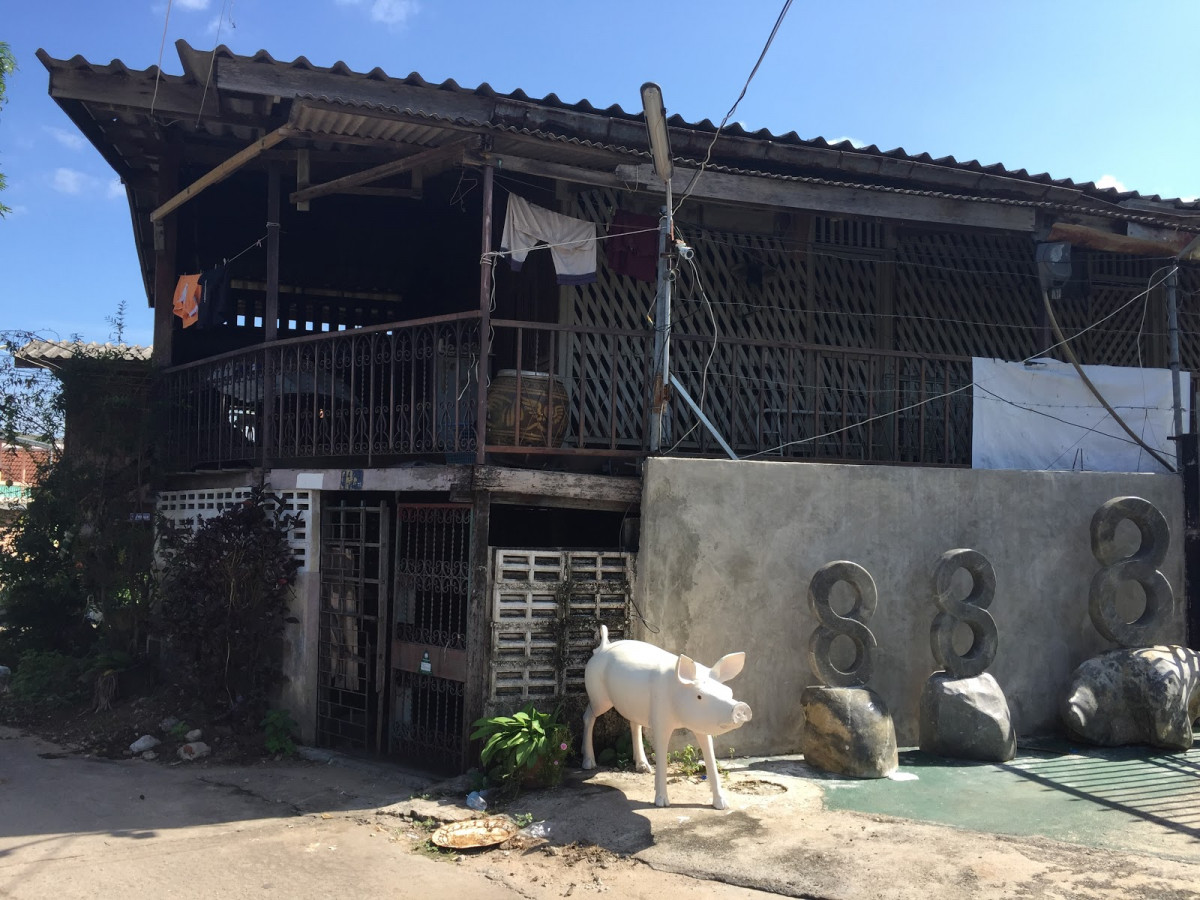
This is the home where my mother grew up. Seeing it in person was unexpected, and a bit of a shock. My mom had vivid memories that she portrayed to us. One was of her falling down the stairs at a young age and getting hurt. I had visions of light shining through the slats and my mother being a toddler. Imagining different stories she has told me through the years of her eating fresh fruit, and taking the petals from flowers and placing them on her and her sister’s fingernails, pulling them so that it was like nail polish upon their fingers.
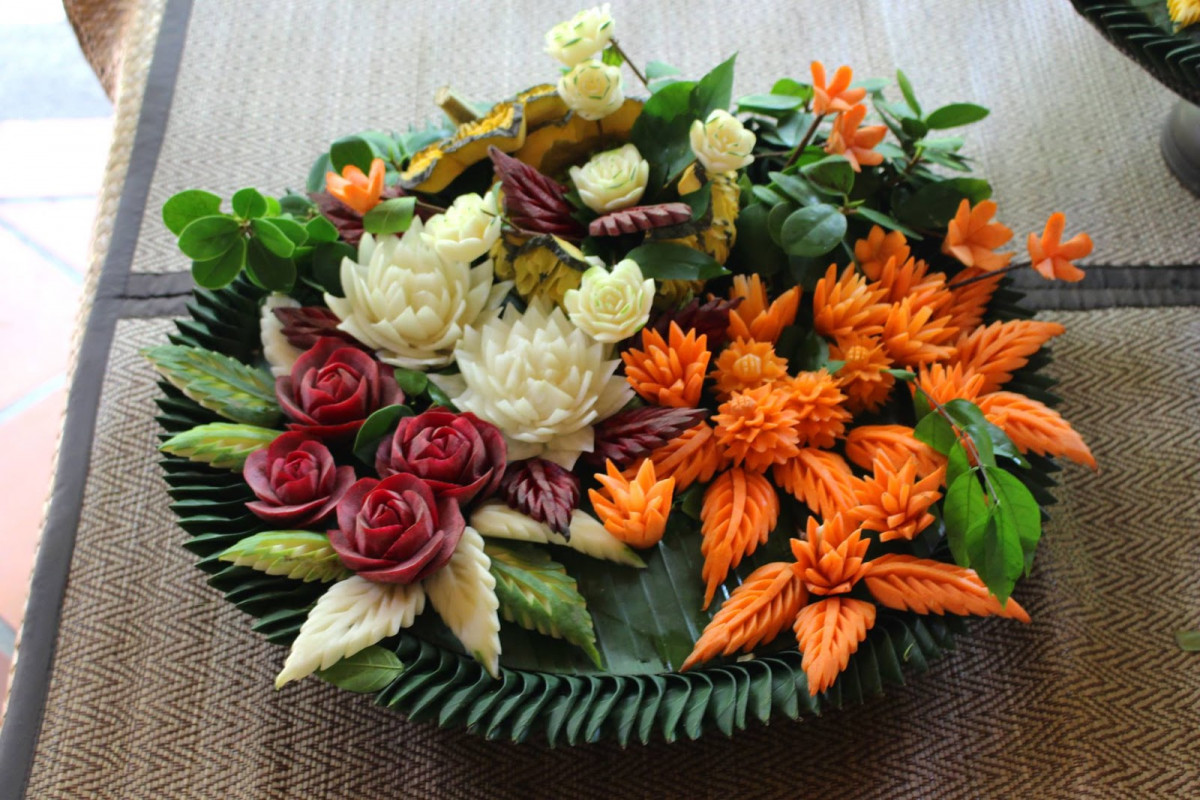
When we visited it was foreign. My sister and I felt so out of place. We couldn’t speak or read the language; we couldn’t communicate well with our family members. And I couldn’t eat, which increased the separation. Much of what we ate did not agree with my stomach, which was torture because the food was delicious. Having my Thai heritage is beautiful, much like this work of edible art that my sister took a picture of. It is something I have tasted, and I have not tasted. It is home, and it isn’t. It is me and it is away from me. It is tasted and untasted.
I have always loved food. I cherish the memories that I have around it, memories with friends, and family near and far. Food gathers people and bonds them together through the experience of eating in community: people saying what they like best, asking what each person ordered, and sharing each other’s dishes. Being taken into that specific place, moment, memory, culture, and community is what helps one go from being alive to truly living.
Six years ago, I spent five months in Kazakhstan. I still have cravings from this chapter in my life. Being so far from home, in a country where I couldn’t read or speak Russian, or Kazakh, food became even more precious to me. I felt like a toddler. In the home where I opared, the mom of the children I was caring for, Diana, became my mentor. Whenever she would let me, I would help Diana prepare dinner. We would have three meals a day, and snacks. All eaten together. To this day, that is the only time in my life where I had such a beautiful meal time rhythm. It was wonderful. Diana would try to cook meals from home (the States) with the available ingredients. The dinner I remember best was her duck. You couldn’t get large quantities of chicken wings/legs, so she bought duck. She used orange juice in the recipe. I was skeptical at first, but boy did I change my tune when I ate it!
When I landed in Kazakhstan, it was -28 degrees Fahrenheit, and we lived at the base of the mountain. When it started to warm up a bit, Curt (Diana’s husband) would bring home fresh round loaves, and I was able to explore more local foods and shops. Getting greens was a challenge, so Diana said that she started using sauerkraut as salad; it was so fresh and delicious! Kazakhstan had delightful pickled vegetables. Another side that became a favorite of mine was thinly sliced pickled carrots. My favorite local dish was Laghman. As far as ingredients go, there were thick freshly made noodles, and homemade pickled vegetables. There was more to it than that, but that is what I remember. It looked nothing like any other dish I had seen, so naturally I was skeptical. I cannot convey how amazing that dish was. I retain whispering memories of the textures and mouthfeels of the dish. The thrill and excitement it gave me remains strong in my mind, but somehow it has to strain to recall the tastes.
What stood above all else, was the tea. I fell in love with Kazakh tea culture. When I entered our neighbor, Nazym’s home for the first time, she welcomed me into her kitchen and asked me if I would like tea. I very happily said yes! The water was hot and waiting. She served me a cup of black tea, asking me if I would like milk or sugar, and how much. It is customary to have milk in your tea there. She explained to me the different customs for tea. Whenever guests came over, it was expected for the hostess to have hot tea and snacks at the ready. Regardless of the number of guests, either the woman of the house, or the eldest daughter would prepare each individual’s tea. She must know how each person takes their tea, or she doesn’t love them. If the tea isn’t hot, she doesn’t love them. It is customary to fill the little bowl halfway, as to encourage the desire for more tea, and to lengthen your stay and conversation. If, by contrast, the teacup is filled to the full, then it translates as “drink quickly and leave.”
In Kazakhstan, when you visited and had tea you would do so for hours. Drinking cup after cup, eating cookies, cakes, and other sweets. When conversations were really long, you’d even have meals. But! Then you would have more tea. They had a saying that when you are full with tea to your collarbone, you drink one more cup so that you are full to your jaw. This is when the company was lively and good. I adored every moment of this. To me, it is one of life’s most precious gifts to gather around a table, around warm delicious tea, yummy snacks, and talk for hours on end. Deep, real conversations with tea fuel my very soul. This chapter of my life was a big piece of what brought me to my dream today; the dream to have my own tea shop.
The creek was cold
and dark: a murky abyss where treasures were found. It was only with a speedy
dip of a hand that you would be successful. Trusting your instinct, finding
your inner jaguar. Sydney, my step-sister, a year younger, was the best of us.
She would square up with the edge of the creek and assume a squatting position;
before you could blink your eyes, she was holding three, glistening, light-brown
creepy crawlers in each of her hands. These were crawdads, and we loved to
catch them. Long day adventures in our backyard, a 300+ acre forest, had us
munching on grubs, worms and other insects we found under the moss of logs. It
was all a great game at that time, searching for the best treasures, kind of
like Pumba, from Disney’s The Lion King. No thought crossed our minds to
go in for lunch, of which there wasn’t much. Sometimes, however, we would sneak
through the house on tip toes to the kitchen pantry to make the Hot Dog Bun Special.
It was always a stale bun, lathered with JIF Peanut Butter and Log Cabin Maple Syrup. It may
seem like an odd creation, but it was all we ever had to work with, so we made
do. As young kiddos, we loved it.
It was quite the
bumpy, unreliable rollercoaster from ages 3 to 10. Switching schools, moving
every three months, eating happy meal upon happy meal. What I do remember well,
are the times we ate together because to me eating was about sharing and giving
to those you love. Being able to have so many of us together was unmatchable. I
was probably 8 or 9 when we moved in with my grandparents. At the same time, my
Aunt Monica, her husband, and 8 children moved in as well. Imagine, 15 people:
5 adults and 10 children living in a two-bedroom Rambler, with 5 beds, one
couch and no dining table. Also, think of the smell that your great-grandmothers
house had: dusty, dog-like, damp, and covered in knick-knacks. On the weekend, grandpa
would say, “Caren, here is 60 bucks, go out up to that place on Sheridan Ave
and buy some pizzas for the lot of us.” My mother would take the money, stick
it in her bra and yell down the hall, “Any of you little monsters want to help
me get pizza?” I loved any moment alone with her, so I climbed out of the kid
mountain yelling, “Me! Me, Mom, I’m coming, one sec, wait! Don’t leave without
me!” We would come back promptly with a giant stack of cheese pizzas. By the
time I had reached the kitchen, the stack of pizza boxes clear over my own head
were nearly empty. You couldn’t step into the house with hot, fresh food and
not have at least two cousins waiting for you at the door. Once I had settled
myself on grandfather’s lap with a sloppy slice, everyone else was on piece
three or four. The twins would wrestle on the ground at grandpa’s feet, and the
adults shared the couch watching the kids play.
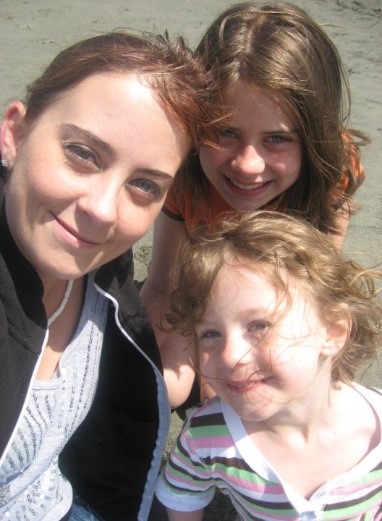
My mom, sister, and me at the beach.
When my mom had made
some extra money, we (my mother, sister and I) would sneak away from the chaos
at home and head to the ocean. Jumping over waves, eating Cutie mandarins,
collecting rocks. We would bask in the sun from morning to late afternoon,
laughing, running and burying each other in the sand. Once my sister became so tired,
the point at which she couldn’t stand anymore (a toddler she was), my mom would yell to me at the tide pool,
“Come on Ann, Emmy is tuckered out, it’s about burger time anyway.”
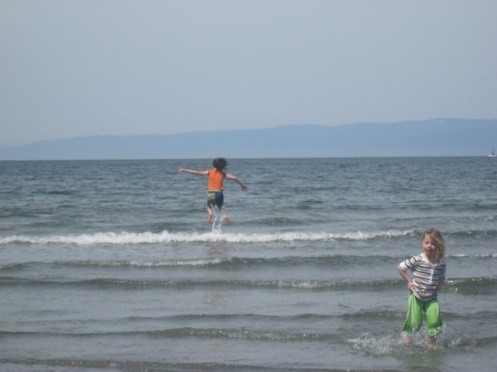
Wave jumping
Fat Smitty’s, Highway 101, Discovery Bay. A small cluttered, dimly lit, greasy burger joint. With the famous ‘Fat Smitty Burger’ for $11.50: $13 with fries, +$1 for bacon. Now I’m sure you are asking yourself. What. On. Earth. Well, maybe not, these days, burgers cost more and do not even come with fries! But ten years ago, this was high and a huge treat, that I begged for the whole car ride. I was twelve for goodness sake, and to take on the burger challenge was a major deal. A double decker sandwich with two ½ pound patties, American cheese and veggie accompaniments. And of course, I wanted fries, oh and bacon, duh. It arrived shortly, and well just the size of the thing was enough to make my stomach drop. All I could think was, ‘How on Earth am I going to defeat this monster?’ Let me take you back though, to the moment I ordered the burger. A wide-eyed waitress, asked me twice, if I meant the Fat Smitty Burger with fries and bacon, Not until the third time did my mother interject to say, “Ma-am yes, she has begged all the way here to eat this burger, and she wants it all, and if I know my Annie, she is going to eat it ALL.” Well, I knew then, I was GOING to finish that burger, NO MATTER WHAT. Flashback to the grand arrival. And was it grand, the cook came out from the kitchen to hand off the burger to the tiny kid at table 3 (My mom said in a retelling later). Ten minutes in and I was rolling. I still remember the first bite. Juicy, melt in your mouth good. Freshly cut lettuce, in those shreds that end up falling all over your plate. Cheese, perfectly melting down the sides of the patty, and a stout bun with sesame seeds blanketing the top. This was a good burger. My mom likes to tell people about forty minutes in, when I was the only one left eating at our table. A group of large burly motorcycle men had all ordered the same as I had. Probably 50 years my senior, had received their burgers and were asking for boxes. When they did, the waitress just laughed at them, and said “Wow, have you seen the kid behind you, she’s accomplishing what none of you men couldn’t!” If you can imagine it now, 5 strangers all huddled around our table, cheering and ahhing at the twelve year old kid who was about to finish the biggest burger, this side of the Mississippi. I would say it took me about an hour to reach the finish line. Bloated like a puffer fish, smiling ear to ear then passing out in the back of Mas’ beater.
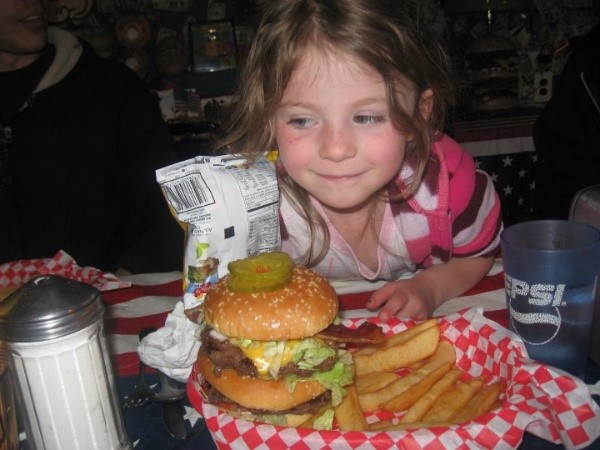
Emmy sizes up the Fat Smitty Burger
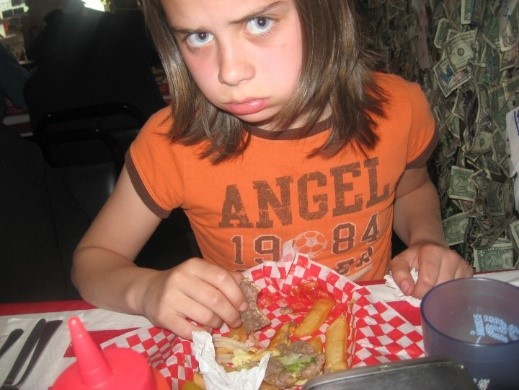
Post Fat Smitty takedown
Being
a child of divorced parents, I would say I have lived two very different eating
lives. Looking back, the early years were dismal. However, things started to
really change when my dad found love after a long slumber in the dark divorce
years. Her name was Alex, she was hip, super tall and knew everything about
plants. A wonder to me, age 6, captivated by all the marvels she could and would
teach me. The biggest thing that happened at this time was a complete diet
shift. While at mom’s, the menu consisted of some fast food item, and at dad’s
there were salads, full meals. My dad was sparked with curiosity in cuisine and
began experimenting with traditional dishes from all over the world. In all
truth I think there was some level of impression being set, but at the time I
was just a kid and was loving the audacity my dad had found in the kitchen. Now
since Alex had come into our lives, boxes of pop tarts and Kraft Mac and Cheese,
were absolutely a no no. It was a salad with every meal or a salad being the
main event of the meal. She was creative too and would make fancy sweets at
breakfast time, but her passion to teach me about vegetables, how they grow and
why they are good for us was overwhelming in the most positive way. I was about
10 when I distinctly recall having a week of only fast food with my mother. It
was lunch time, so we stopped by McDonalds before getting dropped off at my
fathers. I remember walking into the house, looking around the door to see my
father and stepmother eating large chef’s salads. I dropped the happy meal in
my hand to the ground and immediately broke into a fit, crying and begging to
have a salad instead of the terrible food from McD’s. It was at this time, a
major shift happened within me. I remember my mother after that day always
passive aggressively asking me if something was “good” enough, or healthy
enough for me to have. I became greatly invigorated by the type of food we were
eating and where it came from. While I
still craved the occasional burger or French fries, I wanted to support the
bulk of my diet with stuff I could grow, or that my family was growing.
Alex holding a giant plant from her garden.
Audacious Moments, Drastic
Measures
The year is 2015.
I’m a junior at Olympic High School, sitting in front of a computer screen taking
one of those ‘future career path’ tests. The ones where you answered a hundred BS
questions on your likes and dislikes as a person, only to reveal the computer
thinks you should be an accountant. This is the moment I laugh because as it
turns out the only class I’m not passing with an A, is Math. And why on Earth
am I being told by a computer what I will be the happiest and most successful doing?
What I truly wanted to do was something with food. I wasn’t sure what it would be,
but I loved the idea of becoming the world’s best Chef!
I would preach
about my restaurant, writing business plans and giving presentations about the
path to becoming an Executive Chef. At the end of senior year, I signed everyone’s
yearbook with a note that said, ‘This is your FREE ticket to my future Farm to
Table Restaurant. Don’t forget it!’ I spent months applying, and I applied for
scholarship after scholarship, hoping to make enough money for The Culinary
Institute of America (CIA). From the information I had gathered, it was to be
the most prestigious; it was a four-year university dedicated to teaching the
art of cooking. I had bought the first year’s textbook so I could be ahead of
the curve. Reading food
memoirs and watching Anthony Bourdain travel the world eating made me elated to
begin culinary school.
Whelp. If you
thought that the next thing I would tell you was, “It was everything I could
have ever dreamed it would be!” Let me remind you, Disney did not write this
story, as it is no Fairy Tale. What really happened was, my GPA was too low, my
AP scores were too low, and my SAT score was, you guessed it, too low. And I
did not win all the scholarships I had excitedly applied for. As well, I could
not get enough FAFSA to cover the CIA without putting myself in major debt year
one. So, I opted for the quaint community college in West Seattle; it was easy,
I could take a ferry there every morning and I would spend far less time in
school. Two and a half years, not four, and man were those years interesting. It
was during this time that I had decided I would eat anything. The thought was,
“Well, if I am to be the greatest Chef, I must not hyper focus on expressing
myself as a chef, but instead take the time to learn a little bit from everyone,
and where and why they do the things they do with food. To learn every technique, style and type of cooking.”
This was the way I would reach the pinnacle. And man did I go for it! I would stay
extra hours for Competition class, where we would time ourselves breaking down
chickens, filleting fish and tourne-ing potatoes. I would work every food event
on campus and became what some would call the Program’s Representative. I even
got the chance to plan the school garden boxes outside the kitchen. Sadly, I
was the only one to ever harvest from them for the program, but I took
as many opportunities to teach my peers about the flowers and herbs for
garnishes as I could.
Fresh herbs A.K.A. soon to be garnishes.
It was during these three-ish years
that I fell in love with the art and history of French cooking. It was
blissfully romantic. I was studying under Chef Robert Houot, from Alsace
(Southern France). I decided to focus on Charcuterie exclusively. Spending
countless hours in the ‘Meat Room’, I started making a cookbook for the school’s
program. As the Program’s Representative on campus, I also made beautiful
Charcuterie boards for staff events, school events, and fundraising events.
The best work I’ve ever done in my whole life was this Charcuterie. It absolutely blew everyone away, even Chef Houot.
In my last
quarter, I decided that the brutal years I had just gone through as a full-time
student and full time cook in downtown Seattle would not be for nothing. I hadn’t
spent much time with family or friends. Actually, if you were to ask my mother,
she would complain to you for hours about the ghost child coming in at 1am from
work and sneaking out at 4am to go to school. It was nuts. Utterly crazy. I
wasn’t eating well, sleeping well, or socializing at all. So, in a desperate
move on December 17th of 2017, after I graduated the Culinary
Program at South Seattle Community College, I quit my job and bought a $1,600 ticket
to Auckland, New Zealand.
I had absolutely
no plan. My mother would not have it. She hung up when I told her over the
phone. My father high fived me, and my friends questioned why. Hell, even I was
asking: why? How did I make such a crazy decision on a whim, to go to a place that
was 7,000 miles away? After all the hours I had spent commuting, breaking my
back, getting yelled at, being alone: I had had enough. So, I bought the ticket
on the 17th of December to leave on the 5th of January. Less
than a month later, I would be headed to a place I knew nothing about. This was
to be my great culinary odyssey; I wanted to be the chef that knew how to do
everything. I decided I could only do this by starting with raw materials. Alex,
my stepmother, urged me to look into WWOOFing. (There are many names for this
acronym: World Wide Opportunities on Organic Farms, Willing Workers on Organic
Farms, etc.) I paid for a membership to look at New Zealand on the WWOOFing
website, and quickly became excited by all the farms I could work on. I never
researched anything about the country itself; I didn’t care about what tourists
wanted to see, all I wanted was pure reality. The essence of food. Still I was
hesitant to plan. I thought if I did, I wouldn’t be able to run off on a whim
at any moment.
There I was, Auckland
International Airport, starving and tired at 1 am. Of course, I had not thought
ahead to find a hostel or hotel to sleep in. I found the nearest vending
machine and realized that I didn’t have the appropriate change. Quarters just wouldn’t
do. As I stood there stumped, ghostly and annoyed, a man tapped me on the
shoulder. He was tall, slender, had long blond dreadlocks and carried a large
hiking pack. I jumped as I turned, and from his mouth came the most beautiful,
“Oh sorry love, I just see that you haven’t exchanged your change.” Dumbfounded,
I stood there looking at one of the most gorgeous men—with a French accent— I
had seen in the past 24 hours. Let me remind you of how tired I was: it was an 18-hour
flight and I had not slept at all. Dead faced, I stood there and managed to get
out “Uh-huh”. He just laughed, fumbled around in his pocket, then revealed his
hand to me: a pile of shiny silver and gold coins. Of course, I didn’t know the
exchange rate at that moment, so I just stared at him. I said, “Oh, actually, I
don’t need anything. Thanks anyway,” then turned to leave in the opposite direction.
He said something to me I recognized as French but could not translate. I
turned and in the sweetest voice he said, “No need to leave, what would you
like?” He put the change into the machine, pressed some buttons and a couple
snacks fell to the bottom. He bent down from his great height to grab the shiny
colorful bags, then extended one to me. It was a bright blue bag, with a
dancing penguin on the front. Cheezels. He then said, “These are the
best, don’t waste your time on anything else. Trust me.” Then he turned to go, but
I grabbed him and said, “WAIT!” Which was definitely in a yell, as I startled him. “How much do I owe
ya?” He laughed, “Oh love, you owe me nothing. Have a beautiful trip, Au Revoir.”
And he was gone. I looked back to what would be my first taste of New Zealand: Cheezels.
According the imagery on the bag, they would be puffed cheese rounds. I opened
the bag, and an invisible cloud of cheese smoke overwhelmed my face. Crunchy, salty,
sweet. Amazing. An immediate love affair, all because of the nameless French
man in the Auckland Airport.
Only months later did I realize that I could fit the Cheezels on my fingers, like I did with black olives as a kid.
Now, I had not
just flown across the Pacific Ocean to eat a bag of processed puffed Cheezels.
I was there to learn and learn I would. My goal was to work with as many organic
farmers as possible across the country. What I did know about New Zealand, was
the pivotal role that farming had in the economy and everyday life. I started
by heading North to Starlight Organics run by Nye Tatton. She was an
extremely short woman with a huge personality and passion for growing
vegetables. With Nye, I learned the beauty and nature of organic farming. I
started by picking weeds, which lasted about three days. Only after then would
she give me opportunity to pick and plant. I remember the first moment I
encountered a 72-cell tray, booming with beautiful little plants. I thought “Oh I can do
this, easy.” Twenty minutes later I went into the house, saying I was finished.
She just stood there laughing, “Oh what are you a superhero? You finished all 8
trays?” Ha! No. Of course I wasn’t paying attention when she told me I was
planting all of the trays in the greenhouse. By now it was reaching mid-day.
With the sun high in the sky, those 20 minutes slowly extended to 40 minutes,
and 3 hours later, sweating buckets, I was done.
I streamlined the process by digging all the holes before I started planting.
My favorite part
about my two weeks with Nye was working the biggest Farmer’s Market in New
Zealand. It was a 3:30 AM wake up call, 5 AM set up and open at 6.30. Nye urged
me to get ready as the time neared, while I sleepily stacked veggies. Before I
knew it, there were 15 people in our tiny stall. We were selling out of lettuce
and sprouts by 8, and beans and cucumbers by 10. It was overwhelming, and exhilarating.
Me (center), Nye (right), and another WWOOF-er at my first Farmer’s Market in NZ.
I was fortunate to
meet some crazy people along the way, and my most notable moment was with
Barry. I was sitting in the shed braiding garlic when I heard a sputtering
engine coming up the drive. Curious about the newcomer, I climbed atop a
precarious shelving unit to look through the window of the barn. A black Volkswagen
Jetta halted to a stop just before hitting the planters by the front door. The driver’s
side door swung open forcefully. A towering man with an enormous beer belly and
a thick burley Kiwi accent struggled to lift himself out of the car, yelling, “NYE,
NYYYYYE. Where’s this bitch I’m taking to Bayley’s?” I was caught off guard, who
could he be talking about? Me? I guess I was the only “bitch” he could be
shouting about, and Nye had briefly told me to be ready for an adventure today.
I was so nervous, and this did not look like a man I wanted to hang out with. And
don’t get me started on his buddy who crawled out of the passenger side, an
opposite to the previous character. Scrawny and shy mannered, the two were
quite the pair.
Nye came running
out of the house, shouting to me, “Annie, are you ready? Barry is here!” As I
watched her approach Barry with the biggest smile on her face, she launched
herself into his outstretched arms. She seemed the size of a small child in comparison
to him. As he lowered her to the ground she motioned towards the barn. I quickly—and
not so gracefully—attempted to scramble down from the shelves I was balancing
on. As they entered, I was falling off the shelves into the pile of garlic. She
just laughed, making note of my character to Barry under her breath. I
awkwardly scrambled up, to shake his hand, to which he remarked at my firm but
gentle shake. I then grabbed my go bag: Sunscreen, Inhaler, Sunnies (sunglasses),
water, and my togs (the New Zealand slang for swimsuit). Not familiar with this
man, I just looked at Nye through the rain covered windshield of his Jetta, as
we furiously backed out of the driveway. Though I had prepared for the sun, the
weather when we left was dismal, pouring, and grey. The landscape was beyond
compare. Even in the storm, the rolling green hills were mystical and never
ending. Little white sheep dotted the land. As we made it down the road, Barry
started chatting with me about the small stuff— who was I, where’d I come from,
where was I going? In the middle of my life story he interrupted to ask if I
would grab a beer from the cooler for him. I had not realized that next to me
was a cooler; I opened it, and without question handed one to my driver. He
then noted that I too could have a beer, but I quickly declined, realizing what
an absurd idea it was that we were driving though a storm, on a road that could
be described as anything but straight. From our small talk, I gathered
we were on our way across Northland. In just 45 minutes, we had driven from one
coast of the country, all the way to the other coast of the country. Barry
assured me we would soon be at Bayley’s beach, his favorite place in all of Aotearoa—
the Maori word for New Zealand meaning “the land of the long white cloud”.
Bayley’s beach was
golden, blue, and resembled the beauty of Michelangelo’s Sistine Chapel
painting. You know, the fluffy clouds with peachy tones? The sand was a rusty
gold and stretched for miles. Barry whipped the car down the beach, driving
over 150km/hr (90 mi/hr). Finally, he did three donuts before stopping
somewhere down the beach, then we all clambered out of the car and Barry ushered
me to the trunk. Inside were “net” bags (the ones onions come in), and a couple
of coolers. He tossed me a bag and waltzed out into the crashing waves. I ran
up to him, curious as to our purpose here. He then beckoned me to take a wide
strong stance: legs apart, hands free. He said, “I’ll be teaching you the
TuaTua Twist today chick, are you ready?” Not knowing what on earth a TuaTua
was, or why we were carrying empty onion bags into the ocean, I said “Sure”. I
mean, what else could I say? He let a wave wash past us, forceful enough to
knock me out of my warrior position. He laughed, noting that I’d have to be
tougher than that to keep my prime position here. Prime position? What the hell
was he talking about? It was then that he began to do the twist. No, I’m
serious. This 6-foot-tall, beer bellied, scruffy man started wiggling his body
back and forth like the kids used to do back in the day. After a moment he
plunged towards the water, keeping his feet where they were and crouching down.
Then, up with his hands came the most beautiful, glistening clams. We were
clamming! I never had, and this was the most amusing way I could have ever
thought of doing it. So, I twisted. And beneath my toes I felt their shell,
soft and smooth. As a wave passed, I went to plunge. And whooooooooooosh!
There I was, tumbling over with a wave I had not watched for, carrying me back
10 feet. Barry belly laughed, beckoning me back next to him.
We continued like
this for hours, until finally Barry yelled us in. We had so many TuaTua’s, I
thought we might get in trouble for going over quota. But this was not the type
of guy to question, so I packed the pounds and pounds of clams into the trunk,
and then hopped back into his beater. We drove back across the grand rainstorm
that had seemed to plant itself between both coasts, and headed home to Nye. When
he dropped me off, he said, “See you at the feast tonight!”
And oh, was it a
feast! Nye and I made ourselves look pretty before we waltzed on into the lawn bowling
club. Retired men from all corners of the room hooted and hollered when Nye entered;
she was the resident badass farmer, and they praised her. I could smell
shellfish cooking and peeked my head into the kitchen. A table was being put
up, and atop it were two metal trashcans; one was being filled with cooked
TuaTuas, the other was empty. It was simple: boil ‘em in a pot with some garlic,
salt, and pepper. Barry ushered me over to delight in my first taste. I pried
open the two shells and tipped it back. The grainy sand particles filled my
mouth as I chewed on the slightly over cooked flesh. Ha! It was stupendous. He
then took me over to make me a sandwich. It was 6 or 7 Tuas on top of the whitest
of sandwich bread lathered in Margarine. Throwing it back with my first ever
tequila shot made this experience all the sweeter.
New Zealand was
beautiful. Overall, it showed me how important our connection to food is. WWOOFing
wasn’t perfect, not every farm was truly certified Organic. But every farm supplied
me with another opportunity to grow a fresh product or to nurture an animal.
Fretting the Audacious Lifestyle
Coming home from
New Zealand was emotionally debilitating. I had just spent a year discovering
the “true Annie”, and developing real opinions about the world, and more
importantly, the current state of food affairs. A fire had been lit deep within
me; I was going to change the food system, and I would start in Kitsap County.
It was home, and I could live with my parents rent free while I CONQUERED the culinary
world.
Needless to say,
thus far, the plan has not gone as I thought it would. Being back in Bremerton
was bleak, and for two months I shuffled around town, bummed and broke. I was living
at home, eating food that had no love, flavor, or sense of place. Desperate, I
applied to the most dismal of kitchen jobs: SpirosPizza, Bremerton
Bar and Grill and Anthony’s on the Waterfront. I was offered odd
jobs at all three, but I could not bear the idea of working at any of
them. I kept puttering around, waiting for something exciting. It was the beginning
of winter, so of course there were no farm jobs available at the time. One day
I found myself with my grandparents on the way to Bainbridge Island. For Kitsap
County, Bainbridge is the bougiest you can get. My grandmother, thrilled to
have her Saturday lunch buddy back in America, had been taking me out every
weekend since I had come back. She was determined to bring that light back into
my eyes, and sadly, I wasn’t having any of it. That was, until we walked
through the doors of the Hitchcock Deli.
I had read about
the chef who owned the place, Brendan McGill: thirties, family, restaurateur, use
of locally sourced ingredients, and everything made in house. This was it.
I knew the moment we walked in: the smell of the cured meats, the smoker
puffing away in the back, and the buzz of the cooks bouncing around, singing
and laughing. The next week, I was sitting at the front door of the nice
restaurant adjacent to the deli. McGill owned that too. Oh, and the popping
pizza restaurant down the street, as well as two joints across the Puget Sound,
in Seattle. I had done my homework, and he was a star; a James Beard Award
Winner, he was praised on the cover of multiple local and Seattle magazines and
newspapers. As I sat with a copy of my crème colored resume, awaiting Sara
Harvey, the Sous Chef, the door swung open. Looking up thinking maybe she had
arrived, my jaw just dropped open. Of course, the man himself had just walked
in. He looked at me with a smirk, and not a clue in the world who the over-dressed,
high-heeled, 20-year-old, who was sitting at the front of his restaurant was.
“You look as though you are waiting for something… hmm?” he said. To which, in
a very Annie-like manner, I spilled everything about me: my passion for
Charcuterie, my travels in New Zealand, and my dreams to change the food scene.
Calmly, he listened through all of it, as if he knew exactly who I was,
why I was there, and what my future would be. I kept on telling him about how
much of an asset I was in the kitchen, urging that I wasn’t the best, but would
get there. He let me finish, held out his hand, shook mine, and said, “I like
you kid.” And he was gone.
I waited 15 more
minutes to finally meet the Sous; she was the baddest bitch I had ever
seen in chef’s whites. A beautiful braid went down her back, and her arms were
laden with tattoos. She had a crooked smile and an annoyed stupor. Quickly, she
went through all the formalities, and then asked if I wanted to check out the
kitchen. Without any hesitation, I agreed, and we walked back into one of the
nicest kitchens I had ever been in. There was a wood fire stove, thick wood
countertops, copper pans, and it was completely visible to the patrons. I loved
that. As we stood in the middle of service, she watched me, googly-eyed,
looking around with utter satisfaction. Then in a low, but straightforward
voice she said, “Not sure what you said to the boss, but I thought maybe you
would like to see the kitchen you’d be working in.” I flipped around, looking
at her, emotions of happiness and fear all welling up inside me. “So, you got
the job kid.”
I nearly ran out
of the restaurant crying; I couldn’t believe that I could get a job at a place
with the background I had, at the age I was, or as a girl for that matter. Everything
I thought was working against me was really the disguise that landed me a job
in McGill’s kitchen. On my first night, I floated around doing odd jobs for
people in the kitchen: peeling fava beans, slicing garlic cloves on a mandolin,
and brunoising shallots (the fancy French word for an exceptionally fine dice).
I had not eaten anything all day and must have been dehydrated. I told Chef
that I wasn’t feeling well and that I needed to go to the bathroom. She
begrudgingly agreed. I went to the bathroom and— well there’s no way of
sugarcoating it: I passed out on the toilet. When I came to, I shamefully asked
Chef to accompany me to the back and told her what had happened. She told me I
had to go home. Needless to say, this was one of the most embarrassing moments
of my life. Well shit, I thought, I just lost my one shot. The next
morning, I woke to a call from the Sous. She was just calling to reassure me
everything was alright, and that if I wanted to work in her kitchen, I better
take better care of myself before showing up to work. I laughed and thanked her
for the check in.
Hitchcock was a blast. Every day I was receiving produce or fresh seafood. Occasionally, this guy named Preston, a scraggly fellow with ripped flannels, would come in with a case of mushrooms, freshly picked in the Cascades. It was an amusing facade, as Preston was the boss of one of the biggest produce and meat distributors in the greater Puget Sound. I was in my element; not only was I learning crazy new techniques in the kitchen, but I was getting my fill on connection to local food.
I knew, however,
that this wouldn’t last long. Before getting hired, when sitting on the bench
with McGill, I told him that my stay would be short, as I was moving to Olympia
in the spring. I was headed to the Practice of Organic Farming at Evergreen
State College. Before I knew it, I was leaving Hitchcock behind, bummed, but
here I was again: taking a leap.
Unfortunately, the
Organic Farm at Evergreen was less than I thought it would be. I don’t know whether
it was the fact that everything seemed to be falling apart in the background, or
that learning about Organic certification made me want to rip my hair out. Don’t
get me wrong though, the work was fun, the learning was fulfilling, and the connections
I made are irreplaceable. The Practice of Organic Farming gave me the
opportunity to learn about stuff that I hadn’t yet, but it also made me realize
how much of a façade Organic Certification is. What I understand now is that it’s
just another money pit for farmers to pool into. As long as I can have a direct
conversation with the farmer, see their place and practices, and understand
that they are stewards of the land and care for their crop, I’ll support them. I
don’t need a governments label to define them, not when the goal is to be as
local, sustainable, and clean as possible.
Now to the current
state of my own affairs. We can only understand this after I give you a brief health
history update since returning from New Zealand. Unfortunately, my health upon
my return plummeted. My immune system was iffy, and I was getting sick every
time I ate. This led me to cut out red meat from my diet, as it seemed to be
the main culprit; but as time went on, over the past two years, things have gotten
progressively worse. I couldn’t eat anything without getting sick later in the
evening, and the worst part was the blank stares I was getting from doctors,
both Western and Holistic. I was up all hours of the night, tossing and turning
in extreme abdominal pain, and would wake up energy-less every morning. In 2019,
I cut out all dairy completely in hopes that keeping away from red meats and milk
would change things. This worked for a month or two. While some of the pain
subsided, the energy-less manner, sad disposition, and occasional sickness were
still there.
Jump to Winter
Quarter registration, and I’m pumped. A class about food history and culture?
This was right up my alley. With food labs ever week, things couldn’t seem any
better. Comparative Eurasian Foodways: A cultural, historical, and
gastronomic Odyssey (CEF). Wow, what a title I thought, so
Evergreen. I absolutely loved having to overly explain this class to people,
just because the name obviously made their head spin. The burning itch I that
was festering after returning from New Zealand was alive and well, and we would
be studying abroad: three months of this class would be away on a grand
learning adventure.
At this point, I
was classifying myself as a pescatarian with a dairy intolerance. Sounded good
enough, and kind of ridiculous, but I was making do. It was a peer in CEF who
started ushering me towards
the way of veganism by sharing articles, books, movies, and documentaries. Giving
me the notion, that veganism wasn’t this “unattainable, disgusting waste of
time” – as I had thought for so many years prior. Two weeks later, I started
putting all my cans of fish in a box, tucking them away in the cupboard. I was
still eating eggs, but only those that came from my own parents’ chickens.
New pullet eggs in comparison to fresh duck eggs.
As CEF continued
on, I started to feel like an outsider, puttering along with the class each
week. I was getting the notion that my passions for food were dwindling, while
my excitement for veganism and animal activism was blossoming. This was the
class that I dreamed of, and now here I was, blocking and restricting myself
because my entire opinion about the world and our view of the food system, had
changed. Each week, I worked diligently through the readings, loving lectures
and despising labs. I felt like the hugest burden every Friday, always in the
back, not filling out all my matrix pieces on lab reports. I used to be
the girl who tried everything.
It is funny how
you can completely turn your view upside down at a moment’s notice. One day I’m
looking at a pig’s head submerged in stock, my first ‘Headcheese’. The next,
I’m using social media to spout off the wrong doings of the main populous. I am
unsure if this would have happened had I not been in Comparative Eurasian
Foodways, but I guess here I am, learning how to live with my past and
accept my audacious-less future.
I’ve spent the majority of my life on a farm raising sheep
and a small crop of various produce. Before all of that, I lived in a middle
class, white, suburban neighborhood named Daniel’s Ranch located in Carnation,
Washington, a small farm town home of the original producers of carnation milk
and “known” for (at one point) having the world’s most milk-producing cow. Daniel’s
Ranch couldn’t’ve included more than 50-100 families i.e. houses. In regard to
my background with agriculture, my life in the ranch aside from a very small garden in which
tomatoes and Squash were exclusively grown (both of which I despised at the time).
In fact, as a child I was very picky about what I ate. If I had a choice in the
matter of what would be made for a meal, I would insist on spaghetti with
cheese and butter or grilled cheese as well as other foods of a “safe” nature.
By “safe” I mean foods with no strong smells, flavors or textures. My food
pickiness was by no means a product of my upbringing, as my parents were both
quite adventurous with their preferred cuisine. They ate things like raw smoked
salmon, prosciutto, escargot, very runny French omelets and other foods of an
“adventurous” (by my young self’s definition) nature.
It’s very likely that my predisposition towards certain foods can be attributed to my genetic makeup. Flavors that I like and dislike could be a product of what my ancestors had to eat and therefore grew an affinity for, not only a mental predilection, but a chemical, brain rewiring, propensity. According to a genetic test I am more than fifty percent British and/or Irish and according to both my grandfather and the genetic test I am one fourteenth Danish. What can be said about that I don’t know, as ethnic cuisines far from that of English or Danish appeal to me such as spicy African dishes of lamb, salty, acidic Mexican foods with meat bases such as pork tongue, and creamy spice based dishes such as most Indian food. I can however say that some foods that are of my liking within the cuisine of my heritage exist as well. including salty black licorice, smoked salmon, and pickled herring in mustard sauce. Although I do think predetermined, genetic flavor inclination exists, this is not a barrier for affinity towards flavors contrasting those of what our ancestors ate. Also to mention, just because one comes from a culture in which certain foods or flavors are penchant, an example being a certain vegetable popular in cuisine from said culture. It is if not possible likely that an individual does not favor said ingredient.
As a child, very few vegetables appealed to me. Squash, tomatoes, eggplants, cucumbers, mushrooms (not a vegetable, but in my youth, there was no distinction), zucchini and tomatillos all seemed vile and untouchable. However, I wasn’t the type of child who refused to try anything. I mean, how would I know if I didn’t favor something until a tried it? Which, looking back at, is very forward thinking coming from a child under the age of 10. After I had tried something I didn’t like, there was very little chance of myself giving it a second chance. That being said, just because of my disposition didn’t mean my parents would make grilled zucchini or babganoush for dinner any less. My personal affliction with vegetables made my youth especially difficult due to the fact that I was a strict vegetarian from the ages of 6-17. The word vegetarian within the context of myself is somewhat misleading. When the word vegetarian is used the connotation of vegetables is evidently made, despite that, as a vegetarian I ate very few vegetables and instead ate very processed vegetarian “meat”. I understand the precarious nature of a vegetarian not eating many vegetables, but what has to be understood is that I grew up in a time (early 2000’s) where processed, soy-based vegetarian meat was gaining popularity. A well-timed transition on my part I suppose. As opposed to eating spinach dip, hummus, and cucumber sandwiches, for almost every meal, I would eat deep fried soy nuggets and soy breakfast sausage links, cheese, and carbs. In that age where one could be an “unhealthy vegetarian”, I most definitely was. My diet of cheese, carbs, and soy-based products ended when I decided to quit my meatless philosophy and veer towards the very exciting world of meats.
Meat is a very vast and dynamic
section of foodways and without a doubt the reason I became as enthralled with
food as I currently am. For the first time in my life my parents were no longer
asking me to try foods for my own “mind widening” benefit. I was now taking the
initiative upon myself to explore the world of food as I never had before. By
including meat into my meals, a whole new world opened up itself before me and
I finally got to explore it. When I decided to make the meat-eating transition,
I was living on my family’s four acre sheep farm in Duvall, Washington, five
minutes away from Carnation. On our farms humble garden my mother grew plants
in which the likes of younger me had never even heard of such as ground
cherries, kale, and dragon-tongue beans. My culinary world was expanding before
me and I was beyond excited. Living in a small organic farm town meant that
high quality meat was easy to come by. One could have a steady supply of meat
simply by making friends with their free range chicken raising neighbors, or by
having those neighbors introduce you to their organic pig raising cousins, or
even by making a deal with your middle school principal who raises grass fed
beef.
Today I would describe myself as a
food ambitionist: going out of my way to try things I never have before and
making it my goal to be more than well versed in cuisine. I can’t help but
contribute that to my “late bloom” into the food world and from the open-minded
food philosophy of my parents
Prompting this eating memoir is a class at The Evergreen State College, entitled Comparative Eurasian Foodways,in which the focus is to explore history, culture, and gastronomy of Eurasia specifically China, Greece, and Italy. As a reference, the class was asked to read excerpts from one of the most popular food memoirs, titled Shark Fin and Sichuan written by Fuchsia Dunlop. The contents are of her experiences in graduating culinary school in the Sichuan province of China. Although I am not in culinary school, this gastronomy class has an exciting aspect: every Friday the class makes dishes based on the cuisine of the three cultures previously stated. Each base of the meals we make are ones we’ve spent all week learning about via lectures, readings, and media, such as films. Most recently, we focused on meats by making meatballs traditional to said cultures. The Chinese meatball, which to me was flavorfully more unique than the others was one of pork which (aside from the average meatball ingredients) consisted of water chestnuts, sesame oil, soy sauce, ginger and green onion with a reduced, sticky sauce made up of a variety of flavorful ingredients like Shao Xing cooking wine, star anise, and rock sugar. It’s complex, cultural, meat-based foods like this which my younger, vegetarian self had no possible grasp of.
In part one of this memoir, my brilliant awakening to meat was touched upon. To further the readers understanding of my relationship with flesh and its culinary use, I will expand upon this. After being a vegetarian for 12 odd years, my knowledge of meats was beyond lacking. At the age of 17, I couldn’t tell the difference between ham, roast beef, or turkey. Being disconnected entirely from meat eating culture, there was so much about meat that fascinated me. It was all so new, everything I learned held so much weight: the salty, slightly sweet and smoky flavor of ham with its spongy, juicy qualities, the dry, soft turkey with its almost gamy flavor, and roast beef with its utmost complex tantalizing essence; all of it was a learning process and one which was greeted with intense craving. Due to a complete lack of knowledge in meats, that entire genre was comparable to that of the new frontier, the world was my oyster.
On the note of seafood, which to this day is my protein of choice, it was the deciding factor on my ambitious transition into the carnivorous ways. Growing up my entire life in the PNW, in fact forty minutes from the ‘oh-so majestic’ Seattle, there was no lack of seafood. The most acclaimed of such is the salmon, which growing up and still to this day is one of my least favorite seafoods; that is, however, if we’re talking about the Seattle way of cooking it, which is the only form it was ever served to me. To elaborate, a meal which my household ate perhaps once a month maybe more if it was on sale, was salmon fillets baked on cedar panels with brown sugar, salt and pepper, garnished with dill and lemon juice after cooking. As a kid it was a very bland dish with a very uniform flavor, however being high in nutritional value seemingly justified the one note meal. It was in my teenage years that I discovered smoked salmon lox, salmon jerky, and salmon sashimi, which are superior forms of this fish which highlight all the good aspects. The good aspects being the subtle fishiness and the amazing fat which the salmon holds between each layer of its muscles. My preference for raw, cured, and smoked salmon rather than simply a baked one gave rise to my overall inclination to foods prepared with these aforementioned methods.
Raw, cured, and smoked meats are the
essence of what meat should be. As a field trip for my gastronomy class, we
went to Portland, Oregon and got to experience a culinary variety showcase. On
the way to the event while riding in one of the school vans, mostly oblivious
to what I was about to experience, a gas stop was needed. During this break, a
few of us went into the gas station store and bought cheap processed foods to
tide our hunger due to not eating breakfast. I grabbed an extremely processed
‘meat stick’ which only god knows how many different animals coincided in this single
item. Paired with this stick was a highly processed ‘cheese food stick’, which
according to the ingredients consisted of anything but dairy. The reason I’m
mentioning this is for the purpose of juxtaposition of the qualities of food
eaten before and during the variety showcase. Walking into the showcase I was
unprepared for the events proceeding. About eighty vendors all with their own
two-to-three table long booths were preparing and serving tapas-sized plates of
organic, locally grown dishes. Such dishes were oven-roasted small purple
potatoes covered in a caramelized buttermilk sauce seasoned with smoked kelp,
moist tres leches style melon cakes made with special varieties of organic
melons grown in the area, and savory, sweet, flakey pastries topped with
caramelized leeks, all of which were so phenomenal and overshadowed my gas
station snack by such magnitude that I had forgotten I had even partook in such a food until finding the wrapper in
my pocket preceding the event.
Such high-class foods of a higher caliber such as ones sampled at the variety showcase have opened up the culinary world to me more than was previously thought possible by myself. This showcase was a demonstration of culinary creativity and skill. Not only is creativity a main factor in delicious foods, but so is flexibility with the ingredients making up a dish. Take for example, a butternut squash; now this squash is an earthy semi sweet food that in my experience is cubed, oven roasted with olive oil, salt, and pepper and treated as a savory side. Of course, the use of butternut squash can also be that of a sweeter profile by cubing and roasting with cinnamon and brown sugar. However, this is no dessert, simply a sweet side. I experienced a dish at the variety showcase in which butternut squash is pulverized into a squeezable paste, slightly sweetened and squeezed using an icing dispenser into chocolate dipped ice cream cones. The creamy paste is cold, refreshing, quite sweet, and slightly earthy, it tastes very much like a high-quality dessert. However, its base and majority of flavor can be attributed to the vegetable that it is. Now, this food cannot be associated with a specific cuisine or culture, it is merely a product of modern food ingenuity. Taking this gastronomy class and learning about not only historic food culture, but also modern food culture, my palate has been widened and my mentality towards foods and flavors has grown and expanded for the better.
There was a small, rickety wooden stool tucked in the corner
of the kitchen, sitting beneath the white landline telephone mounted on the
wall. Here, I would perch at the counter’s edge and follow along with my mother
as she cooked; she would give me micro-portions of her ingredients, and I would
do my best to imitate whatever she was creating. We would chat in silly French accents and
create lighthearted dramas as we worked on pies, cookies, spaghetti or lentil
stews. I had a favorite wooden spoon and mixing bowl, but I especially loved
the rolling pin and how intentional and productive it felt to roll out the
doughs of floury desserts. Elsewhere, I went by “Ethan,” “E,” or “Ebay.” While
I was with my mother in the kitchen, in my family’s first home on Bawden Street
in Ketchikan, Alaska, I was “Monsieur le Chef.”
Although my alter-ego “Monsieur le Chef” only truly came alive during the brief period between the ages of four and five years old, my times as he are the oldest and most palpable memories of food I can recall. I still smell the light, sweet fluffiness of various flours and doughs, dusting the countertop and my face and hands; I can still see the kitchen, the sun basking the countertops beneath the wide windows that overlooked our small and wild Alaskan garden; I can still feel the muscles of my mouth tighten joyously with long ago smiles and giggling chit-chats shared while I sat on that stool, rolling pin in hand. With the memory of Monsieur le Chef comes a gentle cascade of sensory experience, as well as an overwhelming nostalgic appreciation for the childhood that I lived and for the people who made it so.
My first and most formative food memories were given to me by my mother, ultimately through whom Monsieur le Chef was born. She gave me agency and pride in my culinary creations, however rudimentary and fantastical they may have been; she taught me that work and skill-building did not have to be a chore, and that, with the right company and the right attitude, one could find enjoyment and pride in the completion of tasks. Unfortunately, these lessons were recently remembered and for the majority of my youth I remained quiet, passive and reserved.
I’ve only just rediscovered a serious passion for food and the sensory experiences that are intrinsic to eating. Thinking now in earnest on my relationships with food and the people who shaped my perceptions of it, the passion was always there— it just went unaddressed and sat unfueled. I am older now and thus memory does not flood, but crops up in anecdotal river teeth, fuzzy pictures with sporadic instances of vibrant sensorial clarity. Beginning with my culinary origin as Monsieur le Chef in the kitchen with my mother, I can then trace my love of food and the dimensions of my palate best through other guardians from my youth. Through my father and the parents of my childhood friends, I became further acquainted with the dynamics of food, household kitchen cultures, and family.
At my childhood home, my father was the master of breakfast and a man of simple yet flavorful taste, indulging in cereals and pancake mixes and bacon on the stove. Although they more or less came straight from a box, I don’t believe that I have had pancakes better than the ones my dad used to make. When I would stay the night at a friend’s house, I would miss having breakfast at home, though there was always much to be gained at these fresh and diverse locales.
Health was to be had at Alec’s home,
no doubt his father’s profession as a physician played a role in this culinary
factor. For a long time, a
persistent ribbing of Alec referenced an instance in which Andy, his father,
became very upset with him after discovering Alec had eaten more than two Oreo
cookies. At Sy’s home across the
channel on Pennock Island, we ate Dutch Babies made by his parents, Peggy and
Paul, topped with powdered sugar and lemon juice; I always felt especially
privileged to spend mornings at this dining table, with the rich flavor of
these light and fluffy cakes mingling with the scents of salt spray and fresh
air as we looked out at the ocean and the mountains.
In retrospect, I can see that these
two locations in addition to my immediate home were where my passion for food
first took root. Each household, each cook, had an individual set of
characteristics, systems, and sensations to add to the food that was prepared
for eager young mouths. I am only now beginning to make my journey back to who
I was when I was Monsieur le Chef, and in recognizing those in my life who have
influenced my palate and my culinary perceptions, I will try to cultivate a
more active and intimate relationship with food.
It’s
7:00 A.M. at my grandma’s house; I smell fresh hot coffee, oatmeal, eggs and
fried spam. I hear the sizzle from the grill and the horrible sound my grandma
makes when she scrapes the bottom of the oatmeal pan. As I awake to the smell
of my grandma cooking breakfast, I know it is time to get up. My grandma gives
me a big warm smile and points to the kitchen table where my bowl of brown
sugar with a side of oatmeal is already set up for me to eat. I squeal with
excitement because I know that no one could beat Grandma’s oatmeal. She, of
course, knew to set it out for me ahead of time so the brown sugar could melt,
and the sides would cool. Very quickly, I found out that if you eat from the
outside edge of the bowl first, and then slowly make your way to the middle,
your food will always be at the right temperature. Grandma knew how I ate and
made sure that all my food was prepared that way.
My grandparents’ house was built on my grandpa’s parents farm. Most of the vegetables that we ate during the spring and summer were grown by my grandpa and me. My grandpa was a true Norwegian, so the garden mainly consisted of potatoes. Every year, half the crop would rot due to my grandpa getting impatient and overwatering the potatoes. My grandma would just shake her head but cook the potatoes that survived anyway. She only knew how to make potatoes two ways: boil them ‘til they are mush, or if she boiled them too long, then they were mashed potatoes. Oh boy, did people not like when she did that! But me? I loved it! The best part of the potatoes were that she didn’t put a lot of salt in them, so they tasted perfect.
It’s 3:30 P.M. and I am walking through the front door after school; I run to the fridge and look to see what’s in it. I look down to the bottom shelf and I see an overly-used, worn-down, rectangular yellow Tupperware container, with cold neatly frosted cherry-chip cupcakes. My mouth begins to water as I grab one, sometimes three. I plop myself in front of the TV and devour the cupcake. Thirty minutes later I look behind me and I see a plate of Lefse, a Scandinavian potato flatbread, with butter and brown sugar just sitting there waiting for me. I don’t know how she did it because I never heard her footsteps. She had special powers when it came to getting me to eat. My grandma played an influential role in teaching me how to cook and acknowledging what I like and don’t like to eat. She would make a dish called salmon loaf with creamed peas. Some may call it a peasant dish; I call it a luxury. Granted, I am very sensitive to salt and refuse to add it onto any cooked foods, but I loved this quite rather salty, creamy dish. When I would get home from school and the house smelled like fish, I knew it was going to be a good night.
One drink I will always despise and never wanted to drink is milk. However, my grandma made me drink it before I was allowed to leave the kitchen table. It got to the point that we compromised on a small glass and I just drank that like a shot of whiskey. I never understood why my grandma was so gung-ho on the fact that milk makes yours bones strong. At the time, I didn’t believe it. But, hey! Grandma knows best.
Grandma making lefse.
Overall, if it weren’t for my Grandma, I wouldn’t know who I am as an eater or a person. Yes, she spoiled me rotten, but it gave me a chance to figure out what I genuinely like to eat and cook. I now know what true comfort food is, and that even though Grandma’s potatoes are good, roasting is the way to go. My grandma never made me eat something I didn’t want to, she just encouraged me to try it when I was ready. The same went for cooking. If I didn’t want to cook with her that night, it was okay, but she encouraged it the next day. It’s that sweet, gentle, kind approach that made me into the adventurous eater I am today. Thanks to my grandma I am a cook, baker, future farmer, and adventurous eater.
It’s 5:00 PM and I’m sitting at my grandma’s kitchen table. I get up and go see what she’s doing and if she needs any “help.” I can smell the over-cooked boiled potatoes and broccoli but what I’m most excited about is the fishy, creamy, mushy, to-die-for salmon loaf with creamed peas on top. The food is placed nicely on the table and the food people liked the most is put close to them just so. I run and grab my huge glass of water and sit down as fast as I can so I could get the biggest slice of the loaf. My parents divorced when I was five, so my mom, brother and I lived with my grandparents ‘til my mom could get our house back. We say grace and I start eating my food. I always ate my food in order of what I liked the least to what I liked the most. I quickly learned that if you eat your favorite food last the taste of the food lingers, which I enjoyed. We get done with dinner and I yell, “Is everyone done with the potatoes and broccoli?” Of course, everyone says yes, and I devour every last crumb. As I’m finishing my vegetables out of the corner of my eye, I see it: dessert. Yes, I still had dessert, even after all the food I ate, but it was always worth it. The dessert varied from cake, cookies, or even just my favorite graham crackers filled with Betty Crocker canned vanilla frosting. Having dinner at my grandparents’ house was always a treat.
My Grandparents met atPictSweet, which was a cannery in Stanwood, Washington. My grandpa was
known as “the man leaning on the broom.” One day, my grandpa asked my grandma
if she wanted to go out to breakfast. She thought he was out of his mind
because all she wanted to do was go to sleep since she just got done working a
night shift. My grandma eventually agreed, and it went from there. In 1947 my grandparents
got married, and not soon after my uncle, Kenny, was born; they ended up having
six children, with my mother being the youngest. My grandpa was a first
generation Norwegian, and the food that he grew up on was influenced by his
heritage. His diet included a lot of fish and the milk products from their farm
such as, milk, cream, eggs, and beef. Everything he ate was boiled. My grandma’s
family ate a lot of traditional West Coast American food, which was similar to
my grandpa’s diet. Both of my grandma’s parents were deaf and met because they
were introduced into that social circle. They settled on a dairy farm in
Silvana, Washington and raised my grandma and her younger sister Alice. My
grandma lived through the depression, during which sugar was rationed, but that
didn’t stop my grandma and great aunt from stealing the sugar from the kitchen
to make fudge. Every time my grandma told that story, she always ended it with
“It was all worth it.”
Grandma (left) and Alice (right) at Lake Chelan
When I
dined at my grandparents’ house, I pretty much ate meat or fish, boiled
potatoes (a staple), and a boiled vegetable, which I finished off when everyone
was done. When I cook, I don’t boil my food, but I do eat similar foods such as
fish, potatoes, vegetables, and eggs. My body needs seafood, especially fish. I
have seafood at least once a week, usually twice. If anything, the foods my
body craves the most are seafood, potatoes, vegetables, and eggs. My grandma’s
cooking has tremendously influenced how I cook now, I just kicked it up a notch
and added flavor.
Not
only did my grandma influence my cooking, so did my mom. After we moved out of
my grandparent’s house, my mom was the main cook. Oh boy, when my mom cooked, did
she add flavor. Sometimes the wrong flavor, which was salt. Less is more, in my
opinion. My mom would always have the Food Network Channel on television and
her and I would watch Emeril Lagasse together. Emeril Lagasse had a cooking
show filmed with a live audience, and every time he put spices in his food, he would
yell “Bam!”. Whenever my mom cooked dinner, I would run in and help her, acting
as if we had our own television cooking show. I called it the Mom and Daughter Cooking
Show. It was more like me talking a lot and getting in my mom’s way, but she
let me do it anyways. Recurring dishes in the Schoen household where meat and
potatoes (roasted not boiled), some kind of pasta dish, and random recipes my
mom found that we either kept or never ate again. Without my mom and my grandma’s
different types of cooking I would not be the chef I am today. I cook like my
grandma in that I cook with heart and love. I cook like my mom because of the
style and techniques I use. Whether it be roasting vegetables or looking up new
recipes, my mom and I cook pretty similarly. I do have to say, there is nothing
like a good home cooked meal from my mom. Ever since I was young, both my mom
and grandma instilled in me the value and impact sharing a meal can have on
someone.