
2a: Film studies
I’ve chosen minutes 37:30-39:00 from the lecture titled “How grains domesticated us”, which I’m titling “Human-plant interdependence” in order to explore the program question “Where and how do people raise the foods we are highlighting?” There’s not much to analyze here in terms of filmmaking components, as it is not a film. However I will note that the communication style of James C. Scott is very clear and accessible, as well as a little silly, using phrases like “super specialized floral basket-case”.
He makes the following points in this clip. First, that the way we domesticate or cultivate plants is by creating an ideal environment for them. He goes on to say that the definition of “domesticated” is that it can no longer survive without our attention. Those plants which have phenotypes which don’t please us won’t survive. In this narrative we are the ones with agency, as opposed to the plant. “But if we squint at the matter,” he says, you can see how the plants have also domesticated us. He then reads a quote from Michael Pollan’s Cooked in which Pollan is gardening and thinks to himself that he has become the “slave” of the tomato, not the other way around. James concludes this segment with the message that cultivated plants have shaped our lives in almost every way.
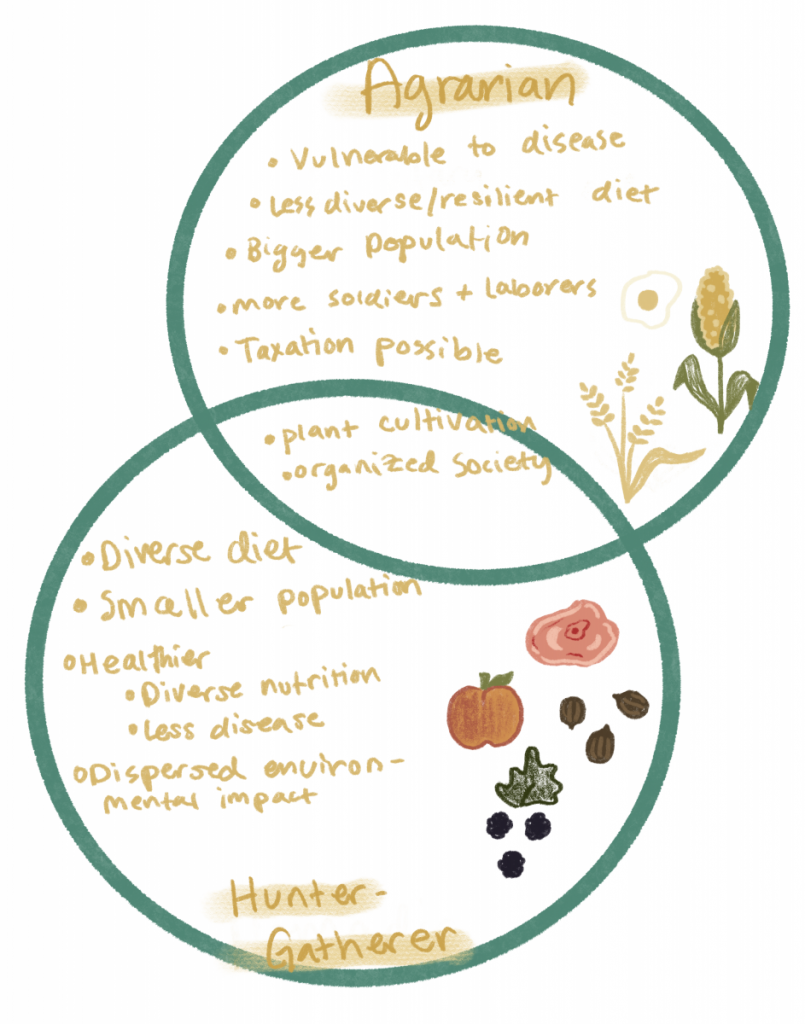
This offers a plant’s perspective into the paradigm of agricultural society that we take for granted. Plants have agency in a sense, offering us gifts of pleasure and practicality in exchange for cultivation. The reason people grow grains in huge fields under controlled circumstances is because the grains like it that way. They make themselves calorically rewarding in big quantities. As we narrow our diets, with the consolidation of the food industry, to just a few varieties of crops, we lose economic and ecological resilience. Scott says early agrarian society was less resilient to famine and disease than hunter-gatherers. We might still have time to make our food ecosystem more resilient as the Earth undergoes a huge climate transformation this century. We have created a relationship with grain crops in which we are effectively “domesticated” so when our small arsenal of food crops fail, we fail.
2b: (Un)Natural History
A grain is any crop which is grown for it’s production of hard, dry seeds or fruit. Examples include barley, oats, wheat, chestnuts, sometimes corn, and rice.
Spring grain crops are harvested in late summer, winter grain crops “over-winter” and flower after vernalization, and facultative grain crops can be planted in either fall or spring because they have a shorter vernalization time.
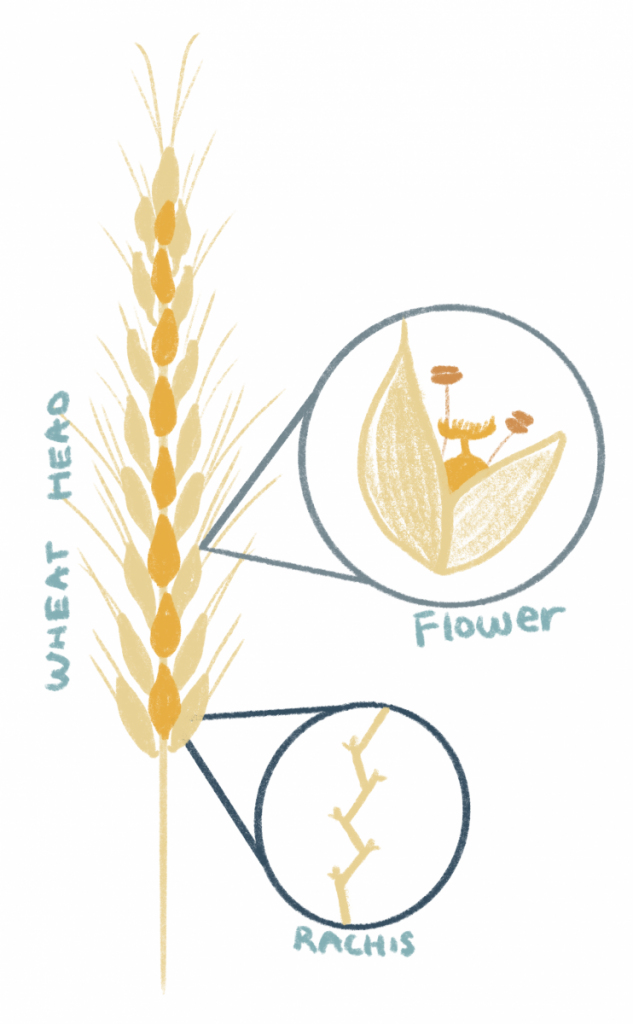
Vernalization is when the plant knows it’s time to flower because it’s been exposed to prolonged cold.
Grass family plants have dense root systems in comparison to wheat and can also be perennial. They do things such as “scavenge” for nutrients and water, prevent erosion, build or maintain soil integrity, not need to be tilled every year, and sequester more carbon.
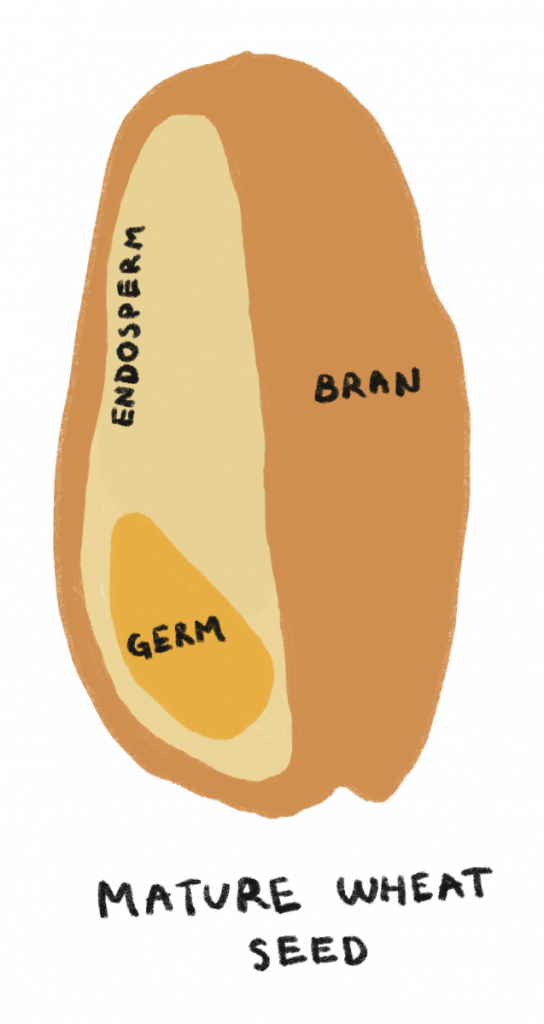
Wheat seeds have a germ, bran, and endosperm. Modern white flour is just the white endosperm, which steel roller mills separate from the rest of the seed. The end product lacks the flavor and nutritional value of the germ and the bran. Most modern “whole wheat” just adds the bran and germ back in after processing, but there is a lack of transparency on how they do this.
2c: Regenerative Agriculture
“Soil is more important than oil.”
unbroken ground film
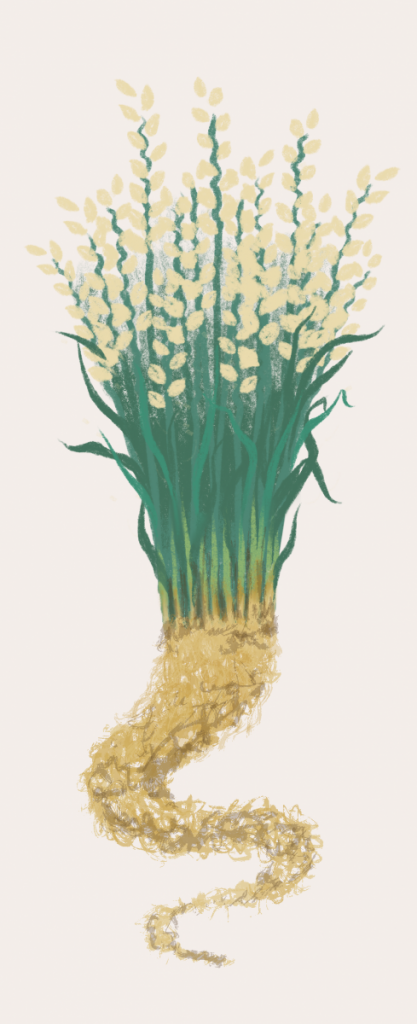
“Grains make up 70% of our diets and 70% of our agricultural land, so it’s extremely important that it’s grown sustainably,” said my classmate Valerie in seminar on Tuesday, “perennial is the way to go.”
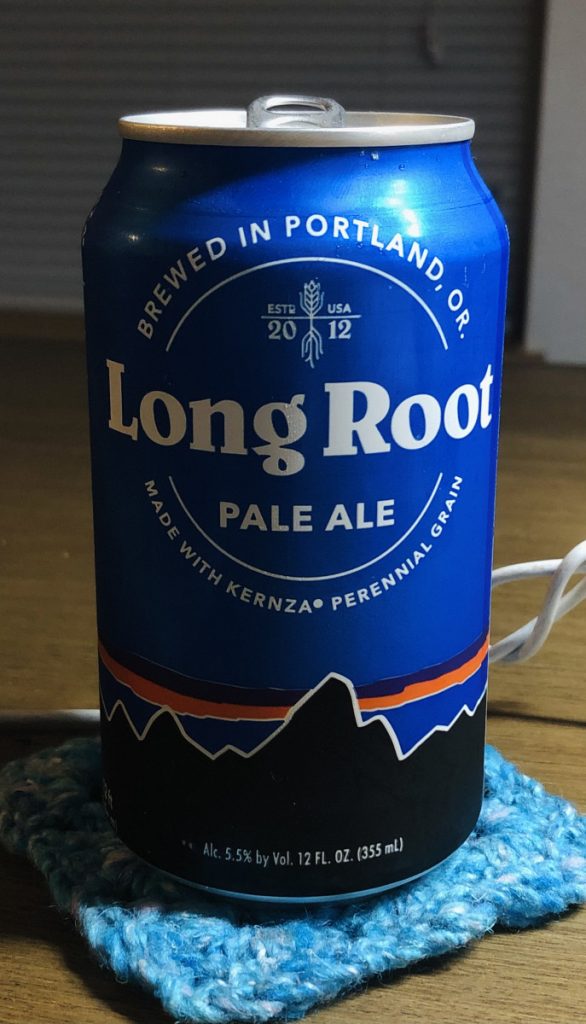
Perennial means a crop which is productive for 2+ years, rather than completing it’s life cycle yearly, as annual plants do.
Why grow grains?
Food: high in carbs, food staple, can grow in many areas of the world, can be stored for a long time.
Economic: selling grains to maltsters and brewers can be good income if you are able to meet specific standards.
Straw: thatched roofing, animal feed for ruminants, brooms and baskets, mulch, cob or adobe building.
Soil conservation: cover cropping to prevent erosion and add organic matter, keeping too much nitrogen from seeping into the soil, roots “scavenge” for nutrients.
However, the grains we grow today are mostly annual, shallow-rooted, and not an efficient food source unless you grow a lot of it. As far as how it’s grown industrially, we see the issue of lack of diversity (meaning a less resilient food system and more intervention like pesticide needed), and also a lack of local grain economies complete with local infrastructure (meaning food and wealth travels a long way).
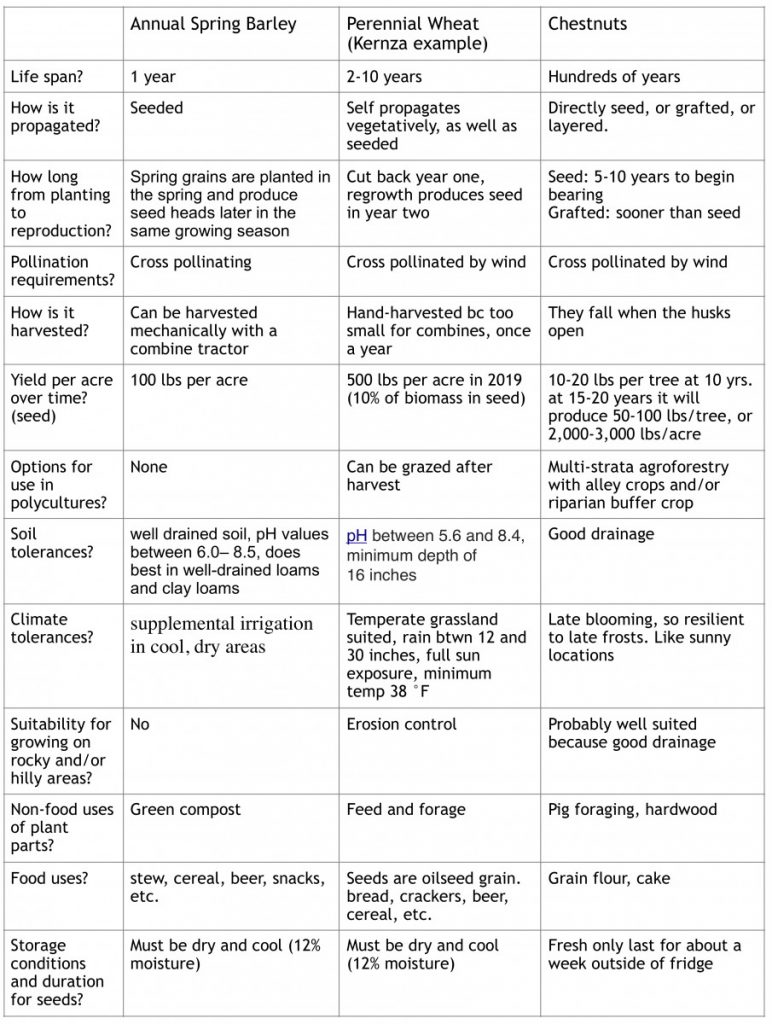
Annual barley has a place in regenerative agriculture as a temporary cover crop or even lawn grass in cool climates. Fall-planted barley roots can prevent nitrogen from leeching into the soil, help retain soil structure integrity, and scavenge for nutrients. When it’s time to plant something new in spring, you can till it in for green manure.
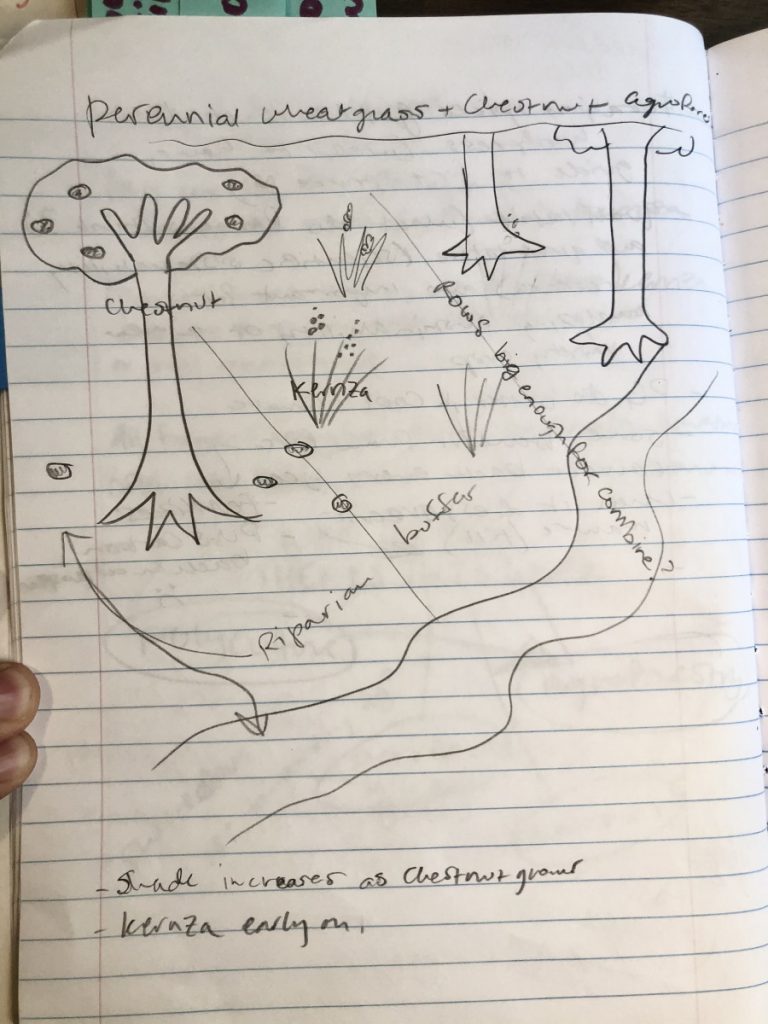
We also learned about some examples of polyculture in the context of grains. The examples we explored were alley cropping (alternating rows of different crops), silvopasture (livestock & trees), and riparian buffer production (growing alongside a river or stream).
2d: Tasting Research
Charlie Bredo of Troubled Monk brewery in Alberta, Canada performed a test to see if a barley’s terroir is expressed in the final product. People who tasted the beer, despite different brewing methods, noticed a distinct flavor across the board.
“People understand how terroir affects wine, hops, and even coffee, but how terroir affects barley hasn’t really been explored.”
charlie Bredo of Troubled Monk brewery
Aba Kiser visited our class on Tuesday 1/19 to talk about the Cascadia Grains conference. The conference is a yearly event where stakeholders in the PNW grains industry connect, network, listen, share, and taste. It’s an opportunity for stakeholders to work on the growth of a local grain economy, like a region-wide local living economy specifically for grains. It’s also a way to connect with consumers.
2e: Tasting lab
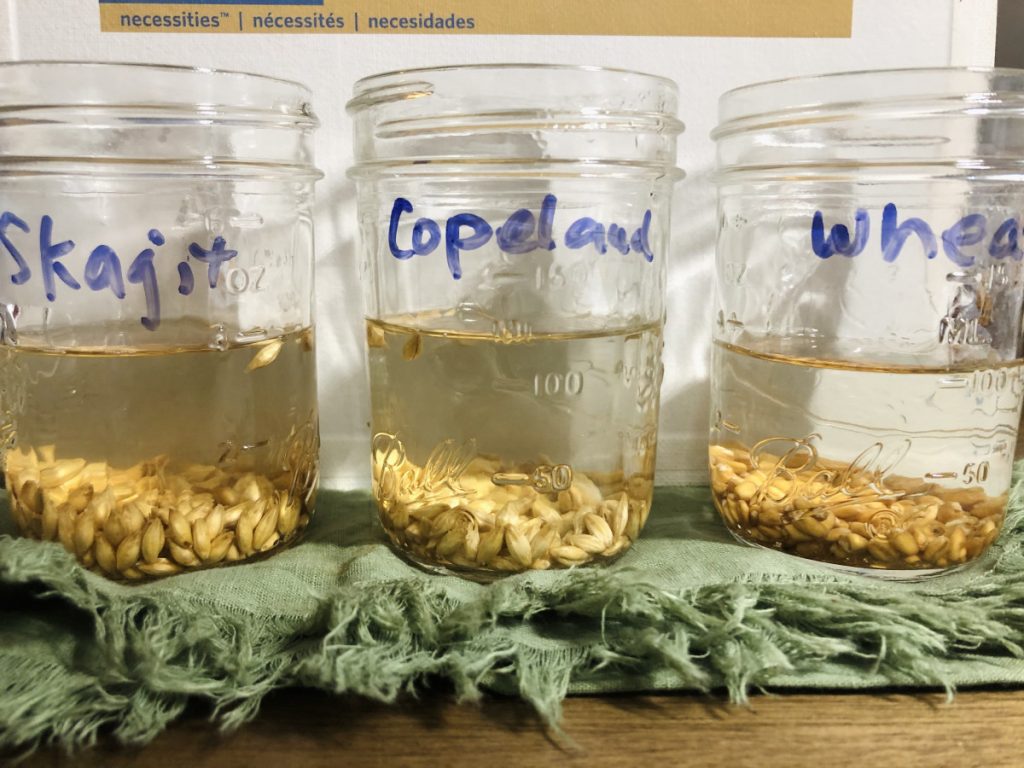
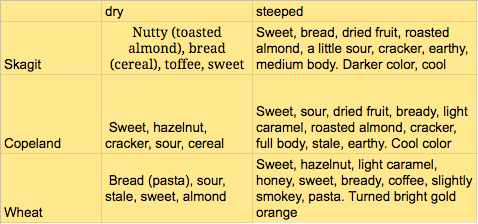
Week 3 we tasted some malted grain. The following are my analysis of the flavors of each sample. Skagit was overall the nuttiest, most satisfying flavor. I was also shocked by the distinct colors made by steeping the different grains, and how powerful the smell and taste became after steeping.
Terroir/Meroir Case Study Tasting Lab:
Malted Grains
Adapted from the 2019 Tumwater Brewfest Sensory Ballot provided by Stephen Bramwell
Read through this entire guide BEFORE beginning the tasting lab!
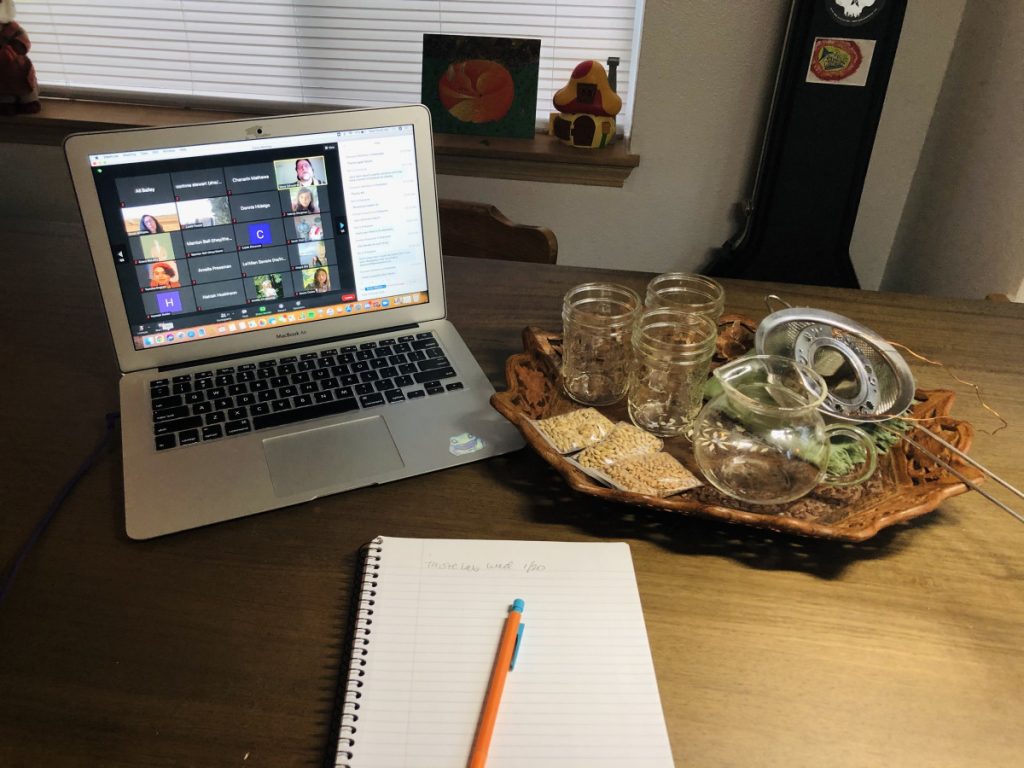
Use about 1/4 of each of the 3 grain samples when answering questions in part I; use remainder in part II. In preparation for the barley tea in part II, boil water and pour 1/2 cup over each sample in three separate clear or white lined glass cups or heat safe glasses. Set aside and let steep for 15 minutes. Complete the following analysis by tasting each malted grain variety and cleansing your palate in between tastings.
Use water and crackers to rinse your palate between samples, if you would like
I) Malted Kernel Tasting
- Taste one sample at a time
- Provide a short description in your own words
- Then rank the samples in your order of preference
Sample 1 Description: (Skagit=100)
dry: light gold color. Very crunchy and VERY nutty (almond). Very sweet and a little salty. I want to eat a bowl of it.
Sample 2 Description: (Wheat=200)
Dry: darker gold color. warm, almost toasty, like bread crust, starchy, nutty.
Sample 3 Description: (Copeland=300)
Dry: Satisfying crunch. Cashew nuttiness. Warm. A little sweet. Less overwhelming flavor than skagit.
Rank the samples by writing the three-digit sample number in the appropriate box based on your overall liking of each sample*
| 1 = like the most | 2 | 3 | 4 = like the least |
| Skagit | Copeland | Wheat |
|
*When determining overall liking, consider the sample’s
appearance, flavor/aroma, mouthfeel, and aftertaste
Now choose as many attributes as you would like from the providedBEER MALT FLAVOR MAPs that you think best differentiate the samples (scroll down for maps)
| Sample 1 Skagit |
Nutty (toasted almond), bread (cereal), toffee, sweet |
| Sample 2 Copeland |
Sweet, hazelnut, cracker, sour, cereal |
| Sample 3 Wheat |
Bread (pasta), sour, stale, sweet, almond
|
|
|
|
II) Hot Steep Analysis: Adapted as “Hot Malted Barley Tea Analysis”
It should now be about 15 minutes since you boiled water and poured ¼ cup over each malted grain sample in three separate clear or white lined glass cups or heat safe glasses. Complete the following analysis by tasting each tea and cleansing your palate in between tastings.
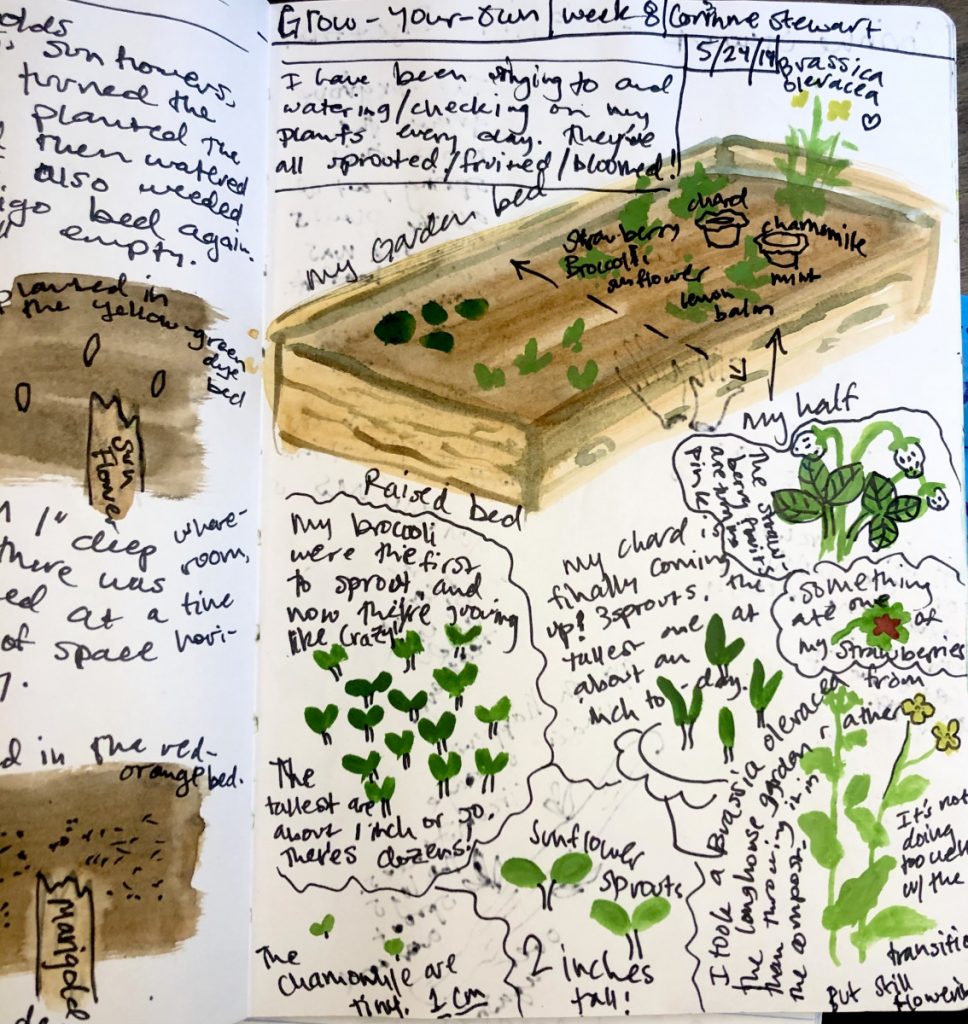
Week 4 we did a tasting lab with spices. I went on a walk to the community garden bed at the dorms that I grew herbs in in 2019. I thought there was no chance someone else hadn’t pulled out my garden by now, but there they were; sage, motherwort, and lemon balm. I was so happy that the seeds I planted were happy, even in winter two years later.
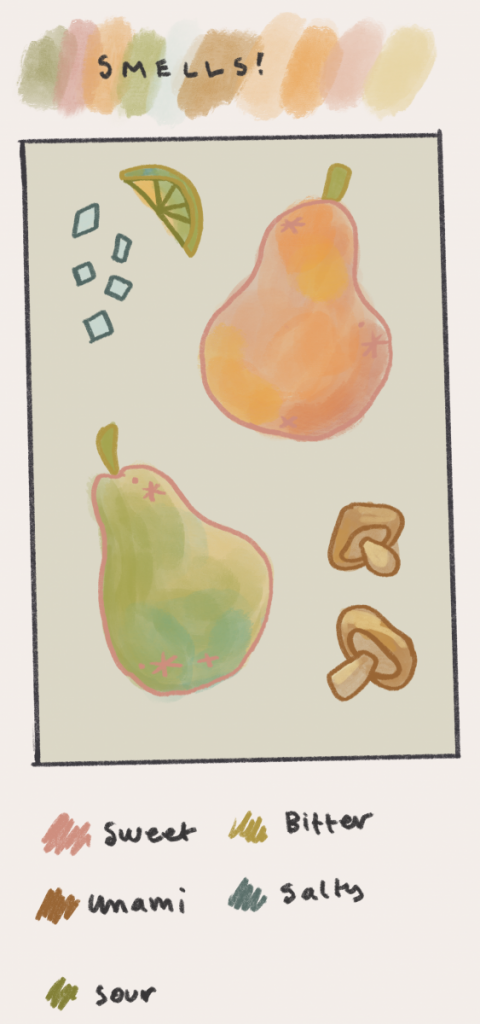
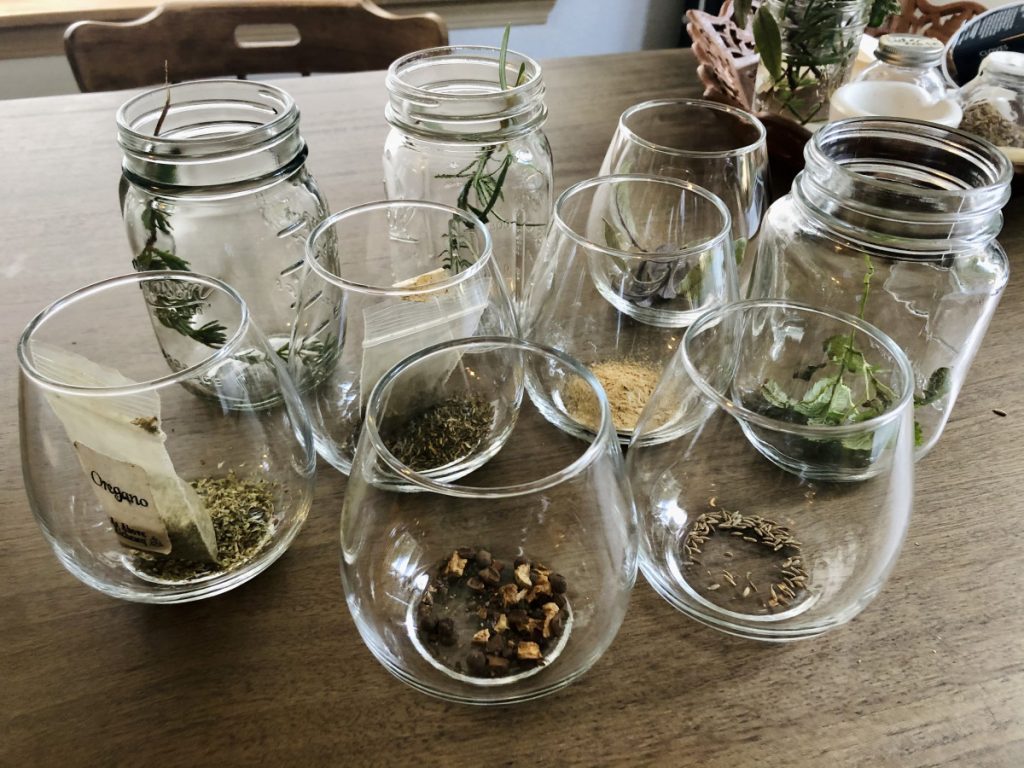
This lab was all about aroma. We tried to distinguish a collection of spices by aroma alone, using nasal and retro-nasal sensory input (our noses and our mouths). It was surprising much easier to distinguish aromas with my mouth than with my nose, I think because the heat of my mouth unlocked some of the non-enzymatic aromas.
“Your tongue draws the outline of the food with the five basic tastes, the way a paint-by-numbers drawing looks before you fill in the sections.”
Barb Stuckey, taste chapter 2

w4 lab
Week 4 – Experiment Guide Question/Answer Form, Taste Chapter Q/A (pp 75, 76, 77, 78)
1) What spices did you decide to bring to this week’s experiments?
9 in all: Foraged purple sage, lemon balm, rosemary, and lavender stems. Dry ginger powder, cumin, “cider mate” (mix of fall spices), thyme, and oregano.
2) What is a fond memory that you have associated with a specific smell? The smell of hibiscus reminds me of herbal iced tea my mom would make a lot
when I was growing up in Texas.
The smell of hay-fed animal droppings reminds me of the rural town where my grandparents used to live in Mexico.
3) What is an unpleasant memory that you have associated with a specific smell, that you are willing to share?
The fake fruity smell of green apple flavoring reminds me of getting sick from nicotine. It’s repulsive to me.
1st Experiment:
4) Did you find that you could easily differentiate between the smell of your spices? Do you think this is the case for all spices?
It was difficult. The ones I use for specific flavors, such as cider mate or lemon balm, were much easier to distinguish than ones I mix with lots of others when cooking such as sage, thyme and rosemary.
5) What about when mixing them up and trying to tease apart the individual spices – did the smells mingle together or was it two distinct smells?
They kind of did both. They complimented each other but were distinct. It was lavender stem and cider mate. One was warm and pepper-spicy and one was cool and minty-spicy so I think that’s why I could tell them apart.
6) Were there any smells that surprised you when you opened your eyes and saw what spice you had been testing?
Rosemary! I thought it was sage. Sage was much more muted than I remember.
7) What are your thoughts or takeaways from the Enzymatic Aroma Chart from Nik Sharma’s Book, The Flavor Equation? Do you draw any parallels between what you just experienced in the 1st experiment?
I think this may have been difficult because I am smelling them without cooking them, so non-enzymatic aromas haven’t been released.
2nd Experiment:
8) How did this experiment differ for you compared to the 1st experiment? Any of your spices stand out to you?
I could identify every herb and spice except for ginger powder, which was extremely faint in aroma. It was much easier to differentiate the different spices than just smelling through my nose. I found that a lot of the aroma came when it hit the back of my mouth, and when I pressed my mouth closed.
9) Between fresh and dry spices, which would you expect to have the highest amount of naturally occurring volatiles?
Fresh, because they haven’t been torn up or dehydrated.
10)Imagine sitting down to a big bowl of hot soup, explain to me what you visualize is happening to the volatiles as they are leaving the soup and begin meeting your body.
They are colliding with one another, dancing, and dissipating into the air, some through my nose.
11)Once you had tasted your spices at the very end of the lab, were you able to differentiate between the interactions between your nose, mouth and tongue that take place to bring you the full picture of flavor?
Yes, I can sense a little better which part of flavor comes through the nose, which parts are sensed through retro-nasal olfaction, and which come from the food being warmed, chewed, and both sensed retro-nasally and by my tastebuds.
Overall:
12)And lastly, my favorite question, what are some personal reflections that you had while going through these experiments?
I actually had to finish my lab later in the day because during discussion and reflection on what memories we connect with certain aromas, I started crying which made my nose stuffy and not very effective at detecting smells. Digging into my childhood memories is difficult. The herbs I picked today, though, just remind me of recent memories, mostly times I’ve cooked with or for other people, which makes me very happy. For example cider mate, ginger, and rosemary remind me of brewing a huge pot of apple cider with my younger siblings when we hosted a “harvest festival” for our household as a homeschool project. Thyme and oregano remind me of pizza nights with my partner.
2f: Sustainable Entrepreneurship

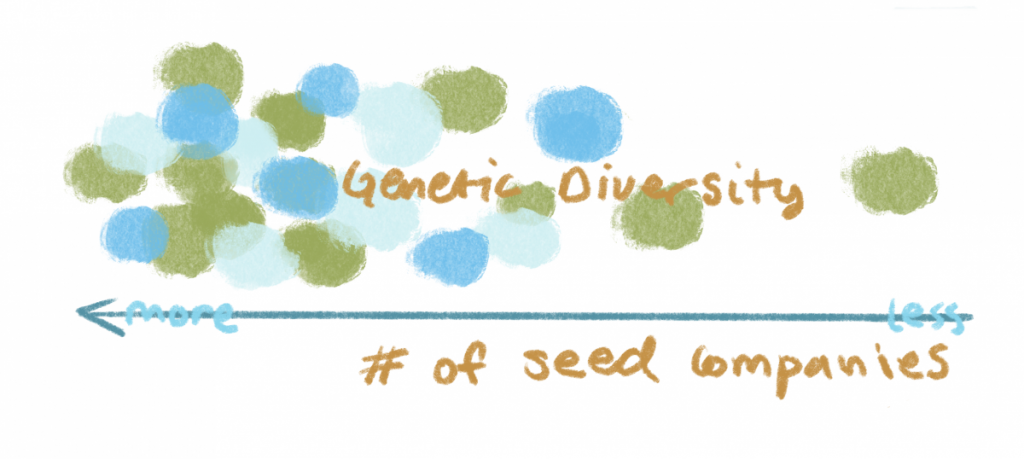
This week my group led a lecture and discussion on GMO’s in the context of sustainable entrepreneurship. Through researching Monsanto/Bayer, I learned a lot about the monopolization of the seed market and the barriers put between farmers and sustainability.

During week 3, Triniti and Zach led a class on local living economies, one model for a sustainable economy. It tied in nicely with Aba Kiser’s presentation on the local grains economy and Cascadia Grains Conference.
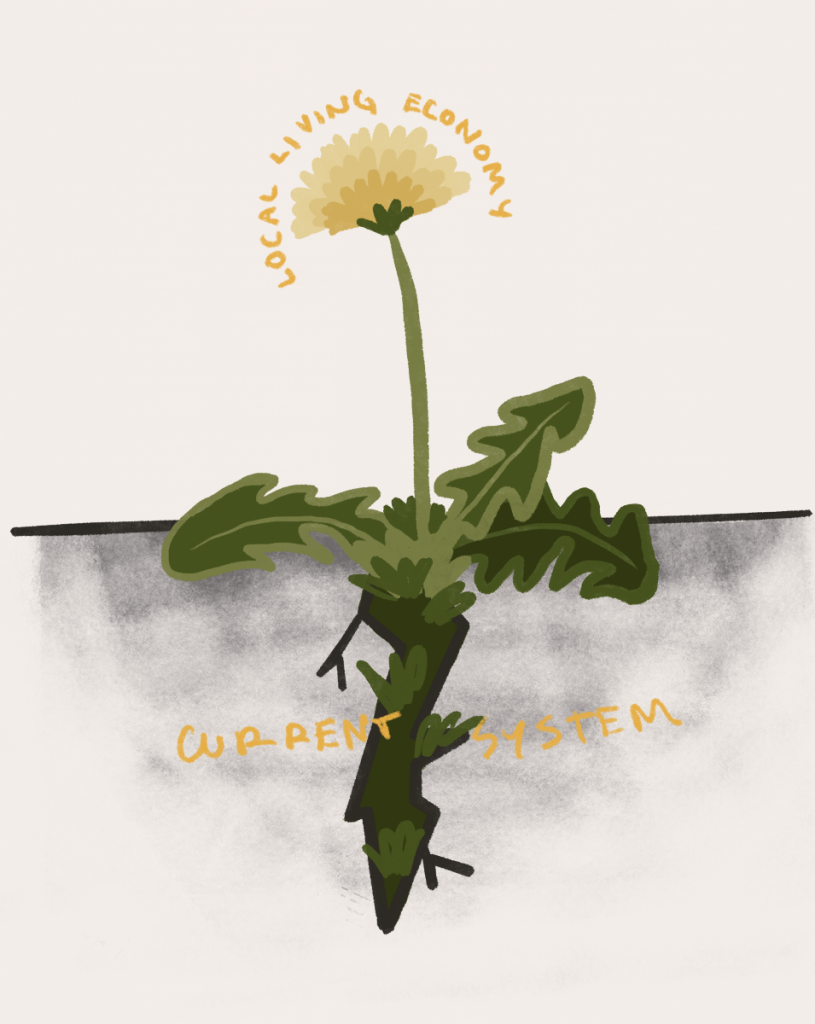
A LLE can keep economic activity in a local area so that employers, employees, and consumers make choices with an informed awareness of their community’s needs. Small businesses in a LLE tend to invest in and collaborate with other local businesses rather than being competitive, as you can see in the way the local Washington grains economy is growing through collaboration between stakeholders. This has the potential to create a food system where wealth circulates equitably and business is done sustainably, at least much more so than the current national food system model.
I notice, though, that small businesses in downtown areas like Olympia or Bellingham attract a lot of business from their terroir or “local” identity, so they see houseless people as a threat to tourism because they visually remind us of our town’s flaws. If a LLE alchemizes from the entrepreneurial spirit of people who see the wellbeing of everyone in their social ecosystem as a form of personal success, seeking to address homelessness for example, it might be a truly sustainable alternative economic model.
Building infrastructure (for malting and storage), training brewers and bakers, interaction with consumers, sensory evaluation, experimentation in the field and the kitchen, collaboration and networking amongst stakeholders (such as Cascadia grain conference), financially supporting farmers who want to invest in new practices, and developing a geographic and temporal Terroir to engage consumers are all strategies we could take to build a local grains economy.
2h: Foodoir
As I continued to read Farming While Black by Leah Penniman, I learned about the Haitian idea of a Konbit, which is where stakeholders (farm staff, volunteers, workers, and consumers or CSA members) gather to work, communicate, and celebrate. Penniman’s konbit gatherings at Soul Fire Farm include a potluck, farm tasks, and a celebratory bonfire at the end of the day.
“Together we cleared the field of brush and celebrated around a canopy-high bonfire…As our project matures, we find that a monthly konbit is a beautiful container for welcoming new friends into our space, reconnecting with alumni and friends, and getting necessary tasks done with joy” (Chapter 2).
This reminds me of times when I’ve been involved in farm or garden projects. I remember one last year, after a week of working through emotional issues that came up with my family from being stuck in quarantine together, we all gathered at my Nana’s house to harvest fall crops, spread soil amendments and plant winter seeds. We got an astonishing amount done in little time, falling into a work rhythm as we talked.
Listening to James Scott’s lecture on grain history and reading Parable of the Sower, I’ve been stewing on the idea that chaos leads to reorganization. When there’s a crop failure, people disperse and learn how to gather and hunt again. During the great depression, some people moved out to the Appalachian mountains and learned how to rely on only the forest and their neighbors. The character Lauren from the Parable of the Sower tries to prepare her community for change so they can survive and regrow their life elsewhere. The seeds we plant now will inform what grows from the rubble in a world devastated by climate change.
All images credit to myself, Corinne Stewart, unless otherwise indicated.
Leave a Reply