Week 4 theme: Potatoes, Weeding, Irrigating, Transplanting, Fermented Plant Juice (using) & Sunscreen
(Remember to check the weather on a regular basis to stay informed on what’s comin’ up!)
NOAA – click for weather
AGweatherNet – click for weather
Readings for the week:
- Transplants chapter (pp 141-160) – Growing Vegetables West of the Cascades
- Chapter 16, Reducing Tillage (173-186) – Building Soils for Better Crops
- “Growing Potatoes: How to Grow Potatoes” – https://www.gardendesign.com/vegetables/potatoes.html
- pp 51-64 – Letters to Young Farmers
1:1 Planning and Preparing (what’s coming up?)
The weeks are going to continue being jam-packed, for every bed that we prep, and seed we put in the ground, our responsibilities grow.
The weather is getting hotter and the days continue getting longer. With the new seedlings being so small, irrigating has been a twice daily chore that can’t be missed. Weeding, too, has now become a priority, so as not to allow the seedlings to be smothered out; I believe that weeding done early (young) is much easier than weeding done later (old).
Having started some seedling trays ahead of the quarter, we are going to have some plants that are ready to be put into the ground, and the fermented plant juice ought to be ready to use. We have one bed prepped and ready for plants or seeds, but we will also need to prep a few more this week to hold some potatoes, as I saved a bunch of fingerling potatoes from last season to be used for seed! I love potatoes and potato plants.
Lastly, with the sun higher in the sky, sun damage is a real threat. Be sure to plan some way to protect yourself from the sun – I use a full zinc sunscreen a couple times a day, depending on how long I’m out there. Love thine skin!

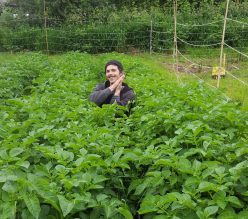
photo of caleb, by caleb
~Tuesday (4/20)~ National Lima-Bean respect day, among other things.
Tuesday will be best spent if we can divide and conquer a few different tasks. We will need to prep at least one more bed and we ought to start tackling the un-tilled half of the planting space. While someone works on this, we will need to have someone else begin weeding the beds that already have seeds; with all the watering that we have been doing in the beds, the weeds have, too, begun to thrive! If we are able to prep a few beds and rid ourselves of weeds (ha!) we will be perfectly set up to make our potato beds and transplant some cabbages on Thursday!
With everything still so small, we will want to be sure to know what plants are our crops and what plants are the weeds, especially since many of the weed seedlings may look identical to some of our crops. We will definitely cover this before we get into it.
~Thursday (4/22)~
If everything goes according to plan for Tuesday, we will be ready and able to seed our potatoes and transplant some cabbages.
For the transplants, it is ideal to put them in the ground on a cloudy/cooler day, or at least not at the hottest point of the day. As soon as they are in their new home, they will be watered and then it is out of our hands. It is common for transplants to look a little weepy for a day, but they soon settle in and get the hang of things. If it is possible, we can try to put the transplants in as soon as we get into the garden on Thursday morning, then we can watch them through out the day and keep them nice and moist.
For our potato bed(s), I like to prep them similarly to what we have been doing up to this point. Once the bed has been formed and amended, I put my potato seeds directly on the soil surface and then bury them with soil dug from the pathways. I believe that this allows for easy rooting up and down, I think that it usually leads to more potatoes, and the trenches help with drainage!
More taters, the merrier!
1:2 Tending and managing (what we did)
I am happy to report that it was yet another productive and fulfilling week in the Community Garden. Not only were we able to go above and beyond the work that was planned for the week, but I also got to speak with a few of the other community garden members that tend to their own plots. In these conversations I received a lot of validation for the work that we are doing, numerous offers of support, and encouragement to continue utilizing the under-used community garden plots. Even further, I have been able to connect with individuals that have been trying to reach out to the community garden coordinator with aspirations of filling an unused plot, and to find them an empty space to tend to and grow within!

photo by Caleb P
At the end of this week 4 of the Spring quarter, my peers and I have filled just about half of the ‘mega plot’ that we have signed up to manage and care for throughout this growing season. Spinach, peas, turnips, runner-beans, green onions, salad mix, radishes, carrots, cabbages, head-lettuce, and potatoes are all in the ground and they all look so incredibly happy and healthy! I am so pleased with the work and the progress that we have made in such a short amount of time and I know that this is only the beginning of a long and fruitful growing season. With the space that we have claimed, we will be producing a bountiful quantity of produce that I look forward to sharing with all that I can.

photo by Caleb P
~On Tuesday, we were very successful in our goal of creating enough beds to hold the incoming transplants and seeds. With Steve’s help, we prepped 2 more beds, weeded the entirety of our established plots, and talk through the importance/necessity of prepping for the incoming weather – no matter what it may be. To be clear, with young plants and newly germinated seeds whose roots are only just beginning to travel deeper into the horizon, different weather events can have dramatic (and possibly devastating) effects. While our soil can hold water for a good long time, the manipulated soil-surface, that has recently been disturbed and then planted/seeded into, is prone to drying out more quickly. If seeds begin germinating during hot, sunny, and/or windy days, they are at a high risk of drying out, and so frequent irrigation is needed until the roots have spread deep enough to remain moist even during the hottest of days.
It is not uncommon for all community gardens to be home to many different weed issues; with many people coming and going, the weeds common to an area are often left to go to seed, thus perpetuating the weed-cycle. In our own Evergreen Community Garden, we are confronted by a few different pernicious weeds: morning glory, comfrey, ranunculus (buttercup), and … kale. The morning glory, comfrey, and ranunculus most commonly propagate through spreading rhizomes and root division, where as the kale spread by seed. I am a bit flabbergasted by the sheer amount of kale seedlings that have begun sprouting in our bed, but once you look around the gardens and see all the flowering kale plants, it makes some sense – luckily they are easily identified and are easy to weed out of the beds.

photo by Caleb P
~On Thursday, we all got to transplant the first seedling trays of the season! On this day perfectly suited for transplanting (overcast, humid, and cool), we got to plant some very healthy looking pointy green cabbages, butter-head lettuces, and sugar-snap peas. Due to the different rates of maturity, we decided to interplant the head lettuces in with the cabbages assuming that the lettuces would be ready to harvest before the cabbages begin to crowd out the entirety of the bed, leaving us with two entire beds filled with cabbages and lettuce! (thanks for the idea Steve!)

photo by Caleb P
1:3 Shishito Pepper Trial
I am so very excited to report that the shishito peppers have begun to sprout! Each of the varieties have germinated remarkably and I am confident that we will have more than enough plants to fill the trial’s needs. Of the 168 seeds that were started, 157 have successfully germinated! I have always struggled with getting peppers to germinate because of the amount of heat that it takes to kick them into drive, but I am proud of myself for ensuring that these were taken good care of through their inception…keep up the good work (**said with bags under the eyes**).
Aside from caring for the pepper plants, I have been working through the experiment-design, trying to make it fit the project’s needs, and into the total plan for the shared space that will hold the trial. I have also been communicating with the Lane Selman of the Culinary Breeding Network, working to set up the shishito trial’s seed-linked page so that I can keep everyone up-to-date on the specifics of the trial (such as germination rates!!).
Now that I have laid eyes on the little green plants, my excitement has been renewed and I cast my mind to a time filled with little wrinkled, green, delicious peppers.

photo by Caleb P
1:4 Mentorship Reflection
I do enjoy finishing off my week by reflecting on the progress that we have all made, and on the work that I put into the planning and preparation. At risk of losing some humbleness, I am proud of my ability thus far, to have plants, tools, maps, etc. ready for each week’s meetings. I have noticed that there is a natural progression to flow of work that must be done through a growing season; with this being the case, it makes my job a little easier as I don’t have to put too much effort into planning what to focus on in the coming weeks. What better way to learn about the flow of farming/gardening than to do it in real time! It is how I learned much of what I know, and I think that it works well for everyone else involved as well.
At this point, though, we have just about covered the building blocks of getting a garden plot up and off of the ground and now we must wait for the plants to soak up some sun, soak up some water and begin making their sugars so that they can grow. I imagine that the next few weeks will be focused on prepping the un-tilled section of the field and keeping the established beds clean and weeded.
I feel like we have all fallen into a nice rhythm and are starting to flow with a bit more ease. Everyone that is helping manage this plot already has some good foundational gardening knowledge and is willing to put in the time and do the work – so I am happily filling in the gaps and trying to point more at the ideas and theories behind why we are doing the things we are doing.
An area that I want to begin focusing on is asking for some support in the everyday mundanities of caring for plants, such as watering, spot weeding, and general observation. As is stands, I have been traveling to the garden, often twice a day (an hour round-trip drive), to water and check on the plants. I think that I am going to try and do a weekly watering sign up to try and relieve some pressure on my schedule. That being said, I like checking on the plots regularly as it gives me some peace of mind and can be very calming.
Well, I guess that is it for this week – I am looking forward to some cooler weather and for a chance to start tackling the un-tilled half of our plot. Send some love to our little vegetables!