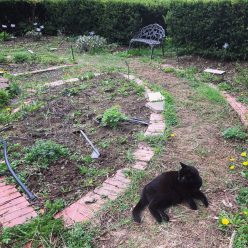

Our first run of the still! We met with past POF students, Travis and El, who had used the still in the past and were willing to pass on their knowledge to us. The morning started by making a basic bread dough using only flour and water; this would act as the sealant for the still as the colander had been dropped and dented, messing up the original sealing action through using the clasp. After the dough was made, we harvested our plant material from the herb garden. Since we hadn’t fully known if we would be running the still today or not, we were only able to harvest a tiny amount of lemon balm, yet still decided to go through with the run just to see how everything worked.

It took a long time for everything to get heated up and for anything to begin coming out of the still, and unfortunately, we did not collect any oil today. However, we were still really grateful for this first run-through as it gave us an idea of timings for our workshops and an idea of how much plant material we would need. It was also really wonderful to have support from Travis, El, and eventually Nitz as well, as their tips and knowledge will be very useful in our future research.

Lemon Balm – Melissa officinalis
Family – Lamiaceae, Mint
Botanical Information:
Habit: herb
Life cycle: perennial
Arrangement: opposite
Leaves: simple leaves | shape – ovate to heart | margins – crenate
Flowers: color – whitish
Underground parts: rhizomes
Ecological Information:
Habitat (growth conditions): partial shade with moist soil, full sun
Origins (native where): east Mediterranean region, West Asia
Horticultural Information:
US Hardiness Zones: 4-9
Propagation methods: root division
Medicinal Information:
Part(s) used for medicine: leaves
Indications: anxiety, insomnia, digestion issues, fever
Actions: calming nervine, sedative, carminative, febrifuge, antiviral
CAUTIONS: possible negative effects on those with hypothyroidism
Access and Use: access – in a garden | harvest – top of growth any time during season, preferably before plant has flowered | use internally as a tea, tincture, vinegar, or honey, use topically as an infused oil or diluted essential oil
Personal experience: I do not have much experience with lemon balm apart from lemon balm teas. I am excited to gain more experience with it through distilling a lemon balm essential oil and also infusing coconut oil with lemon balm.
Food Information:
Part(s) eaten: leaves
Harvest timing: early to late spring
References Cited:
- Gunstone, Tari. The Evergreen Herbal. The Evergreen State College Press, 2018.
- Groves, Maria Noel. Grow Your Own Herbal Remedies. Storey Publishing, 2019.
- de la Foret, Rosalee. “Lemon Balm Benefits.” Web https://www.herbalremediesadvice.org/lemon-balm-benefits.html