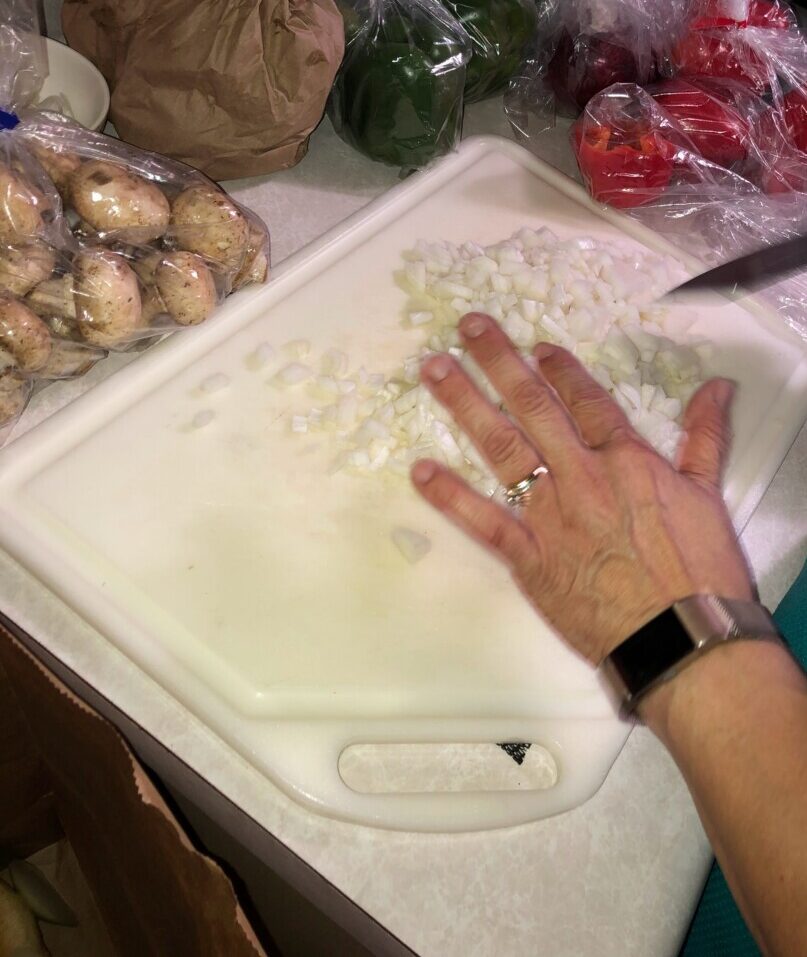
“The recipe—the memory of her mother’s hands—had been lying dormant on her tongue for all those years. Tasting it must have been a kind of homecoming.”
Grace M. Cho, Tastes Like War
I cook by memory more than I cook by recipe. The ghosts of my parents’ hands guide mine as I prepare ingredients, no measurements to be found, but direction nonetheless. If I turn just right, I could see a shadow of my sister next to me, showing me what to do. There are specters, both living and dead, in the kitchen with me, haunting my spice cabinet and pantry.
My mother taught me to make the family’s Italian stuffing when I was still young enough to wear her aprons as a dress. A dish as comforting as it is filling, it appeared every year during the holiday season. She would tell me the history of the recipe, how it traveled from the Old Country to here, with us. It was once written down somewhere with the rest of her Nana’s recipes (pronounced Nah-Nuh, which we theorize is our Americanized version of Nonna), but was passed down to me in the oral tradition.
Mom taught me how to brown the ground pork with salt, pepper, and crushed garlic. How to squeeze water from the spinach and soak the bread in milk. She showed me how to mix all the ingredients in a large bowl. I remember watching her glove covered hands, mixing and kneading, incorporating everything together so no bite would be without the full flavor of the dish. I would marvel at how she never burned her hands despite the heat of the pork just pulled from the stove. Her hands, covered in gold and silver rings made strong from decades of hard work, used to guide my own, small and smooth with youth, in our family’s kitchen.
Cravings dictate my cooking, and my cravings are as mixed as my ancestry. It makes me wonder who exactly is in the kitchen with me; telling me how many cloves of garlic to use, what amount of sesame oil to pour, how long to cook salmon, when to pull the pork from the stove. Intuitive things that require no scale nor clock. Often, it’s my parents’ voices echoing in the back of my head, the same voices that have taught me to cook since I was three and unable to reach the stovetop. Other times, it’s not so much a voice as a gut-feeling that doesn’t wholly belong to me. Some force—some ghost—telling me to wait just a few seconds more before killing the flame or use oregano but not the basil. An interesting instinct; knowledge I don’t remember acquiring, but that I’ve come to know well. By virtue of knowing my own taste buds and that same ghostly intuition, I read the ingredients of an unknown dish and know I will enjoy it—know that it will satisfy me as my comfort foods do.
On September 20, 2020, my father and I made our first jar of kimchi together. With time on both our hands like never before, he fulfilled my years old request of picking back up this food tradition his mother once practiced. Armed with old, glass kimchi jars long since purchased from our usual Korean grocery store and a recipe from an online Korean-run cooking blog, we took up the task of trying to recreate the memory of Grandma Myo Jin’s kimchi. It was something I had never tasted, so it was up to Dad alone to be our guide into the unknown.
The process of making kimchi is one of hands; chopping the salted shrimp, mincing the garlic, grating the ginger, salting the cabbage leaves, slicing the radish, and so on. It’s a day-long process just to put the seasoned leaves into a jar before letting it sit for at least two weeks. A somewhat laborious task that is well rewarded. Dad advised me what knife to use before I made a small cut and split the Napa cabbage the rest of the way with my freshly washed hands, using gentle force so as not to ruin the leaves. I salted the cabbage and bathed the quarters in saltwater while Dad went about making the paste, employing my help for some of the chopping. He removed his rings, and I watched as his large, heavy hands minced the salted shrimp with the skill of many years in the kitchen.
It was left to me to cover the leaves in the paste once their eight-hour soak was up and the excess salt had been properly rinsed off. I covered my hands in gloves and set to work, Mom and Dad both popping into the kitchen to see my progress. Putting the kimchi into the jar proved a messy task and my forearms were stained with lines of bright reddish-orange by the time I was done.
People speak of ancestors guiding them in the kitchen and I wonder, which ancestors? My lineage is a tangle of vines connecting different trees to each other, in the middle of the entwinement lies my siblings and me. As mixed as we are Americanized—two facets of my cultural and ethnic identities that are inseparable from each other and myself—we still carry with us ties to the past, most notably through food. It’s been theorized that taste can be inherited, and I wonder if that is another form of being haunted. Our ancestors still hungering from beyond the grave, still wanting to feed their children no matter how many generations separate us.
Leave a Reply