
Breakfast with Grandpa by lee 이 therese
in loving memory of my Grandpa, Jack


I emerge from the bedroom
		I am seven years old again
allow my eyes to adjust to the light,
the sun dancing through the curtains.
I step lightly,
mind the creaking of the floors,
make my way through the cool hallway,
arrive in the kitchen
& there he is.
It’s anytime between 4 & 6AM.
Grandpa sits at the table by the window
a mug of coffee by his side,
the steam rises
fogs over his glasses.
He wears what he usually does;
a plain colored shirt
this one white
denim overalls
& a plaid flannel over it all.
As I watch him sit there
drinking his coffee
looking at the birds through the window
looking exactly the same as he did the day before
I can’t help but think
“there he is,
as if he never went to sleep.”
I walk over & make myself known.
Grandpa greets me as always
“Morning sweetheart.”
His voice rumbles
it reminds me of the crunching of gravel
& soft thunder.
He helps me get a bowl
pour in my cereal
no milk, I ate my cereal dry back then
grab a spoon
& now we both sit at the table.
I swing my feet,
too short to touch the floor
& munch on my cereal
& he drinks his coffee.
I mumble a random thought every now & then
as kids are want to do.
I could never stand silences for long,
I still can’t, but I am learning.
Grandpa dutifully answers back
our voices soft so we don’t wake the others.
We mostly sit in silence
the cold air slowly being cleared away by the furnace
& watch the world outside move
or not move.
We sit
& the morning is good
& he is there
& I am seven years old
& the world is good.
Category: Creative Writing

When I was a little girl, my summers were red. Memory of that time is tinged the colors of a hot day’s sunset; yellow, orange, red. Every summer it seemed my mother grew tomatoes in her garden. The green vines would outstretch, twining around their thin metal cages. It was an exciting thing, watching a garden grow. I wondered at how the small, green fruit would slowly change colors to the bright reds and oranges of cherry tomatoes, hanging like miniature suns in Mama’s garden. She grew a few kinds, but the cherry tomatoes were the crown jewels.
Small hands reach towards the soft, but sturdy vines, ready to pluck tomatoes from the green’s hold. My mom is with me, her hair is still long in this memory, though I’m sure she’s cut it short by now. She watches me reach for the small, plump cherry tomatoes. Watches as I try to tug one loose, then give up on my efforts for fear that my small struggle will somehow uproot the whole plant. Mom proves my teacher once again, breathing out in either amusement or subtle exasperation before telling me the proper way to pick a tomato.
“Twist it gently when trying to pull it, and if it comes loose that means it’s ripe.” She demonstrates and I study her careful grace. “If it doesn’t come off right away, leave it there. That means it isn’t ready to be picked.”
We go back inside with a bowl full of orange-red sunspots.
Cherry tomatoes were snacking tomatoes, though sometimes Mom would use them in salads. There’s an Italian cucumber & tomato salad Mom’s always been fond of, though it took me a while to get used to it. Despite disliking the tang of the red wine vinegar for this dish, I always delighted in the pieces of cucumber and halved cherry tomatoes covered in herbs.
The big tomatoes, which were never abundant in Mom’s garden, were used for meals like sandwiches, steak, atop salads, caprese salad. The rounded tomatoes, I confess, I used to eat like apples on sunny afternoons when school let out. The ones from the store suited me fine, but I preferred garden fresh tomatoes if they grew.
“I’d never eaten a store-bought tomato until I left for the Navy,” my father tells me during one of our phone calls. Growing up in Northern California, it was the perfect climate for his mom’s multitude of tomato plants. He told me her garden was bursting with life, their backyard filled with tomatoes, honeydew melons, green onions, and Korean hot peppers. An urban paradise. Dad recounted the delectability of those home-grown tomatoes, sweeter than anything sold in the grocery store. Although I myself never saw this fabled garden, I imagine the tomatoes to be as large as softballs and as red as a painted sun.
Unsurprisingly, the most common way we ate tomatoes was through pasta dishes. Baked ziti was my favorite, the penne mixed with creamy ricotta cheese, topped with fresh mozzarella and fresh basil leaves, but of course, the sauce was the most important part. From eggplant parmigiana to regular spaghetti, the dishes wouldn’t be much without a good red sauce. And if you’re Italian, you usually have a recipe in your back pocket.
I remember the first time I asked Mom to show me how to make the family’s spaghetti sauce. I was 18 years old and my grandpa had just died. Mom drove up from Portland to Olympia to pick me up—I feared if I tried to drive myself, I’d only end up crashing the car, done-in by my own grief. I was barely two months into my freshman year at college and I had spent almost every weekend going home to see Grandpa in the hospital.
It was jarring to see him so small and frail, this man who’d once let his grandkids climb all over him like a jungle gym. I kept thinking to myself, I swear he was taller. But it was simply that I used to be smaller, younger. He would tell me he loved me before I left, that he would always love me. He said it in a way that seemed he would die the moment I stepped foot outside of his room. I would tell him “I love you, too” because I was afraid of the same thing. I remember him most clearly wearing wine-red hospital clothes.
I don’t remember much of the time between Mom picking me up and Grandpa’s funeral, but I remember seeing red. For his wake, to be held at my Auntie Dewaina’s house, Mom would be making spaghetti and she would be teaching me how to make the sauce. Despite my grief—or maybe because of my grief—I was still worried about my academics. I was in the program Eating in Translation with Professor Sarah Williams, my first foray into food studies, and was anxious to do well. My in-program ILC was all about family recipes, and so in my grief I became my mother’s student once more.
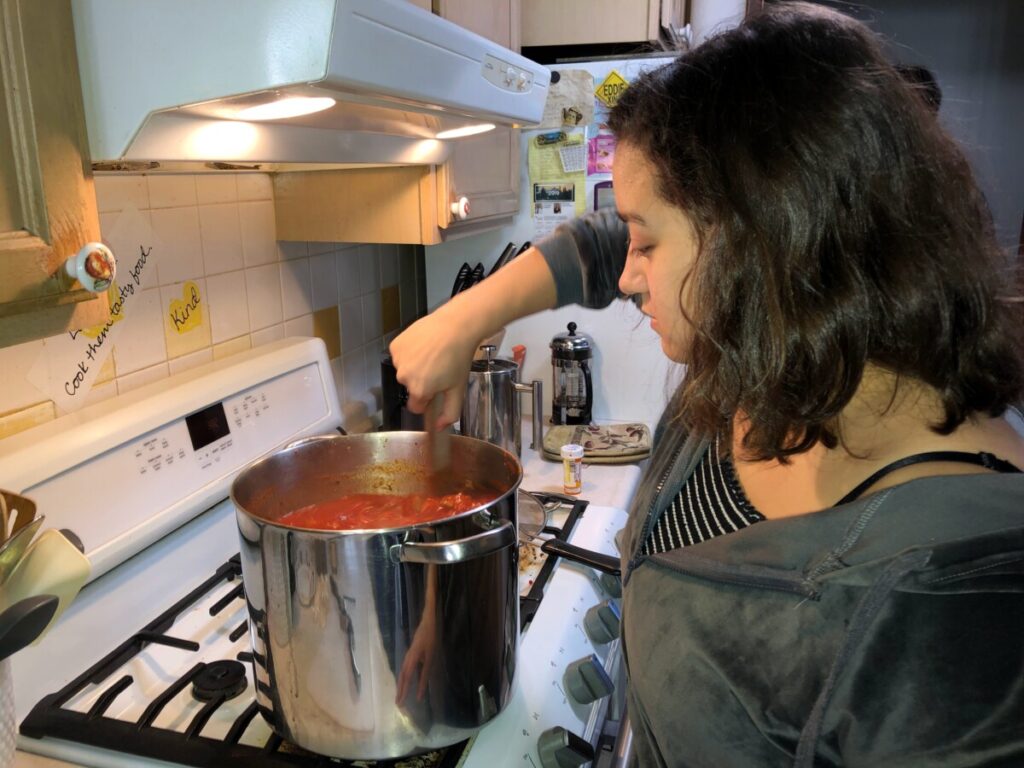
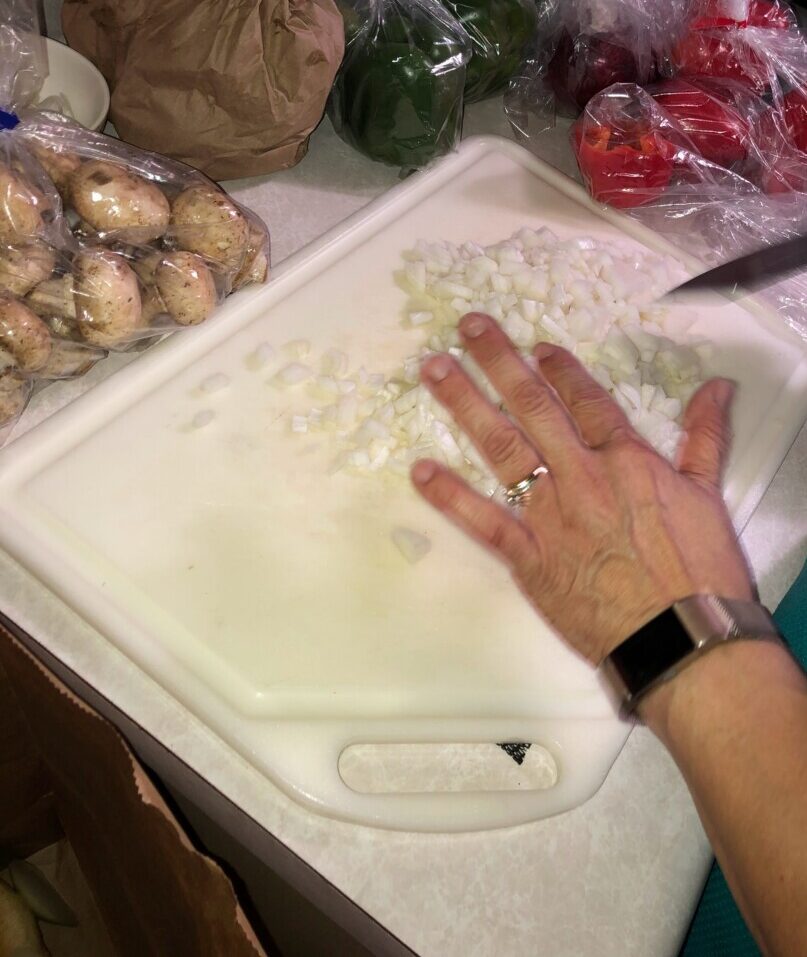
The family sauce is a red sauce you typically see paired with spaghetti. It has its base ingredients that never change—tomatoes, garlic, onions, sugar or carrots to sweeten the acidic taste, oregano, salt, and pepper. What gets added in varies from person to person, Mom being partial to mushrooms, bell peppers, and red pepper flakes in her sauce. According to my mom, a characteristic of a true Italian spaghetti sauce is the use of pork as the meat. She’s not sure if it’s simply a regional thing (our family being from the southern part of Italy) or just a general rule, but every other Italian she’s come across also uses pork in their sauce. Pork shoulder is the most typical cut of meat to use, but ground pork is acceptable in a pinch. Never beef. Mama told me, “Beef is for making meatballs, and even then, it’s a mix of pork and beef.”
We use canned San Marzano tomatoes as well as tomato puree. I watched as Mom reached her hand into the Cento can and pulled out whole tomatoes. She hovers them over the large pot, the bottom of which would already be covered with sizzling mushrooms, bell peppers, onions, and browned pork. She squeezes her hand, crushing the tomato. Red spills from between her fingers into the pot before she drops in what remains of the tomato. It’s carmine, tangy and sweet.
I’ve never been much of a morning person, my insomnia making early afternoon a preferable wake up time, but I fondly remember weekend mornings stirred from my bed by the smell of my parents’ cooking. Saturdays and Sundays were meant for late mornings, often with Mom at the stove and Dad returning from a bakery or patisserie with treats in hand. When I reflect on those mornings gone by, a warm feeling settles in my chest. What love to know someone is waiting for you when you wake up.
My favorite breakfasts were when Mom would cook up potatoes and eggs with either sausage or bacon, all cooked up in a cast iron skillet. The smell of sautéing onions would rise up from the pan laid atop the flame. The aroma and sound of sizzling would set my stomach to rumble, reminding me what such a late wake up time did my hunger no favors. Just as I loved falling asleep to the soft sounds of rainfall, I loved waking up to the sound of something sizzling in the pan echoing down the hall.
In grade school, Dad would bring us swan pastries on many a Saturday morning. As long as I’ve lived (and surely longer), I’ve never known my father to sleep in. Always awake before 7am, I still marvel at his internal clock—and remain thankful mine seems set to 11am most days. These swan treats were cream puffs filled with a light, whip-cream like filling, dusted with powdered sugar. The top was made to look like feathered wings, a delicate swan neck and head arising from the front of the pastry. It was one of the most beautiful desserts I’ve ever seen—and to this day my favorite pastry. He would get them from a French Vietnamese bakery by the name of Lan Vin. At the time when my dad would stop there on those Saturday mornings, their storefront was still in SE Portland, not very far from our neighborhood. The bakery eventually moved locations to NE Portland, in the same building as Pho Oregon. This is the storefront I became familiar with in high school. I was always so excited when I saw that pink box on the counter. It was my favorite part of Saturdays back then, and I found myself anticipating the treats once the week restarted.
These days, breakfast usually happens in a rush. My insomnia still has me cutting it close to when I need to leave for work, often only giving myself 30 minutes to eat. But on the weekends, breakfast remains a slow affair. I usually don’t start cooking until past noon. I’ll stumble out in an old t-shirt of my dad’s that falls almost to my knees, socks and slippers on my feet, and start on my morning ritual.
The motions of cooking are peaceful, reminding me of those calm mornings of childhood. I sometimes wonder if nostalgia tints those days rosier than they were, but I know the memory of my emotions is a truer recount than my memory of events, so I lay that worry to rest. Dressed in my dad’s shirt as I stand over the stove as I often saw Mom do, I find myself caught between the past and present once again. An echo of my parents lingers in my kitchen, a step behind me in ghostly figures as I meander my way around the counters and stoves. A funny thing, how the living can haunt as the dead do. Perhaps memory is really some strange land where life and death exist just the same, unable to tell each other apart.
“The recipe—the memory of her mother’s hands—had been lying dormant on her tongue for all those years. Tasting it must have been a kind of homecoming.”
Grace M. Cho, Tastes Like War
I cook by memory more than I cook by recipe. The ghosts of my parents’ hands guide mine as I prepare ingredients, no measurements to be found, but direction nonetheless. If I turn just right, I could see a shadow of my sister next to me, showing me what to do. There are specters, both living and dead, in the kitchen with me, haunting my spice cabinet and pantry.
My mother taught me to make the family’s Italian stuffing when I was still young enough to wear her aprons as a dress. A dish as comforting as it is filling, it appeared every year during the holiday season. She would tell me the history of the recipe, how it traveled from the Old Country to here, with us. It was once written down somewhere with the rest of her Nana’s recipes (pronounced Nah-Nuh, which we theorize is our Americanized version of Nonna), but was passed down to me in the oral tradition.
Mom taught me how to brown the ground pork with salt, pepper, and crushed garlic. How to squeeze water from the spinach and soak the bread in milk. She showed me how to mix all the ingredients in a large bowl. I remember watching her glove covered hands, mixing and kneading, incorporating everything together so no bite would be without the full flavor of the dish. I would marvel at how she never burned her hands despite the heat of the pork just pulled from the stove. Her hands, covered in gold and silver rings made strong from decades of hard work, used to guide my own, small and smooth with youth, in our family’s kitchen.
Cravings dictate my cooking, and my cravings are as mixed as my ancestry. It makes me wonder who exactly is in the kitchen with me; telling me how many cloves of garlic to use, what amount of sesame oil to pour, how long to cook salmon, when to pull the pork from the stove. Intuitive things that require no scale nor clock. Often, it’s my parents’ voices echoing in the back of my head, the same voices that have taught me to cook since I was three and unable to reach the stovetop. Other times, it’s not so much a voice as a gut-feeling that doesn’t wholly belong to me. Some force—some ghost—telling me to wait just a few seconds more before killing the flame or use oregano but not the basil. An interesting instinct; knowledge I don’t remember acquiring, but that I’ve come to know well. By virtue of knowing my own taste buds and that same ghostly intuition, I read the ingredients of an unknown dish and know I will enjoy it—know that it will satisfy me as my comfort foods do.
On September 20, 2020, my father and I made our first jar of kimchi together. With time on both our hands like never before, he fulfilled my years old request of picking back up this food tradition his mother once practiced. Armed with old, glass kimchi jars long since purchased from our usual Korean grocery store and a recipe from an online Korean-run cooking blog, we took up the task of trying to recreate the memory of Grandma Myo Jin’s kimchi. It was something I had never tasted, so it was up to Dad alone to be our guide into the unknown.
The process of making kimchi is one of hands; chopping the salted shrimp, mincing the garlic, grating the ginger, salting the cabbage leaves, slicing the radish, and so on. It’s a day-long process just to put the seasoned leaves into a jar before letting it sit for at least two weeks. A somewhat laborious task that is well rewarded. Dad advised me what knife to use before I made a small cut and split the Napa cabbage the rest of the way with my freshly washed hands, using gentle force so as not to ruin the leaves. I salted the cabbage and bathed the quarters in saltwater while Dad went about making the paste, employing my help for some of the chopping. He removed his rings, and I watched as his large, heavy hands minced the salted shrimp with the skill of many years in the kitchen.
It was left to me to cover the leaves in the paste once their eight-hour soak was up and the excess salt had been properly rinsed off. I covered my hands in gloves and set to work, Mom and Dad both popping into the kitchen to see my progress. Putting the kimchi into the jar proved a messy task and my forearms were stained with lines of bright reddish-orange by the time I was done.
People speak of ancestors guiding them in the kitchen and I wonder, which ancestors? My lineage is a tangle of vines connecting different trees to each other, in the middle of the entwinement lies my siblings and me. As mixed as we are Americanized—two facets of my cultural and ethnic identities that are inseparable from each other and myself—we still carry with us ties to the past, most notably through food. It’s been theorized that taste can be inherited, and I wonder if that is another form of being haunted. Our ancestors still hungering from beyond the grave, still wanting to feed their children no matter how many generations separate us.