“I ask you, what kind of people worship food and money?” (Dunlop, 2008, p. 153).
Eating Memoir Week 3
The question “what kind of people worship food and money” is not easy to answer. There are certain foods that I love, arguably to the point of worship. I recognize the evils of money, but I also recognize its importance. Being consumers in the modern day means that money is food. Food has also had a long history of being money, in past trade-based economic systems. But today, the former is much more popular. Food and money have always been of equal importance. Is it really that bad to worship what gives you life?
After reading chapters 14-16 of Fuchsia Dunlop’s Shark’s Fin and Sichuan Pepper: A Sweet-Sour Memoir of Eating in china, I realize that it doesn’t matter if something really is that bad. There is always a definable other, and regardless of whether or not their practices are really that otherizing, they will be made out to be. By defining one culture as the other, another asserts it’s dominance over and justifies it’s discrimination of that people. Stereotyping is one way to do this. Whether the stereotype is that a group of people are barbarians or that they are money-worshippers, if it looks bad it will be used. “Most Uyghurs won’t patronize Chinese restaurants, even those that claim to serve food prepared in accordance with Muslim dietary laws. ‘You can’t trust the Chinese not to use any pork products, whatever they say,’ a Uyghur shopkeeper told me. As for the Han Chinese, they tend to see Uyghur restaurants as dirty. And so the two ethnic groups dine separately and don’t talk to each other” (Dunlop, 2018, p. 250).
Of course, there are certain inherent otherizing qualities between almost any two people, such as: one’s staple food being another’s forbidden food. But differences like this should be celebrated, because when this translates into prejudice, it is harmful. It is very easy to use an otherized culture as a scapegoat. This has been seen time and time again throughout history, and can be seen presently as Trump refers to COVID-19 as ‘the Chinese disease,’ blaming the spread of the pandemic on China. Because of this, many people in the US are also refusing to patronize Chinese restaurants, like the Uyghurs in the Dunlop reading. Differences should be used to unite people, rather than separating them.
Food Lab
This week’s food lab was the perfect example of the celebration of two different culture’s differentiating qualities. At first, I wasn’t sure how the flavors of the peanut oil and soy sauce would mix with Cuban black beans, but when it was all put together it worked really well! The marriage of all the different flavors and textures that each culture brought to the table (literally) worked out so nicely. My whole family seemed to agree that this was some of the best eating we had done since the pandemic began.
The tostones looked a little bit wonky, but tasted delicious. We dipped them in salsa, and they were gone before the actual meal was ready. I followed the recipe pretty exactly, except for the vegan substitution of tofu instead of fish. I also didn’t have a way to process the black beans, but I worked with what I had, and it turned out really delicious. It really is a testament of what beautiful things can happen when we open ourselves up to new cultural experiences and celebrate the things that unite us, as well as the things that make us different.
The Recipe
Ingredients for Steamed Fish:
For the fish:
1 lb white fish filets of your choice (Daisy prefers grouper, snapper, sole, or turbo)
1 tsp ground ginger
1 tsp white pepper
1 tsp corn starch
3 scallions, white parts only (reserve greens for sauce)
1 inch piece fresh ginger cut into thin strips, skin on
1 to 2 tbsp peanut oil

For the sauce:
2 tbsp peanut oil
2 inch piece fresh ginger, peeled and cut into matchsticks
3 scallions, green parts only, sliced very thin, crosswise
1 tbsp soy sauce
1 tsp sesame oil
For serving:
Cooked white rice
Ingredients for Black Beans:
2 1/2 lbs dried black beans
2 lbs green peppers (about 5 or 6), 1 cored and left whole with the remainder chopped, medium dice
2 cups extra-virgin olive oil
2 large yellow onions, diced
6.5 oz jar fancy pimentos, pureed in a food processor
3 tbsp + 1 tsp coarse salt
1/2 tsp freshly ground black pepper
1/3 cup apple cider vinegar
Ingredients for Tostones:
3 green plantains
Coarse salt
2 cups vegetable or canola oil
Drawing Lab
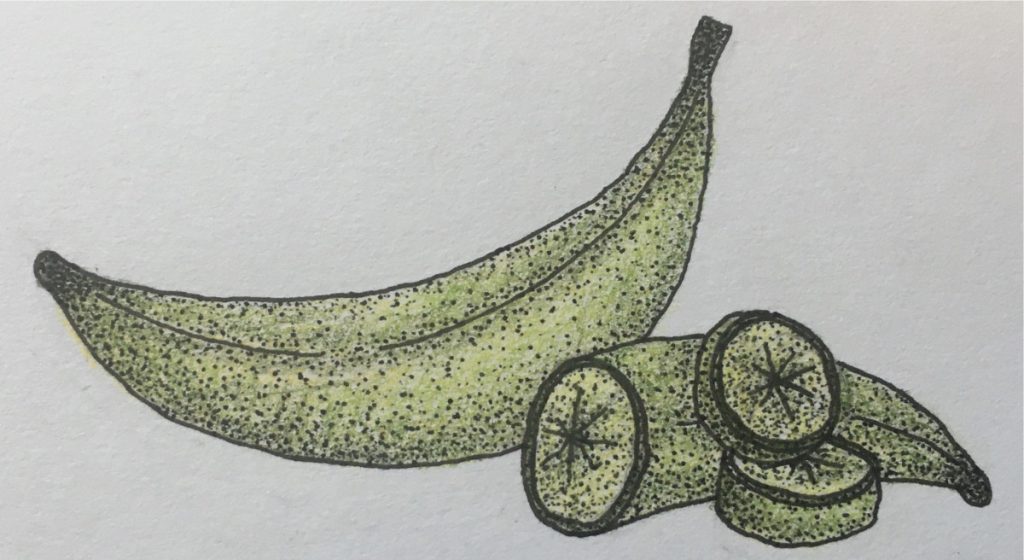
This week’s illustrations are some of my favorites. I did most of these drawings week 8, and it was the first time I had been satisfied with my digital work since getting my iPad back on week 6. The tofu was fun to try digitally (I’ve already attempted tofu with pencil on my week 4 post), and I had a strong vision of a stippled pen and colored pencil drawing of a plantain. I have done both colored pencil and stippling separately but never in the same drawing.
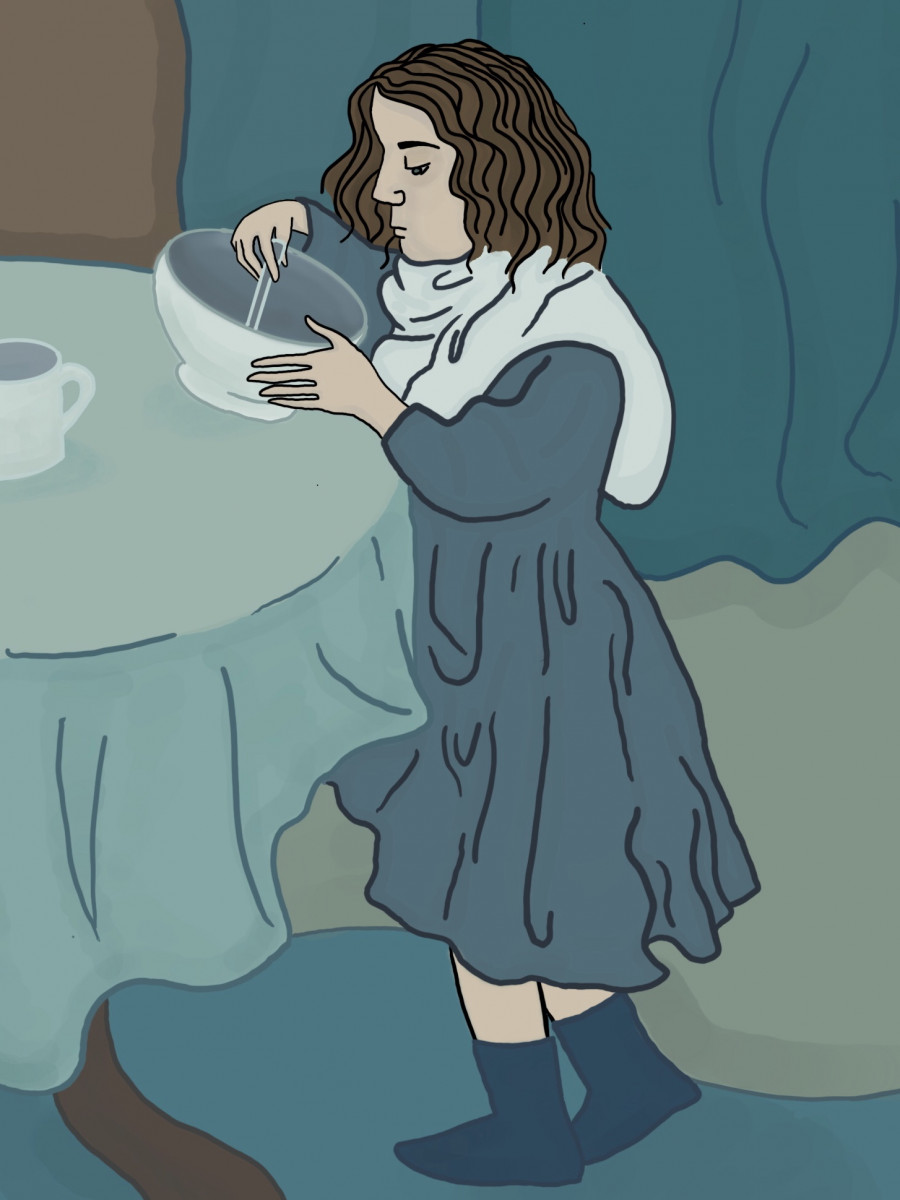
Finally, for the main illustration of this week’s post, I chose to recreate Picasso’s Le Gourmet, which is referenced in Mark Kurlansky’s Choice Cuts: A Savory Selection Of Food Writing From Around the World. “In 1901, Picasso depicted in blue paint a little girl reaching up to a table to scrape a bowl. It is usually labeled by its French title, Le Gourmet. But at a recent show in New York it was translated into English as The Greedy Child. Is a gourmet greedy?” (Kurlansky, 2002, p. 15).
As this week’s topic is about greed, gluttony, and worshiping food, I thought this painting was very fitting for this post. I replaced the girl’s head with a drawing of my own and titled the illustration Le GourME as a way to make myself the subject of the painting. Similar to my week 4 drawing of The Lord Mayor’s Day Feast, I did this to make myself the subject of critique in terms of my own greed and gluttony. I feel that I am not a very greedy or gluttonous person, but sometimes it is healthy to step back and look at your own daily practices through a critical lens, to see where there is room to grow. If there is food to eat, there is room to grow.
Leave a Reply