Eating Memoir Week 8
A beautiful thing happens when people sit around a table together for a meal. This naturally social event causes interaction on a very human level over something that is so common yet personal for everybody. Food, by its very nature, provides an intersection for all sorts of perspectives and experiences. Fuchsia Dunlop Illustrates how different these perspectives can be in “Chinese Food, Culture, and Travel: Conversation with Tyler.” She explains, “When you talk about Chinese Cuisine you always have to take it with a pinch of salt and remember, as I always do, that Chinese people talk about something called ‘Sheitan’ (Western food) and make outrageous generalizations about it too. And you know, of course, from a Chinese point of view it makes sense to talk about Western food being different from Chinese. But from a Western point of view, you see all the distinctions” (Dunlop, https://wordpress.evergreen.edu/covidfoodways/week-8-oyo/).
Everybody eats, but nobody does it in the exact same way. One thing many cultures do have in common, is that eating food is often an inherently social activity. You can learn a lot about people’s different points of view over dinner. Here in America, there is this culture of dinner as a social time for a family to come together toward the end of the day to talk and eat together. Coworkers may eat together on their lunch break. Two friends might go out to eat together after having not seen each other for some time. A couple might go to dinner for a date. Whatever it may be, at the center of all of these human interactions, is the table. And as it can bring likeminded individuals together, it so can unite people of different backgrounds from anywhere in the world. It is very important that people share the food of their cultures with others. This spreading of ideas and tastes and the meanings behind them has the ability to bring people together. It shows us that nobody is really that different. There are commonalities that any two people could find in the way they eat food.
With technological advancement furthering the industrialization of food, this cultural value of food is threatened more and more. Though there are many positive sides to the advancement of technology, the industrialization of food coupled with the changes in what social interaction means (due to social media) are drastically changing the culture of food throughout the world. The image of what dinner was for the American middle class family in 1960s sitcoms, is not what it is today. With many families having dual income households, busy schedules, smartphones, and access to ready-prepared food, a home cooked meal and a conversation are just ‘off the table’ for some. Right now, during the COVID-19 pandemic, the meaning of the table is changing even more from day to day. In the restaurants that are open, every other table is turned upside down to ensure that people keep a safe distance from each other. At ‘Fish Tales Bar and Grill’ in Ocean City, Maryland, they have invented what they call “bumper tables” (https://sites.evergreen.edu/pandemic/weekly-schedule/week-9/). In this scenario, people do not sit around a table at all. Rather, the table sits around them. A person stands in the middle of a donut-shaped table on wheels with Inner-tube edges as a way to ensure a physical barrier to keep people at a distance from each other.
Whether for better or worse, food is changing. Dunlop explains how this change has translated in China. She states, “people lead hectic lives and are increasingly eating more ready prepared food. I think you can see that China is going down the same sad path as the rest of us in some ways. But the thing that gives me hope is that in China, food is understood so deeply as the foundation of health and happiness. It has been a culture that is so obsessed with food” (Dunlop). One thing that cuisines, technological advancement, and bumper tables all show is that people are inventive and creative. People are passionate. Technology can change and people can change, but one thing stays the same: everybody needs food. As long as this is true, food will remain at the center of people’s lives and it will continue to inspire creation, innovation, and interaction. Change is as common as eating. And as social media has the ability to hinder people’s experience of food and culture, it also has the ability to enhance it on a level that we have never seen before. It is how I am sharing this post about food and culture right now.
Cooking Lab
Grilled Pizzettas
This cooking lab was tough for me, because I got to choose what to cook. I had a tough time coming up with what to make for a little bit, but ultimately, pizza was a no-brainer. My mom’s fiancé (Becky) is Italian and is from New York, so she has a lot to say about pizza. Pizza is also a great example of the cultural boundary-blurring nature of food. It has so many cultural influences, and is made so differently from place to place. There are countless different versions of pizza, which is really just toppings on flat bread. This is one of the most common ways that humans have developed to prepare food. Also, pizza is delicious. It’s a crowd favorite, and one of my personal favorites. I chose to make grilled pizzettas as a way to show an alternative take on the pizza. I also chose to make this recipe because it was one in which the crust had a big defining role, and I wanted to highlight the flatbread aspect of pizza. Becky makes these often, and they are delicious.
The Recipe
FOR THE SAUCE
Sauté onions and garlic (a lot of garlic) with salt, crushed red pepper flakes, and black pepper in Extra virgin olive oil until translucent (don’t burn)— add two tbs of tomato paste, stir in, add 1 28 oz can of cento San Marzano peeled tomatoes and a little stock or water to achieve desired consistency, simmer until cooked through. Use immersion blender to purée, if desired, and season to taste
FOR THE DOUGH:
1 1/2 teaspoons active dry yeast
1/2 teaspoon sugar
1 1/2 cups all-purpose flour
1/2 teaspoon salt
2 tablespoons extra-virgin olive oil, plus more for brushing
FOR THE CRUST:
Fill a liquid measuring cup or small bowl with 1/2 cup warm (not hot) water. Add yeast and sugar and stir with a fork; let sit 15 minutes.
Combine flour and salt in a large bowl. Make a well in the center of the flour and pour in olive oil and yeast mixture.
Using a fork, gradually stir the flour into yeast mixture until mostly combined, then mix with your hands to bring the dough together. Turn out onto a clean surface.
Knead dough until smooth. Add flour as needed. Lightly oil a bowl. Add the dough, cover with plastic wrap and set aside in a warm place For one hour or until doubled in size.
Preheat a grill to medium high.
Turn dough out onto a floured surface and divide into 6 pieces. Roll each piece into a ball.
Use a rolling pin to roll out each ball into an oval. Add flour if needed.
Oil the grill and add a few pieces of dough.
Grill for about 2 minutes, until the top is bubbly and the bottom is marked.
Flip and grill until just marked on the other side. Remove from the grill and repeat with the remaining dough.
FINISHING THE PIZZETTA:
Add sauce and toppings.
Place back on grill for a couple minutes, until the pizzetta looks as desired.
Drawing Lab
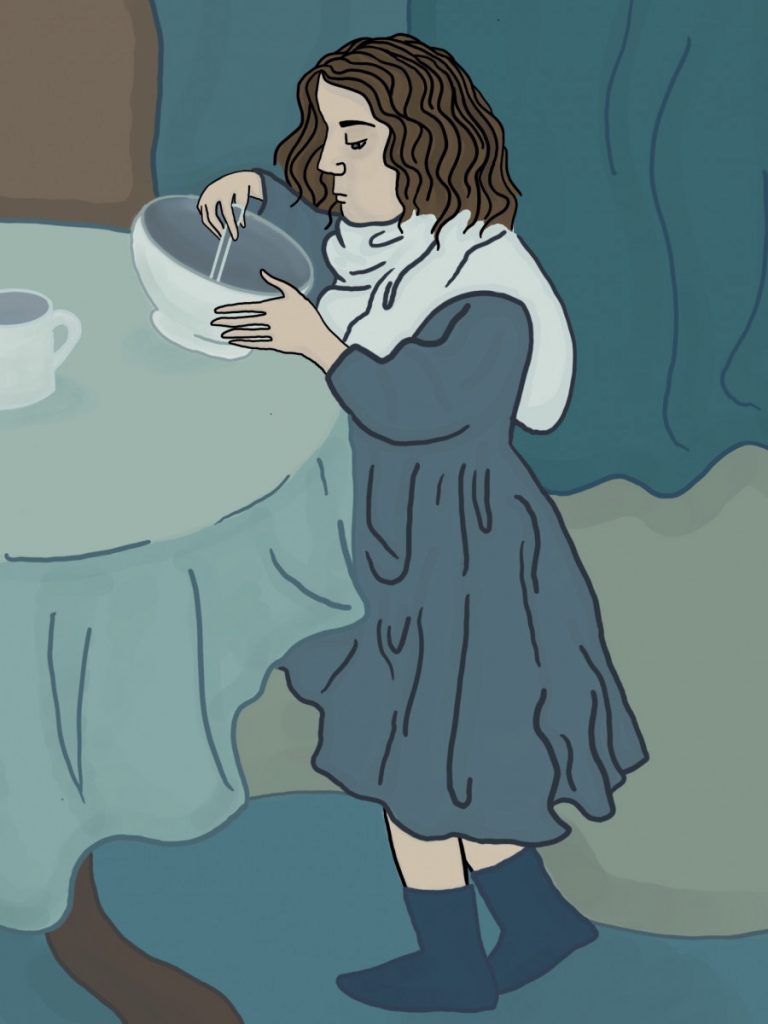
The following quotes from Art in the Lives of Immigrant Communities in the United States, by Paul DiMaggio Illustrate why food is art. Though the quotes are not on the subject of food at all, I chose them because it would still make sense If they were. For this reason, I argue that food is an art form, though some argue otherwise. All of these quotes also show how art has had the exact same role as food in uniting people of different backgrounds and influencing new creations. Food is just as much of an art as music, visual arts, or dance. In that sense, my illustrations of my meals are simply artistic representations of another preexisting work of art in just the same way that my depiction of Picasso’s “Le Gourmet” or my recreation of the engraving “Fatal Effects of Gluttony: A Lord Mayor’s Day Nightmare” were.
“Cultural forms… change As they cross boundaries, incorporating elements of host-country genres or creating true hybrids” (DiMaggio, 2010, p. 10).
“Rather than abandon their old cultures, immigrants developed attachments to new styles while retaining their ties to the old, deploying both as signals of intrinsic satisfaction and as signals of identity” (DiMaggio, 2010, p. 10).
“Just as immigrants can use art to interpret their own experience to themselves and their communities, so can institutions in the host society use art to interpret the immigrant experience to itself” (DiMaggio, 2010, p. 63).
“Both in past and more recent immigration waves, expressive behaviors, including art, have constituted a potent instrument to maintain distinct identities salvage integrity, and negotiate inclusion… because collective self-definitions related to nationality, race, And ethnicity are not static, aesthetic production remains fluid as well, often giving voice to existential realities that are difficult to pinpoint through quotidian language. Art allows for a kind of freedom not found in other forms of communication. And, because the immigrant experience is often restrictive and fraught with danger in receiving areas, art enables immigrants to break across boundaries through the use their imagination” (DiMaggio., 2010, p. 13).
“For nearly 35,000 years, the capacity to communicate through art has supplemented and enhanced spoken and written language” (DiMaggio, 2010, p. 14).
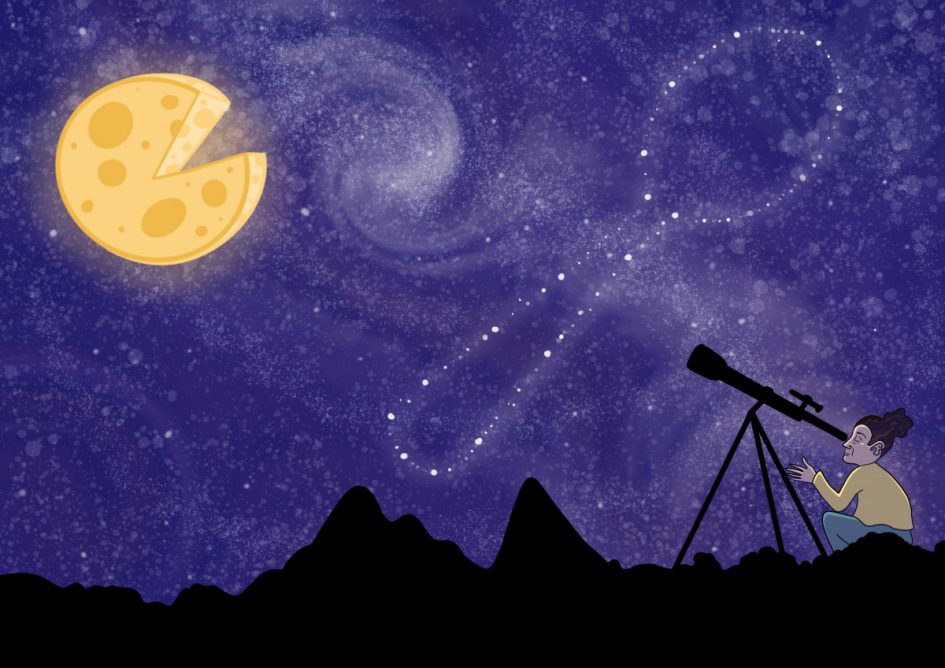
Because this eating memoir is my last, I wanted the illustrations to cover a wide range of different styles. I also wanted the illustrations to demonstrate my progress in digital art as this post will have the most up to date pieces on it. From my first digital image of the Thurston County Food Bank logo to this week’s featured image, I have learned a lot of new things. For the featured image of this post, I chose to illustrate a picture of myself looking through a telescope at a night sky of food. As gastronomy is the study of food and culture, I decided to call this drawing “The Gastronomer” to play on this astronomy-themed image of food.
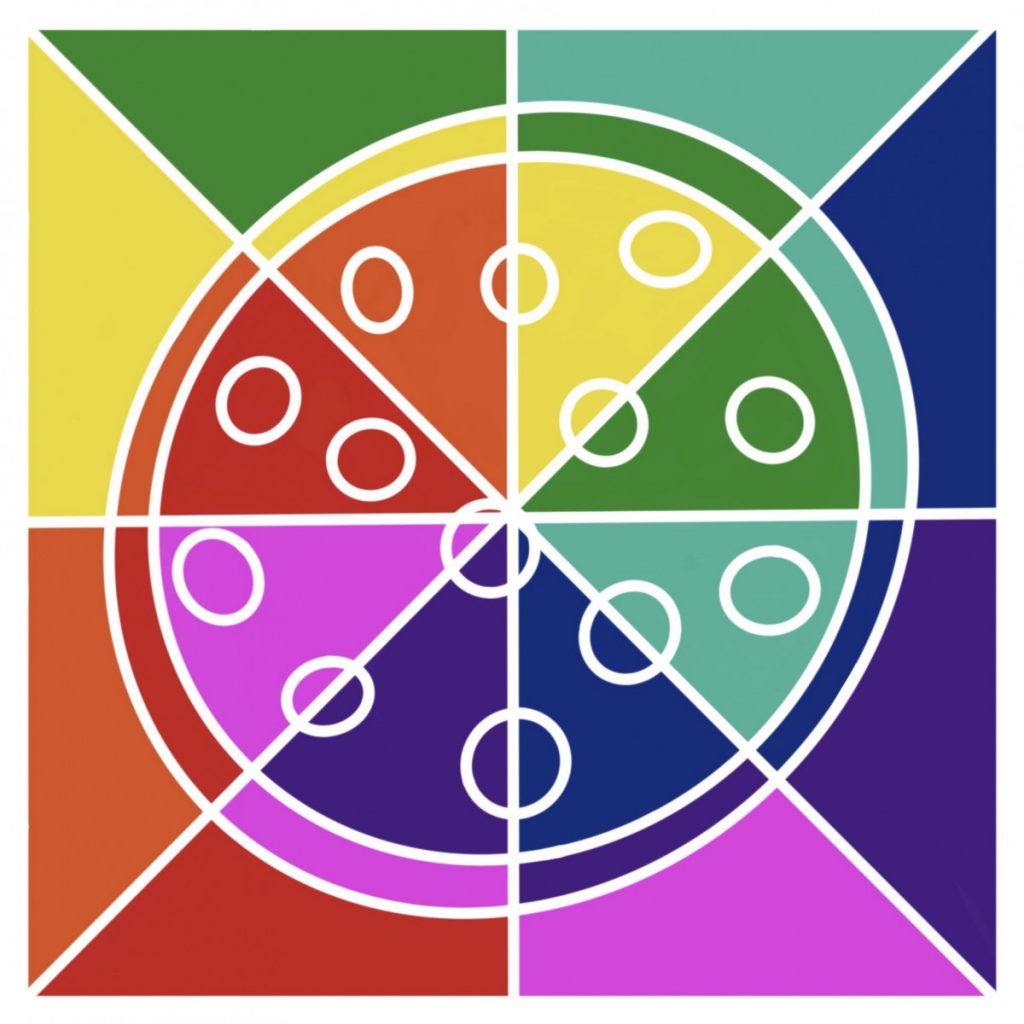
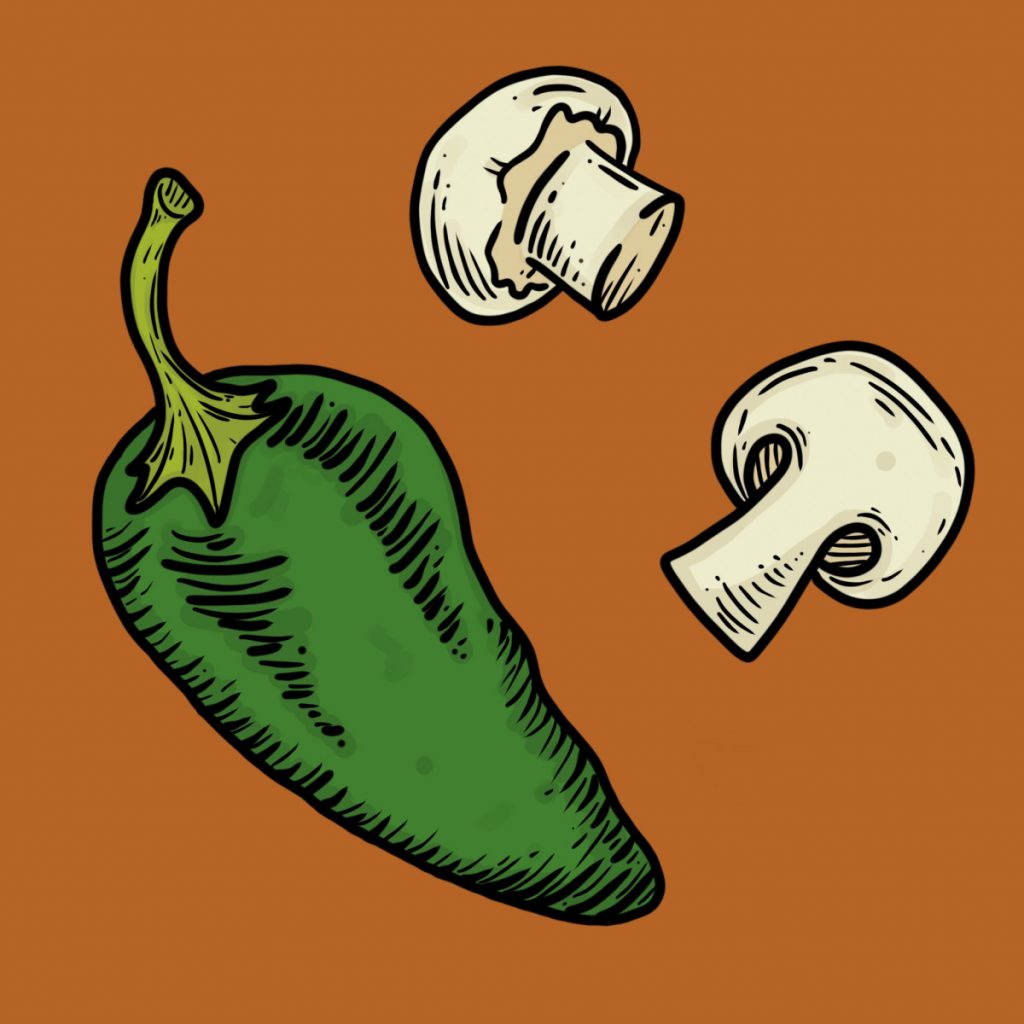
For the food lab, I chose to illustrate a pizza in a sort of Andy Warhol-esque way with each slice of pizza being its own color. I felt like emphasizing the different sections of the pizza was a good way to depict the cultural boundary-blurring nature of pizza. The color of each section is influenced by the color of the sections next to it, while contrasting the color of the piece opposite to it. Each small piece comes together to make one whole image, representing the plethora of cultural influences on pizza. I also illustrated a picture of a jalapeño and two mushrooms, as these are my favorite pizza toppings. I think this image is my best digital representation of food yet.
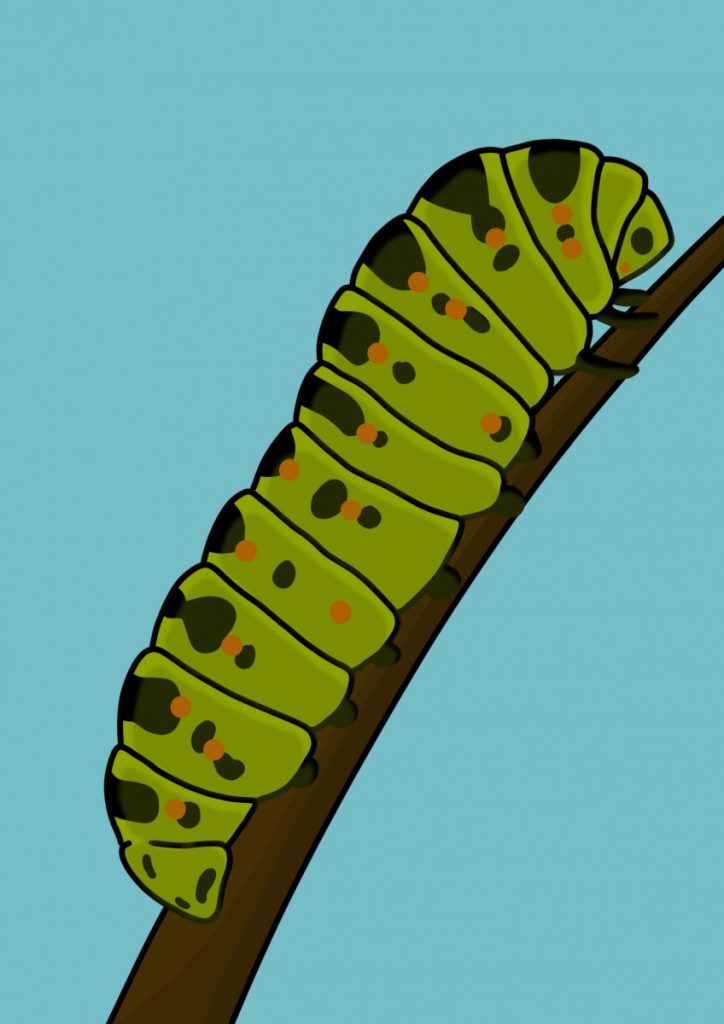
Finally, I chose to illustrate a caterpillar for my drawing lab. I did this because of the significance of the caterpillar in Shark’s Fin and Sichuan Pepper: A Sweet-Sour Memoir of Eating in China. Dunlop explains how the caterpillar was symbolic of her culinary and cultural growth in the epilogue of her book, when she writes “As I ran my eyes up and down the small green creature on my plate, I admitted to myself that, try as I might, I couldn’t really feel shocked at the idea of eating it… Living in China had profoundly changed me, and my tastes… Whether or not to eat the caterpillar was no longer a question of whether I dared to eat it, but of whether I dared to show so flagrantly that I really didn’t give a damn. You can probably guess what happened. Reader, I ate him” (Dunlop, 2008, 310).
The caterpillar also seemed like a good way to close my final post, as my first eating memoir, “Pots and Pan(demic)s” opened with an illustration I did of a butterfly. In that post, I quoted Dunlop from chapter 9 saying, “If you want a real encounter with another culture, you have to abandon your cocoon” (Dunlop, 2008, p. 152). While being cocooned at home During the pandemic, this class and these posts have provided a way for me to leave my cocoon and gain an experience of the world that transcends my small bubble.
Leave a Reply