
•#1a: Film Series: Program Questions in Scenes
“Calling-out to a Higher Power: Two Studies in Worship”

I titled my scenes from the film Black Gold, “Calling-out To a Higher Power: Two Studies in Worship” (11:07 – 13:38) and (29:29 – 30:51) to explore the program question: “What model best enables you to articulate what you are learning about your taste of place in relation to history, nature and culture?” To these concepts I will add ‘economy’, as the central theme of the film is the quest to bridge the economic divide between impoverished Ethiopian coffee farmers and western coffee drinkers. I will compare the two scenes, calling particular attention to the people calling-out to their higher powers, the contrasting accompanying ‘music’ of each prayer, the “church” of each group, as well as the words themselves.
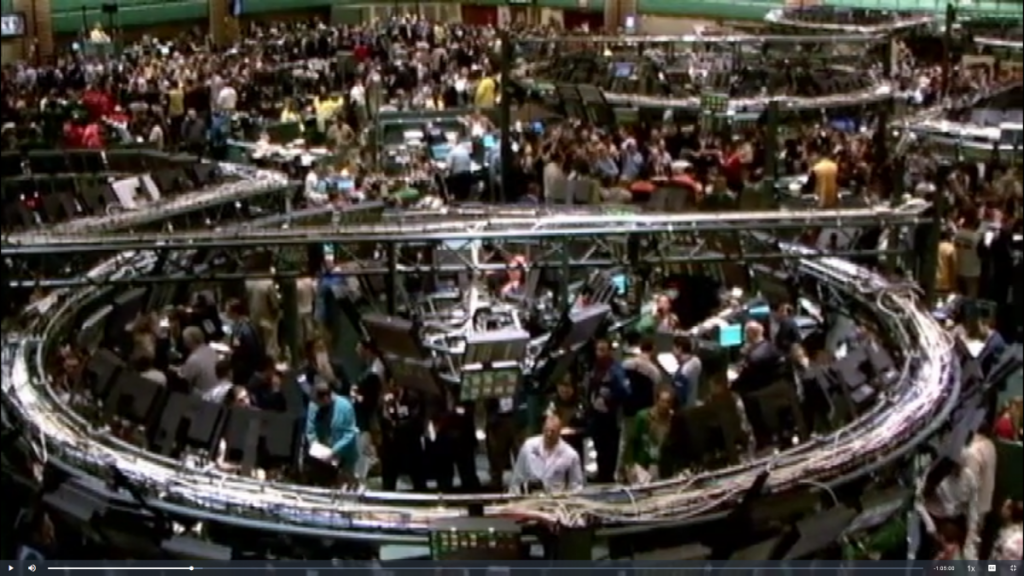
My first scene focuses on the New York Board of Trade, one of the two places in the world in which the price of coffee is established. Narrated by New York Board of Trade Vice President Joe O’Neill, one must watch this scene twice in order to get the full benefit of the experience. I watched the first time, listening carefully as O’Neill explained the basics of commodity coffee trading, revealing that “last year the notional value of all the coffee contracts that was [sic] traded is about $140 billion”, that “coffee is the second most actively traded commodity on the world market” and most importantly, that it “is a centralized marketplace where buyers and sellers congregate to establish the price”; I watched a second time, focused solely on the traders, the trading floor, and the shouts of elation and frustration.
I was drawn to minute 11:48, in which we hear a voice from the floor yell, “Get me out, let me out!”, as if he is trapped. Later in the scene (12:55) we see a wide shot of the trading floor, packed with people all seemingly crying out to an unseen higher power for profit, who theoretically hearing their calls, responds by blessing them with what they ask. No one looks happy or content. The trading floor is a cavernous space: the megachurch of futures trading. The music of the scene is the thrum of agitated voices and ringing phones (televangelism?). I also noticed a conspicuous lack of coffee in the scene: in the citadel of western coffee trading, I didn’t spot a single cup.
The second scene I chose begins with a close-up shot of a small batch of roasting coffee beans over an open fire and vibrant flute music. A group of elders is gathered outside an Ethiopian village in the sunshine. A woman begins rhythmically pounding the roasted coffee beans, which becomes the musical accompaniment of the prayer. They call out:
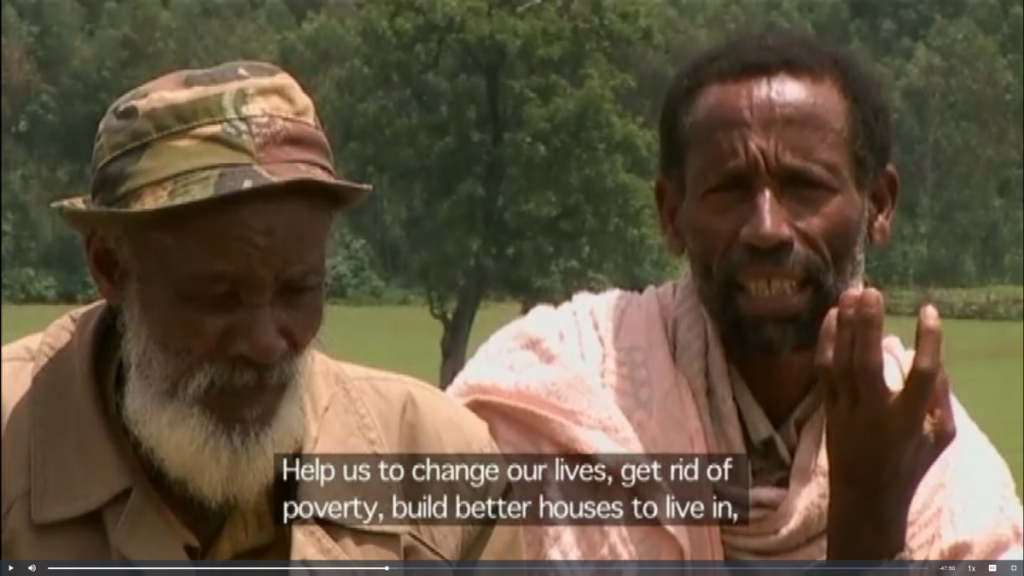
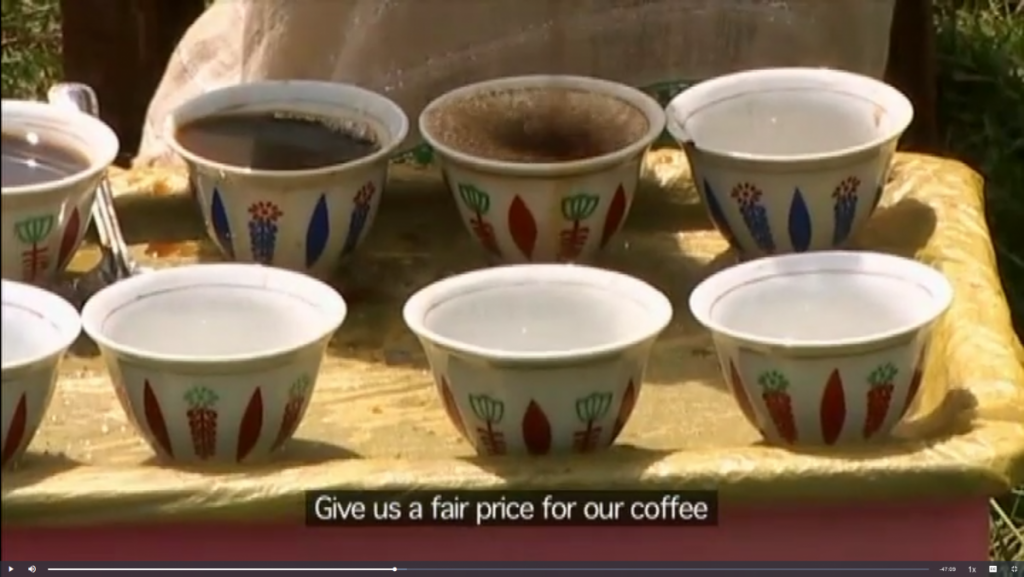
“O God of truth, God of heaven and earth, maker of everything, who created this beautiful land, help us farmers to get more from our green land. Help us to change our lives, get rid of poverty, build better houses to live in, satisfy our needs, educate our children, and improve our lives. Help us leave all our problems behind. Help us satisfy all our wants and needs. Lift us up to a better life. Thank you, God. The God of peace and the God of Ethiopia, give us a more peaceful time. Give us a fair price for the coffee we produce. O God, we ask you to raise the coffee price. Give us a fair price for our coffee. O God, we ask you to raise the coffee price.”
This group also calls out to an unseen higher power, but for peace and sustenance as opposed to profit. The same young woman pours hot coffee at the end of the scene as the prayer concludes, and it almost seems a sacred communion offering, the aroma of the coffee rising with the prayer.
The disconnect between the commodities exchange in New York and the Ethiopian farmers is palpable. One can easily point to the fact that the commodities market supports everyone buying and selling coffee EXCEPT the farmers. The commodity trader’s ecstatic pursuit of profit might be called the worship of Mammon: wealth. So, we see that the actions and prayers of one group prompts the desperate prayers of the other. It is interesting to note the difference in “music” between the two scenes. The trading floor is a cacophonous and chaotic mix of voices, each calling for its own separate prayer to be answered by the unnamed god of the market; the prayers of the Ethiopian farmers are set to the pounding rhythm of the fresh roasted coffee beans, and their voices rise together in almost a chant, calling-out for communal blessings on all the coffee farmers. I’ll share how the juxtaposition of these scenes compelled my thinking surrounding the confluence of wealth, spirituality and labor in order for my audience to better understand the pitfalls of commodification on developing nations.
Independent Lens: Black Gold
Starbucks and Ethiopian Coffee: The Bitter Taste of Exploitation
“Roots of Cheap Coffee in the Ngugo Graveyard”
Film By Curt Fissel and Ellen Friedland.
I titled my scene from the film Delicious Peace Grows in a Ugandan Coffee Bean, “Roots of Cheap Coffee in the Ngugo Graveyard” (20:34 – 22:25) to explore the program questions: “What representations of terroir/meroir are most compelling and why?” and “What model best enables you to articulate what you are learning about your taste of place in relation to history, nature and culture?” I will call my audience’s attention specifically to the graves of Mr. Ngugo’s children which rest on the same land where he grows his coffee, but I hope to speak in a larger way to scene’s treatment of the poverty, malnutrition, and disease which afflict coffee farmers like the Ngugo family. The scene opens with an exterior shot of a Christian church, leading to an interior shot of a service in progress; the singing of the congregants becomes background music for the remainder of the scene, lending an air of worship or hallowed-ness to everything that follows.
The head of the Ngugo family walks home from church along a road bordered by maize. He speaks over footage of his home, a gathering of brick and mud buildings that house his large family. “My family has been living here since 1921. I have my family members. That is my wife, my children, my niece, my nephews, and my grandsons and daughters – about 30. As I have a large family, it is a very big problem of getting some food to feed them. Especially children don’t grow well because they don’t get any balanced diet.” That the family is impoverished is established through their tattered clothing and the meager meal of cabbage being prepared for the group. Small children are at the center of almost every shot, aged from toddler to preteen. The shot then shifts to a personal interview with Ngugo, in which his face becomes the subject, and is seemingly twisted by frustration, guilt, and grief. “Because of my income I don’t maintain the family up to date for buying nets, buying mosquito sprays. So now that brings to the family fell sick of malaria.”
The next shot follows Ngugo through a thicket of bushes to a family cemetery, presumably on his land. He points out the small piles of dirt marked by rock and red brick that mark a small cluster of graves. “That one was my eldest child. He was a boy, he died in 1975. He died of malaria. He was one and a half years. This one also was a boy. He died at the age of 16 months, the same disease, malaria. This one was three months. So, I had three children of mine who passed away.” As he points from grave to grave, we see living children wandering in the cemetery, a living reminder of the three who we’ve are buried there.
I continued researching the connections between malaria and coffee, finding that instances of malaria occur 20% more frequently in areas deforested for coffee production, the insects which cause the disease thriving in the sun warmed soils and puddles. Various studies have shown that the incidence of human malaria and the abundance and distribution of its primary mosquito vectors are associated with deforestation, exploitation of natural resources, human migration, changes in land occupation and land use. The demand for consumer goods in developed countries and subsequent primary commodity production are driving changes in tropical forest landscapes that, in turn, increase malaria risk. Which in turn increases the number of tiny graves in the Ngugo plot. In 2018, malaria resulted in 405,000 deaths, 67% of which were children under 5 years old, and 94% of child <5 years old deaths were in Sub-Saharan Africa. I’ll share how this scene compelled my learning about the connections between coffee, malaria, and child mortality in order for my audience to understand that the price of high-quality goods sold cheaply generally indicates that the value of the labor, or life, which went into the product has also been cheapened.
Global consumption and international trade in deforestation-associated commodities could influence malaria risk
•#3b: (un)Natural Histories
Photography by Sarah Dyer
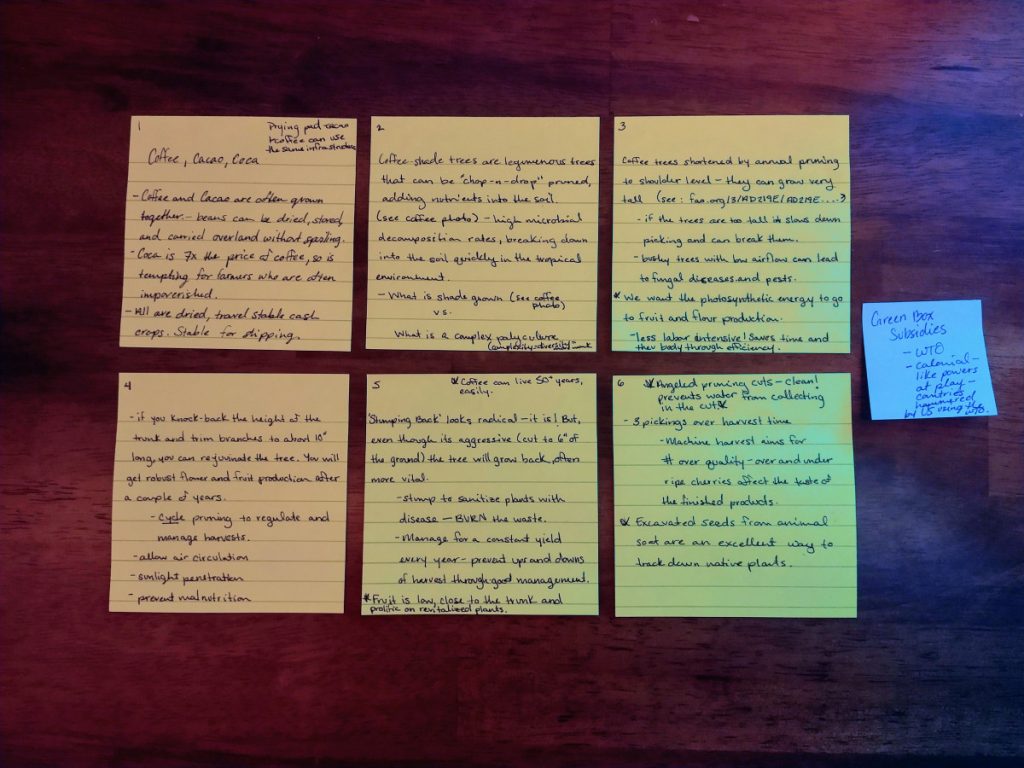
I truly enjoyed our (un)Natural readings this week, and one small factoid in particular jumped out at me from Introduction to Coffee Plant and Genetics and drove my learning all week long. Coffee, grown in areas all around the world in which malaria is prevalent, is related to cinchona, the source of quinine. This odd fact sent me on a learning journey to figure out haw coffee affects malaria and visa versa.
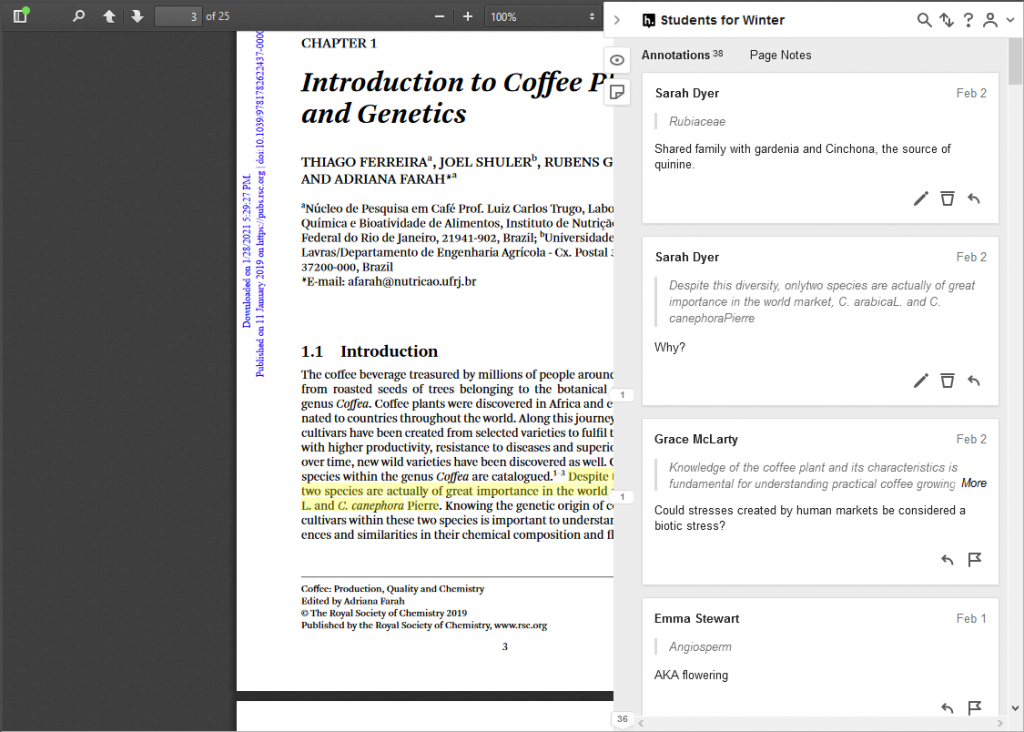
Image by Sarah Dyer.
Introduction to Coffee Plant and Genetics
Coffee Processing Methods – Drying, Washing or Honey?
Washed, Natural, Honey: Coffee Processing 101
Coffee Basics: How do you roast coffee?
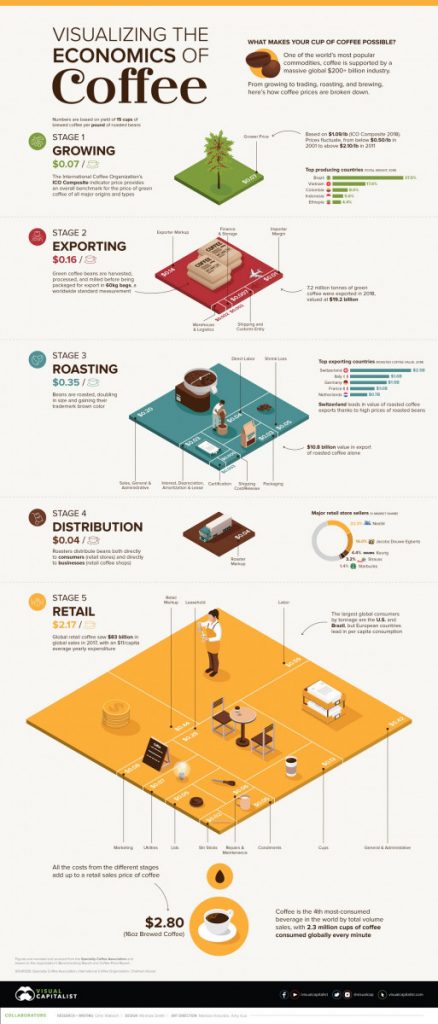
Image by Visual Capitalist.
•#3c: Regenerative Agriculture
Regarding the natural histories of Coffea arabica and Coffea canephora, characterize the range of temperature and precipitation that these species are well adapted to.
| Species | Temp range in degrees C | Precipitation range in mm |
| Coffea arabica | 18-22 C | 1400-2000 mm |
| Coffea canephora | 22-28 C | 2000-2500 mm |
Given the temperature niche of Coffea arabica, why is it most often grown in tropical highlands?
Coffea arabica grows at a higher elevation, and likes long, warm days and cool nights give the coffee cherries enough time to ripen properly, and a dry season at the time of flowering. Geologically younger and nutrient rich soils help the coffee as well.
Given projected changes to tropical climates during this century, what impacts will climate change likely have on the production of Coffea arabica?
As temperature rises, production will theoretically have to move to a higher elevation. Coffea arabica production will have to move higher up in elevation, as will Robusta varietals, making lowland areas altogether unsuitable for coffee.
For coffee farmers that rely on production of Coffea arabica in high rainfall areas, a simple climate change adaptation strategy would be to replant with Coffea canephora. Given our interest in the ‘taste of place’, what impact would this species switch have for coffee roasters and coffee drinkers?
Arabica is considered higher quality and simply tastes better than Coffea canephora; through the lens of taste, this wouldn’t be ideal. Perhaps investing in hybrid varieties would be a better answer to the problem.
For the next questions consider our program tagline, “towards agroecological agribusiness?” in relation to our coffee tasting lab conversation with Bob B. and the assigned article Climate change adaptation, coffee, and corporate social responsibility: challenges and opportunities.
Define CSR:
Corporate Social Responsibility (CSR) is broadly defined as “A company’s sense of responsibility towards the community and environment (both ecological and social) in which it operates.
Give a real or theoretical example of CSR for a coffee roasting business in the global north that aims to improve the socio/economic situation of a specific group of smallholder coffee producers.
Starbucks has several community-related CSR targets, such as education support for its workers, the Farmer Loan Program, which provided low-interest finance to farmers in their supply chain to make changes. The tree donation program, which aims to donate 100 million “resilient” trees to farmers by 2025. It is also relevant to note that Starbucks is part of CERES Business for Innovative Climate and Energy Policy (BICEP) network, as well as a signee of the 2015 “Pledge” by major US companies to address climate change.
Define CSV:
Creating Shared Value (CSV) involves policies and operating practices that enhance the competitiveness of a company while simultaneously advancing the economic and social conditions in the communities in which it operates. Shared value creation focuses on identifying and expanding the connections between societal and economic progress.
Give a real or theoretical example of CSV for a coffee roasting business in the global north that directly addresses climate change adaptation for a group of smallholder coffee producers through regenerative agriculture practices.
Tchibo is German coffee whose goal since 2006 has been to become a 100% sustainable business. The company’s 2018 sustainability report claims that Tchibo believes in sustainability “Because we believe that our future business success depends on a sustainable business policy”. Tchibo is also concerned with its carbon footprint, highlighting it as one of its key performance metrics. The company is also concerned with sustainable sourcing, and support to coffee farmers is more front and center. In addition, Tchibo explicitly mentions climate change as a threat to the future of the industry and outlines specific actions to help farmers adapt.
Define climate change mitigation.
Climate change mitigation is a human intervention to reduce the sources or enhance the sinks of greenhouse gases. For example, reducing fossil fuels in favor of renewables, conserving forests and other ecosystems, energy, and fuel efficiency.
What types of climate change mitigation activities has the global coffee value chain invested in?
Reducing fossil fuels within the supply chain, creating agroforestry polyculture systems in which multiple products can be grown, filtering smoke from roasters, and water conservation are all climate change mitigation strategies used by the coffee industry.
Define climate change adaptation.
The process of adjustment to actual or expected climate and its effects. In human systems, adaption seeks to moderate or avoid harm or exploit beneficial opportunities. Flood resistant buildings and cities, using more resilient crop varieties, shifting production to different areas and migration are examples of climate adaptation.
Consider regenerative agriculture practices that directly address climate change adaptation for small-scale producers of Coffea arabica.
What practices can help prevent soil erosion to increase resilience for intense storms?
The two tier shade canopy is the first component of soil conservation measures. Shade tree reduces the velocity of rain drops and help in percolation of rain water into deeper layers. Contour planting, terracing and staggered planting/trenching across the slope are the other practices to be adopted in coffee plantations. A number of soil conservation measures like post monsoon scuffling, mulching young coffee, cover digging, opening of cradle pits across the slope (staggered trenching) in established holdings are commonly recommended. Theses trenches acts as mini compost pit inside the coffee plantation.
What practices can help improve soil water holding capacity to increase resiliency for droughts?
In order to combat the drought, it is recommended to adopt drought ameliorative spray like nutrient mixture spray, Lantana camera extract spray or contact shade management using lime solution or planting drought tolerant selections in new areas.
What practices can help moderate air temperatures around the coffee plants?
Foliar spray of 10% spray lime (Ca(OH)2) in combination with 0.5% starch (20 kg spray lime along with 1 kg starch in 200 l of water) could be given to the upper surface of the leaves, once after 40 to 45 days of last rainfall. The lime spray reflects the direct solar radiation thus, reducing leaf temperature and acts as a contact shade protecting the leaves from chlorosis and scorching.
Before you recommend completely covering the coffee plants with shade trees, what problems can intense shade have on coffee diseases and yield?
Over-shading with coffee plants increases humidity, which can cause fungal diseases, leaf rust and insect infestation, like borers, and less yield from lack of direct sun.
For climate change adaptation in Mesoamerica, why might Coffea arabica growers prefer to switch to growing cacao?
Not only is coffee more sensitive than cocoa to future climate, but also the tree species commonly used in coffee plantations are more vulnerable to the expected climate change. Cocoa as an alternative to coffee could potentially occur in most of the vulnerable coffee areas.
Whether growing coffee or cacao in mixed agroforestry plantings, explain how climate change will require farmers to adapt the mix of tree species they plant (give two examples from the article “The future of coffee and cocoa in a warmer Mesoamerica”).
The distribution range of 79% of the tree species assessed in coffee areas and 62% of the tree species assessed in cocoa areas will drastically shrink or become unsuitable in both remaining and vulnerable areas for coffee and cocoa. Major losses are expected for the most popular trees used for fruits, N-fixing and timber in mid-altitudinal coffee areas (400–700 m a.s.l.) and lowland cocoa areas (0–300 m a.s.l.).
However, it seems highly probable that current agroforestry schemes will need to be modified in terms of species composition, since some of the most popular tree species are also vulnerable to future climate. It is particularly concerning the losses in habitat suitability of N-fixing trees such as E. poeppigiana (poró) and the majority of Inga species. These species make up the most abundant agroforestry trees in coffee and cocoa plantations in Mesoamerica, and have a key role for the management of soil fertility and sustain more stable productivity especially in low-input and small farming plantations. Therefore, our results anticipate a serious threat for future coffee and cocoa plantations if alternatives for N-fixing species are not promptly identified.
One often-mentioned climate change adaptation strategy for tropical farmers is to relocate them to better climates zones to continue growing the same type of crop, e.g. Coffea arabica. Critics of this concept note social and ecological concerns of moving farmers to these imagined other/better places, which in reality are already populated by other farmers or exist in a relatively ‘natural’ state – likely home to indigenous people that practice lower disturbance land management, aka looks wild to foreign eyes.
What social conflicts are created by moving people as a climate change adaptation strategy?
Some consequences of climate change induced movements of people might include war as different cultural groups clash over land and cultural values, disease as people migrate into areas with different pathogens or experience refugee-ism, deforestation of areas previously uninhabited or sparsely inhabited by indigenous peoples.
What consequences to ecosystem services and carbon balance result from converting relatively intact ecosystems to farming systems (yes, even shade-grown coffee)?
When intact ecosystems are converted to any farming system, the disturbance of the soil will release CO2 into the atmosphere and the biomass removal will reduce CO2 mitigation. Generally, species diversity will suffer, which leads to disease and other issues, ultimately damaging the system as a whole. When root systems are disturbed, the threat of erosion increases.
It is fair to argue that coffee agroforestry practices can increase carbon sequestration (climate change mitigation) and help growers adapt to climate change stressors. Write a 1-2 sentence ‘elevator pitch’ to coffee executives for why they should help coffee producers invest in coffee agroforestry practices.
Shortly put, the coffee industry is on a precipice and will fail if bold action isn’t taken to help growers adapt to climate change stressors. Creating shared value and investing in growers now is an investment in the survival and continuation of your business in the long term. CSV is addressing social concerns in a company’s business practices, and that it may not be counter-intuitive to profit but can contribute to profit maximization and a company’s long-term success.
Finally, imagine that you have been hired as a consultant to review Starbucks climate change program.
Make an argument for why massively increasing their investment to breed good tasting coffee cultivars that are resistant to coffee leaf rust, drought, and higher temperatures would be the single most valuable contribution to smallholder coffee producer sustainability.
In the next 30 years, Coffea arabica will no longer be stable in its current environment due to climate change. It is imperative that an investment is made now to develop good tasting coffee cultivars that are resistant to coffee leaf rust, drought, and higher temperature. Rather than forcing the migration of these farmers to higher elevations, by employing science and proper agroforestry management skills strides can be made to replant tolerant species in traditional areas. This also promotes uniformity with quality beans that can resist disease and challenging temperatures while being grown by traditional coffee farmers.
Make an argument for why Starbucks should increasingly promote chocolate-based beverages and support for coffee producers to transition to cacao production as a way to adapt to climate change while creating shared value between Starbucks and tropical farmers.
Creating agroforestry systems that produce several cash crops, like cacao and coffee, is more environmentally stable and more economically stable for the farmer. By promoting chocolate-based beverages, Starbucks creates shared value with its farmers; the farmers have a stable, well-paying market for both products and Starbucks has a stable supplier (one whom it controls to a degree). Agroforestry can move easily to cacao production once coffee will no longer grow in a region due to climate change, and by transitioning to cacao-based products now, Starbucks could plan for a future in which coffee may be more of a rarity.
Cacao and Coffea – the Differences and Similarities of Chocolate and Coffee
•#3d: Case Study Tasting Research: Coffee
Photography by Sarah Dyer.
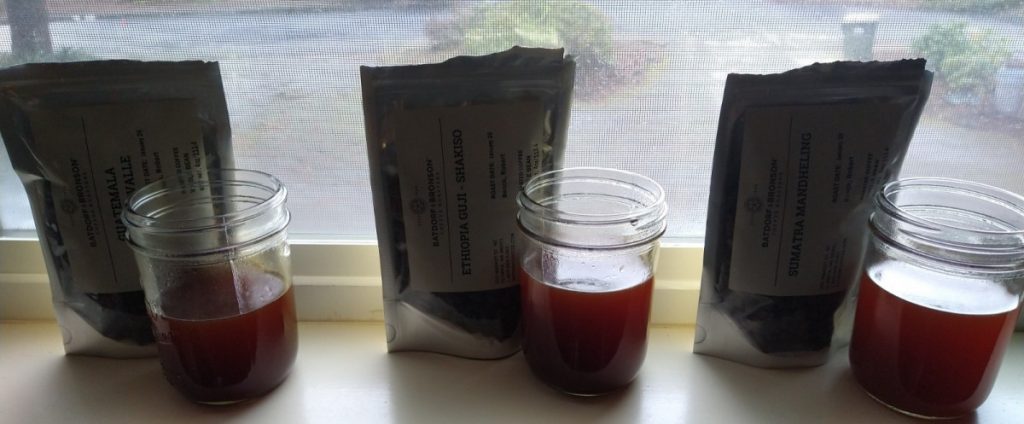
Because I missed the initial coffee cupping with Bob Benck, Ali, Val and I participated in a coffee cupping of our Batdorf and Bronson samples on Friday, March 5th, 2021. Ali was kind enough to lead our group through the tasting, as she has experience as a craft barista and had participated in coffee cupping previously. We enjoyed each other’s company and the lovely coffee!
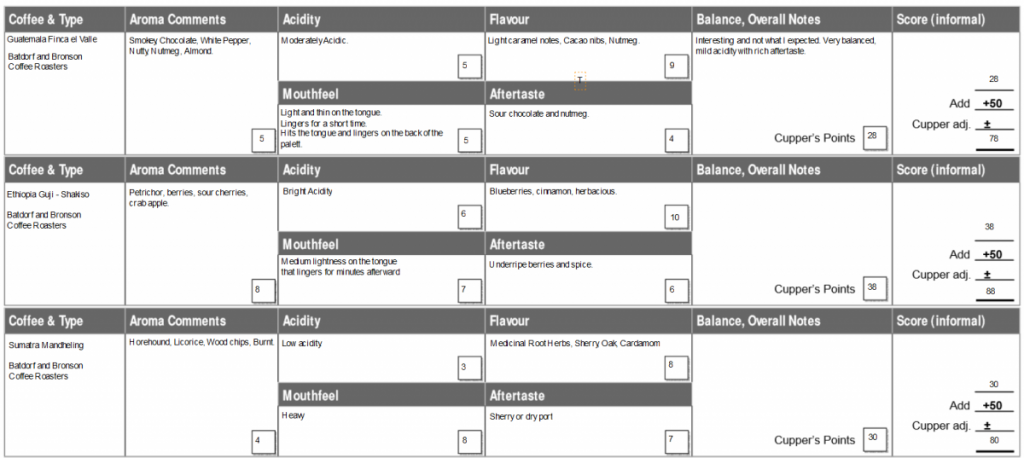
https://www.pdffiller.com/1086681-fillable-coffee-cupping-sheet-form
Image by Sarah Dyer.
Interactive Coffee Taster’s Flavor Wheel
Coffee and Water – How to Use High Quality Water to Brew the Best Coffee
How to Make Your Own Coffee Brewing Water?
The Story of How I Became a Q Grader
How to Taste Coffee – Learn from a Professional
•#3e: Stuckey’s Taste Book Experiments
The experiments done in this lab are all taken from Barb Stuckey’s book, Taste and adapted from the work of Caleb Poppe.
On February 10th, 2021, program aide Caleb Poppe led us on an exploration of the senses of sight and smell. We set out to trick our own taste buds by fooling our eyes. Then we attempted to discern which snacks our classmates had based solely on the sound of the food being chewed. The outcome was tremendously interesting!
Supplies you’ll need:
- Several different light-colored juices or flavored waters.
- Several different choices of your favorite snacks.
- The 3 different food dyes that we provided to you.
1st Experiment: “Can Color Color Taste?” pp 114, 115
In this experiment we will be trying to fool our taste buds by first fooling our own eyes. With the beverages that you brought to today’s experiment and the food dye baggies that I provided to you, you will be altering the color of your drinks until they are unrecognizable, such as turning your orange juice green, or your grapefruit juice a deep red.
Once you have the juices mixed and poured into separate glasses, you can begin to taste each drink one by one, paying keen attention to color before taking your gulp. Can you feel your mind wandering to different flavor ques in anticipation for the incoming beverage?
(Unfortunately, there will be an element of mystery missing from the whole experiment as we will be having to mix and change our own beverages, resulting in us knowing which color corresponds with which drink. Perhaps, if you have time, this can be done again with friends, family, or roommates in which you facilitate the experiment yourself!)
2nd Experiment: “Hear your favorite foods.” pp 131
To prepare for this experiment all you will need are your snacks and your imagination. You will be released out into breakout rooms in zoom with 3 or 4 other students and, armed with your snacks, you will begin quizzing each other on the cacophony of sounds the emanate from your snack when being chewed; that is to say, you will guess which snack your peer is chewing! For the first round, be sure to keep your snacks a mystery to everyone in your group to see whether your partners can guess correctly, without having any clue as to what snacks you brought. Once one person has gone through each of their snacks, they can reveal what snacks they brought to the table.
**If there is time, we will do another where we do another round of loud chewing, but now we will have some idea as to which snacks are being eaten.**
General Experiment Questions:
What snacks did you choose to bring to the experiments and why?
I chose to bring plain potato chips, hummus and cheese puffs to the workshop, because they all have distinct and interesting textures.
What beverages did you bring to the experiments and why?
I chose to bring water, orange juice and southern sweet tea. I was interested to work with orange because of Stuckey’s writing, and I chose sweet tea because it is a personal favorite and has a distinct taste and smell. Water seemed like the perfect control.
What is your favorite snack food? From your own perspective, what is the story of how your favorite snack made it to your hands?
My favorite snack food are dolmas; Dolmas are composed of seasoned rice, and sometimes vegetables, wrapped in grape leaves and marinated in a mix of olive oil, lemon juice and spices. I tried them for the first time at a small Mediterranean restaurant in Spokane, Washington called Azar’s. I remember clearly that a belly dancer was performing, but my attention was completely drawn to the dolmas; the texture of the grape leaves is wonderful and gives some bite to the otherwise soft snacks. They are hearty and dense, but also have a complex, bright and light sensibility to them.
1st Experiment Questions:
Please reflect on your experience through this experiment; did you notice any difference in how your mind prepared and received a drink of a strange color? Why do you think that you experienced it this way?
I was excited to trick myself with color, and wanted to experience a range of things. I chose water, orange juice and southern sweet tea as my drink subjects, each with a different goal in mind. I wanted to see if blue/gray water tasted dirty to me, and it did: bog water. I added red die to orange juice, and I perceived it to be sweeter, or at least less sour. I wanted the color of my tea darker, and wondered if it would taste richer, stronger, or sweeter. The tea seemed more satisfying, but because I couldn’t detect extra bitterness it didn’t feel stronger.
Why do you think some farmers grow different colors of the same vegetable?
Farmers might grow different colored vegetables simply because it’s different. When we think of green, we think of growth; when we think of other colors they change our food psyches in different ways. Purple vegetables are very popular, for example, and that popularity might relate back to the human association with elitism, privilege, divinity, and royalty.
Do you have an example from your own life where the appearance of a food affected your decision of whether or not to buy it?
The appearance of food is always a huge factor in buying my whole foods, though I obviously haven’t seen the foods which restaurants prepare for me; I suppose that I allow the cooks to take a lot of agency in preparing my food, a lot of trust.
If you were to cook and eat an entire meal while being blindfolded for the whole experience, what meal would you choose? Why?
I would roast a whole chicken with herbs de province, baby potatoes, and Brussels sprouts. I would probably make 3-ingredient flourless peanut butter cookies for dessert. The chicken, potatoes, and sprouts could all be roasted together in one pan, allowing me to forgo using open flames and boiling pots, as well as minimal knife work. The herbs have such strong aromatic properties that I would probably be able to assemble a proper mix blindfolded, and as long as I knew the weight of the chicken, I could determine proper cooking time.
The cookies are three ingredients, and they only use a cup sized dry measure for sugar and peanut butter and a single egg, so they are simple to prepare. Additionally, they sometimes need adjustment, with additional sugar or peanut butter depending on brand/type. To get this cookie right, the dough texture is key, and I know I could assemble it properly with my hands.
2nd Experiment Questions:
Please reflect on your experience through this experiment; did you find it difficult to guess the snacks purely on the sound they make when being chewed?
I couldn’t guess a single snack, but I enjoyed trying to guess. It surprised me how close a chip sounds in comparison to anything crunchy. However, my cheese puffs were recognized after a guess or two.
Is there a certain food that you particularly enjoy the sound of (eating, cooking, drying, boiling, etc.)?
I love the sound of a dehydrator. My grandfather used to make jerky and dried apples every winter. He kept his dehydrator in the laundry room, where the smell wouldn’t bother my grandmother, who is extremely smell sensitive. I remember how warm that room was; I would sneak in to thieve jerky, and I specifically remember the hot, sweet smell and the feeling of hot air blowing across my face. The sound of a dehydrator makes me smile before I see it.
Bonus Question: If you had to choose one of your five senses (sight, smell, hearing, tasting, or touch) to give up every time you ate a meal, which would you choose? Why?
I would choose to lose my hearing. I would feel most comfortable losing hearing because I rely on my other senses, particularly smell, when I eat, and I have significant hearing loss on one side already.
How Do Different Senses Affect the Way We Taste?
Sense of Smell and Coffee – How Can You Improve Your Smelling?
Flavor of Coffee is a Matter of Flavor
Salt in Coffee – Does it Make Sense?
•#3f: Sustainable Entrepreneurship
Week 6 Reflective and Preparatory Diary Entry
Based on the readings, class discussions and presentations, I reflected on the following questions, where I attempted to use illustrative examples from the literature, resources, discussion we have had thus far.
Question #1: Does the cooperative model, in its many forms, inherently encompass sustainability and regenerative agriculture values? Why or why not?
The cooperative model is not inherently completely sustainable, as co-op’s have no duty beyond meeting their members’ needs. However, there is a clear and direct linkage between sustainability and how cooperatives describe themselves (the Seven Principles), though the relationship to the social and community dimensions of sustainability are stronger than those of economy and environment. The values of the members are at play in a cooperative’s sustainability, though cooperatives are based on stated values which include self-determination, democratic leadership, equality, equity, and solidarity: all concepts common to sustainability discourse. In terms of producer cooperatives, adopting sustainability and a regenerative agriculture makes sense in terms of long-term ability for the co-op to thrive. Ultimately, the inherent sustainability in a cooperative is that it is a community of people and not an investment vehicle, where invested capital is entitled to a return but is not the impetus for unrestrained growth.
Question #2: What is the potential for the alternative business model presented last week (cooperatives) for transforming and strengthening our local food and agriculture system in the South Puget Sound area?
There exists great potential for cooperatives to strengthen local economies and food security within their communities. Local cooperatives, such as Tulip Credit Union and The Olympia Food Co-op, work to support our local food and agriculture systems, and I local and regional farmers’ cooperatives could begin to close the loops in our Puget Sound food systems.
Question #3: How might a worker-owned cooperative model challenge our traditional conceptions of “work”?
If we look at Marx’s Four Aspects of Alienation, we might say that the capitalist model of work separates workers from the decisions surrounding products of their labor, and that workers are separated from how the work is done and do not determine “pacing, patterns, timing, tools, or techniques of their work.” Workers are thus, denied the capability of being creative in their work. Additionally, capitalist workers work as isolated individuals and not part of an effort to meet a group need. In Marx’s system alienation is called that condition of man where his “own act becomes to him an alien power, standing over and against him, instead of being ruled by him.” Erich Fromm says “[The worker] spends his time doing things in which he is not interested, with people in whom he is not interested, producing things in which he is not interested.” In a worker cooperative, however, workers own their jobs and can thereby decide how they are treated and how they want to operate the business. Worker cooperatives break the alienation of traditional capitalism, creating room for job satisfaction and capable of meeting all the worker’s needs, up to and including self-actualization.
•#3g: Climate and Resilience Event Series/Seminar
“More Spare and More Concentrated: Eco-Media and the Traditional Ethiopian Coffee Ceremony”
Video by Evergreen Media Services.
In exploring Climate Justice and Resilience Speaker Ruth Hayes’s presentation, “Eco-Media: The Environmental Footprint of Media and the Myth of the Cloud”, I connected the semiotic process in media and a quote from filmmaker Robert Schaller, and then applied that thinking as a framework to the terroir-laden art form of the traditional Ethiopian coffee ritual.
I was first struck by a quote of Schaller’s, which Hayes presents in the context of Nadia Bozak’s discussion of the huge overproduction of media images. She states, “Robert Schaller’s pinhole camera motion pictures are an example. Schaller made his camera from two plastic 16-millimeter film boxes. He hand-cranks the film through it, hand processes it, and sometimes creates his own homemade emulsion. He wrote in notes accompanying this film, Under the Shadow of Marcus Mountain, “Our eyes see constantly, but what do we actually notice? That vision is excessive, wasteful even. In pairing it down it becomes more spare and more concentrated.” (40:34 – 41:10).
Later, during the Q&A portion of the event, is was drawn to what Hayes defined as the stages of the semiotic process: “…part of experimental film making is recreating or creating situations of firstness and I think this is a thing that a lot of audiences initially have frustration with when they first are exposed to experimental films because they come in with an expectation of mediation. But in an experimental film, the expectation should be that you have no expectations, and that part of the experience is you watching your own response to this thing that’s happening in front of you or around you or however it’s being presented and then afterwards you begin to go into the secondness and the thirdness where you’re just describing your reactions and what you saw and then naming it…while you’re watching films be taking notes: what do you see, what do you hear, what are you feeling, what is going on? That’s the firstness, and then you move to description and analysis. So those are different stages of a semiotic process.” (59:57 – 61:48)
The traditional Ethiopian coffee ceremony begins with the host, always female, spreading an assortment of fresh grasses and flowers on the floor and table. An incense burner, typically filled with frankincense or sandalwood, is lit, filling the air with an intoxicating aroma. Raw coffee beans are washed before being roasted thoroughly in a skillet over an open charcoal fire, until the beans are black and charred. The host will encourage guests to smell the strong beans, the aroma of coffee mixing with the incense. The beans are ground with a pestle and mortar, before being added to the jebena, a special spouted pot containing boiling water, which is placed back over the charcoal in order to brew. Brewing coffee in a jebena is one of the oldest methods of making coffee and participating in an Ethiopian coffee ceremony is one of the most generous, ritualistic ways to drink it.
Once the coffee is brewed, the host carefully pours it into handleless demitasse cups. The cups are filled right to the brim, but not a drop over, and poured slowly and evenly about one foot above the cups. The coffee is bitter, thick and potent, and often paired with savory snacks like popcorn or puffed barley. Using the same beans, the process is then repeated twice more, in between cups, more water is added to replenish the pot. This continues until the ceremony is complete. The whole ritual can take well over an hour. The three cups each have a distinctive role in the ritual. Arbol, the first, is the strongest. Cup number two, or tona, is milder after the second brewing. The final cup, berekha, holds the most importance as it is seen as a blessing.
In applying Schaller’s quote to terroir, and particularly coffee, one might say that we drink-in cheap coffee constantly, but that our tasting is excessive and wasteful, borne of the commodity coffee industry which cares relatively little for the product or producer. His answer to this overconsumption is to pair-down the constancy of the stimuli, the assault to the senses, in order to concentrate the sensory experience, rendering it special, ceremonial, spiritual. It is said that a transformation of the spirit takes place during the three rounds of the Ethiopian coffee ceremony thanks to coffee’s spiritual properties.
Schaller’s own work creates materials, tools, and methods on a personal, non-industrial scale: visual terroir, in which the production is as important as the product. Adding Hayes’s explanation of the semiotic process, one could relate the traditional three cups to ideas of firstness, secondness, and thirdness; the strong first cup gives way to something milder, and perhaps more complex, which in turn becomes a blessing. It is through sensory understanding that those blessings are made manifest, opening a door for description and analysis. You experience the cup in its fullness, and “in pairing it down it becomes more spare and more concentrated”, which is the essence of terroir.
Video by VPRO Metropolis.
The Origin of Coffee
Coffee and Climate Change: Snow in the Sahara and Heavy Rains in Costa Rica
•#3h: Foodoir: Your Story of Tasting Place
“Another moment several years later impressed me with the power of aroma alone. I had managed to grow what looked like an oversize taste bud on the tip of my tongue, maybe an eighth of an inch across: a good joke for a food writer! Eventually I saw a specialist who advised removing it. He gave me a local anesthetic, snipped it out, then cauterized the wound with an electrical instrument that burns and seals the blood vessels. There was a puff of smoke, and I smelled the typical aroma of beef on a very hot grill, burned but also slightly decomposed. A surprise, but it made perfect sense: it was the aroma of grilled McGee! Another good joke. And as I had that lighthearted thought, I got light-headed, then leaden-limbed, and broke into a cold sweat. The physician quickly reclined the chair, and in a couple of minutes I was fine again, just embarrassed. I had thought that I was taking the experience in stride, even relishing the irony, but my body ambushed me. Another unforgettable moment and smell.”
Harold McGee, Nose dive: a field guide to the world’s smells, preface
Sucking Lemonheads in the E.R.
At 8:30 PM, my partner called to me from the living room that dinner was ready: shrimp linguini with sundried tomatoes and capers in a white wine sauce. I’d been working for hours and had forgotten to eat lunch, and my mouth watered in anticipation. I enjoyed the entire dish thoroughly, down to the last bite. Right up until my face started swelling.
It started with a pinching sensation at the back of my jaw, which I equate with eating anything extremely sour. This feeling is normally followed by excessive salivation, but my mouth was dry. And the pinching feeling wasn’t going away. I rubbed my jaw, slowly beginning to realize that the annoying sensation wasn’t subsiding and that my jaw was swelling. I asked my partner if I was crazy, and he stared back stoically and said, “Defiantly swollen.”
I ran to the mirror; the left side side of my face and neck was, for lack of a better word, engorged. I prodded the lump experimentally, and the sensation was one of intense pressure, not pain. It was bigger than an egg, smaller than baseball, and had appeared out of nowhere. My mind started to race.
Not an allergy. I’ve never had a severe reaction to any food, and the swelling is only on one side, and I’m breathing fine.
Yelling to the other room: “Wouldn’t it suck if I were allergic to seafood?, Do you think its an allergy?, Should we go to the E.R.?, How big is it?”
Take a baby aspirin. Take a Benadryl, just in case.
Not a reaction to trauma. This is too sudden. Blood clot.
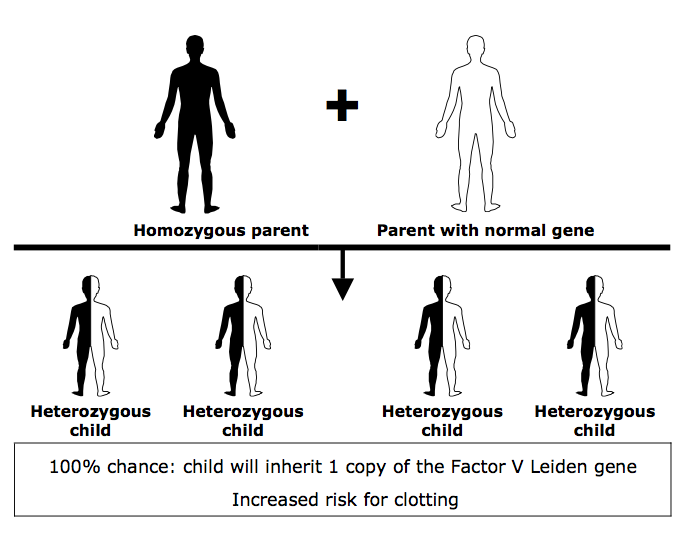
Image from stoptheclot.org.
My mind always goes to ‘blood clot’. My father passed away at the age of 32 because of a blood clot. Only after his death did we discover that he was a homozygous carrier of a genetic disorder called Factor V Leiden. I am a heterozygous carrier of the same disorder, and I had my first major clot in 2015 and my first stroke in 2016.
I was sure I was having another stroke. And in that moment I had a flood of seemingly random thoughts. I replayed my stroke in my mind, reliving the event, trying to classify whether what I was feeling now was the same sensation. I remembered my father’s funeral. I remembered the feeling of outliving my father, the birthday in which I surpassed him for time on Earth. And Sanford and Sons.
I started laughing hysterically in the car on the way to the hospital. My partner looked nervous. “What’s so funny?” Sanford and Sons I giggled. Holding my neck I put on my best Redd Foxx rasp. “Elizabeth, I’m coming to join you honey.” I erupted into peels of laughter, bordering on hysteria. “Who’s Elizabeth,” he asked me, obviously confused. “Shut-up dummy!”, I shouted back. He looked at me as if I’d lost my mind. I spent the rest of the ride to the hospital laying out the finer points of the sitcom, explaining how Fred Sanford manipulates his son with constant threats of “the big one”.
The Emergency Room was quieter than I could have hoped, and after I explained my anxieties, I was seen fairly quickly. The doctor was very kind and conducted a thorough exam. I was prepared for the worst: surgery or blood thinners. It was at this moment, as I was drumming-up all of my fortitude to accept bad news, that I heard the doctor say, “I think you have an irritated salivary gland.

I looked at her incredulously. “What?”
An irritated Parotid gland, I think, or you might have a salivary stone. You don’t have a clot, but I want to look inside your mouth for abscesses just in case. Reaching into my open mouth, she prodded the back of my jaw, and seemed satisfied. She prescribed me antibiotics in case of infection, but the one sure-fire cure for a blocked or irritated salivary gland is a basic taste- sour. Sour candy, lemon juice, or anything else that might make you pucker was recommended.
I was so embarrassed at my borderline hysterics for what had turned-out to be a fairly innocuous, common medical condition. But my relief and gratitude outweighed any embarrassment substantially. Hot packs and sour candy. Ok.
I waited outside of the E.R. for my ride; my partner had gone to a friend’s place to wait for me, as Covid rules don’t allow anyone to accompany the patient. I dropped into the front seat and was grateful for the soothing heat. “We need to stop at the 7/11,” I said. “Why,” he asked.
“To fill a prescription.”
Leave a Reply