
•#2a: Film Series: Program Questions in Scenes
“A Grain to Dismantle Late-Stage Capitalism”
I titled my scene from the Patagonia film Unbroken Ground, “A Grain to Dismantle Late-Stage Capitalism” (13:34 – 16:11) to explore the two program questions: “How can terroir/meroir best be understood, represented, and shared? What disciplines, practices or media are needed and why for knowing and communicating the following aspects of terroir/meroir?” and, “What is meant by regenerative agriculture and how can it guide us towards farming and food system sustainability?” I’ll call my audience’s attention to the ‘magic’ Skagit Valley, the light and uplifting music, the “patchwork quilt” of fields, the pastoral aesthetic of the shots, and the tiny seed at the center of it all, as well as the words of breeders and farmers working within the Skagit Valley.
The beginning of my scene introduces the viewer to the ‘magic’ Skagit Valley; light, ethereal music plays over a high aerial shot of the idyllic farming community: a patchwork quilt of fields. Local farmer Dave Hedlin of Hedlin’s Family Farms credits the success of Skagit Valley’s agriculture to the maritime climate and wonderful soil: the terroir. The scene cuts from Hedlin to an extremely pastoral scene: a pair of farmers riding a tiny combine through a small patch of grain. Hedlin continues, “Frankly, it’s a real privilege to farm here, but it’s also a big responsibility because you don’t want to be the generation that let it go.”
Over scenes of healthy fields and active farm work, Dr. Stephen Jones, Director of WSU’s Bread Lab, explains that his mission in selectively breeding grain is to make what they do “work for the farmer.” He continues, “As plant breeders, [who] don’t do GMO or genetically modified anything, make a crop that can yield a little more for the farmer and have the right functionality and flavors and nutritional value.” The scene now cuts to Keith and Crystie Kisler of Finnriver Farm and Cidery, who’ve grown 4 acres of Koto buckwheat; Keith explains that the buckwheat is special in that it will feed humans as opposed to becoming animal feed, and he displays a unique and impressive attitude regarding the interconnectedness of human and environmental health. Over scenes of his buckwheat harvest and close-ups of the soil at Finnriver Farm, Kisler says, “[It] would be easier if the whole valley was one crop; you know, we just went and did that crop and sold it on contract. But I think it’s healthier for the farmer to have this diversity: it’s healthier for the soil, it’s healthier for the community”.
The voice of Doctor Jones appears over wide shots of the buckwheat field and a close-up shot of the seeds in the Kislers’ hands. “Buckwheat. We use this sort of a symbol of attempting to keep value where it’s produced. It’s really a nice model of this. It’s a reedy decentralization of what we do.” This spoke to me in the same way of Kristy Mucci’s article in Heated, “A Chicory to Dismantle Late-Stage Capitalism”, hence the name of my scene. Hedlin reappears at the end of the scene with a stack of fresh barley, some set to be malted and some to be shipped to an organic distiller. Hedlin goes on to say that he will measure the success of his farming methods through their long-term circumstances: “If a hundred years from now there are viable family farms on this valley floor and salmon in our rivers like there are now and ducks and waterfowl and shorebirds and everything that we have here: if a hundred years from now all that still exists everybody wins.”
The scene ends with a sunset shot over a farm and orchard, the sun blazing center screen covering the landscape in warm tones and leaving the viewer with closing text describing the continued mission of the WSU Bread Lab to develop diversity in locally grown organic grains. I’ll share how this scene compelled my learning surrounding the marketing of regenerative agriculture techniques, diversified crop development, and terroir for my audience to better understand the interconnectedness of the health of environments, people and economies.
“The Horse Is Not Economically Independent, Nor Is the Woman”
I titled my scene from the James C. Scott lecture How Grain Domesticated Us, “The Horse Is Not Economically Independent, Nor Is the Woman” (46:30 – 48:11) to explore the program question: “What model best enables you to articulate what you are learning about your taste of place in relation to history, nature and culture.” I will call attention to Dr. Scott’s research connecting grain and animal domestication to female domestication– at the reproductive service of the patriarchy.
Throughout my scene Dr. Scott stands behind a lectern in dim lighting. He states, “the systematic use of products of the living animal, particularly its reproductive functions, are what sets animal domestication is apart from intensified hunting. Although I don’t have time to make the argument here, I think I might argue that the way to understand domestication is the way in which Homo sapiens takes over and manages the reproductive functions of plants and animals that are domesticated. That is to say, to change the reproduction and control of plants in order to produce the seeds and fruits that are desired to in a sense take over what had been wild animals (herd animals) and tutor and to organize their reproductive functions so as to maximize the amount of meat or other products that they produce.”
“And I would argue that if we are to understand domestication as the control over production, it is fruitful to extend it to the first agrarian societies in which you have property relations and the patriarchal family, in which the reproductive services of women become extremely central and their productivity in producing laborers, and if you like domesticated animals, for the patriarchal family is absolutely central as well. It’s when you get the Domus, and you get the statues of women in which their reproductive functions are exaggeratedly represented in the sort of Neolithic statues of women, that I think points in that direction.”
It is interesting to note that after announcing that he will not make one, Dr Scott goes on to make an excellent argument tying the patriarchy to domestication and the early formation of states. I connected this lecture to Richard Wrangham’s book Catching Fire: How Cooking Made Us Human, as well as Charlotte Perkins Gilman’s book Women and Economics: A Study of the Economic Relation Between Men and Women as a Factor in Social Evolution, from which I drew the title of my scene. In her book, Gilman states, “The labor of women in the house, certainly, enables men to produce more wealth than they otherwise could; and in this way women are economic factors in society. But so are horses…the horse is not economically independent, nor is the woman.” I’ll share how this scene compelled my learning about proto-terroir, domestication and women in order for my audience to better understand that the patriarchal control of women’s bodies has occurred since before the existence of the state and that the domestication of plants and animals led to the domestication of women.
•#2b: (un)Natural Histories
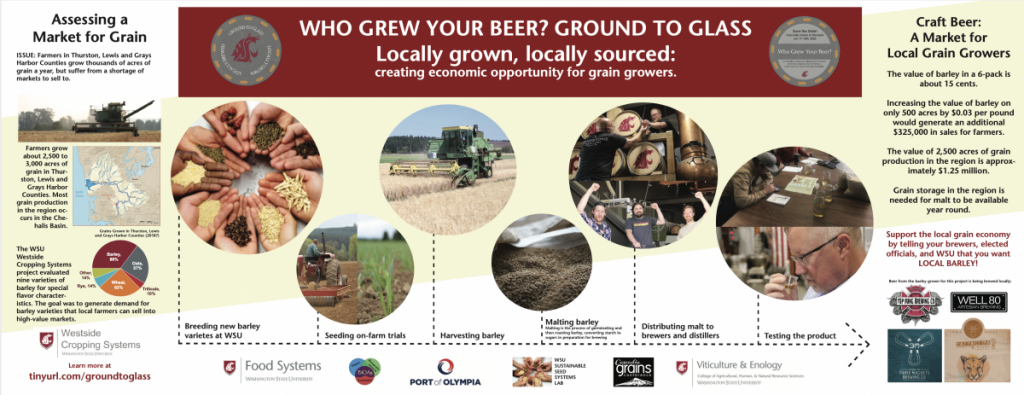
Image by Stephen Bramwell.
We had the opportunity this week to read and annotate Stephen Bramwell’s grain project report “From Ground to Glass“, as well as talk to the author in person. The WSU Westside Cropping System project evaluated nine varieties of barley for special flavor characteristics. The goal was to generate demand for barley varieties that local farmers can sell into high value markets.
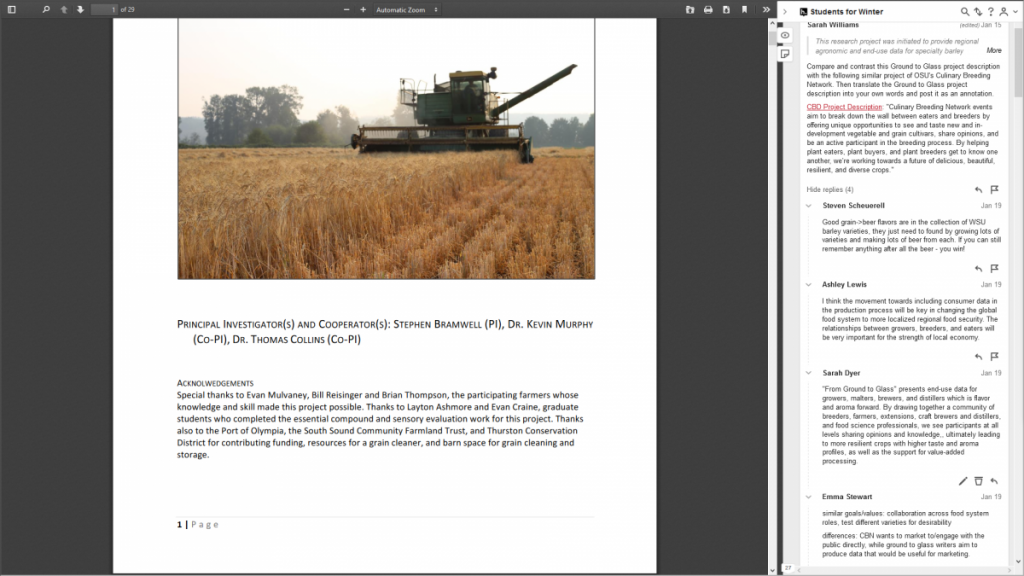
Image by Sarah Dyer.
Ultimately, the project demonstrated enormous interest among the craft malting and distilling industries, as well as the general public. Locally produced, experimental malting barley varieties were met with initial skepticism among brewers, but eventually great enthusiasm. The general public indicated overwhelming interest at the sensory evaluation held at the Tumwater Brewfest in August 2019. Additionally, well established craft distillers in Seattle, WA and elsewhere are eager to be involved in and support additional WSU varietal and flavor evaluation research that could supply the industry with regionally distinctive malt. Brewers purchased over 3,500 lbs of malt to experiment with, and had placed orders for more malting barley at the completion of the final report.
Video by Flowstate Creatives.
Barley
Perennialized Grains
Chestnuts
•#2c: Regenerative Agriculture
Weeks 3 & 4 Regenerative Agriculture Workshop: Grains
1. Why grain plants? List benefits as food, straw, soil conservation.
Multiple avenues of value-added products. Feed and fodder for various kinds of animals. Thatching for roofs and cob houses. Ability to weave baskets, and some clothing. Cover crop and green manure amendment. Sustenance. Root systems preventing erosion. Nitrogen fixing.
2. List challenges/problems with grain crops for human and environmental well-being.
Grain crops must be rotated, or they will deplete the soil. Health issues (e.g. diabetes) caused by over-consumption. Ergot-ism, like the Salem Witch Trials. Deforestation to produce boutique ancient grains like quinoa in monocultures.
3. What is meant by spring, winter, and facultative grain crops (e.g., barley or wheat)?
Winter crops are sown in fall and are harvested in summer; winter wheat must undergo a process called vernalization, which is the induction of a plant’s flowering process by exposure to the prolonged cold of winter, or by an artificial equivalent. Spring crops are sown in spring and harvested in fall. Facultative crops are sown in winter or spring and need a vernalization time of 15 to 30 days of temps around 37 to 59.
4. What is vernalization and why is it important to understand for growing grain crops?
Vernalization is defined as the qualitative or quantitative dependence of plants on exposure to a low temperature to flower. Temperature affects flowering, metabolic activities, and germination of seeds in plants.
Plants such as wheat and barley have a ‘spring variety’ and a ‘winter variety’. The ‘spring variety’ is usually planted in the spring season. As a result, it flowers and produces grains by the end of the growing season. The ‘winter variety’, however, is planted in autumn. It germinates over winter, grows in the spring and is harvested in summer. In contrast to the spring variety, the winter variety will not flower or produce grains within the flowering season if planted in spring.
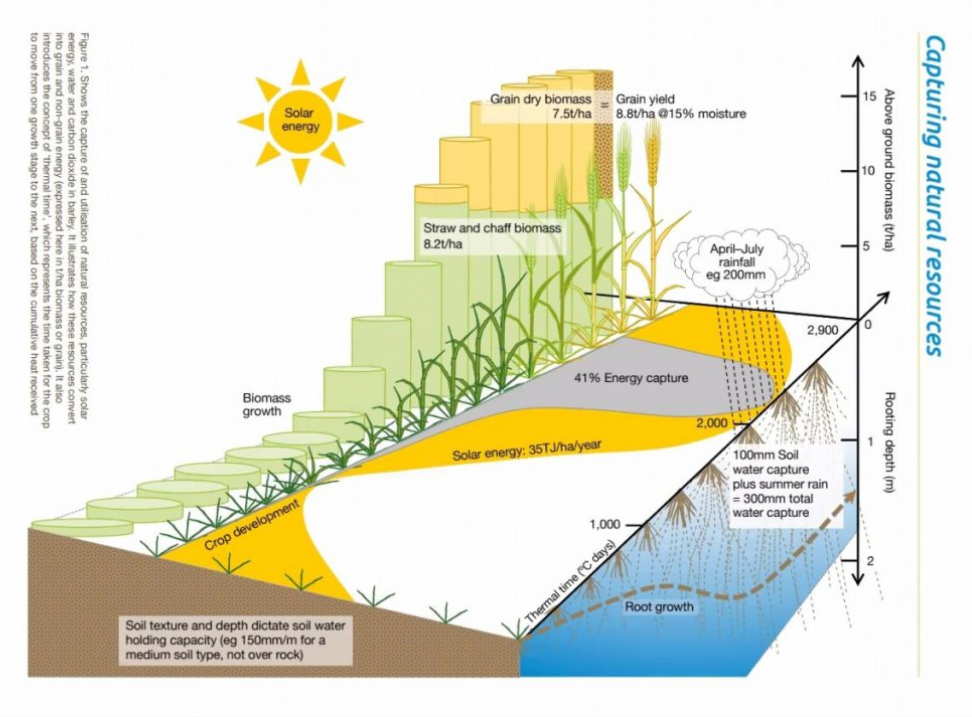
5. For barley, explain how growing degree days are used to predict plant development.
Growing degree days are calculated using temperature variations and are used alongside phenology models to forecast crop stages. This helps accurately predict and anticipate plant development phases.
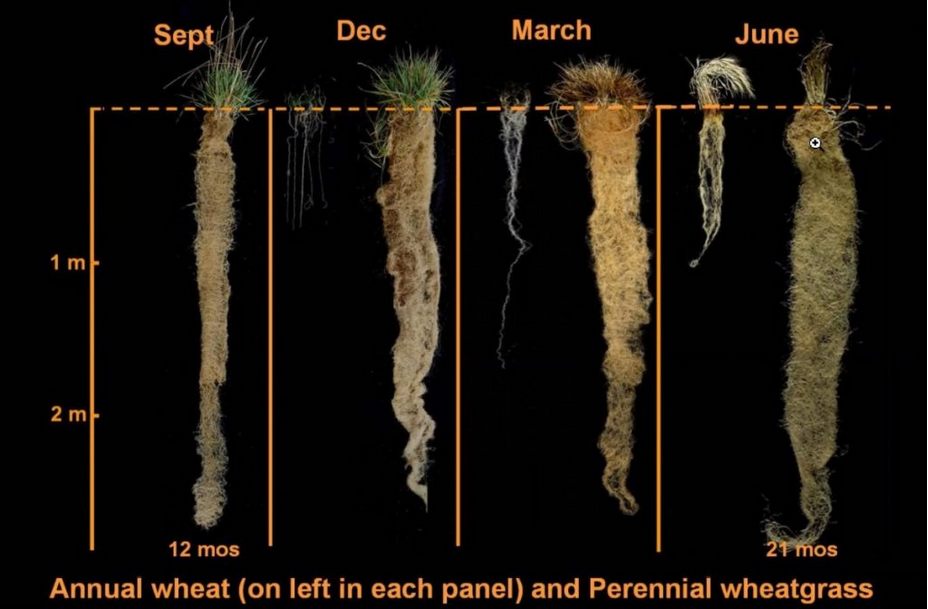
6. Grass-family grain root systems – what is the general form the root systems take and how can this positively impact soil structure?
Grass-family grain root systems are extremely long and thick. Grass roots help improve soil structure by increasing porosity and adding organic material that helps bind soil particles together. In compacted or clay soils, spreading roots break up soil and create pathways through which water can seep deep within the subsoil.
7. Discuss what you have learned about using grass-family grains for cover crops.
They are cheap to plant and easy to manage. They’re easy to control, and the threat of weediness is low if they are properly controlled. They are good at uptaking nutrients, and
Their root masses penetrate downward and outward, scavenging nutrients from manure applications and leachate from the previous crop. They are among the best sources of over-winter soil organic matter, and small grains are a better source of active carbon than legumes, which has many benefits for soil. Soil organic matter supports improved soil biological diversity, water infiltration, drainage, nutrient availability, and retention of water and nutrients.
Small grains begin growth quickly, especially in early fall with late summer residual heat. Even a few weeks into their growth, soil infiltration is improved. All small grains are valuable to break up a rotation with early or late season vegetables, anything from garlic to tomatoes to pumpkins, since they provide the break of grasses in a heavily broad-leaf-based rotation. They buffer soil against extremes in temperature. There are few pests or diseases they host that will be a problem for the rotation as a whole – unless you have an exclusively small grain rotation (not advised).
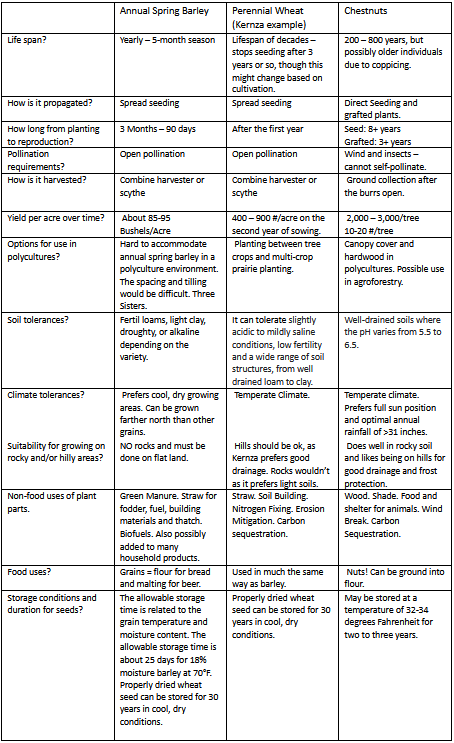
Comparative Analysis of Annual Spring Barley, Perennial Kernza, and Chestnut Trees
•#2d: Case Study Tasting Research: Grains
Cascadia Grains Conference
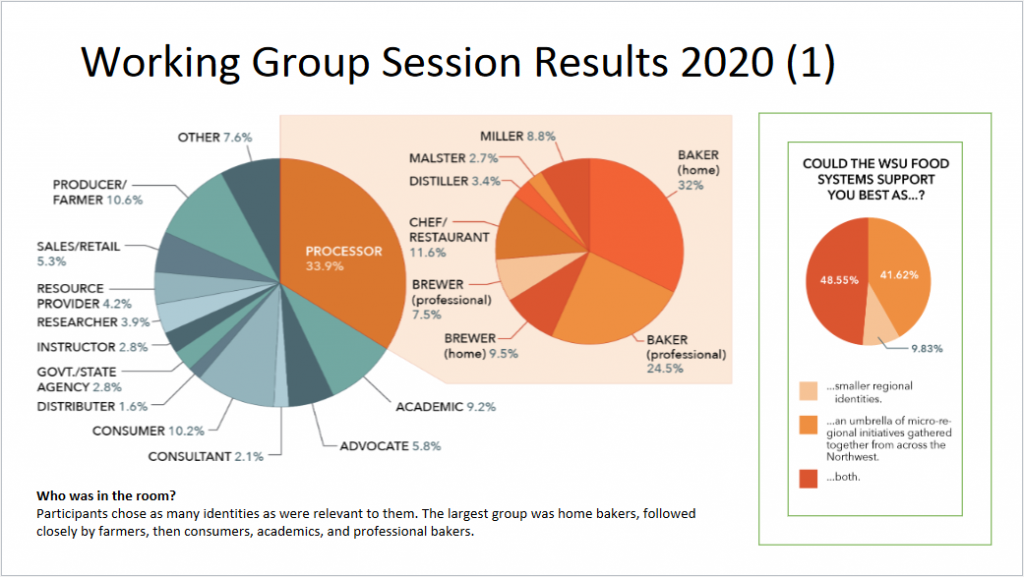
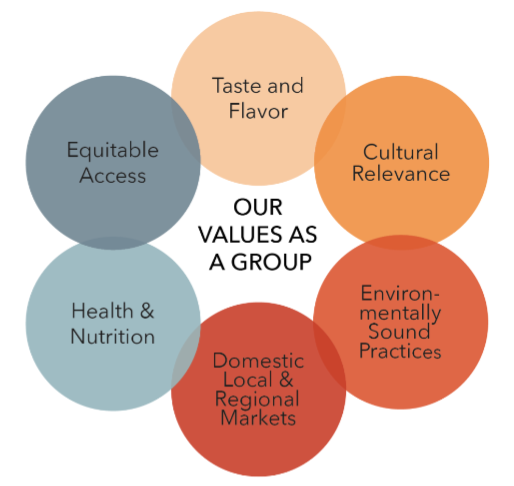
Image by Aba Kiser.
On Tuesday, January 19th, Aba Kiser presented a short lecture to our program concerning the Cascadia Grains Conference. This yearly event connects grain enthusiasts in the Pacific Northwest and provides an environment for brewers, bakers and farmers to network, listen, share, and taste.
The Conference provides an opportunity for stakeholders to grow a local grain economy – connecting with each other and consumers to regionalize craft grain production in the PNW. Cascadia Grains’ mission as re-vitalizing a culturally-relevant, environmentally-sound, regional grain movement in the Cascadia bioregion that is focused on equitable access, health and nutrition, and taste and flavor.
Cascadia Grains
Terroir of WA Grains: Malt Sensory Lab
We welcomed Stephen Bramwell, Director of the WSU Thurston County Extension Office, to our program meeting this week to lead us through a Malted Grains Sensory Lab. We also had the opportunity to study and annotate his grains project report, “From Ground to Glass.” (See #2b) Our tasting matrix is adapted from the 2019 Tumwater Brewfest Sensory Ballot provided by Stephen Bramwell.
Directions:
Use about 1/4 of each of the 3 grain samples when answering questions in Part I; use remainder in Part II. In preparation for the barley tea in Part II, boil water and pour 1/2 cup over each sample in three separate clear or white lined glass cups or heat safe glasses. Set aside and let steep for 15 minutes. Complete the following analysis by tasting each malted grain variety and cleansing your palate in between tastings. Use water and crackers to rinse your palate between samples, if you would like.
I) Malted Kernel Tasting
- Taste one sample at a time
- Provide a short description in your own words
- Then rank the samples in your order of preference
Sample 1 Description: (Skagit=100) – Extremely nutty and sweet. Pecan pith and nutmeat. Savory finish akin to garbanzo beans. Tea.
Sample 2 Description: (Wheat=200) – Mild and gluey. Almost no definable taste. Thick.
Sample 3 Description: (Copeland=300) – Grassy and bright. Slightly bitter. Chalky.
Rank the samples by writing the three-digit sample number in the appropriate box based on your overall liking of each sample. When determining overall liking, consider the sample’s appearance, flavor/aroma, mouthfeel, and aftertaste.

Now choose as many attributes as you would like from the provided MALT FLAVOR Maps that you think best differentiate the samples.
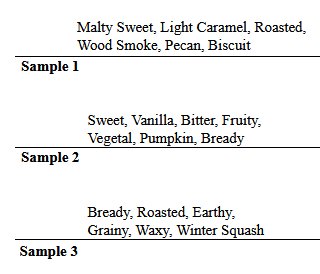
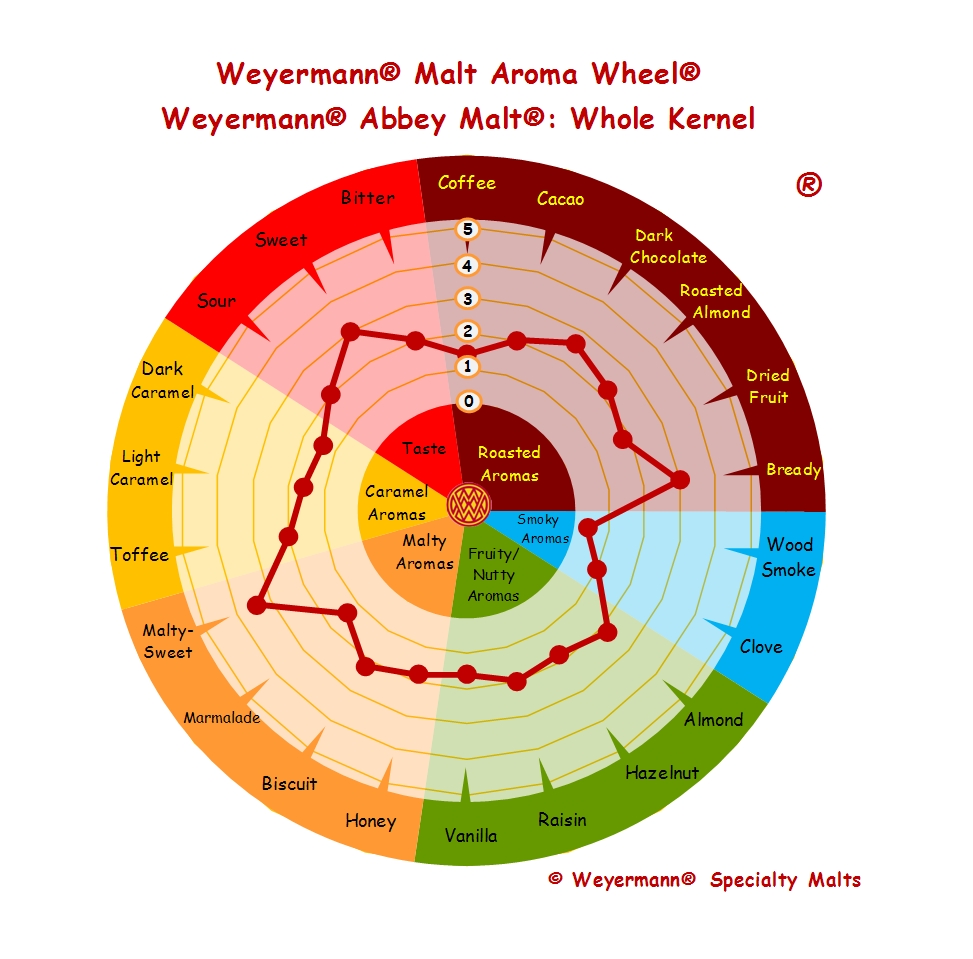
Image by Weyermann.
II) Hot Steep Analysis: Adapted as “Hot Malted Barley Tea Analysis”
It should now be about 15 minutes since you boiled water and poured ¼ cup over each malted grain sample in three separate clear or white lined glass cups or heat safe glasses. Complete the following analysis by tasting each tea and cleansing your palate in between tastings.
Choose as many attributes as you would like from the provided MALT FLAVOR Maps that you think best differentiate the samples.
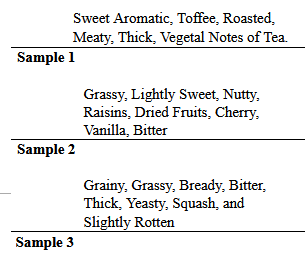
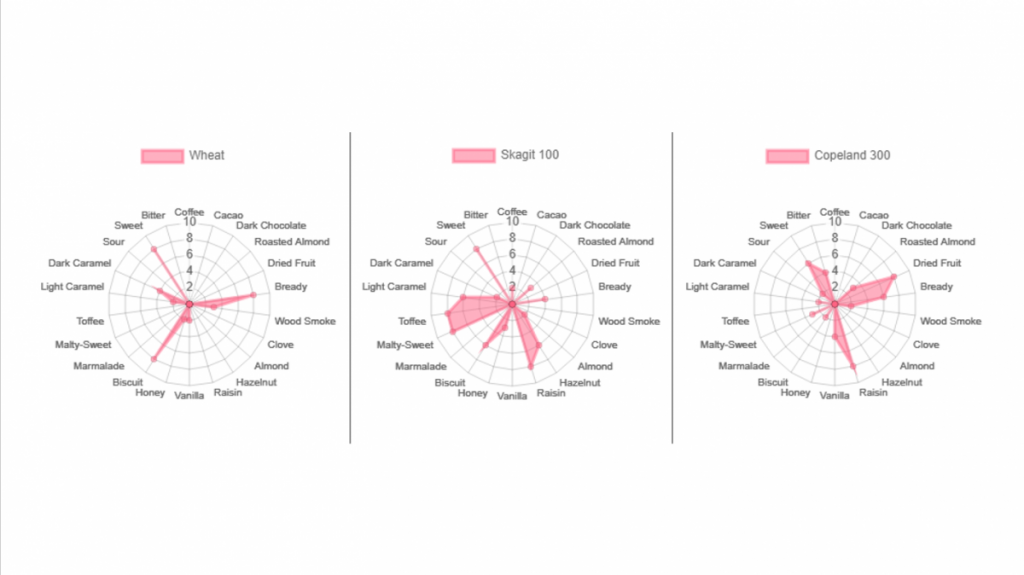
Image by Sarah Dyer.
Craft Maltster’s Guild: Malt Sensory
Malting Barley Characteristics for Craft Brewers
Breakthroughs in the Science Behind Malt Flavor
New Research Links Base Malt Flavor to Drinkers’ Beer Preferences
•#2e: Stuckey’s Taste Book Experiments
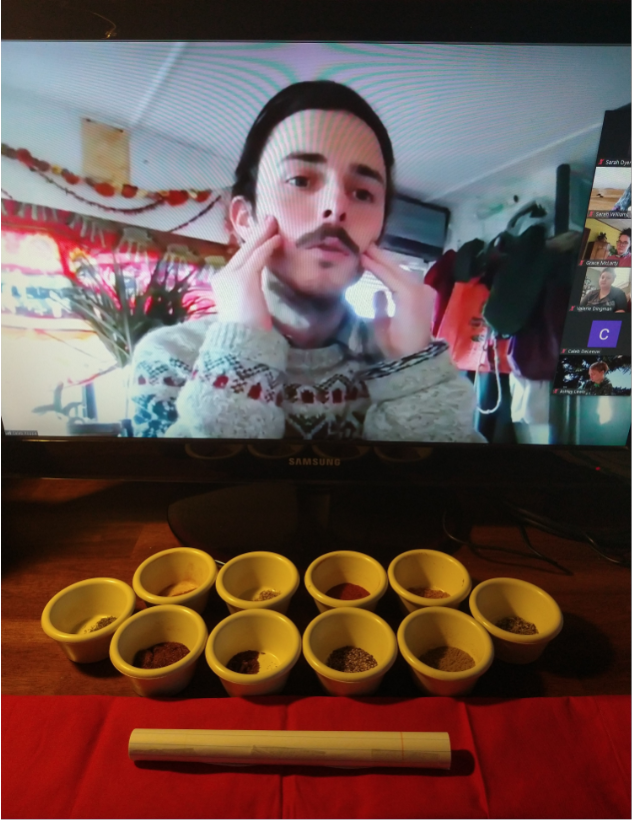
Image by Sarah Dyer
In this week’s taste experiments we dove deeper into our own senses of smell and aroma. Led by program aide Caleb Poppe, we walked through 2 experiments this week, a modified Nose Smelling vs Mouth Smelling on page 75&76 and the Spice Rack Challenge on page 77&78.
Supplies you’ll need:
- Spices, fresh AND dry if possible (10 max)
- A couple of clean cups
- A rag or paper towel
- A clean piece of paper
- Paper and pencil/pen
1st Experiment: “Taste what you’re missing: Spice Rack Aroma Challenge” pages 77, 78
In this experiment we put our powers of olfactory recollection to the test! After we had gathered up some of our spices, we were asked to put a small amount of each spice into its own individual cup so that you have various cups each containing a single spice.
For some of our fresh spices it was good to rub them back and forth in our hands a few times before placing them into the cup to release some of the volatiles – once the spices were in the cup, we gathered them close together and covered them with a towel.
With the spices staged – we randomly pulled-out a cup with a mystery spice, smelled it, and guessed which one it was! No peeking! Once we made our guess, we opened our eyes to see if we were correct! If we guessed correctly, we set it aside (to use later). If we guessed incorrectly we put it back under the towel and gave it another go. We did this until we hd blindly guessed all of our spices!
**Challenge Stage!** With our eyes closed, we mixed a few of the spices together and shook them up so that they become homogeneous. This may also be done with already mixed spice blends that you may have in your spice rack, with blended curry seasonings, or even with coca-cola. Once we had a few cups of mixed-up spices, we covered them with the towel and did the challenge again, trying to differentiate which spices were mixed together.
2nd Experiment: “Taste what you’re missing: Nose Smelling vs. Mouth Smelling” page 75,76 (MODIFIED)
Instead of using juice, butter, and peanut butter, we used the spice samples that we were using for the earlier experiment. We reset your cups so that they each contained a small amount of a single spice and covered them up with a towel.
Now that we had tested our nose’s detective ability in trying to differentiate between smells, we played around a little with mouth smelling, that is, retro-nasally experiencing these spices. We were asked to have a clean piece of paper for this experiment in lieu of unnecessary plastic straws, instead rolling the piece of paper into a straw-like structure. Throughout this experiment, we kept our cups covered with a towel, ensuring that the majority of the volatiles remained within the cup.
Now grab one of your spice cups and keep it covered, try to weasel your ‘straw’ under the rag so that we don’t lose too many volatiles and go ahead a breath in through the straw.
Still keeping the cups covered with a towel, we squeezed the paper straw under the towel and into the cup, careful that the straw is not actually in the spice. Breathing in through the straw, we were asked to remain reflective as we moved from one spice to the next. Did these spices retro-nasally smell differently than they nose smelled? How was this different than just smelling them with our noses?
We finished the experiment by taking small tastes of the spices that we had been using, paying attention to what senses were being triggered.
General Experiment Questions:
What spices did you decide to bring to this week’s experiments?
I chose ten spices, all dried: Dill, Paprika, Coriander, Parsley, Sage, Black Pepper, Cloves, Thyme, Chili, and Cinnamon.
What is a fond memory that you have associated with a specific smell?
I love the smell of wood smoke because it reminds me of my parents’ restaurant and the wood smoke of the BBQ pit. All of our clothes carried the smell as well, and while at the time it wasn’t always pleasant, I find myself drawn to the smell of smoke now.
What is an unpleasant memory that you have associated with a specific smell that you are willing to share?
I hate the smell of the industrial sanitizers they use in hospitals, which seem to be the same at all hospitals.
1st Experiment Questions:
Did you find that you could easily differentiate between the smell of your spices? Do you think this is the case for all spices?
I could easily differentiate between most of the spices, but after about 6 or seven, my nose became tingly and ‘overwhelmed’ by the volatiles. I had a hard time distinguishing between coriander and black pepper, both of which came toward the end of the experiment.
What about when mixing them up and trying to tease apart the individual spices – did the smells mingle together or was it two distinct smells?
I combined my spices into two mixes which I thought complemented each other, which I will use for cooking later. I reserved my paprika for a garnish. The first mix is chili, cinnamon, coriander, black pepper, and cloves. The second is sage, parsley, thyme, and dill. Some spices in each mix seem to overwhelm others, which is why proportion is key when utilizing a mix of spices. The cinnamon and clove were the aromatic stars. The other mix was thyme and sage heavy, though both of those were my freshest spices.
Were there any smells that surprised you when you opened your eyes and saw what spice you had been testing?
I thought I would more easily be able to distinguish between the spices than I was. I’m not sure if it is a failure of my palate or my old, old spices.
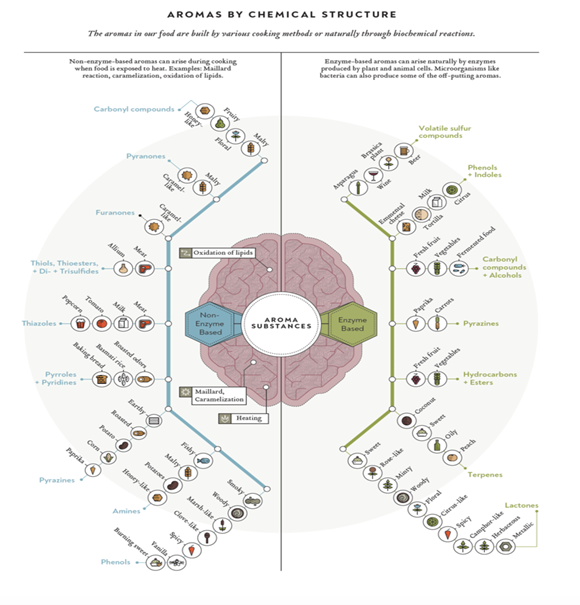
Adapted from a document by Caleb Poppe.
What are your thoughts or takeaways from the Enzymatic Aroma Chart from Nik Sharma’s Book, The Flavor Equation? Do you draw any parallels between what you just experienced in the 1st experiment?
It shows how aromas can transform once cooked, and alerted me to the fact that I had only tasted some of these spices after being cooked, which changed their volatile profile.
2nd Experiment Questions:
How did this experiment differ for you compared to the 1st experiment? Any of your spices stand out to you?
This was so much easier than using my nose, as it utilized a mix of tongue and nose. The sensory experience of the volatiles on my tongue helped me to correctly identify each spice much easier than the previous experiment.
Between fresh and dry spices, which would you expect to have the highest amount of naturally occurring volatiles?
Fresh herbs or spices should have higher volatile levels, as they dissipate over time.
Imagine sitting down to a big bowl of hot soup, explain to me what you visualize is happening to the volatiles as they are leaving the soup and begin meeting your body.
I imagine the volatiles wafting up towards me and when the aroma hits my nose being trapped in a steamy, aromatic cloud. As I open my mouth slightly, the aroma changes and I begin to salivate, the smell becoming deeper and more complex.
Once you had tasted your spices at the very end of the lab, were you able to differentiate between the interactions between your nose, mouth and tongue that take place to bring you the full picture of flavor?
I was able to distinguish the aromatic interactions between my nose, mouth, and tongue, though I was surprised to note that only after exploring each one singularly was I able to truly see a “bigger picture”.
And lastly, my favorite question, what are some personal reflections that you had while going through these experiments?
I intimately connect these smells with the idea of work. Spices are one of the aromas that exemplify and permeate professional kitchens, and prep work will often involve having between 4 and 6 buckets of herbs and spices open at one time. I was also thinking about how much I appreciate pairing botanicals with cocktails, and how handsome a sprig of rosemary looks inside a glass.
Video produced by MOFAD for their 2015 exhibition, Flavor: Making It and Faking It.
•#2f: Sustainable Entrepreneurship

Before helping build Group 2’s presentation last week, I was unaware of just how complicated the topic of GMOs could be; in exploring the confluence between GMOs, sustainability, food security, and entrepreneurship, I found no easy answers. What I did develop was the ability to critically analyze the tensions between science, public perception, and sustainability, as well as the means to identify and describe the enterprises and innovations surrounding GMOs.
I narrated the portion of our presentation devoted to Navdanya, an Indian Non-Governmental Organization, founded in 1987 by Dr. Vandana Shiva. Navdanya means both “nine seeds” and the “new gift” in Hindi. Navdanya International, a sister organization, was founded as an NPO in Italy in 2011 to strengthen Navdanya’s global outreach and mission.
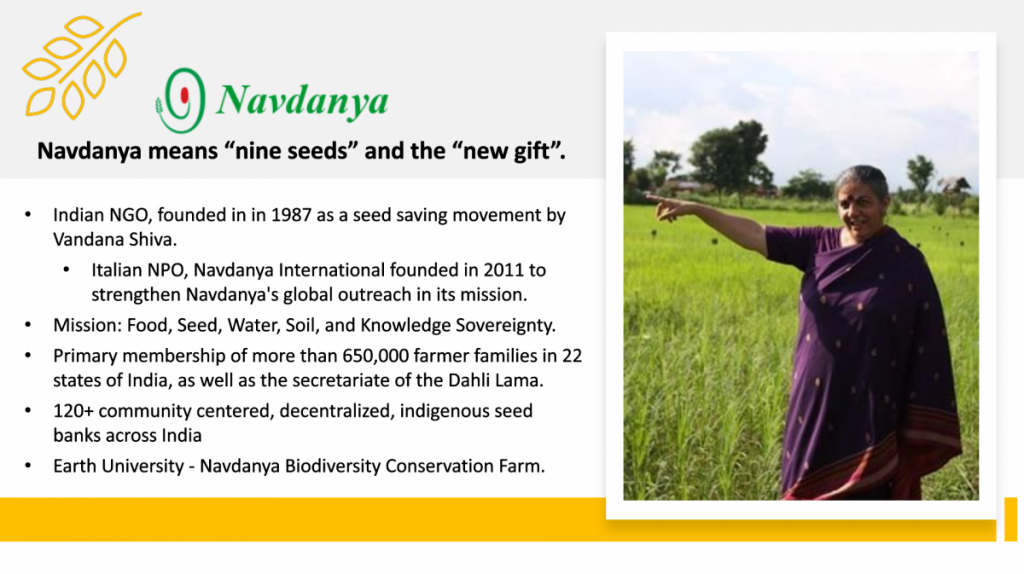
So, what is that mission? Navdanya is an Earth Centric, Women centric and Farmer led movement for the protection of Biological and cultural Diversity. They live and practice the philosophy of Earth Democracy (the basis of which is found in the Bhagavad Gita as Earth Family) with no separations between nature and humans and no hierarchies between species, culture, gender, race and faiths. For the purposes of this presentation, we focused in on Food Sovereignty and Seed Sovereignty.
FOOD SOVEREIGNTY is the right of peoples to healthy and culturally appropriate food produced through ecologically sound and sustainable methods, and their right to define their own food and agriculture systems. It puts the aspirations and needs of those who produce, distribute and consume food at the heart of food systems and policies rather than the demands of markets and corporations. It defends the interests and inclusion of the next generation. It offers a strategy to resist and dismantle the current corporate trade and food regime, and directions for food, farming, pastoral and fisheries systems determined by local producers and users.
Food sovereignty prioritizes local and national economies and markets and empowers peasant and family farmer-driven agriculture, artisanal-fishing, pastoralist-led grazing, and food production, distribution and consumption based on environmental, social and economic sustainability. Food sovereignty promotes transparent trade that guarantees just incomes to all peoples as well as the rights of consumers to control their food and nutrition. It ensures that the rights to use and manage lands, territories, waters, seeds, livestock and biodiversity are in the hands of those of us who produce food. Food sovereignty implies new social relations free of oppression and inequality between men and women, peoples, racial groups, social and economic classes and generations.
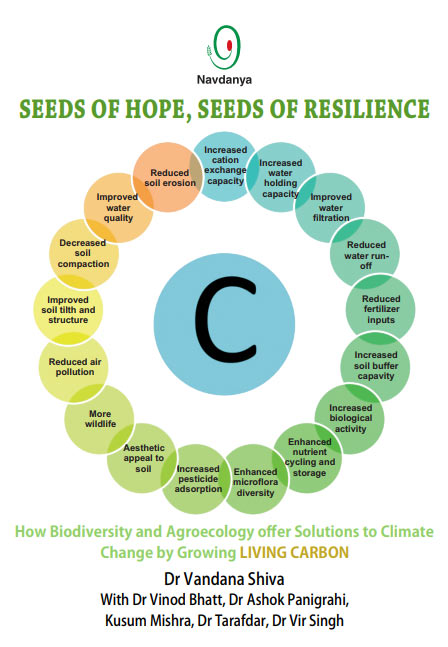
SEED SOVEREIGNTY is the fundamental right of all peoples and generations to grow, use, save, replant, breed, share, disseminate, exchange, barter and sell seeds. It includes the right of access to open-sourced seeds that are not genetically modified or otherwise altered contrary to Nature’s own system. Seed represents profound potential for improving our food and agricultural systems. Plants can be bred to thrive without pesticides and to naturally resist disease, and to be adaptable to changing regional climates and environmental conditions; they can also be bred to improve the quality of our food. However, to the seed company which has just consolidated, maintaining regional varieties is less important than providing increasingly productive seeds to for a limited number of regions which produce most commercial fruits and vegetables.
A few issues surrounding the negative effects of corporate consolidation in seed companies include both the availability of current varieties and breeding of vegetable varieties for regional climates. Seed industry consolidation leads to less choice and higher prices for farmers, as well as limiting diversity of seed in our landscapes and marketplace and weakens our food security. Often these companies are subsidiaries of chemical companies, creating a system in which farmers are kept reliant on inputs which are expensive and detrimental to the environment. These companies aggressively protect patent rights on seeds, which means less innovation and more restrictions on how seed is used and exchanged, including for seed saving and research purposes.
When researchers use traditional knowledge without permission, or exploits the cultures they’re drawing from, it’s called BIOPIRACY. Biopiracy happens when researchers or research organizations take biological resources without official sanction, largely from less affluent countries or marginalized people. A less politically charged word for biopiracy is bioprospecting. This is more commonly used by research groups who attempt to search for biological resources in a legal and respectful manner.
Although biopiracy might happen within a country, with elite groups or government officials taking resources from less influential citizens, it has more of a reputation for occurring between different countries. Biopiracy often accentuates power inequalities between wealthy, technology-rich countries and less affluent, yet bioresource-rich, countries. Historically, biopiracy has been linked to colonialism, with formerly colonized countries having many of their resources forcibly removed. You might think of biopiracy as scientific colonialism.
Video by Navdanya.
“A patent on seed implies that a farmer saving seed is an ‘intellectual property thief ‘. But it means more. A system in which seed has become a corporate monopoly, a system in which a few companies control the seed supply is in effect a system of slavery for farmers. Where the freedom of seed disappears, the freedom of farmers disappears.”
Dr vandana shiva
So why does Navdanya oppose GMO’s?
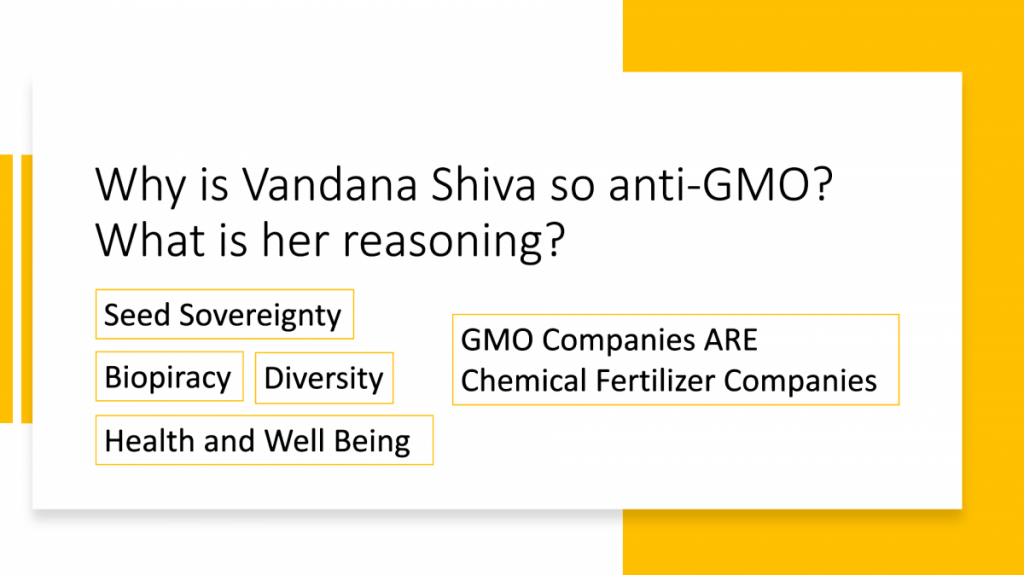
- Seed Sovereignty and therefore food sovereignty is not respected.
- Biodiversity is compromised.
- Health and wellbeing of all life is compromised.
- Biopiracy is a threat to farmers and food systems. At present, Navdanya has filed suit and won in the EU against biopiracy patenting of Neem, Basmati Rice, and Wheat.
- GMO companies ARE chemical fertilizer companies, as we will see.
India has witnessed around 300,000 farmer-suicides over the past two decades. Biotech opponents attribute most of these suicides to the monopolization of the cotton seed sector. Suspected links surfaced 3 years before the seed’s commercialization by Monsanto They characterize this distressing phenomenon as ‘genocide’, averring that such suicides were unheard of prior to the commodification. They argue that the 2002 introduction of Bt. cotton dramatized the situation.
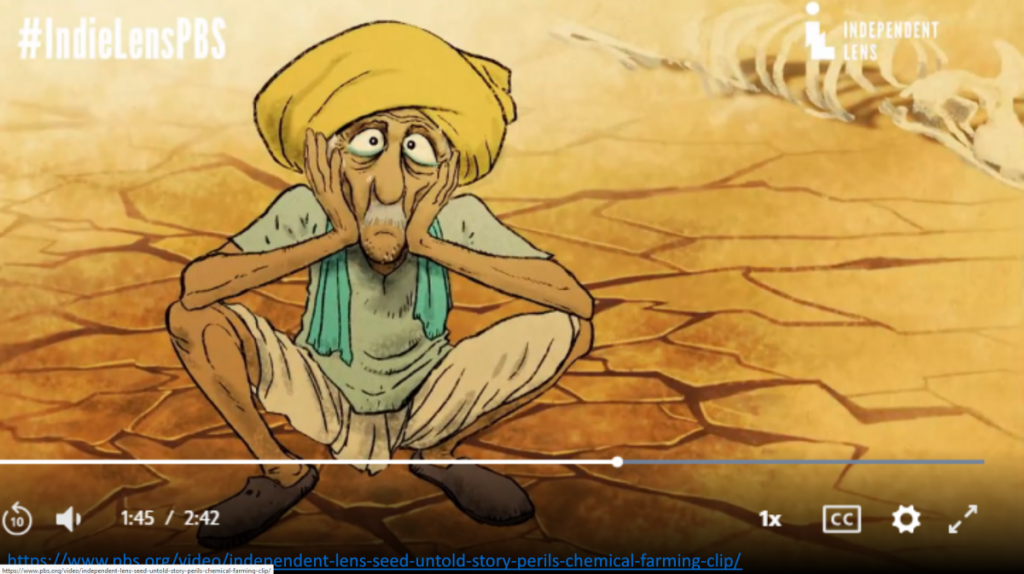
Holding transgenic seeds responsible, they dubbed them “Seeds of Suicide, Seeds of Slavery, and Seeds of Despair”. Huge media coverage and a parliamentary committee report have intensified the debate. The Acharya report attributes the increase of farmer-suicides after 2002 to Bt. cotton cultivation. Similarly, Daily Mail and The Guardian journalists and the award-winning documentary Bitter Seeds also link Bt. cotton cultivation with farmer-suicide. This linkage was alleged also by Charles, the prince of Wales. These allegations have been criticized by others for their lack of scientific rigor, especially the lack of transparency in their methodology.
To conclude my portion of the presentation, I called attention to the ownership changes occurring from 1996, when the top three corporations in the global seed industry controlled 22% of the industry, to 2018.
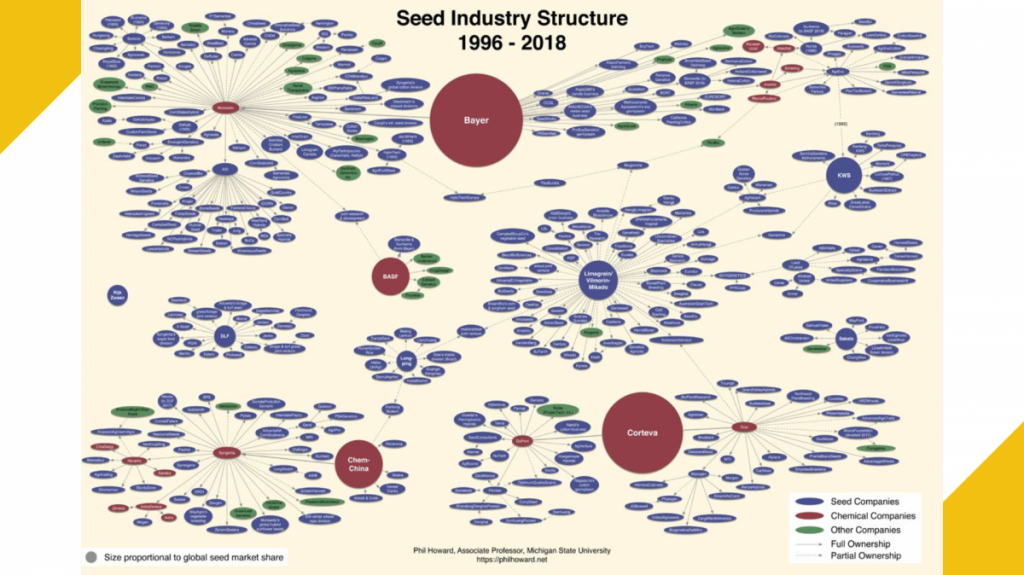
Image by Dr. Phil Howard.
In recent years, the “Big 6” agrichemical/seed firms have combined into the “Big 4”:
- Dow and DuPont merged in 2015 and then divided into three companies, including Corteva
- Chemchina acquired Syngenta
- Bayer acquired Monsanto
- Bayer’s seed divisions were sold to BASF (BASF SE is a German multinational chemical company and the largest chemical producer in the world.)
These four firms now control an estimated 60+% of global proprietary seed sales.
•#2g: Climate and Resilience Event Series/Seminar
•#2h: Foodoir: Your Story of Tasting Place
“People ask me: Why do you write about food? Why don’t you write about the struggle for power and security, and about love, the way others do?
They ask it accusingly, as if I were somehow gross, unfaithful to the honor of my craft.
The easiest answer is to say that, like most other humans, I am hungry. But there is more than that. It seems to me that our three basic needs, for food and security and love, are so mixed and mingled and entwined that we cannot straightly think of one without the others. So it happens that when I write of hunger, I am really writing about love and the hunger for it, and warmth and the love of it and the hunger for it…and then the warmth and richness and fine reality of hunger satisfied…and it is all one.
I tell about myself and how I ate bread on a lasting hillside, or drank red wine in a room now blown to bits, and it happens without my willing it that I am telling too about the people with me then, and their other deeper needs for love and happiness.
There is food in the bowl, and more often than not, because of what honesty I have, there is nourishment in the heart, to feed the wilder, more insistent hungers. We must eat. If, in the face of that dread fact, we can find other nourishment, and tolerance and compassion for it, we’ll be no less full of human dignity.
There is communion of more than our bodies when bread is broken and wine drunk. And that is my answer, when people ask me: Why do you write about hunger, and not wars or love?”
M.F.K. Fisher, The Gastronomical Me, Foreword
Kirksville Calling
The summer I turned sixteen, my younger brother and I were sent to visit my maternal great-grandmother in Kirksville, Missouri. My aunt was driving a monstrous, black Chevy Suburban with my four cousins, younger brother and myself sprawled indelicately across the cabin; her goal was to deliver us to our grandmother’s house and to collect us two weeks later. I think it may have been the first time I’d traveled farther North than Tennessee, and I was terribly car sick for the entire ride.
Granny B, Bernice Olive Mullanix, was a hard woman. My grandfather worked for the railroad before settling in rural Adair County, Missouri to open a general store, feed store, and eventually a dairy farm. My mother reports that she was always tough and strict while my great grandfather would whittle his granddaughters little toys or tell them stories.
The worst trouble of my mother’s young life happened upon the occasion of a visit to the Martinstown Store, in which she and her sisters wore their dress-up heels and climbed over all the feed bags, poking little heel-shaped holes in Every. Single. Bag. Granny B was livid and not even my Grandfather Beryl saved them from the switch.
So this was the woman to whom we two teenagers were shipped for two weeks. We were suspicious to say the least; it all seemed so much like a punishment. That first night, we sat at her kitchen table waiting anxiously for our meal. Well, I wasn’t so anxious; I had always been an adventurous eater, not picky and willing to experiment. My brother, on the other hand, was the complete opposite.
I will never forget Granny B setting a large dish of canned green beans on the table, along with a bottle of French dressing, and saying, “Here’s a good salad for you.” I looked at my brother and he looked at me. I shrugged, loading my plate, and he pouted, pushing the beans around his in an effort to look engaged. It was one of the first things, we agreed, that stood out about this strange trip. But it wasn’t the last.
“Don’t upset the pop on the Davenport!”, Granny B called from the kitchen. I didn’t understand a word of it, and went about my business. My brother sipped his Coke. “What’s a Davenport?”, he asks me. I don’t know…
Granny B took us on endlessly long car rides through rural Missouri, calling out local points of interest, sites of family history, and Grandpa Beryl’s grave. I don’t remember getting out of the car.
We spent every day seeking a way to get out of the house. We wandered the streets of Kirksville, haunting the local mod bookstore and drinking free, bad coffee. My brother’s hair grew in beautiful, long black ringlets and we were mistaken for sisters on more than one occasion. We went to the pool only once: the water in June was still blisteringly cold and we left an hour later with blue fingertips, looking over our shoulders and wondering how the other kids could handle it.
We left Kirksville two weeks later, traveled home, and it fell to the back of my memory. My sweet sixteen came and went, and a decade of birthdays after that, before I began to understand the power, potential and failure of that summer. My grandmother was a hard, strict, miraculous woman, and it took me many years longer than it should have to understand that fact in its fullness.
She was the town’s first postmistress, she ran the dairy as a solo venture, and she managed the Martinstown Store. She lived through hardship, food insecurity, and was the master of her own destiny in a time when that was rare for women. She didn’t smile unless she meant it. She raised a daughter, who though stricken by polio, went on to attend New York University, earning a degree in journalism. She contributed recipes to her daughter’s newspaper for 20 years under the pseudonym “Grandma Neighbor”. She was the hero I needed as a teenager, but one whom I didn’t accept or appreciate at the time.
I don’t remember Granny cooking much. I vaguely recall a dish of kielbasa and overcooked cabbage, but nothing stands out more than those canned green beans. Granny wasn’t much for cooking: she didn’t seem to have time for it. And that seems to be as much a part of my terroir as anything else.
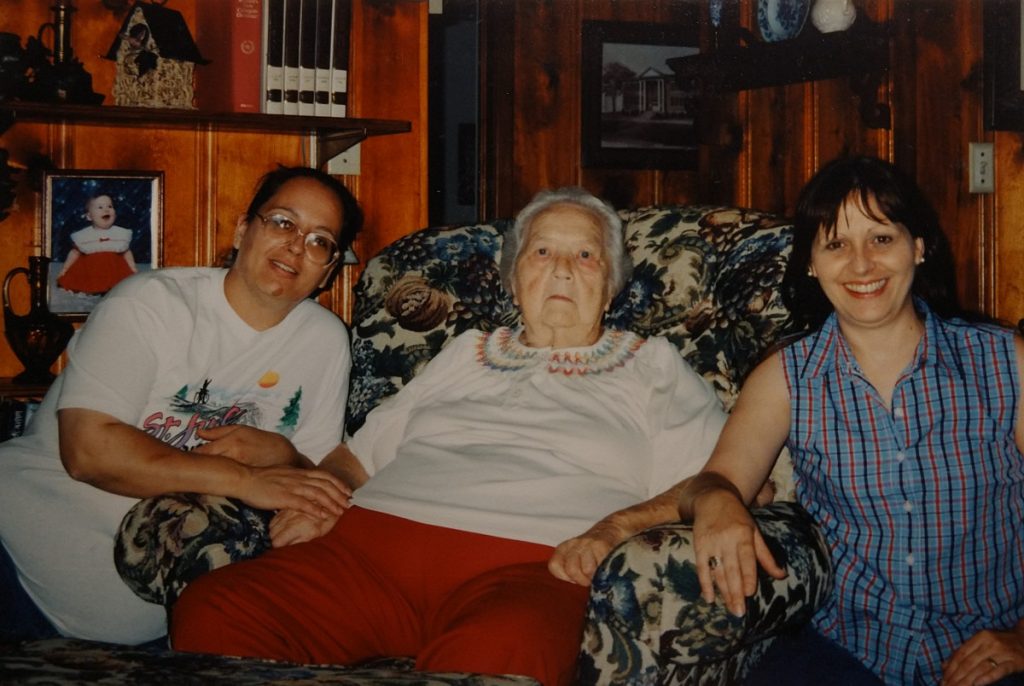
Photography by Sarah Dyer.
Leave a Reply