
#2a: Film Series: Program Questions in Scenes and Overview
Week 3
For week 3 I have chosen minutes 11:00-13:35 from the film Unbroken ground, which I have titled “Possibilities”. This scene shows how monocropping on large acreages and heavy use of pesticides is the norm in grain production, but there are some scientists and farmers trying to diversify grain crops and grow them organically. The story behind this scene is looking back at the problems from the past and present methods of grain production, but also being able to feel hopeful for the future and the improvements that have been made. This scene addresses the program question: What is the potential of sustainable food and agricultural entrepreneurship to transform the existing industrial food system market? This scene answers this question by showing the strides that are being made towards more sustainable grain production.

Credit: “Unbroken Ground”
Week 4
For week 4 I have chosen minutes 34:50-37:00 from How Grains Have Domesticated Us, which I have titled “Not Rushing to Change”. In this scene James Scott is explaining how hunter-gatherer societies were not always eager to switch over to practicing agriculture. Some hunter-gatherers would plant some “crops”, however it was more consistent/reliable and less time consuming for them to forage and hunt for food. The story this scene tells is that farming does not necessarily mean a better quality of life, despite popular belief. Hunter-gatherers enjoyed a more stable and diverse food supply than what agriculture could offer. Often communities switched to agriculture when their increased populations demanded more food than the land naturally provided. This clip addresses the course question: Where and how do people raise the foods we are highlighting? The clip addresses this question by explaining how and why people started to switch over to agricultural ways of life.

Credit: Farming History – introduction (farm-direct.co.uk)
#2b: (un)Natural Histories
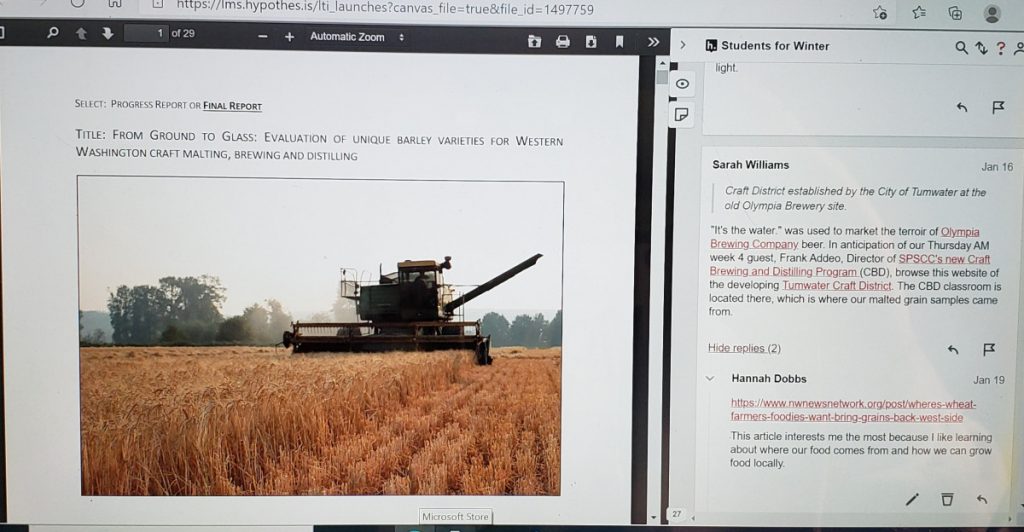
We have been using Hypothisis.is to annotate articles, answer questions, and view our classmates comments. Below is an annotation I made for the article “From Ground To Glass”
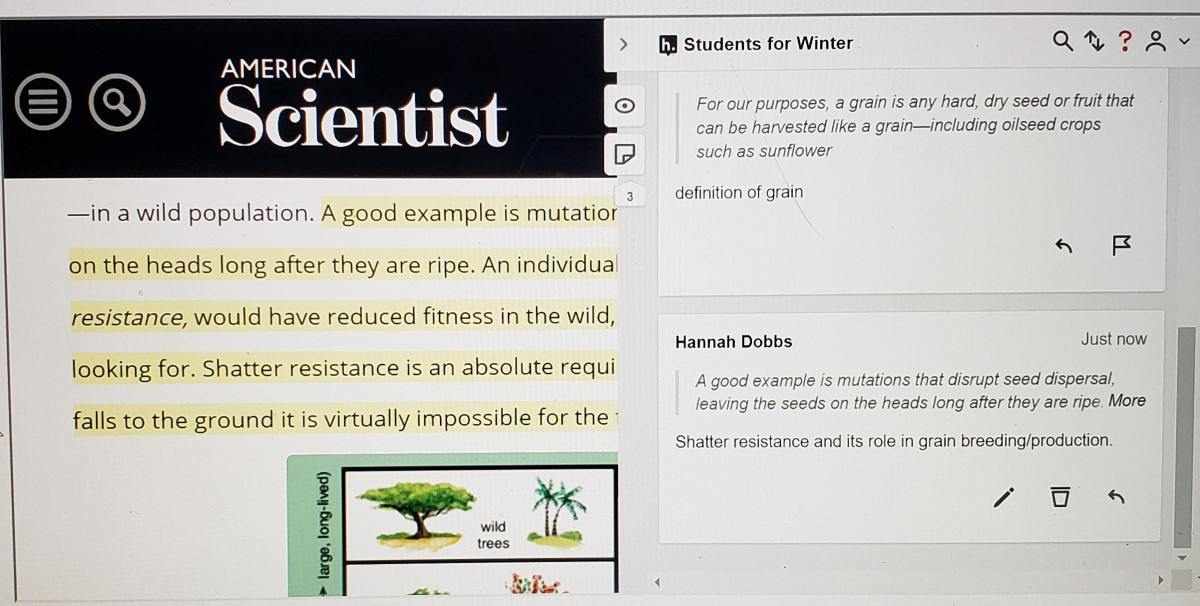
I also annotated the article “Wild Plants to the Rescue: Breeding perennial grains could improve food security and soil health”
#2c: Regenerative Agriculture
1. Why grain plants? List benefits as food, straw, soil conservation.
Grains are very versatile, they are used in countless foods that humans eat as well as being widely used for animal feeds. While the seed is used as food the stalks can be used as straw. The roots and stalks of grain plants can be left in the field to decay and add organic matter to the soil.
2. List challenges/problems with grain crops for human and environmental well-being.
-Most of the grain we grow goes to feed livestock, which causes lots of deforestation, water use, etc. -Most grains we grow are annuals, which have a shallow root structure and get tilled in each year, resulting in loss of topsoil. -Most grains are not grown organically, causing the use of lots of harmful pesticides.
3. What is meant by spring, winter, and facultative grain crops (eg barley or wheat)?
Winter, spring, and facultative grain crops refer to the time of year the crop is grown. Spring grain crops are sown in the spring and harvested in the fall while winter crops are sown in the fall and harvested in the summer. Facultative crops can be grown as either spring or winter crops.
4. What is vernalization and why is it important to understand for growing grain crops?
Vernalization is when a plant experiences a period of cold temperatures so that it will put more of its energy into reproductive growth.
5. For barley, explain how growing degree days are used to predict plant development.
By knowing, generally, how many days crops will be able to grow you will be able to predict when they will be ready to harvest.
6. Grass-family grain root systems – what is the general form the root systems take and how can this positively impact soil structure?
These grains have fibrous root systems. Fibrous root systems add a lot of organic matter to the soil.
7. Discuss what you have learned about using grass-family grains for cover crops.
Grains can make great cover crops because they are quick to germinate and grow and produce a lot of biomass. Grain cover crops also add nutrients to the soil and break up soil compaction.
#2d: Case Study Tasting Research: Grains
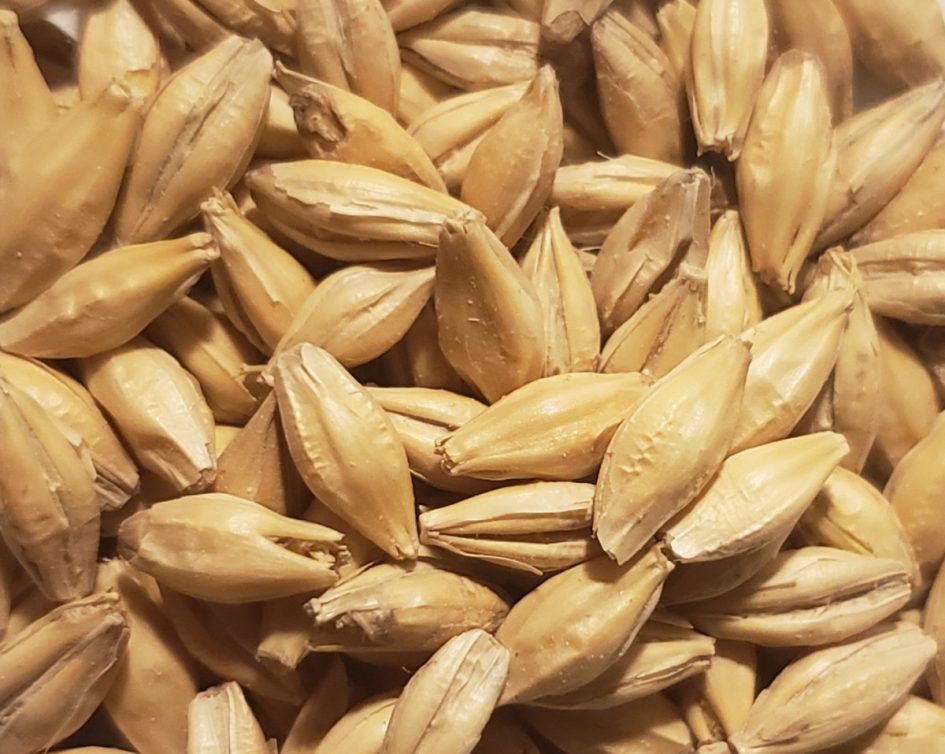
This week we tasted malted grains! I have attached the tasting lab below.
I) Malted Kernel Tasting
1. Taste one sample at a time 2. Provide a short description in your own words 3. Then rank the samples in your order of preference
Sample 1 Description: (Skagit=100) Slightly sweet and somewhat savory.
Sample 2 Description: (Wheat=200) Mild earthy flavor.
Sample 3 Description: (Copeland=300) More powdery texture. Slightly sweet flavor.
1 Rank the samples by writing the three-digit sample number in the appropriate box based on your overall liking of each sample* 1 = like the most 2 3 4 = like the least
#1=100, #2= 300 , #3=200
Now choose as many attributes as you would like from the provided BEER MALT FLAVOR MAPs that you think best differentiate the samples. Sample 1: Sweet, Dried fruit, Nutty Sample 2: Biscuit, Hazelnut, Vanilla Sample 3: Earthy, Bready, Waxy
II) Hot Steep Analysis: Adapted as “Hot Malted Barley Tea Analysis”
Choose as many attributes as you would like from the provided BEER MALT FLAVOR MAPs that you think best differentiate the samples
Sample 1: Woody, Bready, Nutty, Sweet Sample 2: Sweet, Bready, Floral Sample 3: Stale, Bready, Earthy
#2e: Stuckey’s Taste Book Experiments
This weeks experiment from “Taste” by Barb Stucky:
1) What spices did you decide to bring to this week’s experiments? Cinnamon, Sage, and Pepper
2) What is a fond memory that you have associated with a specific smell? The smell of vanilla extract always reminds me of baking cookies with my grandma when I was little.
3) What is an unpleasant memory that you have associated with a specific smell, that you are willing to share? I cant think of one.
1 st Experiment:
4) Did you find that you could easily differentiate between the smell of your spices? Do you think this is the case for all spices? Yes I could. I don’t think this would be the case for all spices, I am very familiar with the spices I chose so they were easy to differentiate.
5) What about when mixing them up and trying to tease apart the individual spices – did the smells mingle together or was it two distinct smells? The smells mingled a little but if I focused I could differentiate them.
6) Were there any smells that surprised you when you opened your eyes and saw what spice you had been testing? I could guess which spices I had been tasting so I was not surprised.
7) What are your thoughts or takeaways from the Enzymatic Aroma Chart from Nik Sharma’s Book, The Flavor Equation? Do you draw any parallels between what you just experienced in the 1st experiment? I thought the chart was very interesting.
2nd Experiment:
8) How did this experiment differ for you compared to the 1st experiment? Any of your spices stand out to you? I felt like the flavor/smell might have been a little stronger in this experiment, cinnamon especially stood out to me.
9) Between fresh and dry spices, which would you expect to have the highest amount of naturally occurring volatiles? I would expect fresh spices to have the highest amount of naturally occurring volatiles.
10) Imagine sitting down to a big bowl of hot soup, explain to me what you visualize is happening to the volatiles as they are leaving the soup and begin meeting your body. I imagine the volatiles floating up with the steam from the soup.
#2f: Sustainable Entrepreneurship
We learned about GMO’s and what role they play regarding perennial wheat development through presentations given by classmates. We also learned about WSU’s Bread Lab and the work they are doing to perennialize wheat.
My Week 4 Diary Entry:
Question #1: In your own perspective, what does “sustainable and equitable food production” mean?
To me sustainable and equitable food means local production of foods grown organically. In a sustainable system farmers grow a diversity of foods and do not monocrop. Tillage and other practices that alter the land should be limited as much as possible. Plant food sources should be at the forefront due to their decreased harm to the environment. In an equitable system there are lots of small farms opposed to a few large farms and workers are paid and treated fairly. Healthy organic food would also need to be available to everyone, not just the wealthy.
Question #2: What is the potential for the alternative business model presented last week (local, living economies) for transforming and strengthening our local food and agriculture system in the South Puget Sound area?
The model presented in local, living economies shows the potential of a system that gives equal opportunity to everyone and allows wealth to spread to groups that have traditionally been blocked from it. By giving people of color access to land and resources, which have been kept from them, we could have a new generation of small farmers to provide local foods to the area. Over time this will allow wealth to spread and improve our community and quality of life.
Question #3: What elements might be crucial in developing a local grain economy in this region?
In order to develop a local grain economy in this region we need to ensure that there is enough affordable farmland. There needs to be enough demand for grains that are locally produced.
#2g: Climate and Resilience Event Series/Seminar
I watched Evergreen Prof. Ruth Hayes, on “Eco-Media; the Environmental Footprint of Media and the Myth of the Cloud”. In this talk Professor Hayes discussed media literacy, eco-media, and how harmful the film industry is to the environment. The film and media industry not only pollutes the environment, but also can cut citizens off from environmental resources and create huge amounts of waste.
#2h: Foodoir: Your Story of Tasting Place
This quarter I have been reading the foodoir “Farming While Black” by Leah Penniman. This book tells the story of Leah discovering her love of agriculture and starting a farm to feed her community. As well as reflecting on the undervalued achievements of black farmers and helping young black farmers connect with the land. Leah also offers lots of practical farming advice and insights on running a small CSA farm. I have attached some of my favorite quotes below:
“In the United States, we spend less on food, as a percentage of our income, than any other country in the world. This is because the true costs of industrial food on the environment and human health are externalized.”
Farming While Black
“In the case of marginal soils, digging down is not prudent; rather, you build up. This building-up process is also known as no-till and has the incredible side benefit of slowing climate change. In fact, if all farmers adopted the practices described in this section, we could capture 106.25 gigatons into the soil in less than 5 years, which would halt climate change.”
Farming While Black
“A legacy of environmental racism has contaminated many of the sacred soils in our neighborhoods with arsenic, cadmium, copper, lead, nickel, selenium, and petroleum pollution. From the demolition of buildings containing toxic materials, to atmospheric deposit of air pollution, to industrial effluent, the land in our communities bears a disproportionate burden of harmful toxins.”
Farming While Black
#2i: Bibliography
2016. “Unbroken Ground” Patagonia Provisions
Penniman, Leah, and Karen Washington. Farming While Black: Soul Fire Farm’s Practical Guide to Liberation on the Land. Chelsea Green Publishing, 2018.
Scott, James. 2015. “How Grains Have Domesticated Us” DOI: How Grains Domesticated Us, James C. Scott, SOAS, University of London – YouTube
Farming History – Introduction, www.farm-direct.co.uk/farming/history/shorthist.html.
Leave a Reply