
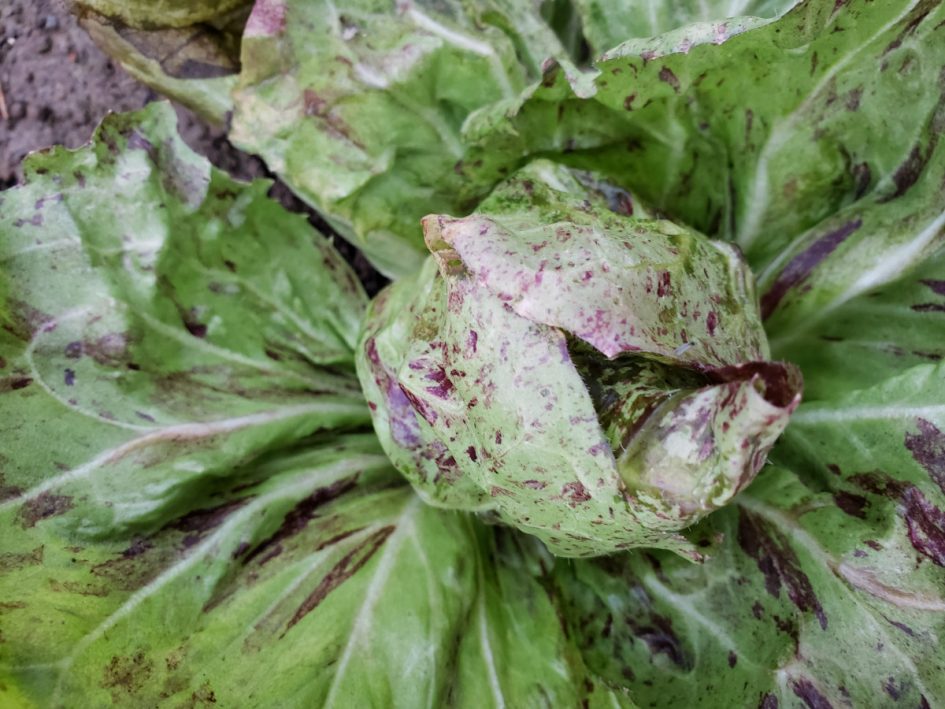
#5a: Film Series: Program Questions in Scenes and Overview
Week 9 RADICCHIO WEEK: Uprising Seeds / Wild Roots / Local Roots, Forcing Techniques – YouTube
This week I have chosen minutes 18:47-22:20 from RADICCHIO WEEK: Uprising Seeds / Wild Roots / Local Roots, Forcing Techniques. I have named this scene “What Forcing is”. In this scene Jason Salvo from Local Roots Farm explains what forcing radicchio plants is. He talks about how the plants go dormant in the winter, and by placing them in a heated indoor environment they start growing again. You can also control the color and texture of plants by changing the lighting. The story this scene tells is how a farm can successfully grow radicchio throughout the winter. I appreciated his thorough explanation of radicchio forcing as I had never heard of this process before. This scene addresses the program questions: Where and how do people raise the foods we are highlighting? What factors influence the quality of these foods, especially their flavor? The scene addresses these questions by explaining how radicchio is grown in WA and what practices can affect appearance and texture.
“Sometimes when you leave your carrots in the refrigerator and the tops start growing again, exact same concept.”
Jason Salvo
Local Roots Farm
Questions this scene left me with:
- Is all of the extra care/time spent making radicchio market ready worth it for growers?
- Would it be more profitable to grow greens that are more standard and do not require so much post harvest maintenance?

Credit: Meet the Italian Farm Growing Some of the Best Radicchio in the World | Serious Eats
#5b: (un)Natural Histories
Chicories are native to Europe, Western Asia, and North Africa. Today chicories are grown all around the world. Radicchio production began and developed in Italy before spreading to North America and other countries. Chicories grow best in cool, mild climates in full sun. Radicchio can be grown in warm environments but will become very bitter. Chicories should be planted in late summer-early fall and harvested in winter-spring for the best results. Chicories prefer soil with high organic matter that can hold moisture and is well drained.
#5c: Regenerative Agriculture
Radicchio is a good choice for diversifying winter vegetable production in the PNW because radicchio can survive all winter in the field without cover. Lots of other greens crops cannot handle all of the rain and freezing temperatures. Radicchio tolerates the amount of precipitation and cold we get in the PNW and will maintain quality throughout winter as long as they get sun. Frost even makes radicchio taste sweeter. The best timing for radicchio plantings are in late summer(June-August) so they can reach maturity before winter. Radicchio can be susceptible to bacterial and fungal diseases if the leave are kept moist when temperatures are warm. To manage this growers could use drip irrigation instead of overhead.
#5d: Case Study Tasting Research: Radicchio
Radicchio Tasting Form – March 3rd, 2021
- Flavor Rating (0 – 5)
- Forced Treviso Tardivo- 2
- Belgian Endive- 4
- Frisee – 3
- Bitterness Rating (0 – 5)
- Forced Treviso Tardivo- 4.5
- Belgian Endive- 3
- Frisee -3
- From the perspective of a consumer, what is your opinion, solution, and/or concern about having access to local vegetables throughout the winter months?
I think access to local vegetables year round is very important and very possible, especially in our mild climate. The biggest problem with winter vegetables is that there is not a lot of variety, which is important to consumers.
4. From the perspective from a grower/farmer, what is your opinion, solution, and/or concern about having access to local vegetables throughout the winter months?
As a farmer there are vegetables that can be overwintered in the PNW but to be able to harvest all winter requires a lot of advanced planning and summer planting. There is also an issue with diversity of vegetables that can overwinter. By late winter farmers market customers are most likely getting tired of greens and root vegetables. Farmers should jump on any opportunity to diversify winter production.
5. Do you think it is always feasible to only shop for vegetables that are in season for your local region?
It is definitely possible but not always convenient or cost effective. Farmers that sell locally often charge higher prices than the out of season produce that can be bought in grocery stores. There also is not near;y as much variety.
6. Having watched, listened, and read about radicchio over the last two quarters, what recipes, meals, and/or products are you excited to try, or have tried? Were they a success?
I have not eaten very much radicchio because I don’t usually like bitter flavors. I am excited to try radicchio in a salad with a sweet dressing or braised.
7. Now that we have been exposed to many different foods and drinks, and have a deeper understanding of our own perception of flavors, how would you ‘build your lexicon’ in relation to the flavor complex of radicchio? What categories and/or words might you use? Use the CBN’s Winter Squash Flavor Wheel (squash wheel) for inspiration.
I would use works like: Bitter, Floral, and Earthy
#5f: Sustainable Entrepreneurship
This week group seven presented on sustainability and the meat industry and Daniel Cherniske gave a talk on aquaponics.
Week 10 Diary Entry:
OPTION #1: You may choose to respond to the conversation we had with Daniel Cherniske, highlighting insights from that session, questions that have arisen, etc.
I enjoyed the conversation we had with Daniel Cherniske, I appreciated his honesty and insights on aquaponics. In the last few years I have seen lots of articles describing aquaponics as the “future of farming” and a more environmentally friendly alternative to traditional agriculture. These articles always made me nervous as someone who wanted to get into more traditional organic agriculture. I didn’t see my love of farming translating to a sterile indoor environment, so I did not want aquaponics to become the common way to grow vegetables. After Daniels’ talk I don’t think I have to worry about the future of agriculture shifting to aquaponics. What Daniel said about the inputs required to create an indoor environment that could grow crops being worse for the environment than those crops being grown outdoors made a lot of sense to me. I also thought it was interesting that the crops grown in aquaponics systems were often nutrient deprived and not very healthy. I agree that the best way to grow food is to work with nature, not against it. I also appreciated Daniel talking about his experience in Peru and his naïve belief that he had something to teach people in Peru about permaculture. A lot of people who have been in that situation do not learn from it or are not willing to talk openly about their mistakes. Daniel did a great job sharing his experience and explaining his mistakes. I took a lot away from this talk and am grateful Daniel took the time to speak with us.
Questions to ask our guest speaker during our class seminar this week:
- Are there programs in place for low income people to get CSA subscriptions at reduced prices?
- Does the food-hub take some of the prophet from the CSA subscriptions, or does all of the money go to the farmers?
- Where does the funding for the food-hub come from?
#5g: Climate and Resilience Event Series/Seminar
The Climate Event that I watched this week is “Climate Justice in Global Context” by Evergreen Professor Shangrila Joshi. In this talk Joshi discusses climate justice and its connection with racial justice in a global context. She explains how climate change disproportionally affects people of color in countries that have done very little to cause climate change. She describes climate change mitigation efforts in Nepal by sharing the positives and negatives that have come from these efforts
What I found most striking about her talk was her overview of how the USA is one of the countries that is the most responsible for climate change. Despite the devastation climate change causes to the most vulnerable people, the US refuses to make any meaningful changes. I think this sentiment is summed up well in a quote from George H. W. Bush in 1992;
“The American lifestyle is not open to negotiation.”
George H. W. Bush
Shangrila included this quote in her presentation and it will definitely stick with me.
Credit: Climate Justice in Global Context – YouTube
#2h: Foodoir: Your Story of Tasting Place
Credit: Penniman, Leah, and Karen Washington. Farming While Black: Soul Fire Farm’s Practical Guide to Liberation on the Land. Chelsea Green Publishing, 2018.
This quarter I have been reading the foodoir “Farming While Black” by Leah Penniman. This book tells the story of Leah discovering her love of agriculture and starting a farm to feed her community. As well as reflecting on the undervalued achievements of black farmers and helping young black farmers connect with the land. Leah also offers lots of practical farming advice and insights on running a small CSA farm. I have attached some of my favorite quotes below:
“White neighborhoods have an average of four times as many supermarkets as predominantly Black communities. As a result of these food apartheid conditions, incidences of diabetes, obesity, and heart disease are highest for Black, Indigenous, and Latinx people. Black Americans are also three times more likely to go hungry than white Americans.”
Leah Penniman
Farming While Black
This quote reinforces the importance of the work Leah, and many other Black farmers, are doing to provide fresh produce to communities that have quite literally been blocked from accessing healthy food.
“It’s not just in Flint where Black families experience disproportionate environmental burdens. A preponderance of research shows that environmental racism is alive and well in America.”
Leah Penniman
Farming While Black
This quote connect well to the Climate Event “Climate Justice in Global Context” that I watched this week. Professor Shangrila Joshi does a great job of highlighting how the actions of the US have impacted those in other countries. Leah does a good job of highlighting how the harshest consequences of climate change and environmental pollution also fall disproportionally on Black communities within the US.
#5i: Profitability of Radicchio Compared to Other Winter Greens
Questions this scene left me with:
- Is all of the extra care/time spent making radicchio market ready worth it for growers?
- Would it be more profitable to grow greens that are more standard and do not require so much post harvest maintenance?
How profitable is growing radicchio for small farmers compared to other greens that can be harvested throughout winter?
Factors to consider:
- Rows per bed and spacing
- Days To Maturity
- Direct Seeded or Transplanted
- Number of Harvests
- Harvest/Storage Process
- Price of Crop at Market
I wanted to find out how the profitability of radicchio would compare to other overwintering greens for a small farmer selling at farmers markets. It is hard to take all of the factors into account, but I compared some key factors in the production of radicchio, salad mix greens, head lettuce, mustard greens, and arugula.
What prompted me to ask this question was learning about all of the extra steps and extensive care some growers seem to give to their radicchio. This made me wonder how worth it this crop could be.
Radicchio Vs. other Greens – Google Sheets
In conclusion radicchio seems more profitable than other popular winter greens. However radicchio was barley higher than head lettuce. There are factors that I couldn’t calculate exactly such as time spent harvesting, washing, and packing, insect and disease pressure, and what customers are wanting to buy. My projected earnings per 50ft bed also does not account for any crop loss, which is unrealistic. The actual money made could be significantly less depending on how much of the crop is unsellable. Still, even considering these factors, radicchio seems like a worthwhile crop for farmers.
#5j: Bibliography
Penniman, Leah, and Karen Washington. Farming While Black: Soul Fire Farm’s Practical Guide to Liberation on the Land. Chelsea Green Publishing, 2018.
Prakash, Sheela. “Meet the Italian Farm Growing Some of the Best Radicchio in the World.” Serious Eats, Serious Eats, 10 Aug. 2018, www.seriouseats.com/2014/03/meet-the-italian-farm-growing-some-of-the-best-racicchio-in-the-world.html.
“Climate Justice in Global Context.” YouTube, YouTube, 24 Feb. 2021, www.youtube.com/watch?v=yxfensyIAhc.
“RADICCHIO WEEK: Uprising Seeds / Wild Roots / Local Roots, Forcing Techniques.” YouTube, YouTube, 10 Dec. 2020, www.youtube.com/watch?v=Xxnx3bkY-8c.
Leave a Reply