
#4a: Film Series: Program Questions in Scenes and Overview
Week 7
For week 7 I have chosen minutes 5:10-8:20 from “Why this $300 clam is so important to Native Americans and China”. I have named this scene “Fishing Wars”. This scene shows how Native people in Washington were stripped of their land and then denied fishing rights by the state government. I was particularly struck by the footage of Native people protesting these cruel fishing bands and the fish-ins that were held. It was very clear that they were fighting for their lives. The story behind this scene is one of tribes that were thriving prior to settlers coming to Washington being stripped of everything they had and yet continuing to fight back. There is a little hope being shown through Native geoduck farmers today being able to make a living farming their traditional foods. This scene addresses the program question: What criteria exist for assessing the role of agricultural businesses in building communities through food justice and sustainable practices? The scene addresses this question by giving an example of a community that has deep cultural ties to geoduck and are still farming them today despite the challenges they face to have the right to eat their traditional foods.

Credit: https://www.dfo-mpo.gc.ca/species-especes/profiles-profils/geoduck-clam-panope-pac-eng.html
Week 8
This week I have chosen minutes 1:20-3:30 from Zanzibar’s Female Seaweed Farmers. I have named this scene “Seaweed Farmers”. This scene showed female employees on a seaweed farm in Zanzibar. It was explained that this work could be very hard and tiring without a lot of prophet. In the area the farm is located most of the jobs available to women are either seaweed farming or something with tourism. The thing that stood out to me the most about this scene was the workers explaining how challenging the job could be and how it was hard to make much money because of low seaweed prices. Then the scene cut to the white, well-dressed CEO who started explaining how good the working conditions were and how well paid her employees were. I was very struck by this contrast. To me the story this scene tells is one of women who live in an area with few job opportunities for women taking the best job that was available to them, despite the challenges. This scene addresses the program question: Where and how do people raise the foods we are highlighting? The scene addresses this question by highlighting a seaweed farm and showing how they farm.

Credit: Zanzibar’s Female Seaweed Farmers; Helen Joubert – Alexander Street, a ProQuest Company (oclc.org)
#4b: (un)Natural Histories/Regenerative Ag.
- What impact did the Boldt decision and associated court cases have for Native American rights and access to marine resources in the state of Washington?
This decision granted Native people fishing rights in WA that they had been stripped of by the state government. This decision greatly increased Native peoples access to fishing on their own land. It stated that half fish caught are allocated to Native people.
2. Describe the life cycle of the geoduck (from one adult generation to the next adult generation).
A small percentage of fertilized geoduck eggs make it to adulthood. Those that survive burrow down into the sand, using their foot, where they will stay for the rest of their lives.
3. How can farming geoducks in the Salish Sea improve water quality by removing excess nitrogen from the water?
Geoducks filter the water when it passes through their bodies and eat some of the algae in the water, which removes nitrogen from the environment.
4. As a climate change mitigation strategy, do you think it is reasonable to claim that geoduck aquaculture releases less carbon dioxide per kg of animal protein than the same quantity of protein derived from land-raised livestock. Why or why not (justify your answer)?
Yes I think that is very safe to say. Geoducks are native here and have a positive impact on the local ecosystem. They also are able to get food on their own and do not drink fresh water. Land raised livestock cause a much greater strain on the environment. All of the deforestation alone causes huge amounts of carbon dioxide to be released.
5. Why is plastic used in current geoduck farming methods, and can you imagine an alternate strategy to avoid plastic use in the Salish Sea?
Plastic is put around geoducks to mark where they are under the sand. A possible alternative would be using wood or a compostable material that breaks down very slowly.
6. Describe the generalized life cycle of a kelp species (from one diploid generation to the next diploid generation).
Parents release male and female spores that attach to something and grow into a new plant.
7. How can farming seaweed in the Salish Sea improve water quality by removing excess nitrogen from the water?
Seaweed absorbs nutrients, including nitrogen, from the water. This causes the seaweed to remove nitrogen from the water.
8. Describe how carbon dioxide emissions are causing ocean acidification.
The large amount of carbon dioxide in the air is getting absorbed by the ocean. All of this Co2 when mixed with ocean water creates carbonic acid which has been causing the ocean to be more acidic.
9. Given acidifying ocean waters, describe how growing seaweed in close proximity to shellfish can improve the ability of shellfish to create their calcium carbonate shells.
With conditions in the ocean becoming more polluted and acidic the conditions are not ideal for shellfish to create their shells. Seaweed absorbs excess nutrients/pollutants in the water, making conditions more favorable for shellfish.
10. To scale up seaweed aquaculture as a blue carbon strategy for climate mitigation, describe some of the research, regulatory and/or market issues that need to be addressed to facilitate scaling up ocean production.
Seaweed and shellfish absorb a lot of toxins that are in the ocean so water quality where they are produced is very important, and clean water is becoming more sparse. There are also a lot of things to work out such as who gets access to what areas to farm.
11. To scale up the use of seaweed used in cattle feed as a strategy to reduce bovine methane emissions, describe some of the research, regulatory and/or market issues for:
A. Seaweed production
To feed all, or even some, of the cattle in the U.S. alone would require a huge increase in production. This would require tons of new infrastructure and space and would be a huge undertaking.
B. Animal Feed Production
Seaweed production is not cheap, most likely this would be an added expense for farmers.
C. Livestock Production
Since adding seaweed to cattle feed would be an added expense that does not directly result in a greater prophet for the farmer, I doubt many big cattle farms would use this.
#4d: Case Study Tasting Research
Needed:
- 4 mugs or canning jars
- Boiling water (during the 10:45am break)
- A thermos with additional hot water
- Seaweed samples
- Your favorite tea (black, green, or herbal)
- Dinner plans
GEODUCK “TASTING”
- WHAT DOES GEODUCK TASTE LIKE?
I have never tried it but from what I have heard Geoduck is slightly sweet and salty and very chewy
2. WHAT IS “Q”?
Q is a word people in Tiwan use to describe a certain chewy texture.
3. LABEL THE PARTS OF THE GEODUCK:
1. Shell
2. Siphon tip
3. Siphon
4. Body
5. Mantle
6. Foot
7. Gills
8. Gut
9. Sack
BREAK TIME
Please heat up your water during this time, and set up the following 4 cups:
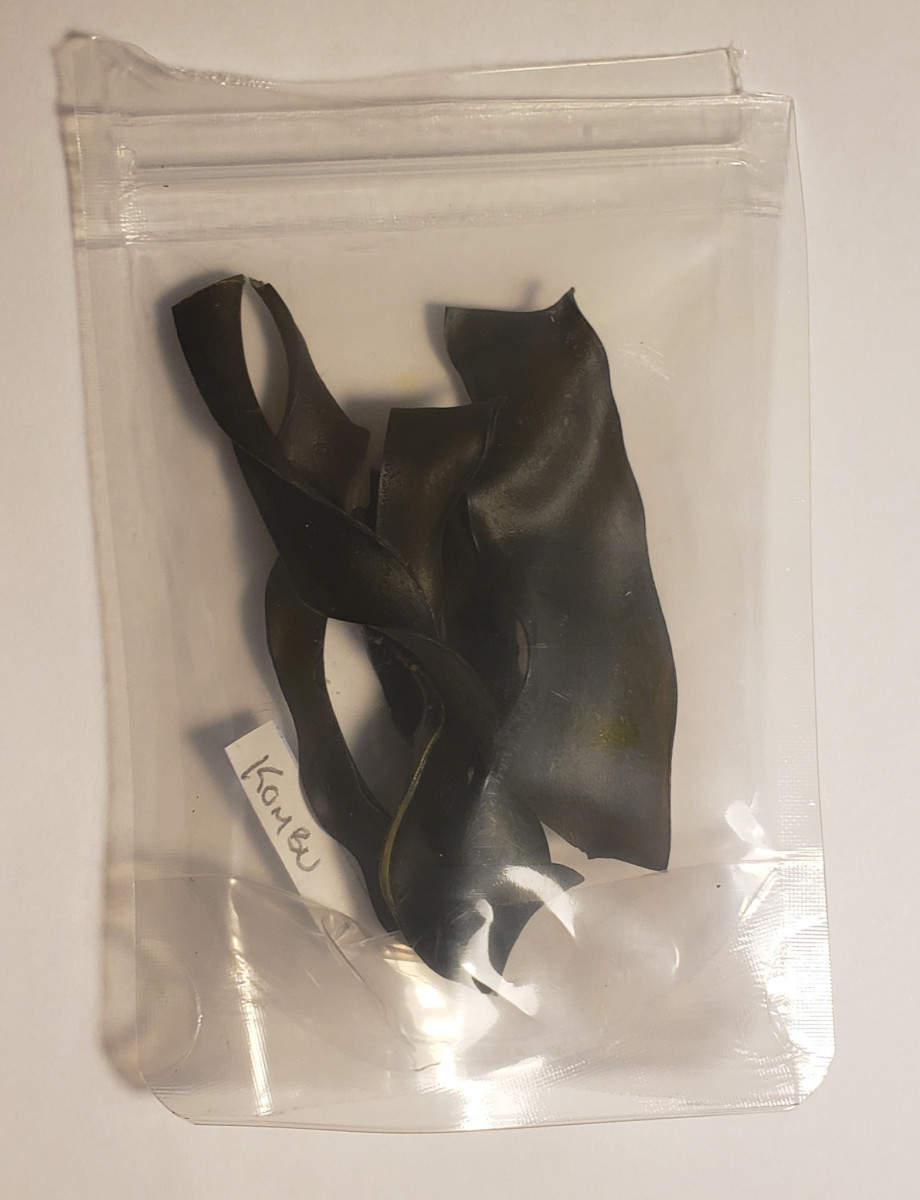
- One piece of kombu (roughly 3”x1”)
- A couple pieces of wakame (roughly 3”x1”)
- The equivalent amount of sea palm (about 8 pieces)
- Your favorite tea + a piece of wakame
When we return from the break, you’ll pour boiling water in each of the seaweed cups and let them steep while Annie tells us about her seaweed ILC. Wait to add water to your favorite tea until we start tasting the seaweed, so the tea is not oversteeped (it will be the last thing we taste).
SEAWEED TASTING
4. WHAT ARE THE THREE SEAWEEDS WE ARE TASTING TODAY?
Kombu, Wakame, and Sea Palm
5. WHAT TYPE OF SEAWEED ARE THEY?
They are Kelp
6. WHAT ARE THE HEALTH BENEFITS OF SEAWEED?
Seaweed contains a lot of vitamins and minerals as well as antioxidents.
7. WHAT IS THE BIGGEST THREAT TO THE OCEAN RIGHT NOW? Why?
The biggest threat to the ocean is acidification, caused by pollution, which kills sea life.
Seaweed #1: Sea Palm
Tea:
Color: Dark Green
Aroma: like the sea
Texture: Tender
Mouthfeel: silky,moist
Taste: Salty
Aftertaste: mild salty
Reconstituted:
Color: medium-light green
Aroma: Slight sea
Texture: Spongy
Mouthfeel: Fatty
Taste: Nutty, salty
Aftertaste: mild nutty
Dried
Color: Dark Green
Aroma: Nutty
Texture: Crunchy
Mouthfeel: Leathery
Taste: Salty, Savory
Aftertaste: mild salty
Seaweed #2: Kombu
Tea:
Color: Dark Green
Aroma: like the sea
Texture: Crispy
Mouthfeel: Gelatinous, slimy
Taste: Salty
Aftertaste: mild salty
Reconstituted:
Color: forest green
Aroma: mild
Texture:Slimy
Mouthfeel: Juicy
Taste: salty/shellfish
Aftertaste: mild
Dried
Color: forest green
Aroma: Vegetal
Texture: fridged, tough
Mouthfeel: slimy
Taste: mild salty/shellfish
Aftertaste: salty
Seaweed #3: Wakame
Tea:
Color: Dark green
Aroma: nutty
Texture: firm
Mouthfeel: flaky
Taste: salty, slightly sweet
Aftertaste: mild salt
Reconstituted:
Color: lighter green
Aroma: nutty, like the sea
Texture: tender
Mouthfeel: silky
Taste: mild salt/sweet
Aftertaste: mild salt
Dried
Color: dark green
Aroma: sea
Texture: crisp
Mouthfeel: dry, flaky
Taste: salty and slightly sweet
Aftertaste: mild salty
SEAWEED MEROIR FLAVOR LEXICON
Color
Light green, Yellowish green, purplish green, dark green, blackish
Aroma/Flavor
Caramelized, nutty, shellfish, earthy, eggy, herbaceous, fruity, vegetal
Texture
Crisp, firm, tender, springy, spongy, fibrous, squeaky, flaky
Taste
Bitter, salty, umami, sour, sweet
Mouthfeel
Burst-in-mouth, Melt-in-mouth, juicy, moist, fatty, silky, slippery, gelatinous, glutinous
Aftertaste
Lingering, clean, astringent
REFLECTION
8. WHAT WERE SOME OF YOUR FAVORITE GEODUCK AND/OR SEAWEED DISHES PRESENTED TODAY?
Sea palm was definitley my favorite. Kombu was too slimy and I didnt love the flavor of wakame.
9. HAVE YOU EVER EATEN GEODUCK? If yes, please tell the story. How was it prepared? What did you think?
No, I have not eaten geoduck.
10. WHAT OTHER FOOD HAVE YOU EATEN THAT HAVE “Q”?
Tapioka balls in boba tea, especially chewy noodles, and vegan jerky.
11. WOULD YOU ORDER A GEODUCK SHIPPED TO YOUR HOUSE? If yes, how much would you be willing to pay for it? If no, why?
No, because I am vegan.
12. WHAT WOULD YOU MAKE WITH GEODUCK IF THE SKY WAS THE LIMIT?
Someone mentioned putting it in a pasta which sounded really good.
13. HAVE YOU EATEN SEAWEED BEFORE? If yes, what was your most memorable time? If no, what stopped you from eating it?
Yes, I love the sheets of seaweed that are sold to be eaten as a snack. I also really enjoy seaweed salad.
14. WHAT TEA DID YOU EXPERIMENT WITH ADDING SEAWEED TO TODAY? Did they complement each other, or detract? What kind of tea do you think would pair well?
I used earl grey tea with sea palm. They did not go very well together, I didnt like the saltyness mixed with the tea flavor.
15. HOW DID YOU PREPARE THE LEFTOVER SEAWEED? Share recipe details if you want, and Emily might feature it on her website!
I ate it raw as a snack and really enjoyed it!
16. WHAT DID YOU LEARN FROM ANNIE’S RESEARCH STRUCTURE AND FOCUS? Please share your notes.
I thought what she learned about the times of year certain seaweeds could be harvested was very interesting. I always thought it could be harvested at any point. I also thought it was interesting that the places that seaweed can be harvested are very limited due to water quality.
#4e: Stuckey’s Taste Book Experiments
- Of the 5 basic tastes, which do you believe your body craves the most?
Sweet
2. Do you have a specific (or favorite) way to enjoy that basic taste?
I love all deserts, especially chocolate.
1st Experiment Questions:
3. What was your initial reaction to the bitter nail tea with nothing added to it?
It was too bitter for me, I have a history of not liking bitter foods.
4. How did the bitterness change between the different cups containing sugar and/or salt?
With the salt the bitterness was masked a lot, but I was still not a fan of the taste. The sugar also did a good job of masking the bitter and made the taste slightly more pleasant.
5. There seems to be two groups of coffee/tea drinkers: people who enjoy the drink in its unaltered form, and others who like modify it with fats and sugars. Give different example of a way we humans alter classically bitter foods or drink to make them more palatable.
People tend to add sugars and creams to bitter drinks. Sweet dressings are often added to bitter foods, such as radicchio.
6. What are your thoughts on regionally/culturally acquired flavor preferences? Do you believe that flavor preference is a learned behavior, instinctual, or a mixture of both? When you taste a flavor, when does its objectivity end and your subjectivity begin?
I think it is a mix of both. I think people grow accustomed to the foods they have been eating their whole lives and stepping outside of that can be jarring at first. I do not become accustomed to new foods quickly but my tastes definitely do change over time.
2nd Experiment Questions: (OPTIONAL)
7. Do you enjoy grapefruit? Why do you think some people love the flavor of raw grapefruit, and others can’t stand it?
I enjoy grapefruit but I don’t love it. It has an intense flavor, I think anytime a food has a strong flavor people will have strong responses in both directions.
8. How did the addition of sugar alter the flavor of the grapefruit?
The sugar muted the strong bitterness.
9. How did the addition of the salt alter the flavor of the grapefruit?
I mostly tasted the salt and grapefruit separately, they did not mix together very much.
10. Did the addition of the sugar and/or salt change your opinion on grapefruit?
No, I still feel the same about grapefruit.
11. Seeing as these two experiments both consisted of altering a food or drink by adding salt or sugar, did you find any similarities or differences between the two experiments?
I thought that with the addition of sugar/salt the intense flavor of the foods we were tasting became more muted.
#4f: Sustainable Entrepreneurship
For Week 7 group five gave a presentation on Social Enterprises and Benefit Corporations. For week 8 group 6 gave a presentation on fisheries and sustainability. What stood out the most to me during this presentation was that a lot of plastic and garbage found in the ocean comes from commercial fisheries.
My Week 8 Diary Entry:
Question 1:
● What are the similarities between the B Impact Assessment protocol and our three frameworks?
Both the B Impact Assessment and our frameworks aim to encourage businesses to have a positive impact on society and their communities. Both offer services to help businesses have a more positive impact.
● What are the differences between the B Impact Assessment protocol and our three frameworks?
Some differences between the B Impact Assessment and our frameworks are: The B impact assessment focuses more on assessing how positive or negative a business impact is while our frameworks focused more on providing resources so that businesses can better themselves. The B Assessment also focuses mostly on environmental sustainability while our frameworks focused on both environmental sustainability and racial justice.
● What is missing in the B Impact Assessment protocol?
The B Impact Assessment mostly focuses on environmental sustainability and not social issues.
Question 2: Select a Case Study company from the list. Look through their B Corp case study report, as well as their website, social media pages, and any other information that you can find on them.
● What is their B-score?
I chose Ben and Jerry’s. Their B score was 89 in 2012 and 101 in 2014.
● What does their B Score mean? In other words, where did they perform well? What specifically do they do well in their highest performing area? Where do they perform poorly? Why?
They scored higher than the average business. They did especially well in the environment section. The only reason I could find that they got a good environment score was that they source from family farmers and don’t use synthetic hormones on their cows. The B score assessment was very complimentary of B&J’s. Knowing the hugely negative impact the dairy industry has on the environment I am confused as to why they got such a good score, over double the average, and they didn’t provide much reasoning for such a good score. The only section they performed below average was community.
● What might be areas of improvement for them (based on the information you can find)? You can also use elements of the three frameworks we introduced in class to identify areas of improvement as well.
I think Ben & Jerry’s could focus on making more dairy free ice cream to become more environmentally friendly.
#4g: Climate and Resilience Event Series/Seminar
This week I watched the climate event: Modeling Wildfire in Oregon with John Bolte. In this talk Professor John Bolte from Oregon State University discusses technology that could predict what the effects of climate change will look like and what the effects of different climate mitigation plans would look like.
#4h: Foodoir: Your Story of Tasting Place
This quarter I have been reading the foodoir “Farming While Black” by Leah Penniman. This book tells the story of Leah discovering her love of agriculture and starting a farm to feed her community. As well as reflecting on the undervalued achievements of black farmers and helping young black farmers connect with the land. Leah also offers lots of practical farming advice and insights on running a small CSA farm. I have attached some of my favorite quotes below:
“Civil rights veteran Baba Curtis Hayes Muhammad, explained to us that “without black farmers, there would have been no Freedom Summer-in fact, no civil rights movement.”……Baba Muhammad explained the central role that black farmers had played during the civil rights movement, coordinating campaigns for desegregation and voting rights as well as providing food, housing, bail money, and safe haven for activists and displaced tenant farmers.”
Leah Penniman
Farming While Black
I found this quote very interesting because I was not at all aware of the role black farmers played in the civil rights movement. I wish that I had been taught more about this topic earlier in my life
“The US Department of Agriculture’s destruction of parity pricing and its “get big or get out” policies since the 1950’s undermined the small farm economy and incentivized consolidation. As agriculture declined in the area, the prison industry rose to take its place.”
Leah Penniman
Farming While Black
This quote struck me because the more I learn about government spending regarding agriculture, the more I see how the cards are stacked against small farmers. Especially small famers of color. Small farms in the 50’s did not have a good chance of making it unless they had the resources to scale up, resources that have been systematically blocked from people of color.
#4i: Bibliography
Penniman, Leah, and Karen Washington. Farming While Black: Soul Fire Farm’s Practical Guide to Liberation on the Land. Chelsea Green Publishing, 2018.
Stuckey, Barb. Taste: Surprising Stories and Science about Why Food Tastes Good. Atria Paperback, 2013.
YouTube, 2019, “Why this $300 clam is so important to Native Americans and China” Why this $300 clam is so important to Native Americans and China – YouTube
2019, “Zanzibar’s Female Seaweed Farmers”
Zanzibar’s Female Seaweed Farmers; Helen Joubert – Alexander Street, a ProQuest Company (oclc.org)
Leave a Reply