

Café con leche in Granada, Spain
Photo by Val
Arabia: What is it?
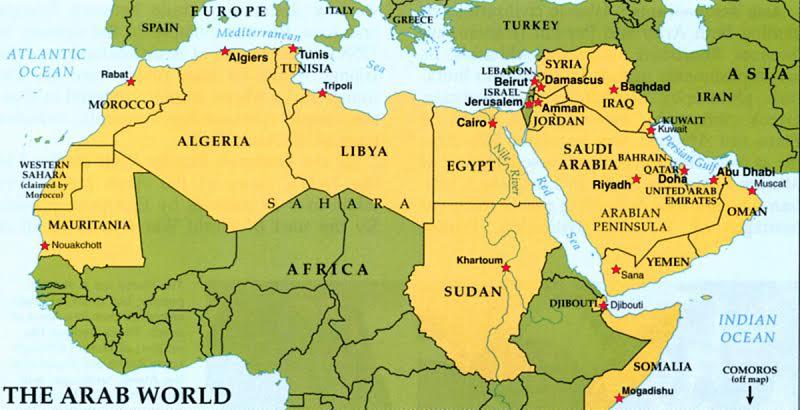
Yassin Alsadi, Samer. “Map of the Arab World.” Research Gate, ResearchGate GmbH, www.researchgate.net/figure/Map-of-the-Arab-World_fig1_305584980.
- Arab countries are religiously and ethnically diverse with Islam being the dominant religion in most countries.
- 22 Arab countries/areas: Algeria, Bahrain, the Comoros Islands, Djibouti, Egypt, Iraq, Jordan, Kuwait, Lebanon, Libya, Morocco, Mauritania, Oman, Palestine, Qatar, Saudi Arabia, Somalia, Sudan, Syria, Tunisia, United Arab Emirates, and Yemen.
- Iran and Turkey are not Arab countries.
- The Arab world includes Muslims, Christians and Jews
- To be an Arab, like an American, is a cultural trait rather than racial.
- Arabic is the official and the original language of the Qur’an, the Islamic holy book.
- The majority of people in the Arab world adhere to Islam, and the religion has official status in most countries
- It can also be defined as those countries where Arabic is the dominant language.
The Arab Spring
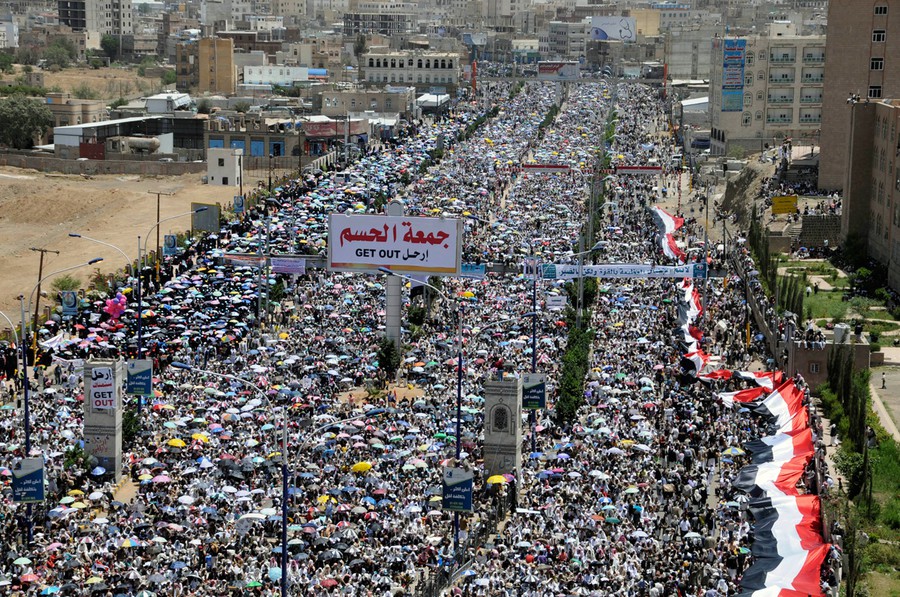
Hamoud, Mohammed. “Anti-Government Protesters Attend a Demonstration Demanding the Resignation of President Saleh, in Sanaa, Yemen, on Friday, May 13, 2011.” The Atlantuc, The Atlantic Monthly Group, 3 June 2011, www.theatlantic.com/photo/2011/06/crisis-in-yemen/100079/.
- Since December 2010 there were revolutions in Tunisia and Egypt, a civil war in Libya, civil uprisings in Bahrain, Syria, and Yemen, and major protests in Algeria, Jordan, Morocco, and Oman.
- Protesters were generally young people, who also used the social media, such as Facebook, Twitter, and YouTube, to organize, communicate, and raise awareness in the face of their governments‘ attempts at censorship.
- “The people want to bring down the regime” was a common slogan.
- Many demonstrations met violent responses from government authorities, as well as from pro-government militias.
- In all countries, there were accusations of human rights violations, government corruption, unemployment, extreme poverty, and a large percentage of educated but dissatisfied youth within the population.
What Happened After the Arab Spring?

Sherif9282. “A Protester Holds a Placard in Tahrir Square Referring to Facebook and Twitter, Acknowledging the Role Played by Social Media during the 2011 Egyptian Revolution.” University of Washington, University of Washington, 20 Nov. 2013, www.washington.edu/news/2013/11/20/study-shines-light-on-what-makes-digital-activism-effective/.
Why is Yemen at War?
Coffee in Yemen
The Coffee Farmers of Yemen
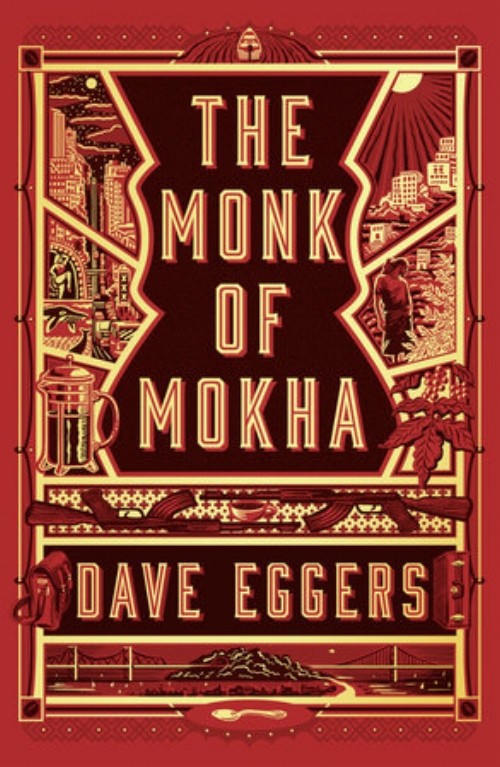
The Monk of Mokha is a real-life story of a young man, named Mokhtar Alkhanshali, who’s life as a doorman radically changes. Mokhtar falls in love with coffee at a late age, this new life change leads him to the coffee farms in his home country of Yemen. He soon realizes that his goal in life is to resurrect the famous coffee industry in Yemen. After working with local coffee farmers and creating his own processing mill, Mokhtar soon finds himself in the middle of a civil war. Mokhtar was stranded in Yemen, with no way back to America. After escaping being imprisoned twice, Mokhtar was able to get himself, and his coffee samples, across the Red Sea to Djibouti and finally onto a plane for Seattle. Soon after the Seattle Specialty Coffee Expo, Mokhtar and his company, The Port of Mokha, started to successfully export coffee from Yemen, becoming some of the most famous coffee found in the world.
“The Monk of Mokha.” Dave Eggers, daveeggers.net/monkofmokha.
How a man’s dangerous quest for coffee inspiered Dave Eggers new book
Film Series: Program Questions in Scenes and Overview
Week 5
- ‘Monk of Mokha’ tells the story of your culture-crossing, life-changing cup of coffee, PBS New Hour (6 min)
- Black Coffee, Point of Origin podcast #28 (Stephen Satterfield, 40 min) plus browse related links at this website while listening to the Black Coffee podcast
- Black Gold. Website with reviews and film on campus library streaming service Kanopy. (Directors Marc and Nick Francis, 2006, 77 min).
Week 6
- Olympia Coffee (website to browse with assorted short videos, 30 min)
- Black Coffee Northwest (website plus google for related news items)
- Love, Coffee, Yemen: A Story of Hope, fueled by coffee by Mokhtar Alkhanshali | Nuqat 2019 (36 min)
- Top 8 Coffee Documentaries to Watch Online for Free (8 min)
- Recommended: Delicious Peace Grows in a Ugandan Coffee Bean (2010, 40 min)
Love, Coffee, Yemen: A Story of Hope, fueled by coffee by Mokhtar Alkhanshali
I chose minute 16 to 18:29 from Love, Coffee, Yemen and have called it the Conscious Consumers Taste. Mokhtar Alkhanshali, from the Monk of Mokha, was speaking about his journey with Yemeni’s coffee at the Nuqat 2019 Regional Conference: The State of the Elastic Mind. Mokhtar starts by explaining how the 21 samples of coffee he had procured from Yemen produced 19 cuppings of horrible coffee with all the worst defects there were, but 2 samples rated 90+ in the cupping; scoring a 90+ is one of the highest possible coffee ratings and is very rare. Mokhtar then went back to Yemen to work with the coffee farms, but he found out that there was little to no structure to their picking and processing methods. He then went on to explain that there is a relationship between what you pay for and what you get. Mokhtar had told a lady that he would pay her more is she picked just the red cherries and her response to him was that she would pick rainbow cherries if she was paid more. He then went on to explain that these farmers do not know what their coffee tastes like because it’s usually being processed, roasted, and exported in other places. In this scene he ends on the note that there is a political reality to everything we consume and we need to be conscious consumers of coffee. By being more consciences of the coffee, we are consuming, we can help those small coffee farms and small coffee roasters instead of supporting big coffee, by doing this we support them in growing and learning. When we chose coffee from a small roaster, who gets their beans from a small grower we know exactly where and who that money is going to. We also get better tasting and higher quality coffee as their beans are most likely picked and roasted in smaller batches.
(un)Natural Histories
Hypothisis.is: Things I found insightful, questions that popped up, and thoughts that I had while reading these articles
- Introduction to Coffee Plant and Genetics
- endemicity
- least 125 species in the genus Coffea thats a lot of species…
- wonder if there are more we have yet to discover
- They tend to be robust plants but are almost completely sterile
- how do these types reproduce then?
- equatorial regions, such as Colombia, the coffee flowering and fruit cycle may occur at various times throughout the year
- does this affect productiveness?
- https://www.baristainstitute.com/blog/jori-korhonen/january-2020/coffee-processing-methods-drying-washing-or-honey
- How to coffee is processed can have a dramatic effect on the resulting cup and nowadays roasters and baristas are concentrating on coffee processing to describe the coffee.
- can this be included in coffee terroir?
- fruitiness and sweetness
- could this be from the skin and pulp sitting around the seeds for a while in the sun?
- How to coffee is processed can have a dramatic effect on the resulting cup and nowadays roasters and baristas are concentrating on coffee processing to describe the coffee.
- https://perfectdailygrind.com/2016/07/washed-natural-honey-coffee-processing-101/
- Producers will often wait to see how much rain has fallen before decide whether to produce washed, honey, or natural coffee.
- Coffee processing rarely makes it into the industry headlines or coffee shop discussions, but it’s an integral part of crafting the flavour and character of your cup of coffee.
- https://counterculturecoffee.com/blog/coffee-basics-roasting
- The gradient of beans shown here represents roast levels per minute from one to sixteen
- https://www.circularcoffeefund.com/blog/2020/7/9/ecosystem-services-in-your-cup-of-coffee
- Bees like coffee! The scope of ecosystem services could be enlarged even more if we think about the benefits for other species rather than humans. You are not the only one who receives a caffeine boost from coffee. Also, bees enjoy low caffeine amounts while sucking coffee flowers’ nectar; and it seems to be helpful for bees’ memory!
- What other polinators like the caffeine boost?
- Think about pollination. If conditions are good within an ecosystem, meaning adequate balance and no use of pesticides; plants, flowers, insects, and animals will be thriving and pollination will occur. In turn, humans benefit from having more new plants around them… it is just the perfect nature’s equilibrium!
- Some of the benefits that can be obtained from a balanced ecosystem are pollination, climate regulation, water purification, erosion control, carbon sequestration, and disease control (control of plant pathogens and human diseases)
- Payment of Ecosystem Services as a strategy for conservation. This mechanism tries to encourage stewards, often farmers or indigenous communities, to be active in the restoration of natural ecosystems and prevention of deforestation.
- Shaded coffee plantations are being preferred in recent years over coffee plantations, for its performance in the conservation of ecosystem integrity
- Agricultural land-use history in different tropical countries showed the erosion and depletion of soils in some areas where full sun coffee has been cultivated.
- The desire to implement an intensive coffee plantation, led to the deforestation of primary and secondary forests, with the consequent implementation of a monoculture system, often accompanied by the use of pesticides and chemical fertilizers.
- Are we able to turn this land back around and if so how long will that take?
- Bees like coffee! The scope of ecosystem services could be enlarged even more if we think about the benefits for other species rather than humans. You are not the only one who receives a caffeine boost from coffee. Also, bees enjoy low caffeine amounts while sucking coffee flowers’ nectar; and it seems to be helpful for bees’ memory!
- https://time.com/5318245/coffee-industry-climate-change/#:~:text=Climate%20change%20ranks%20high%20among,grow%20and%20expensive%20to%20buy.&text=Rising%20temperatures%20will%20bring%20drought,insects%20that%20pollinate%20coffee%20plants
- Starbucks
- Why does Starbucks taste better in the EU? I can not stand drinking Starbucks in the states.
- long-term challenges and opportunities. Climate change ranks high among them
- As temperatures rise and droughts intensify, good coffee will become increasingly difficult to grow and expensive to buy.
- climate change is going to play a bigger role in affecting the quality and integrity of coffee.
- Rising temperatures will bring drought, increase the range of diseases and kill large swaths of the insects that pollinate coffee plants
- About half of the land around the world currently used to produce high-quality coffee could be unproductive by 2050, according to a recent study in the journal Climatic Change.
- Instead of just purchasing coffee, they work with small farms to help them adapt to changing conditions, providing seeds, monitoring production and suggesting new agricultural practices.
- Declining supplies and a growing coffee-drinking population mean climate change could turn a daily pick-me-up into a high-priced luxury, threatening the continued growth of the industry’s customer base.
- Farmers in some regions will be able to adapt by growing at higher elevations, but in others there is nowhere else to go. Entire regions risk becoming unable to continue producing Arabica coffee, and Schultz and others say there’s no way to make the more resilient Robusta variety, which is sometimes blended with Arabica to make instant coffee, palatable to the broad coffee-drinking public
- Is there a way to graft the two together? To make a bean that is nice like Arabica, but sutibale to higher temps and rainfall like Robusta?
- Scientists also warn that climate change increases the likelihood of disease, including the dreaded la roya, or stem rust
- Starbucks
- coffee_CorporateSocialResponse_ClimateChangeAdaptation.pdf
- A human intervention to reduce the sourcesor enhance the sinks of greenhouse gases.”
- climate mitigation
- The process of adjustment to actual or expected climate andits effects. In human systems, adaptation seeks to moderate oravoid harm or exploit beneficial opportunities
- climate adaptation
- CSR policies of coffee com-panies are not always environmental in nature. In fact,many corporations focused on workers’pay
- Environmental CSR, or “Corporate Ecological Responsibility” focuses on “mitigating a firm’s impact on the natural environment
- One analysis of British coffee companies identified a total of 94 distinct sustainability indicators. Of these, 44 were environmental, 30 were social and 20 were economic in nature
- some companies see third-party certification as a means to“check the box”of environmental and climate-related
- Can this actually be a CSR if in reality these companies themself are not doing anything?
- industry-wide criticism that too much emphasis is placed on meeting third-party certification standards and industry guidelines.
- the concept of climate adaptation implies that there is no answer for climate change and that humanity must accept the impacts
- If by accepting the impacts and deal with them are we then complying wit climate adaptation or is climate adaptation just a concept that can never actually done becaue climate change has no answer to it?
- possible but somewhat unlikely explanation is that coffee companies are not aware of the extent that the Arabica crop is threatened by climate change.
- Could Arabica adapt to these new climate changes?
- A human intervention to reduce the sourcesor enhance the sinks of greenhouse gases.”
Regenerative Agriculture
Coffee: Where is it grown?
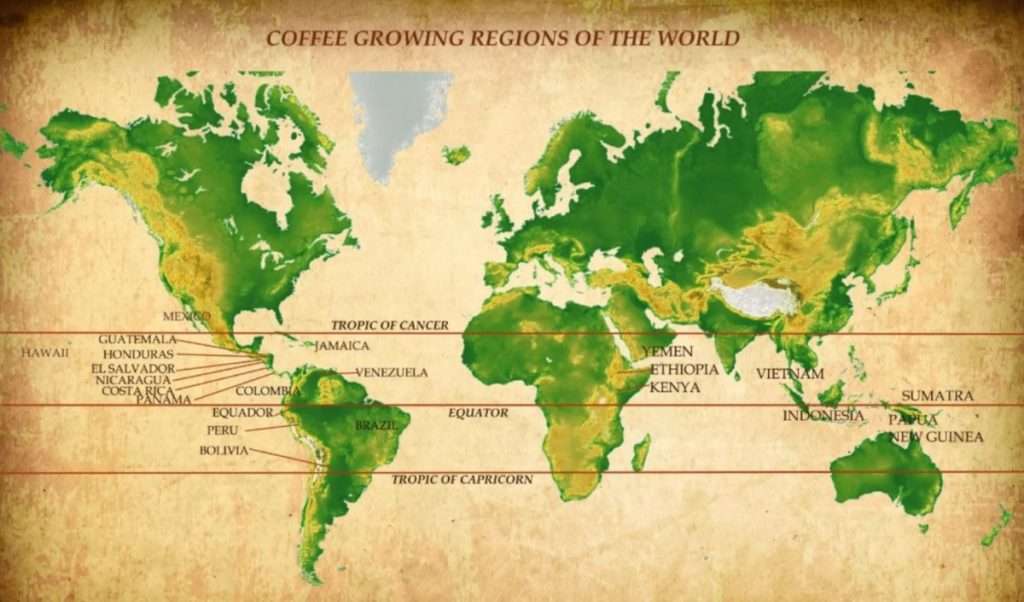
“Coffee Growing Regions of the Wolrd.” Rabika Coffee, RABIKA COFFEE, www.rabikacoffee.com/FrontEnd/index.php?page=news&onepage&id=6&lang=EN.
What makes the coffee growing region so unique? Its the rainfall, temperatures, and primary productivity of the land.
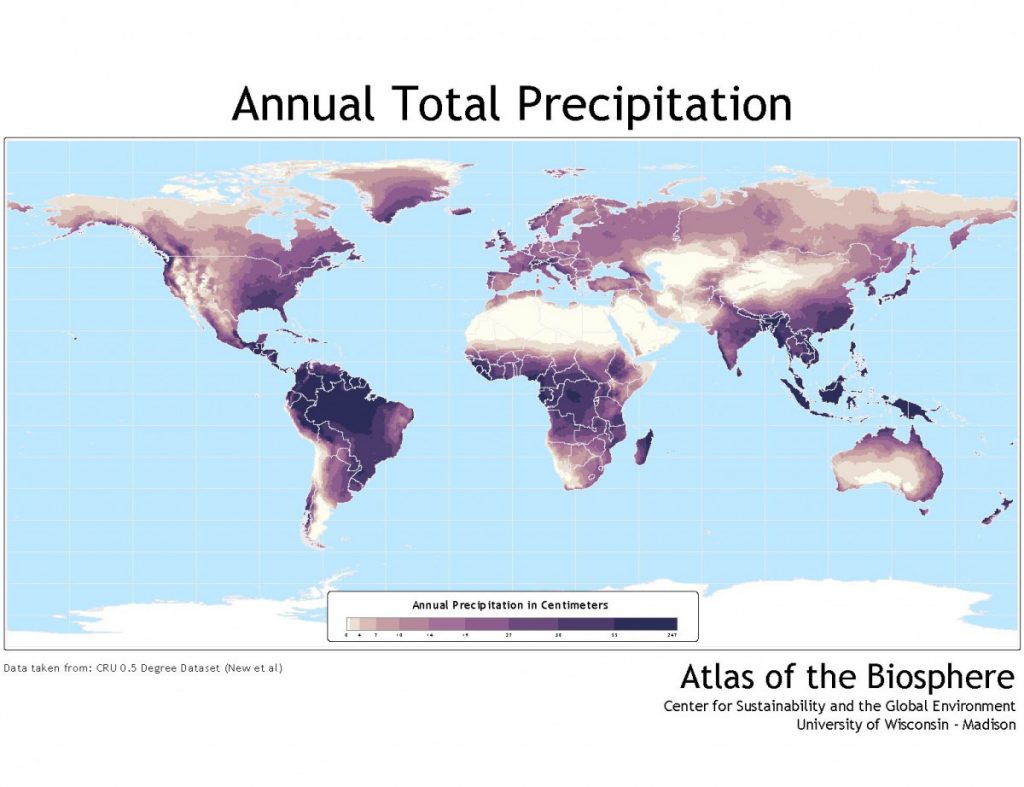
“Total Annual Precipitation.” NASA. 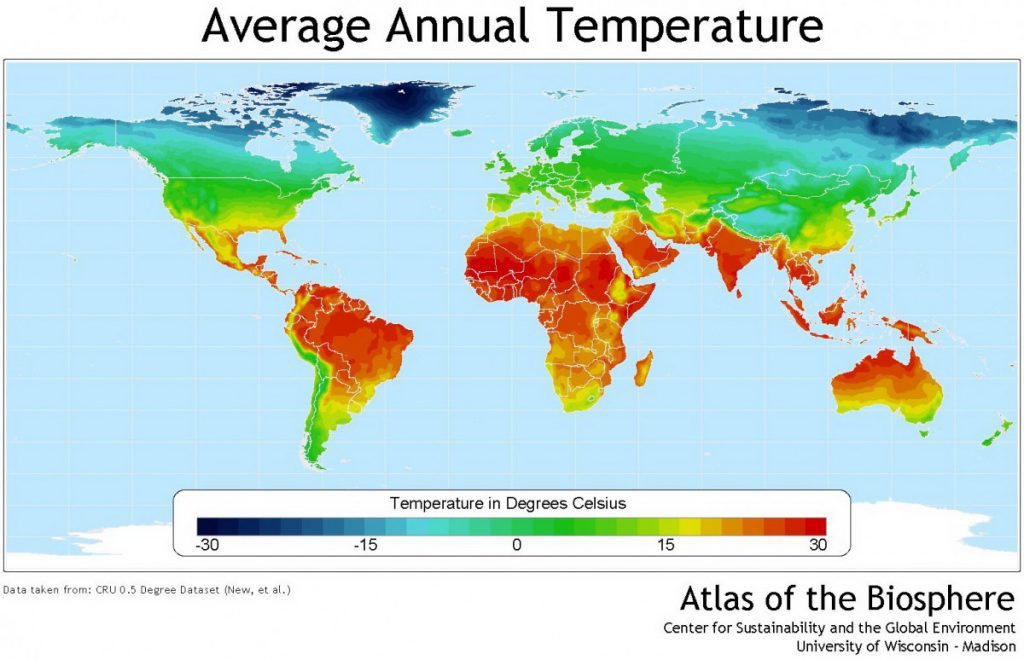
“Average Annual Temperature.” Vivid Maps. 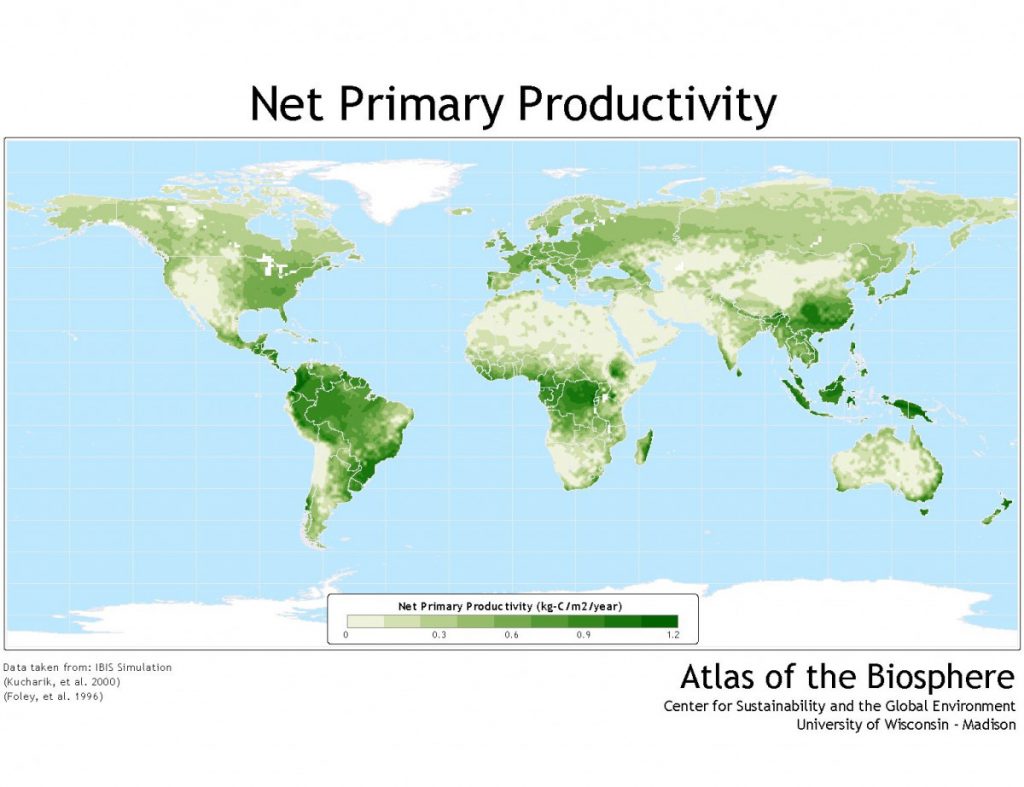
“Net Primary Productivity.” Center for Sustainability and the Global Environment University of Wisconsin-Madison.
At this time coffee is currently produced in about 80 tropical countries from around 125 coffee species. Annually 9 million tons of green beans are produced.
17% of the world’s population drinks around 65% of the worlds coffee.
Coffea Arabic is associated with a higher beverage quality.
The Cultivation
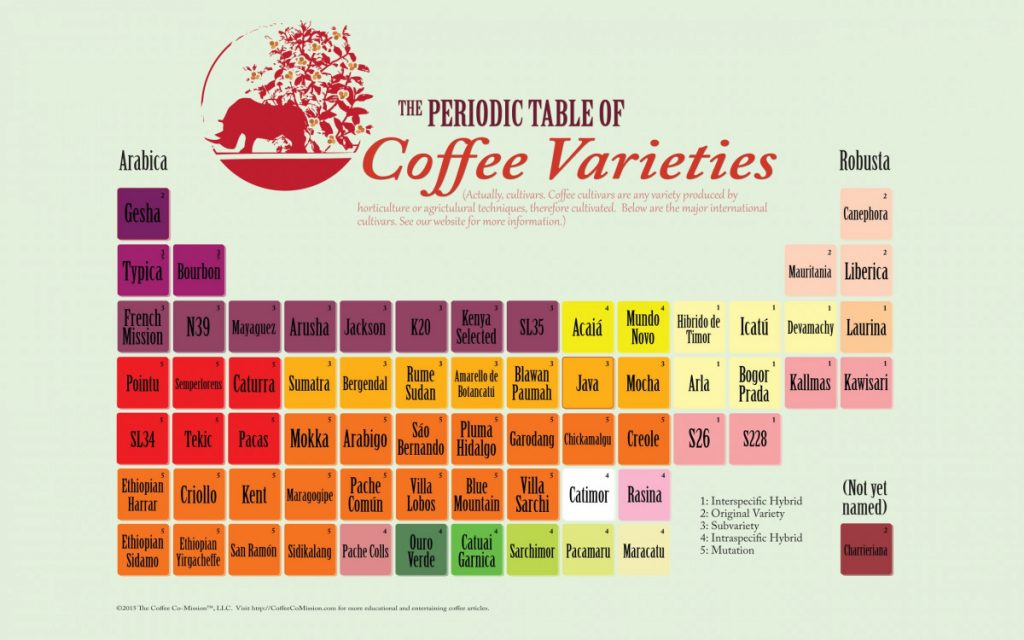
The Coffee Co-Mission. “The Periodic Table of Coffee Varieties or Cultivars.” The Coffee Co-Mission, medium.com/@CoffeeCoMission/infographic-periodic-table-of-coffee-varieties-or-cultivars-57dbce92c788.
There are two main methods of coffee cultivation, sun grown and shade grown.
Shade Grown
- Shade grown is the more traditional approach, as it mimics the natural way coffee used to grow.
- Shade grown coffee has taller trees that provide a canopy, creating biodiversity. By growing these different crops together helps create a resistance to pests and diseases.
- This diversity also has a positive impact on both the wildlife and the coffee plants. More diverse trees can increase the bird population and also can increase pollinating insects. These birds then can serve as natural predators of coffee pests.
- The canopy cover from the shade trees can also help in other ways, such as protection of the top soil from erosion. These diverse trees also create a number of different root systems that can also help in erosion, but also by helping fix the soil.
- The cooling effect from the shade helps produce a higher quality, denser coffee beans. These beans can then be sold to specialty coffee roasters at a higher price.
- The different trees found in shade grown coffee areas can also help provide an additional income.
Conservation Science: Amanda Rodewald Discusses Shade Grown Coffee
Sun Grown
- In the 1970s the idea of growing coffee in full sun was introduced
- Could give a higher yield, meaning higher profit
- Has an adverse effect on the ecosystem and coffee quality
- In Central America sun grown coffee has led to 2.5 million acers of deforestation
- Sun grown monocrops of coffee removes the natural barriers to pests, reduces bird habitats, and requires an increased use of chemical pesticides
Pruning and Stumping
- Pruning and stumping can help to improve the health and yield of coffee plants. Coffee cherry production naturally decreases with age, exhaustion, or phytosanitary problems
- Trees should be routinely pruned after harvest for maintenance
Coffee Diseases and Pests
- Coffee berry borer
- Coffee leaf miner
- Root knot nematodes
- Coffee leaf rust
- Coffee berry disease
- American leaf spot
- Coffee wilt disease
The Processing
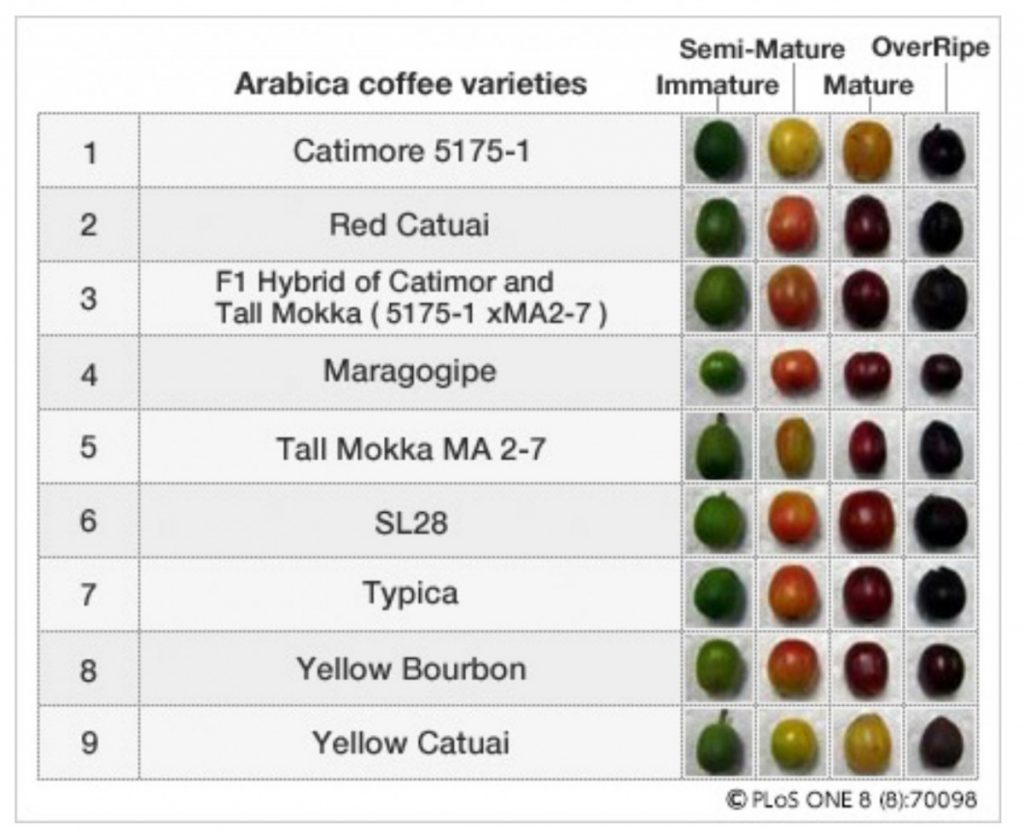
“Nine Cultivars of Harvested Coffee Fruits at Four Levels of Ripeness.” Suntory, SUNTORY HOLDINGS LIMITED, www.suntory.com/sic/research/t_coffee/index.html.
Natural/ Dry Processing
- After the coffee cherries are picked, they are spread out into a thin layer to dry in the sun
- In order to avoid mold, rotting, or fermentation the cherries are turned on a regular basis
- Once the cherries have dried, the skin and dried fruit flesh are removed mechanically
- This process is more common in regions where there is little to no water access
- Ethiopia
- Some parts of Brazil
- This process can add flavors of fruitiness and sweetness, no matter the variety or the region
- It can also add wild fermentation flavors or alcohol like notes
Natural Coffee Processing
Washed/ Wet Process
- After the coffee cherries are picked the flesh of the cherries are removed from the beans mechanically
- The beans are then put into a water tank where fermentation removes any flesh left on the beans
- If the beans are left to ferment too long it can have a negative effect on the flavor of the coffee
- After being fermented, the beans are then washed to remove whatever flesh was left and are then ready to be dried
- The drying process is pretty much just like the natural process of drying
- Beans can also be mechanically dried
- This is especially helpful in regions where there is not much sunshine or there is excess humidity
- This process brings about bright and acidic flavors
- This process is preferred by farmers and producers, because when it is done properly it can reduce the risk of defects and is often a more stable way of processing the coffee
- This process does require more water than other processes, thus it is more expensive
Washed Coffee Processing
Honey/ Semi Washed/ Pulped Natural
- This process is commonly used mainly in Central American Countries
- Costa Rica
- El Salvador
- After the coffee cherries are picked, they are mechanically depulped
- The depulping machines have been set to leave a certain amount of flesh on the beans
- The beans then go to the drying patios
- This process offers positive attributes
- The sweetness of the natural process
- The brightness of the washed process
Honey Coffee Processing
Other processing methods include anaerobic, carbonic maceration, and giling basah.
Many times, coffee processers will wait to see just how much rain has fallen in the season in order to decide what processing method they will use. With heavy rains it is harder to create a good natural coffee because the coffee cherries can start to split. With little rainfall, honey or natural processing is great because the sugars in the cherries have not had the chance to be washed away.
After the processing is completed, the beans now have a moisture content that is low enough to safely be stored before exporting.
Just before the beans are exported they are hulled.
Roasting
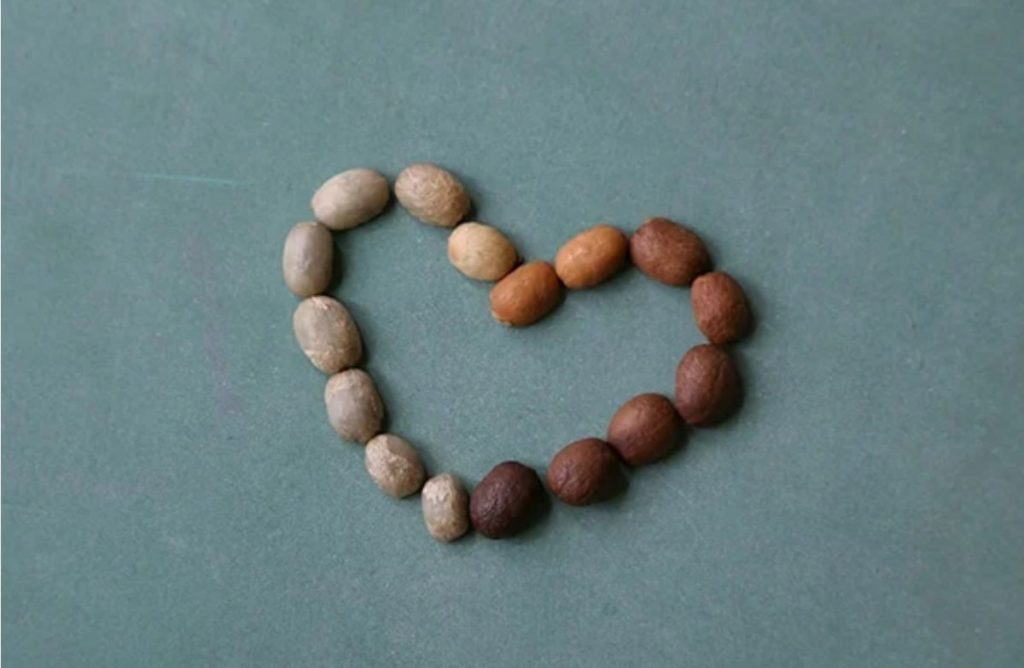
“The Gradient of Beans Shown Here Represents Roast Levels per Minute from One to Sixteen.” Counter Culture Coffee, counterculturecoffee.com/blog/coffee-basics-roasting.
Green coffee beans go through a process that is called roasting. This is where the green beans are transformed into the roasted coffee beans that we use to brew our coffee.
This is done by bringing the coffee to a specific internal temperature or a certain level of development. This is done through the careful application of heat and very close observation.
Heat not only caramelizes the sugars in the beans, but it also browns the beans during roasting.
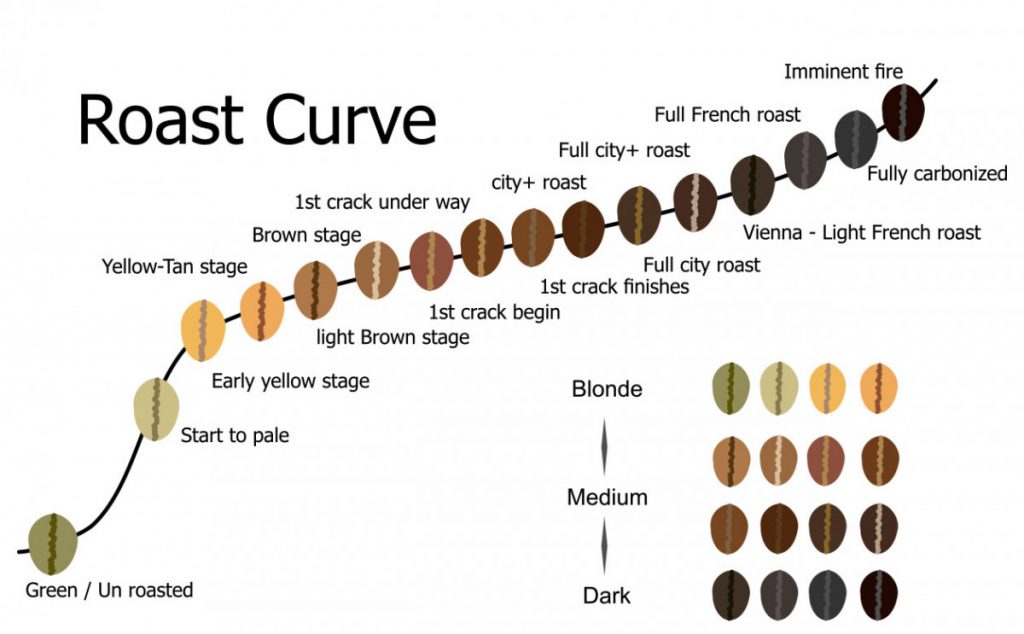
Pongpinun Traisrisilp. “Roast Curve.” Kauai Coffee, kauaicoffee.com/kauai-coffee-roasting-guide/.

“Coffee Color Scale.” Know Your Grinder, Know Your Grinder, knowyourgrinder.com/best-home-coffee-bean-roasters-reviews/.
Darker roasts tend to have more of the roasting application characters, while lighter roasts tend to have more of the characteristics of the coffee itself.
Case Study Tasting Research: Coffee
2019 Tour of Batdorf and Bronson with Eating in Translation
Video by Val
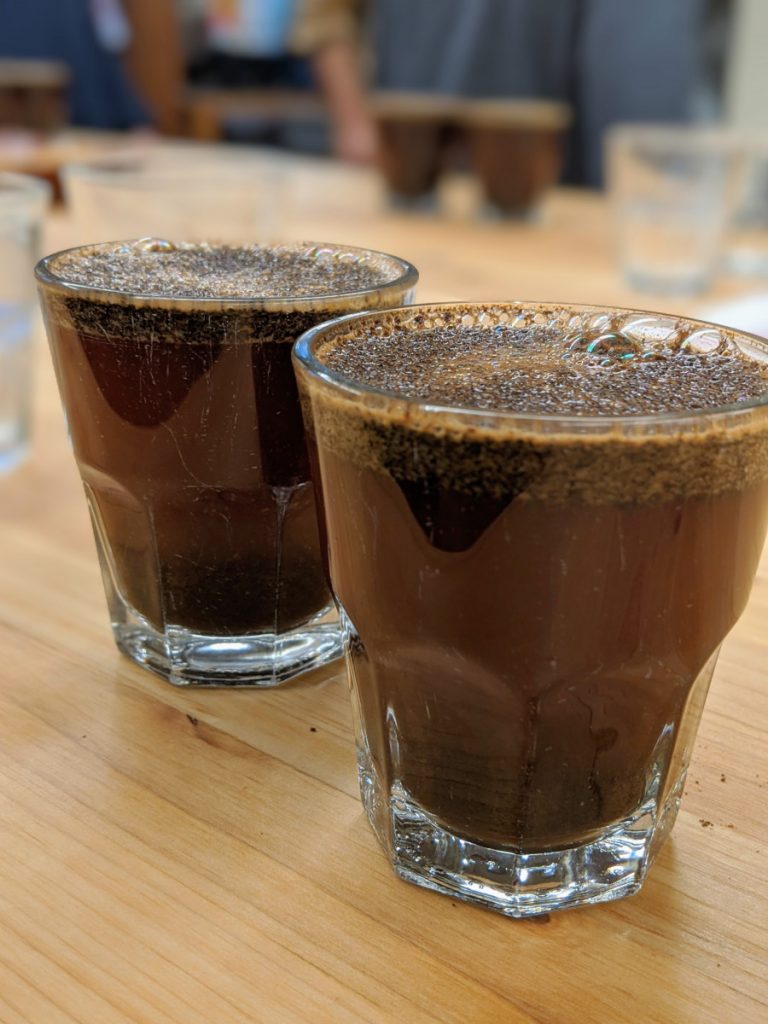
2019 Coffee cupping at Batdorf and Bronson with Eating in Translation
Photo by Val
For the coffee cupping with Bob Benck of Batdorf and Bronson we tried Sumatra Mandheling, Guatemala El Valle, and Ethiopia Shakiso Guji. I later tried a Yemin coffee, the Relief Blend from the Port of Mokha.
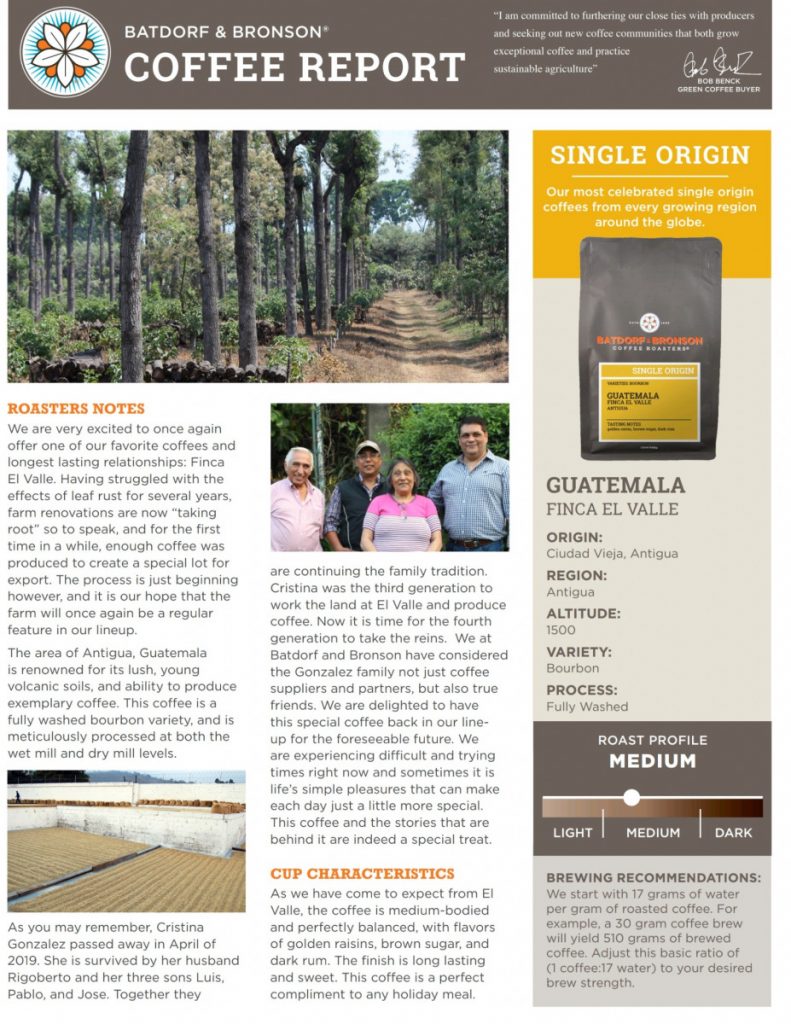
Batdorf and Bronson Coffee Roasters. “Guatemala El Valle.”
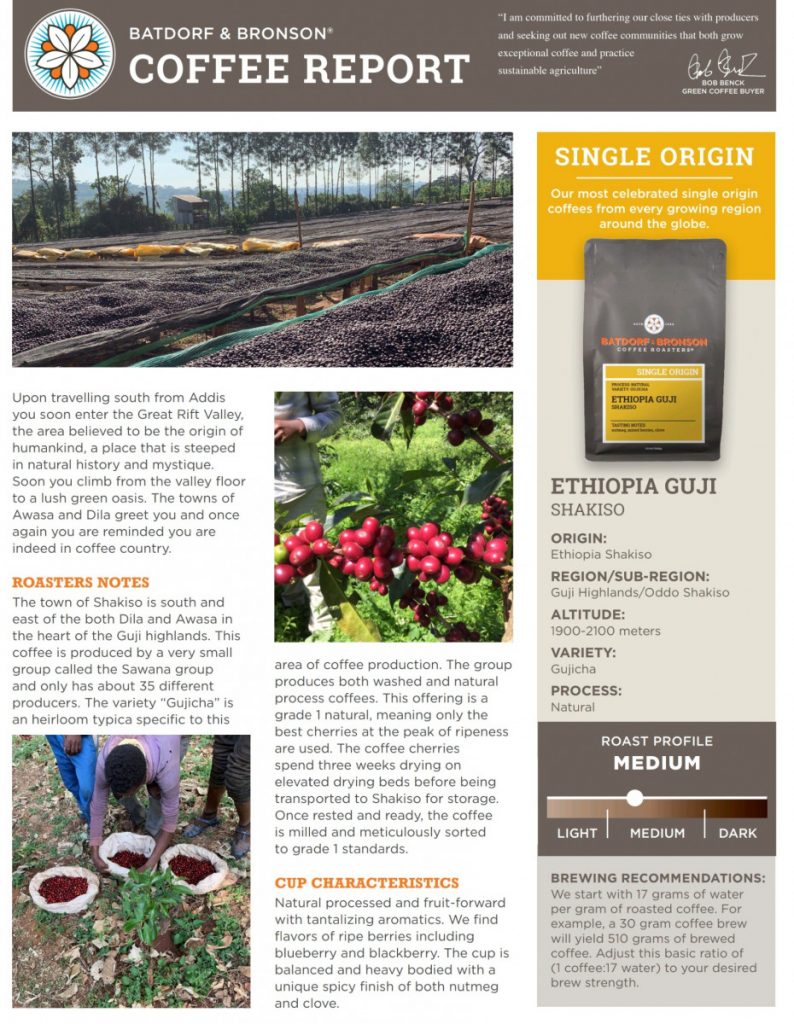
Batdorf and Bronson Coffee Roasters. “Ethiopia Shakiso Guji.”
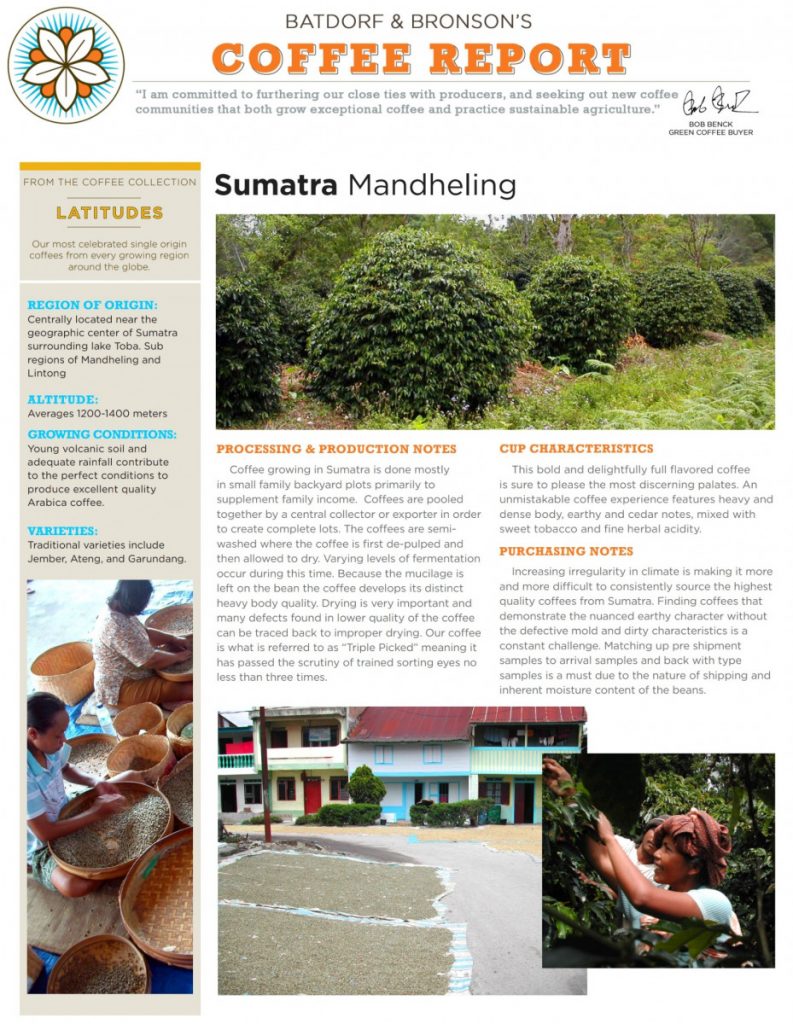
Batdorf and Bronson Coffee Roasters. “Sumatra Mandheling.”
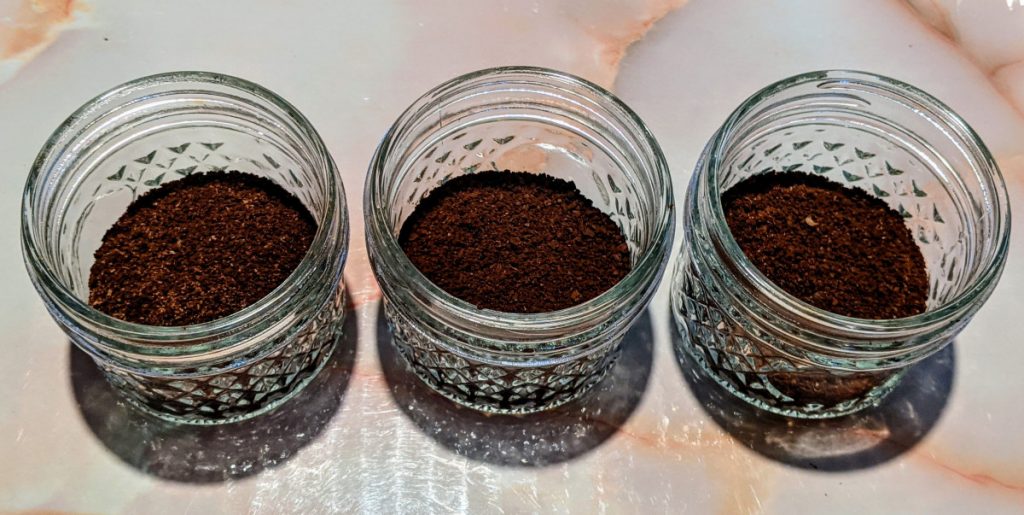
Ground coffee ready for the coffee cupping
Photo by Val

Grounds steeping
Photo by Val
Breaking the crust
Video by Val
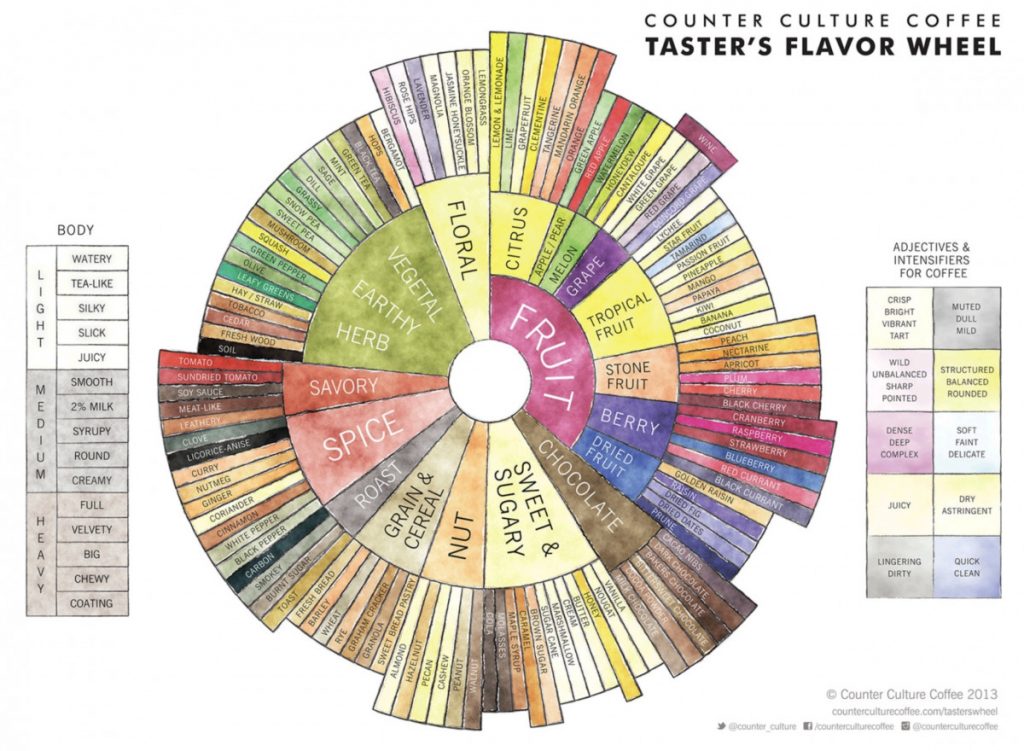
Counter Culture Coffee. “The Counter Culture Coffee Taster’s Flavor Wheel.” Daily Coffee News, Daily Coffee News LLC, 6 Jan. 2014, dailycoffeenews.com/2014/01/06/the-new-tasters-flavor-wheel-a-recalibration-of-coffee-dialogue/.
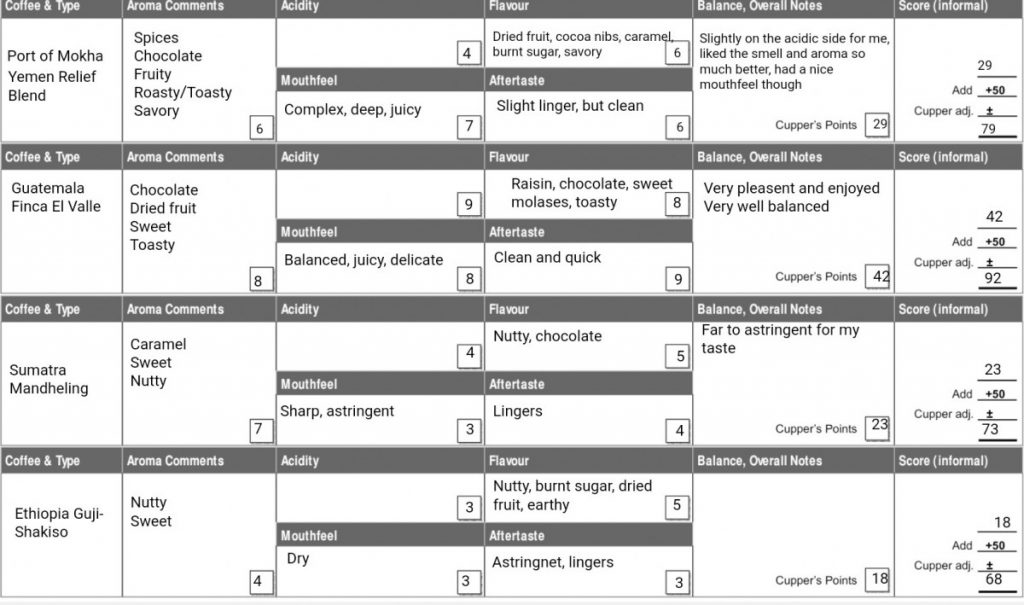
This is a quick form of my coffee cuppings. I definitely feel that I would need more tastings to become better at this, as right now I feel that the acidity masks many flavor notes for me. The Guatemala coffee was definitely my favorite out of the cupping.
Breaking the crust of the Yemeni coffee
Video by Val
Stuckey’s Taste Book Experiments
Week 6 – Experiment Guide Question/Answer Form
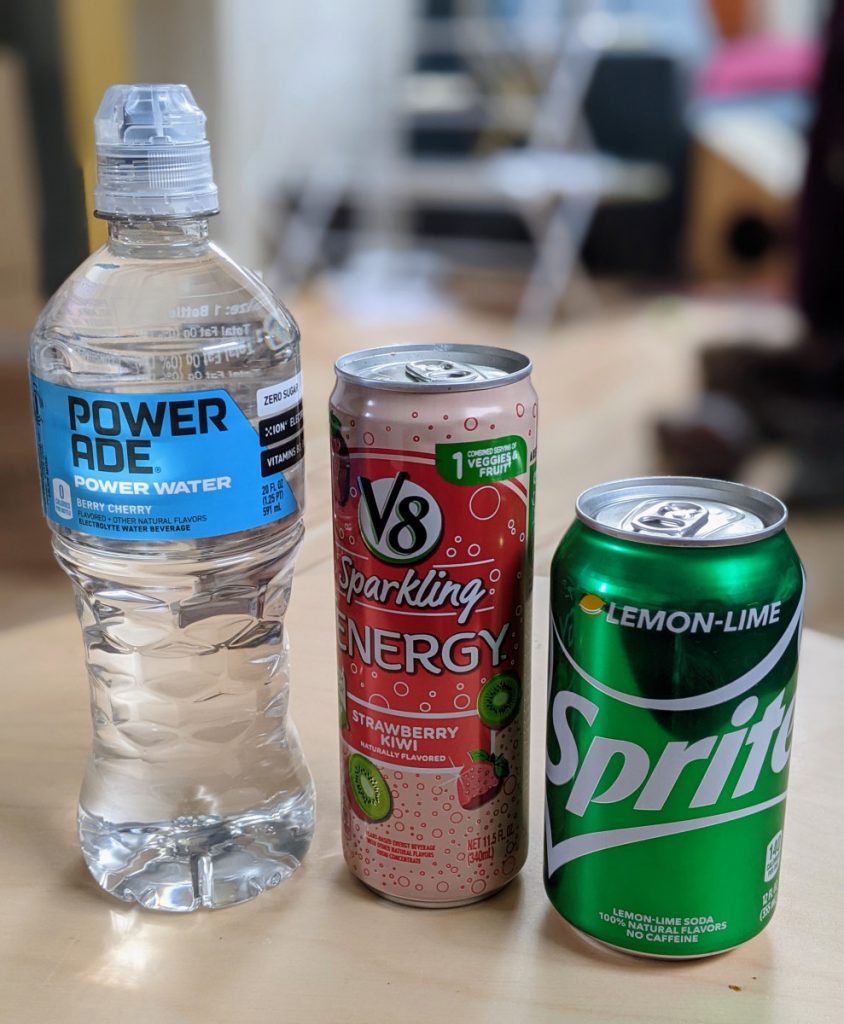
Powerade, V8 Sparkling Energy, and Sprit
Photo by Val
1) What snacks did you choose to bring to the experiments and why?
Doritos, mini original triscuits, twizlers
2) What beverages did you bring to the experiments and why?
Sprit, powerade berry cherry, v8 sparkling energy strawberry kiwi
3) What is your favorite snack food? From your own perspective, what is the story of how your favorite snack made it to your hands?
Brie, it’s my love of cheese. It’s the best warmed up with a little apricot jam and some crostoni.
4) Please reflect on your experience through this experiment; did you notice any difference in how your mind prepared and received a drink of a strange color? Why do you think that you experienced it this way?
Sprit: green- sweet no snappiness, smelled like sprit but doesn’t taste like sprit
powerade berry cherry: red- cherry smell is very strong
v8 sparkling energy strawberry kiwi: yellow- sweeter than usual but doesn’t have the usual sourness
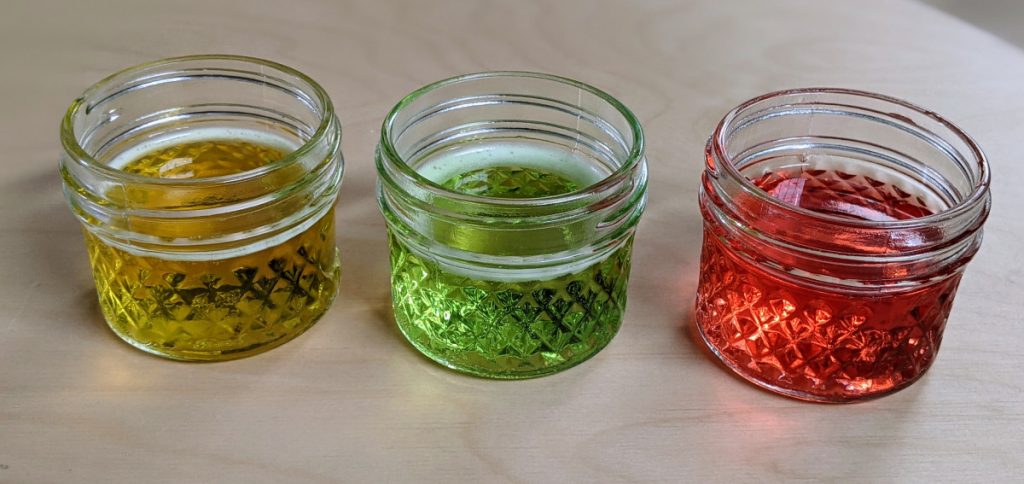
Powerade, V8 Sparkling Energy, and Sprit with food coloring
Photo by Val
5) Why do you think some farmers grow different colors of the same vegetable?
It gives them a variety within the same species of plants.
6) Do you have an example from your own life where the appearance of a food affected your decision of whether or not to buy it?
I can’t deal with pate or anything of the sort, it gives off an awful smell. I avoid it with everything that I can.
7) If you were to cook and eat an entire meal while being blindfolded for the whole experience, what meal would you choose? Why?
Definitely spinach lasagna. I don’t even use a recipe for it any more, it’s all based on taste, a pinch of this, handful of that, etc.
8) Please reflect on your experience through this experiment; did you find it difficult to guess the snacks purely on the sound they make when being chewed?
Yesss, it was pretty hard to figure out what it was, we had a problem with being able to hear the sound over zoom. I bet it would probably be different if it was in person.
9) Is there a certain food that you particularly enjoy the sound of (eating, cooking, drying, boiling, etc.)?
I’m gonna have to go with brie again, I just absolutely love the feeling of the warm melty salty cheese in my mouth, then a little crunch from the crostoni and sweetness from the apricot jam.
10) If you had to choose one of your five senses (sight, smell, hearing, tasting, or touch) to give up every time you ate a meal, which would you choose? Why?
Hearing, I can deal with out the sound of my food, but I gotta see it, smell it, and taste it!
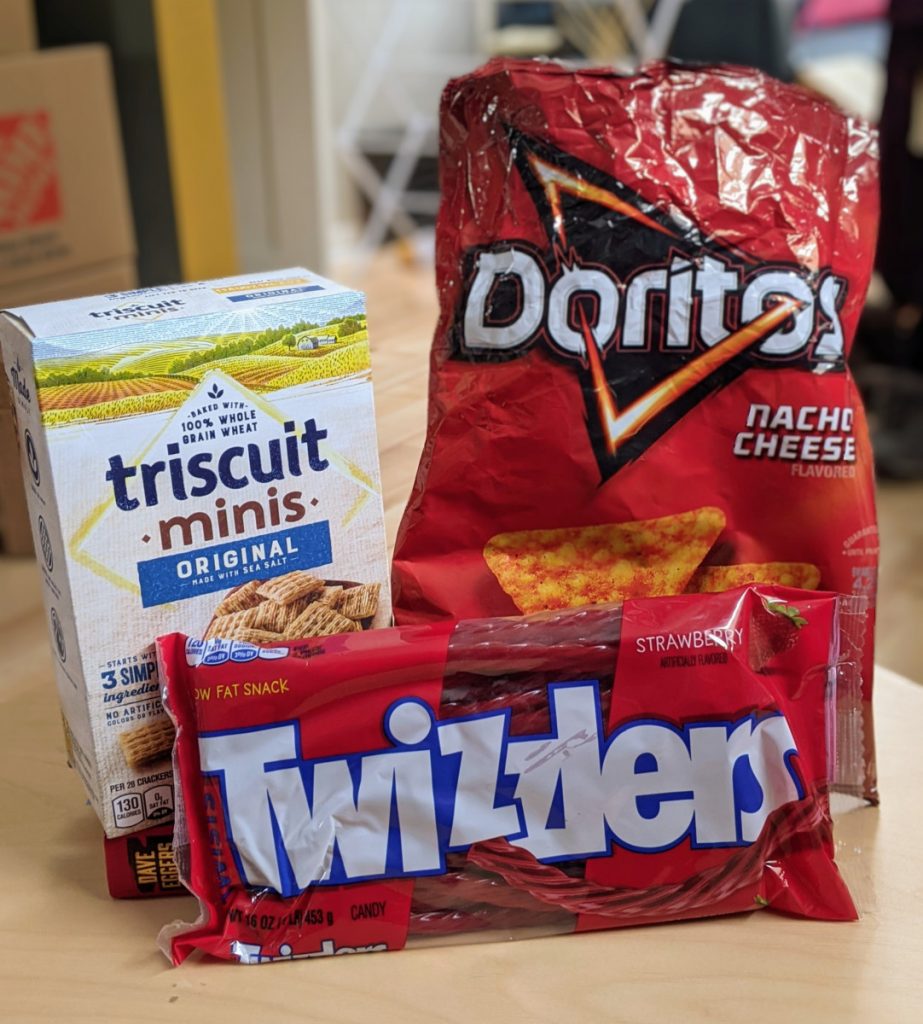
Mini Triscuit, Twizzlers,and Doritos
Photo by Val
Sustainable Entrepreneurship
Cooperatives
7 Cooperative Principles
- Voluntary and open membership
- Democratic member control
- Member’s economic participation
- Autonomy and independence
- Education, training, and information
- Cooperation among cooperatives
- Concern for community
Things to considered when creating a Co-Op
- What primary activity is the co-op for
- How to admit new members
- Whether to charge fees for breaking the rules
- What is needed to do to keep active membership
- What is needed to qualify to become a director
- What procedures are used to run meetings
- How funds will be raised
- How accounts, shares, and fundraising will be handled
- When and how financial reports will be audited/reviewed
Why Coffee Farmers Built a Global Cooperative from Seed-to-Cup: The Story of Pachamama Coffee
Types of Cooperatives
- Consumer: Owned by the consumers who buy goods/ services from the cooperative
- Producer: Owned by the producers of the commodities/craft who have joined forces to process and/or market their products
- Worker: Owned and democratically governed by employees who become cooperative members
- Purchasing: Owned by independent businesses or municipalities to improve purchasing power
- Hybrid: A combination of cooperative types, where people with common interest band together
Sometimes Co-ops fail due to reasons such as; shareholders are not properly incentivized, centralized power, lack of support, or succession shortage.
Climate Change, Sustainability, and Food/Agriculture Systems model
Now more than ever farmers are having to adapt to changing and unpredictable growing conditions due to climate change.
Apple growers are facing warmer winters in northern states that keep apple trees from going into a type of hibernation, causing the trees to blooms too early and susceptible to freezing.
While snow can insulate the apple tree roots in colder climate, not having enough snow can be harmful to the root system. Extreme temperature swings put stress on the trees and unpredictable extreme weather can damage yields.
87% of corn farmers and 66% of coffee farmers in Central America have reported that climate change has negatively affected their crops. Only 46% of these farmers have adjusted or changed their farming practices to account for climate change.
50% of all of earths habitable land is used for agriculture and about 70% of that land is used for livestock raising.
This massive land use results in lack of biodiversity; this negatively impacts plant and soil health.
70% of all rainforest deforestation is caused by agriculture, mainly beef, soy, and palm oil.
The equivalent of 40 football fields of rainforest is cleared every minute due to agriculture.
Currently agriculture is responsible for 23% of all total greenhouse gas emissions.
About a 1/3 of all crops are already lost to insect pests, pathogens, and/or weeds.
Rising temperatures boots the rate at which insects can digest food.
Extreme weather and chaining weather patterns make it difficult to predict infection potential and development.
Climate change will likely lead to the increased use of pesticides.
Biodiversity is the best climate insuracne.
Climate and Resilience Event Series/Seminar
Sámi Perspectives on Green Colonialism: Response to Climate Change
Green Coloniallism in the Arctic: Introduction
Green Coloniallism in the Arctic: Aslak Holmberg
Green Colonialism in the Arctic: Stefan Mikaelsson
Coffee and Climate Change
Coffee, Climate Change & Extinction: A conversation with Dr Aaron Davis at Kew
- Currently, 75 coffee species (60% of all coffee species) are on the IUCN Red List
- 13 species critically endangered
- 40 species endangered
- 22 species vulnerable
- Since Coffea Arabica is very climate sensitive, the impact of climate change will be harsh, increased pest and disease, along with decreased yield production.
- Currently, Central America is believed to be the most affected by climate change as it is currently affected by extreme weather, such as droughts, hurricanes, and El Nino-southern oscillation.
- On the Global Climate Risk Index, Honduras is ranked 1st, Nicaragua 4th, and Guatemala 10th
- Currently, Arabica coffee is found around 800 to 1200 masl, by 2050 the optimal growing elevations will likely increase to 1200 to 1600 masl. These elevation shifts mean that the higher elevations in the future will have similar climate conditions as those currently in lower elevation.
- It is predicted that at low elevations (500 to 800 masl) coffee will be affected the most. Arabica will most likely disappear all together and will most likely be replaced by either cocoa or Robusta. In the range of 800 to 1200 masl, a variety of new varieties will be required to continue production. At higher elevations of 1200 to 1400 masl little negative changes is predicted, but switching to shade grown and incorporation of irrigation is highly recommended. It is recommended to expand to new areas above 1400 masl.
- This moving into new areas of higher elevation does pose a threat to animals, forests, and other natural resources at these higher elevations.
- With the coming years of climate change, the land available to grow Arabica is going to greatly decrease. New varieties that are more productive and that can handle the new climate, disease, and insects are needed quickly.
- Coffee is a tree crop so that means it can take 2-3 years to come to maturity. This means that it can take 20 plus years to bring a new variety to market.
- At the moment the World Coffee Research Company has paired with partners to jointly develop the next generation of F1 hybrids. They are aiming to release these new varieties to local framers in Central America and Africa by 2025.
- These researchers are looking for key characteristics:
- Disease resistance or tolerance
- Aromatic quality
- Productivity
- Climate resilience
- Uniformity and ripening times
- Production efficiency
- Abiotic stress tolerances
- In Central America there are currently three groups of crosses (54 crosses)
- In 2017, the first 46 hybrids were transferred to the field and were harvested for the first time in 2019.
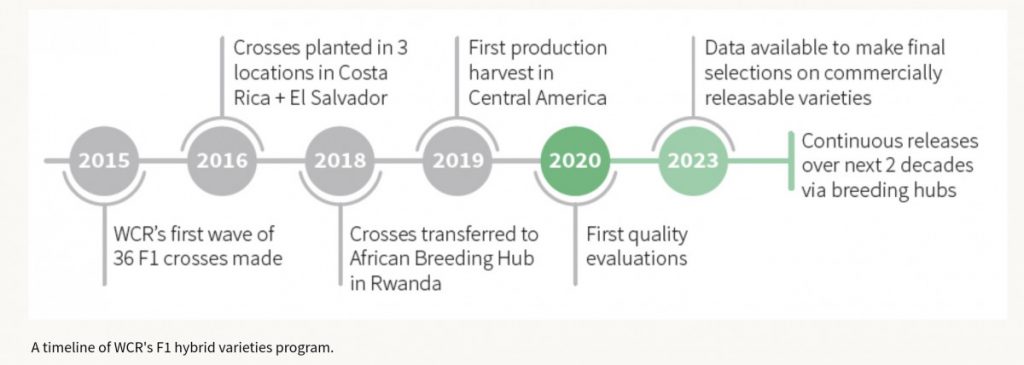
“A Timeline of WCR’s F1 Hybrid Varieties Program.” World Coffee Research, worldcoffeeresearch.org/work/next-generation-f1-hybrids/.
The race to develop coffee that can survive climate change
Foodoir: Your Story of Tasting Place
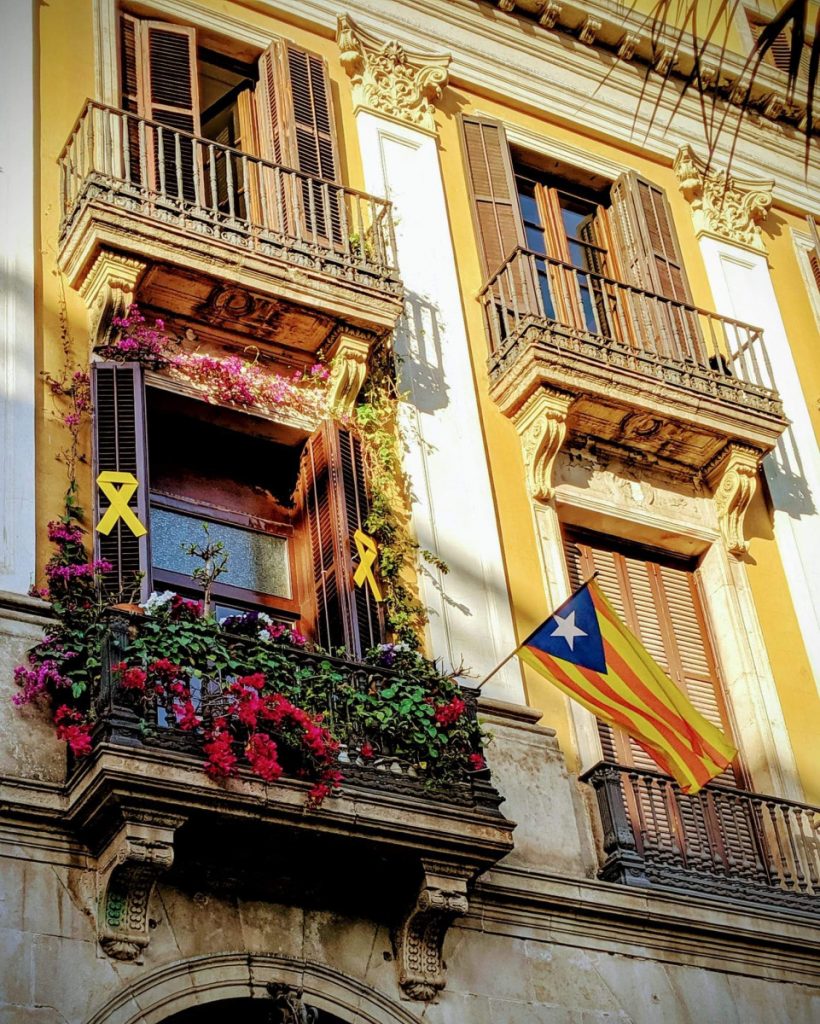
Catalan independence flag in Barcelona, Spain
Photo by Val
Catalonia is an autonomous region of Spain. It has its own parliament, government, president, police force, flag and anthem, and public broadcaster.
Beginning in the 1850s various individuals and organizations wanted independence from Spain. The first organized independence party was Estat Català (Catalan State) in 1922.
During the Spanish Civil War Franco abolished Catalans autonomy in 1938. It was not until after Franco’s death in 1975 was Catalonia able to regain its autonomy.
In 2009 the contemporary independence movement began after the Partido Popular (Peoples Party) challenged the 2006 Statue of Autonomy. In 2009 and 2010 symbolic referendums of independence were held. A snap election in 2012 was sparked by the 2010 ruling of the statue of Autonomy to be unconstitutional, and led to the first pro-independence majority ever in Catalan parliament.
In 2014 the new government held a non-binding referendum, which yielded that a large majority were in favor of independent. In 2016 President Puigdemont told parliament that a binding referendum on independence would be held in September 2017.
This referendum was considered illegal by the Spanish government. The Spanish police took action and tried to stop the referendum from happening. They raided voting stations and closed then down. They even seized ballot papers and threatened to fine those who manned polling stations up to €300,000. The Spanish government shut down web sites and even demanded that Google remove a voting location app from their app store. Because of this many parents stepped forward and set up “events” in schools (where many polling locations are set) over the weekend and kept them occupied during the vote.
Though the vote said 90% of people would approve a split from Spain, it was only a 43% voter turnout.
Many election organizers and cabinet officials were arrested, which only sparked more demonstrations and protests in the streets of Barcelona.
On October 25, 2017 the separatist majority of the Catalan Parliament declared independence. This caused the Spanish government to in force Article 155. Article 155 dismisses Catalonia’s autonomy, dissolving parliament and its leaders, and imposes direct rule from the central government in Madrid. A snap election for new officials was held on December 21.
The Catalan president, Carles Puigdemont, self-exiled himself to Brussels on November 5 after being charged with rebellion, sedition and misuse of public funds. Several other leaders also fled abroad. Many of those who stayed were arrested and charged with treason.
Catalonia’s independence movement, explained
“Then, to her mother’s proud bewilderment, she went all alone to Paris, studied medicine, and became a roentgenologist. She was there when the city fell, and I wonder now whether Papazi’s fanatical hatred fo the Boches has upheld her, or whether the latent sensuality in her small round body has taught her that headaches are not always made by men, even German men.” – The Gastronomical Me p. 84
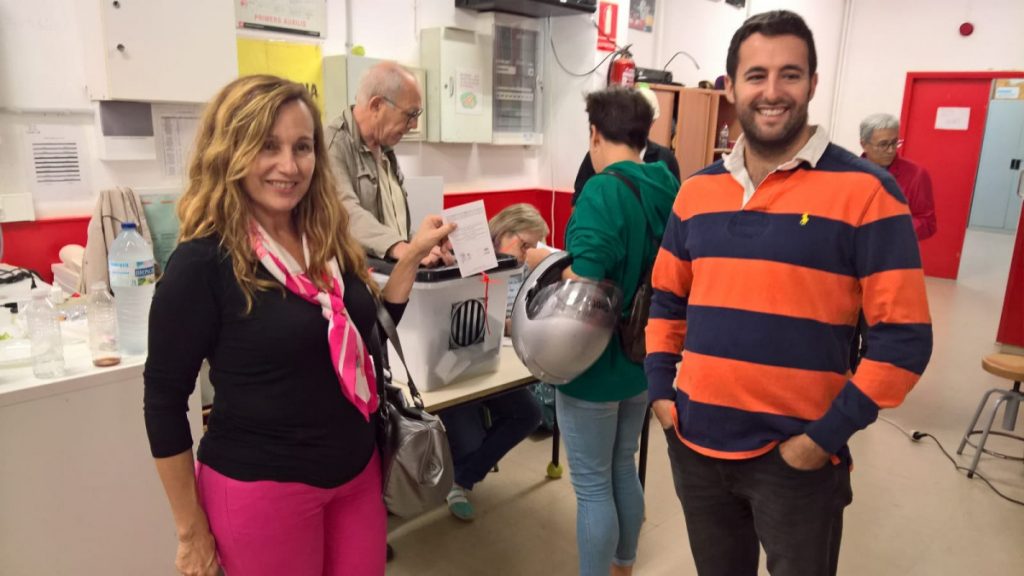
My host mom Rosa and her son voting
Picture by Val
My first study abroad to Spain was with WCCCSA (Washington Community College Consortium for Study Abroad). I had never really traveled much by myself and never outside of the country before, unless you count Canada. I had never really thought to look into what was going on in the place I was going to. When most people hear Barcelona, they think of art Nuevo and Gaudi, the beach and the ocean, and sangria (though sangria is a very touristy thing to get). I would have never thought I would be experiencing an independence movement. The first time I really heard about this independence movement was from my host mom, Rosa. She was telling us what to expect if these protests got much bigger, that the public transit systems would most likely be shut down. Now we lived almost five miles from school and I could not sleep that night as the dread of not being able to take the subway was gnawing at me. Well, the next morning the school had sent out an emailing saying that the transit system was suspended. Turns out I was not willing to walk 5 miles to school, as taxis hike up their fees during times like these. A couple weeks later I had decided to go out one night, and well it just happened that the public transit system shut down again. I don’t even remember how far away I was from my place, but as being it was 4 in the morning and I was a slight bit intoxicated, I grabbed one of the only cabs I could find and paid over €50. The following nights at 11pm, just like clockwork, people would hang out their windows and bang pots and pans in favor of the independence movement. Several times on my short walk from the subway to school I would see protests happening. These protests were different though, nothing like protests in the US. Both sides would be walking down the streets together chanting each their own chant. It was very few and far between to ever see a scuffle between the two sides. That is until the voting. Madrid had sent in the Guardia Civil to Barcelona. The funny thing here is that they were housing the Guardia Civil on a Disney cruise ship in the port for the several months they were there. The Guardia Civil were there to shut down the voting. The closer it got to the voting date the higher the tensions were. The only time my host mom told us to be careful when we were out and about was on the day of voting. This is when things got a little violent, but in all honesty, nothing was as violent as the news made it out to be. It was really only at one polling station where there was violence between protesters/voters and the Guardia Civil. Never once did I feel like I was ever going to be in a place that was not going to be safe for me. I was so surprised at how peaceful these protests turned out to be. Yes, there was your usual dumpster firers and such, but in reality, it was nothing compared to protests here in the states. Later on in the day on October 1 myself and the three other study abroad students that lived with me went with our host mom and her son to the neighborhoods local polling station so she could vote. It felt so powerful seeing her vote and being so happy afterwards, she even did a little dance. I don’t think I could have ever asked for a better and more fulfilling time to have been in Barcelona. To say I watched it all unfold from an apartment window in Barcelona.
Roucous pot-banging from the balconies in Barcelona – 20 Sept 2017

Café bombón in Spain 
Nous Nous in Morocco 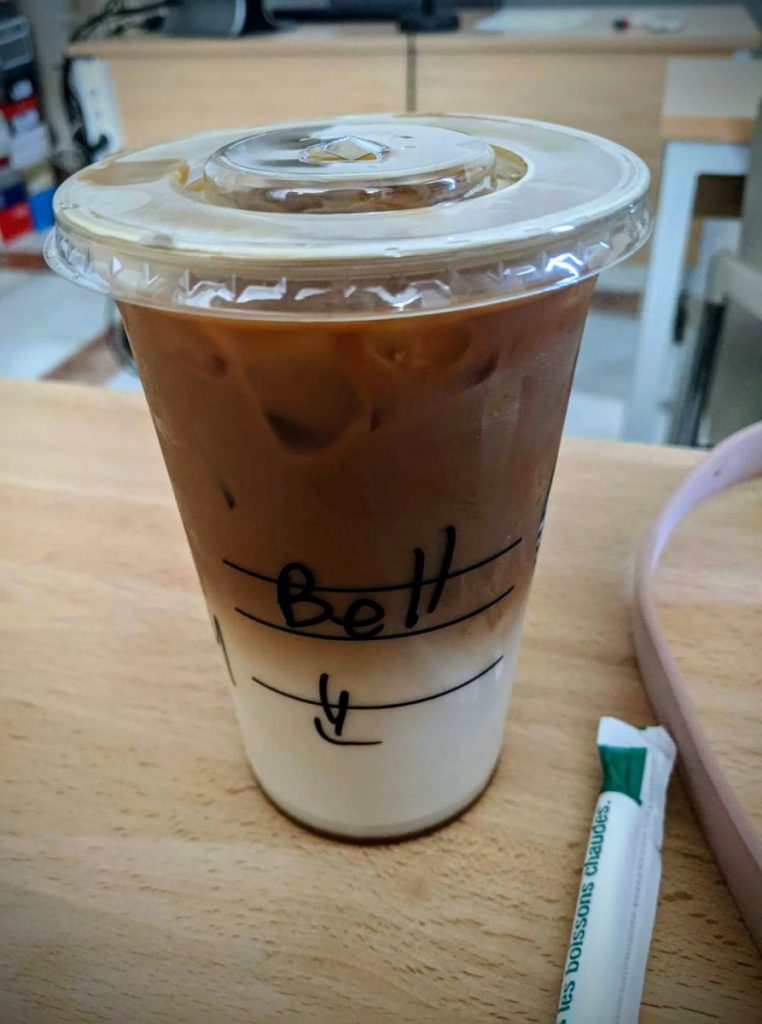
Caramel Macchiato for “Bell” aka Val in Seville 
Café con leche in Granada
Photos by Val
Bibliography
Alsadi, Samer Yassin. “Figure 1. Map of the Arab World.” ResearchGate, ResearchGate GmbH, 1 Aug. 2018, www.researchgate.net/figure/Map-of-the-Arab-World_fig1_305584980.
“Average Annual Temperature.” Vivid Maps, 24 Apr. 2016, vividmaps.com/average-annual-temperature/.
Batdorf & Bronson Coffee Roasters, www.batdorfcoffee.com/.
Brown, Nick. “The New Taster’s Flavor Wheel: A Recalibration of Coffee Dialogue.” Daily Coffee News by Roast Magazine, Daily Coffee News LLC, 6 Jan. 2014, dailycoffeenews.com/2014/01/06/the-new-tasters-flavor-wheel-a-recalibration-of-coffee-dialogue/.
“Catalonia’s Bid for Independence from Spain Explained.” BBC News, BBC, 18 Oct. 2019, www.bbc.com/news/world-europe-29478415.
Chudnovsky, Abby. “Sun-Grown vs. Shade-Grown: How It Impacts the Environment and the Farmers.” De La Gente, De La Gente, 22 Mar. 2020, www.dlgcoffee.org/news/2017/4/6/coffee-cultivation-sun-grown-shade-grown-and-how-it-impacts-the-environment-and-the-farmers.
“Coffee Roasting Basics.” Counter Culture Coffee, Counter Culture Coffee, 23 June 2020, counterculturecoffee.com/blog/coffee-basics-roasting.
CoMission, The Coffee. “Infographic: Periodic Table of Coffee Varieties or Cultivars.” Medium, Medium, 12 Mar. 2015, medium.com/@CoffeeCoMission/infographic-periodic-table-of-coffee-varieties-or-cultivars-57dbce92c788.
Davis, Aaron P., et al. “High Extinction Risk for Wild Coffee Species and Implications for Coffee Sector Sustainability.” Science Advances, American Association for the Advancement of Science, 1 Jan. 2019, advances.sciencemag.org/content/5/1/eaav3473?previewDate=17-11-2014+21%3A15+Europe%2FHelsinki%2Fviihde%3Fform_vo%3Dohjelm.
“Educator Guide: Precipitation Towers: Modeling Weather Data.” NASA, NASA, 19 Apr. 2018, www.jpl.nasa.gov/edu/teach/activity/precipitation-towers-modeling-weather-data/.
Eggers, Dave. “Monk of Mokha.” Dave Eggers, daveeggers.net/monkofmokha.
Ferreira, Thiago, et al. “CHAPTER 1 Introduction to Coffee Plant and Genetics.” Royal Society of Chemistry, Royal Society of Chemistry, pubs.rsc.org/en/content/chapterhtml/2019/bk9781782620044-00001?isbn=978-1-78262-004-4&sercode=bk.
Fornero, Laura. “A Producer’s Guide to Pruning & Stumping Coffee Trees.” Perfect Daily Grind, Perfect Daily Grind, 16 Apr. 2020, perfectdailygrind.com/2019/08/a-producers-guide-to-pruning-stumping-coffee-trees/.
“History of Coffee.” Rabika Coffee, Rabika Coffee, www.rabikacoffee.com/FrontEnd/index.php?page=news&onepage&id=6&lang=EN.
Jones, Sam. “What Is the Story of Catalan Independence – and What Happens next?” The Guardian, Guardian News and Media, 14 Oct. 2019, www.theguardian.com/world/2019/oct/14/catalan-independence-what-is-the-story-what-happens-next.
Kelley, Peter. “Study Shines Light on What Makes Digital Activism Effective.” UW News, University of Washington, 20 Nov. 2013, www.washington.edu/news/2013/11/20/study-shines-light-on-what-makes-digital-activism-effective/.
Keulen, Maarten van. “Ecosystem Services in Your Cup of Coffee.” Circular Coffee Fund, Circular Coffee Fund, 4 Nov. 2020, www.circularcoffeefund.com/blog/2020/7/9/ecosystem-services-in-your-cup-of-coffee.
Know Your Grinder. “We Review The Best Home Coffee Bean Roasters of 2021.” Know Your Grinder, Know Your Grinder, 18 Jan. 2021, knowyourgrinder.com/best-home-coffee-bean-roasters-reviews/.
Korhonen, Jori. “Coffee Processing Methods – Drying, Washing or Honey?” Paulig – Barista Institute, www.baristainstitute.com/blog/jori-korhonen/january-2020/coffee-processing-methods-drying-washing-or-honey.
Krishnan, Sarada. “Sustainable Coffee Production.” Oxford Research Encyclopedia of Environmental Science, Oxford University Press, 28 June 2017, oxfordre.com/environmentalscience/environmentalscience/view/10.1093/acrefore/9780199389414.001.0001/acrefore-9780199389414-e-224.
M. Barbet-Massin, F. Jiguet, et al. “Climate Change Adaptation of Coffee Production in Space and Time.” Climatic Change, Springer Netherlands, 26 Oct. 2016, link.springer.com/article/10.1007/s10584-016-1788-9#Tab2.
McSwain, Tessa. “Kauai Coffee Roasting Guide: Blog: Kauai Coffee Company.” Kauai Coffee, Kauai Coffee, 20 Dec. 2019, kauaicoffee.com/kauai-coffee-roasting-guide/.
“Net Primary Productivity.” Center for Sustainability and the Global Environment | SAGE | University of Wisconsin-Madison, The Board of Regents of the University of Wisconsin System, nelson.wisc.edu/sage/data-and-models/atlas/maps.php?datasetid=37&includerelatedlinks=1&dataset=37.
Next-Generation F1 Hybrid Varieties, worldcoffeeresearch.org/work/next-generation-f1-hybrids/.
P. Bansal, K. Roth, et al. “Climate Change Adaptation, Coffee, and Corporate Social Responsibility: Challenges and Opportunities.” International Journal of Corporate Social Responsibility, SpringerOpen, 1 Jan. 1970, jcsr.springeropen.com/articles/10.1186/s40991-020-00048-0.
Taylor, Alan. “Crisis in Yemen.” The Atlantic, Atlantic Media Company, 3 June 2011, www.theatlantic.com/photo/2011/06/crisis-in-yemen/100079/.
Torres, Olga. “Introduction.” The Arab World Today.
Torres, Olga. “The ‘Arab Springs’.” The Arab World Today.
Turp, Robert. “Washed, Natural, Honey: Coffee Processing 101.” Perfect Daily Grind, Perfect Daily Grind, 9 Oct. 2020, perfectdailygrind.com/2016/07/washed-natural-honey-coffee-processing-101/.
“What Are the Compounds in Green Coffee Beans That Change Depending on the Maturity of the Coffee Cherries?: Suntory Global Innovation Center.” Suntory, SUNTORY HOLDINGS LIMITED, www.suntory.com/sic/research/t_coffee/index.html.
Wikipedia, Wikimedia Foundation, 24 Feb. 2021, en.m.wikipedia.org/wiki/Catalan_independence_movement#:~:text=The%20Catalan%20independence%20movement%20(Catalan,North%20Catalonia%20from%20France%20and.
Worland, Justin. “Climate Change Is Threatening Your Morning Cup of Coffee.” Time, Time, 21 June 2018, time.com/5318245/coffee-industry-climate-change/#:~:text=Climate%20change%20ranks%20high%20among,grow%20and%20expensive%20to%20buy.&text=Rising%20temperatures%20will%20bring%20drought,insects%20that%20pollinate%20coffee%20plants.
Leave a Reply