

Café con leche in Granada, Spain
Photo by Val
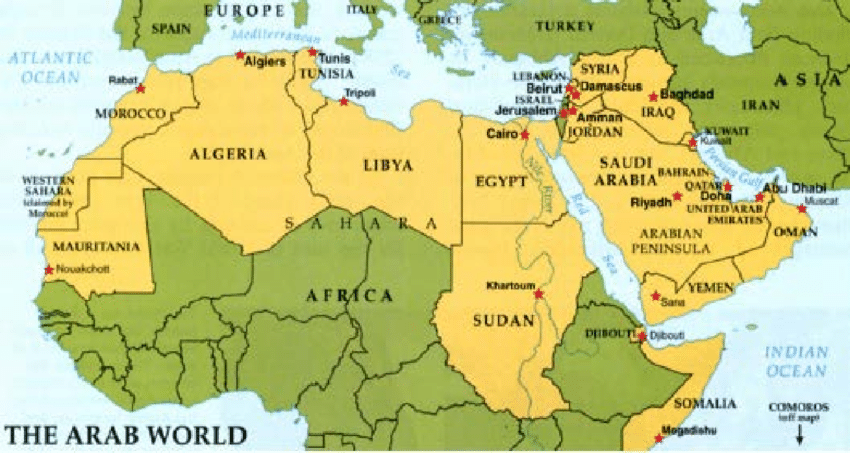
Arabia: What is it?
- It can also be defined as those countries where Arabic is the dominant language.
- Arab countries are religiously and ethnically diverse with Islam being the dominant religion in most countries.
- 22 Arab countries/areas: Algeria, Bahrain, the Comoros Islands, Djibouti, Egypt, Iraq, Jordan, Kuwait, Lebanon, Libya, Morocco, Mauritania, Oman, Palestine, Qatar, Saudi Arabia, Somalia, Sudan, Syria, Tunisia, United Arab Emirates, and Yemen.
- Iran and Turkey are not Arab countries.
- The Arab world includes Muslims, Christians and Jews
- To be an Arab, like an American, is a cultural trait rather than racial.
- Arabic is the official and the original language of the Qur’an, the Islamic holy book.
- The majority of people in the Arab world adhere to Islam, and the religion has official status in most countries
The Arab Spring

- Since December 2010 there were revolutions in Tunisia and Egypt, a civil war in Libya, civil uprisings in Bahrain, Syria, and Yemen, and major protests in Algeria, Jordan, Morocco, and Oman.
- Protesters were generally young people, who also used the social media, such as Facebook, Twitter, and YouTube, to organize, communicate, and raise awareness in the face of their governments‘ attempts at censorship.
- “The people want to bring down the regime” was a common slogan.
- Many demonstrations met violent responses from government authorities, as well as from pro-government militias.
- In all countries, there were accusations of human rights violations, government corruption, unemployment, extreme poverty, and a large percentage of educated but dissatisfied youth within the population.

Coffee
#3a: Film Series: Program Questions in Scenes and Overview
Wk 5: Coffee
- ‘Monk of Mokha’ tells the story of your culture-crossing, life-changing cup of coffee, PBS New Hour (6 min)
- Black Coffee, Point of Origin podcast #28 (Stephen Satterfield, 40 min) plus browse related links at this website while listening to the Black Coffee podcast
- Black Gold. Website with reviews and film on campus library streaming service Kanopy. (Directors Marc and Nick Francis, 2006, 77 min).
Week 5
- Olympia Coffee (website to browse with assorted short videos, 30 min)
- Black Coffee Northwest (website plus google for related news items)
- Love, Coffee, Yemen: A Story of Hope, fueled by coffee by Mokhtar Alkhanshali | Nuqat 2019 (36 min)
- Top 8 Coffee Documentaries to Watch Online for Free (8 min)
- Recommended: Delicious Peace Grows in a Ugandan Coffee Bean (2010, 40 min)
I chose minute 16 to 18:29 from Love, Coffee, Yemen and have called it the Conscious Consumers Taste. Mokhtar Alkhanshali, from the Monk of Mokha, was speaking about his journey with Yemeni’s coffee at the Nuqat 2019 Regional Conference: The State of the Elastic Mind. Mokhtar starts by explaining how the 21 samples of coffee he had procured from Yemen produced 19 cuppings of horrible coffee with all the worst defects there were, but 2 samples rated 90+ in the cupping; scoring a 90+ is one of the highest possible coffee ratings and is very rare. Mokhtar then went back to Yemen to work with the coffee farms, but he found out that there was little to no structure to their picking and processing methods. He then went on to explain that there is a relationship between what you pay for and what you get. Mokhtar had told a lady that he would pay her more is she picked just the red cherries and her response to him was that she would pick rainbow cherries if she was paid more. He then went on to explain that these farmers do not know what their coffee tastes like because it’s usually being processed, roasted, and exported in other places. In this scene he ends on the note that there is a political reality to everything we consume and we need to be conscious consumers of coffee. By being more consciences of the coffee, we are consuming, we can help those small coffee farms and small coffee roasters instead of supporting big coffee, by doing this we support them in growing and learning. When we chose coffee from a small roaster, who gets their beans from a small grower we know exactly where and who that money is going to. We also get better tasting and higher quality coffee as their beans are most likely picked and roasted in smaller batches.
#3b: (un)Natural Histories
- Introduction to Coffee Plant and Genetics
- endemicity
- least 125 species in the genus Coffeathats a lot of species…
- wonder if there are more we have yet to discover
- They tend to be robust plants but are almost completely sterile
- how do these types reproduce then?
- equatorial regions, such as Colombia, the coffee flowering and fruit cycle may occur at various times throughout the year
- does this affect productiveness?
- https://www.baristainstitute.com/blog/jori-korhonen/january-2020/coffee-processing-methods-drying-washing-or-honey
- How to coffee is processed can have a dramatic effect on the resulting cup and nowadays roasters and baristas are concentrating on coffee processing to describe the coffee.
- can this be included in coffee terroir?
- fruitiness and sweetness
- could this be from the skin and pulp sitting around the seeds for a while in the sun?
- How to coffee is processed can have a dramatic effect on the resulting cup and nowadays roasters and baristas are concentrating on coffee processing to describe the coffee.
- https://perfectdailygrind.com/2016/07/washed-natural-honey-coffee-processing-101/
- Producers will often wait to see how much rain has fallen before decide whether to produce washed, honey, or natural coffee.
- Coffee processing rarely makes it into the industry headlines or coffee shop discussions, but it’s an integral part of crafting the flavour and character of your cup of coffee.
- https://counterculturecoffee.com/blog/coffee-basics-roasting
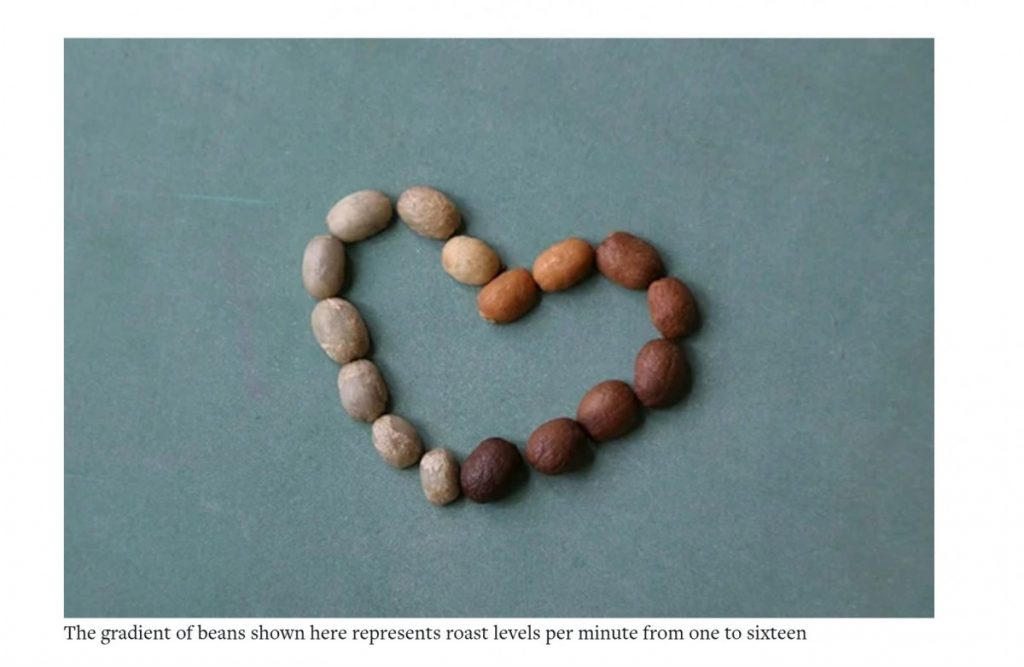
- The gradient of beans shown here represents roast levels per minute from one to sixteen
- https://www.circularcoffeefund.com/blog/2020/7/9/ecosystem-services-in-your-cup-of-coffee
- Bees like coffee! The scope of ecosystem services could be enlarged even more if we think about the benefits for other species rather than humans. You are not the only one who receives a caffeine boost from coffee. Also, bees enjoy low caffeine amounts while sucking coffee flowers’ nectar; and it seems to be helpful for bees’ memory!
- What other polinators like the caffeine boost?
- Think about pollination. If conditions are good within an ecosystem, meaning adequate balance and no use of pesticides; plants, flowers, insects, and animals will be thriving and pollination will occur. In turn, humans benefit from having more new plants around them… it is just the perfect nature’s equilibrium!
- Some of the benefits that can be obtained from a balanced ecosystem are pollination, climate regulation, water purification, erosion control, carbon sequestration, and disease control (control of plant pathogens and human diseases)
- Payment of Ecosystem Services as a strategy for conservation. This mechanism tries to encourage stewards, often farmers or indigenous communities, to be active in the restoration of natural ecosystems and prevention of deforestation.
- Shaded coffee plantations are being preferred in recent years over coffee plantations, for its performance in the conservation of ecosystem integrity
- Agricultural land-use history in different tropical countries showed the erosion and depletion of soils in some areas where full sun coffee has been cultivated.
- The desire to implement an intensive coffee plantation, led to the deforestation of primary and secondary forests, with the consequent implementation of a monoculture system, often accompanied by the use of pesticides and chemical fertilizers.
- Are we able to turn this land back around and if so how long will that take?
- Bees like coffee! The scope of ecosystem services could be enlarged even more if we think about the benefits for other species rather than humans. You are not the only one who receives a caffeine boost from coffee. Also, bees enjoy low caffeine amounts while sucking coffee flowers’ nectar; and it seems to be helpful for bees’ memory!
- https://time.com/5318245/coffee-industry-climate-change/#:~:text=Climate%20change%20ranks%20high%20among,grow%20and%20expensive%20to%20buy.&text=Rising%20temperatures%20will%20bring%20drought,insects%20that%20pollinate%20coffee%20plants
- Starbucks
- Why does Starbucks taste better in the EU? I can not stand drinking Starbucks in the states.
- long-term challenges and opportunities. Climate change ranks high among them
- As temperatures rise and droughts intensify, good coffee will become increasingly difficult to grow and expensive to buy.
- climate change is going to play a bigger role in affecting the quality and integrity of coffee.
- Rising temperatures will bring drought, increase the range of diseases and kill large swaths of the insects that pollinate coffee plants
- About half of the land around the world currently used to produce high-quality coffee could be unproductive by 2050, according to a recent study in the journal Climatic Change.
- Instead of just purchasing coffee, they work with small farms to help them adapt to changing conditions, providing seeds, monitoring production and suggesting new agricultural practices.
- Declining supplies and a growing coffee-drinking population mean climate change could turn a daily pick-me-up into a high-priced luxury, threatening the continued growth of the industry’s customer base.
- Farmers in some regions will be able to adapt by growing at higher elevations, but in others there is nowhere else to go. Entire regions risk becoming unable to continue producing Arabica coffee, and Schultz and others say there’s no way to make the more resilient Robusta variety, which is sometimes blended with Arabica to make instant coffee, palatable to the broad coffee-drinking public
- Is there a way to graft the two together? To make a bean that is nice like Arabica, but sutibale to higher temps and rainfall like Robusta?
- Scientists also warn that climate change increases the likelihood of disease, including the dreaded la roya, or stem rust
- Starbucks
- coffee_CorporateSocialResponse_ClimateChangeAdaptation.pdf
- A human intervention to reduce the sourcesor enhance the sinks of greenhouse gases.”
- climate mitigation
- The process of adjustment to actual or expected climate andits effects. In human systems, adaptation seeks to moderate oravoid harm or exploit beneficial opportunities
- climate adaptation
- CSR policies of coffee com-panies are not always environmental in nature. In fact,many corporations focused on workers’pay
- Environmental CSR, or“Corporate EcologicalResponsibility”focuses on“mitigating a firm’s impact onthe natural environment
- One analysisof British coffee companies identified a total of 94 dis-tinct sustainability indicators. Of these, 44 were environ-mental, 30 were social and 20 were economic in nature
- some companies seethird-party certification as a means to“check the box”ofenvironmental and climate-related
- Can this actually be a CSR if in reality these companies themself are not doing anything?
- industry-wide criticismthat too much emphasis is placed on meeting third-party certification standards and industry guidelines.
- the concept of climateadaptation implies that there is no answer for climatechange and that humanity must accept the impacts
- If by accepting the impacts and deal with them are we then complying wit climate adaptation or is climate adaptation just a concept that can never actually done becaue climate change has no answer to it?
- possible but somewhat unlikely explanation is thatcoffee companies are not aware of the extent thatthe Arabica crop is threatened by climate change.
- Could Arabica adapt to these new climate changes?
- A human intervention to reduce the sourcesor enhance the sinks of greenhouse gases.”
#3c: Regenerative Agriculture
Coffee
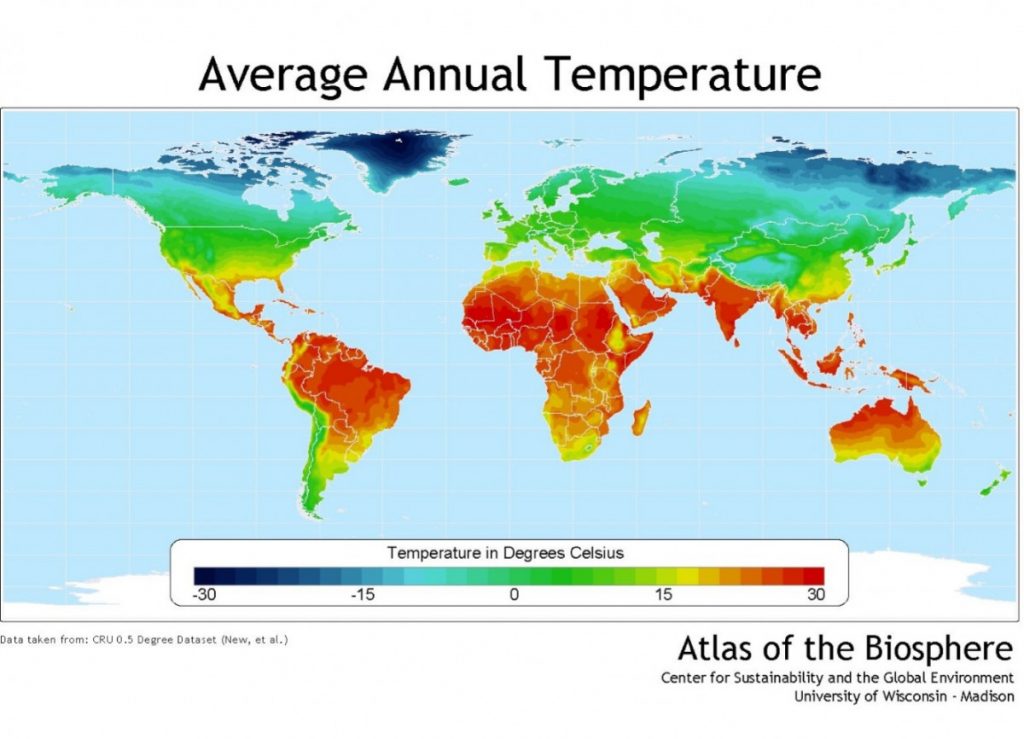

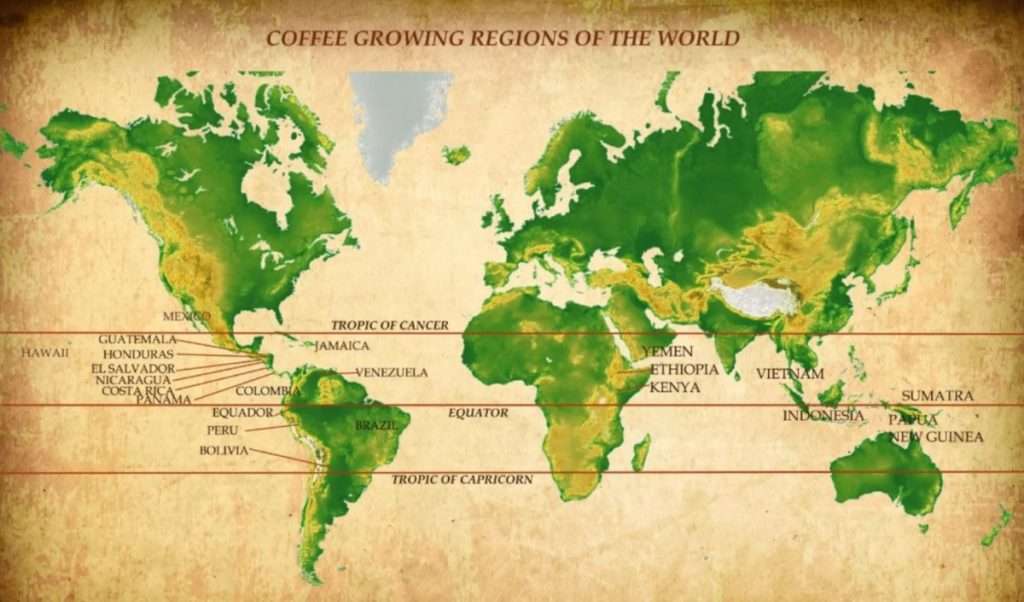
Coffee is produced in about 80 tropical countries and produces around 9 million tons of green beans annually, from around 125 coffee species.
Higher beverage quality is often associated with Coffea Arabica (Arabica coffee.)
65% of the world’s coffee is consumed by just 17% of the worlds population.
The Cultivation
There are two main methods of coffee cultivation, sun grown and shade grown.
Shade Grown
- Shade grown is the more traditional approach, as it mimics the natural way coffee used to grow.
- Shade grown coffee has taller trees that provide a canopy, creating biodiversity. By growing these different crops together helps create a resistance to pests and diseases.
- This diversity also has a positive impact on both the wildlife and the coffee plants. More diverse trees can increase the bird population and also can increase pollinating insects. These birds then can serve as natural predators of coffee pests.
- The canopy cover from the shade trees can also help in other ways, such as protection of the top soil from erosion. These diverse trees also create a number of different root systems that can also help in erosion, but also by helping fix the soil.
- The cooling effect from the shade helps produce a higher quality, denser coffee beans. These beans can then be sold to specialty coffee roasters at a higher price.
- The different trees found in shade grown coffee areas can also help provide with an additional income.
Sun Grown
- In the 1970s the idea of growing coffee in full sun was introduced
- Could give a higher yield, meaning higher profit
- Has an adverse effect on the ecosystem and coffee quality
- In Central America sun grown coffee has led to 2.5 million acers of deforestation
- Sun grown monocrops of coffee removes the natural barriers to pests, reduces bird habitats, and requires an increased use of chemical pesticides
Pruning and Stumping
- Pruning and stumping can help to improve the health and yield of coffee plants
- Coffee cherry production naturally decreases with age, exhaustion, or phytosanitary problems
- Trees should be routinely pruned after harvest for maintenance
Coffee Diseases and Pests
- Coffee berry borer
- Coffee leaf miner
- Root knot nematodes
- Coffee leaf rust
- Coffee berry disease
- American leaf spot
- Coffee wilt disease
The Processing
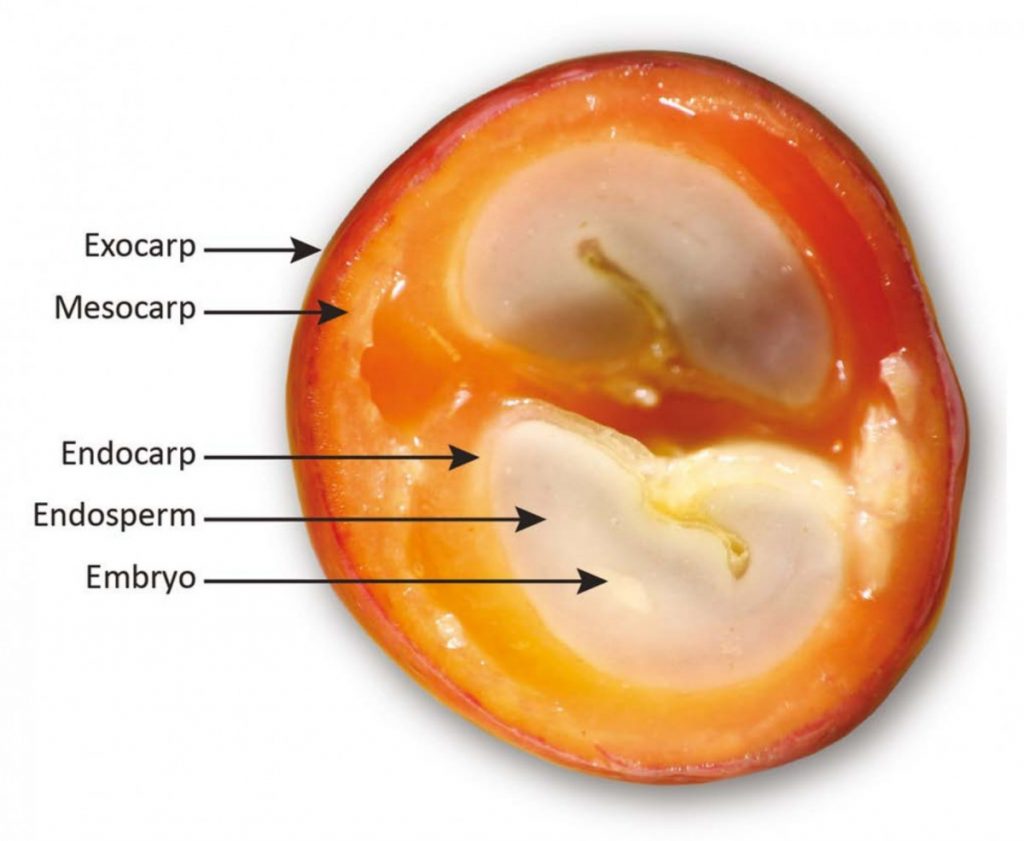
Introduction to Coffee Plant and Genetics
Natural/ Dry Processing
- After the coffee cherries are picked, they are spread out into a thin layer to dry in the sun
- To avoid mold, fermentation, or rotting the cherries are turned regularly
- Once the cherries are dry the skin and dried fruit flesh are removed mechanically
- This process is common in regions where there is no access to water
- Ethiopia
- Some parts of Brazil
- This process can add flavors of fruitiness and sweetness, regardless of the variety and region
- It can also add wild fermentation flavors or alcohol like notes
Washed/ Wet Process
- After the coffee cherries are picked the fruit flesh is removed from the beans mechanically before the beans are dried
- The beans are then put into a water tank where fermentation removes the remainder of the fruit flesh
- If the beans are fermented for too long it can have a negative effect on the flavor of the coffee
- After the fermentation the beans are washed to remove any leftover flesh, they are then ready to be dried
- The drying process is pretty much just like the natural process of drying
- Beans can also be mechanically dried
- Especially in regions where there is not enough sunshine or excess humidity
- This process brings about bright and acidic flavors
- This process is preferred by farmers and producers when done properly because it reduces the risk of defects and is a more stable way to process coffee
- This process does require more water than other processes, thus it is more expensive
Honey/ Semi Washed/ Pulped Natual
- This process is commonly used mainly in Central American Countries
- Costa Rica
- El Salvador
- After being picked the coffee cherries are mechanically depulped
- The depulping machines are set to leave a specific amount of flesh on the beans
- The beans then go to the drying patios
- This process offers positive attributes
- The sweetness of the natural process
- The brightness of the washed process
Other processing methods include anaerobic, carbonic maceration, and giling basah.
After the processing is completed the beans moisture contents low enough to safely be stored before exporting.
Just before the beans are exported the beans are hulled.
Often times producers will wait to see how much rain has fallen during the season before they decide whether to produce washed, honey, or natural coffee.
Heavy rain makes it harder to produce a good natural coffee as the coffee cherries can start to split.
If it hasn’t rained, this is great for honey or natural coffee because no sugars will get washed away.
Roasting
shutterstock: pongpinun traisrisilp
https://kauaicoffee.com/kauai-coffee-roasting-guide/
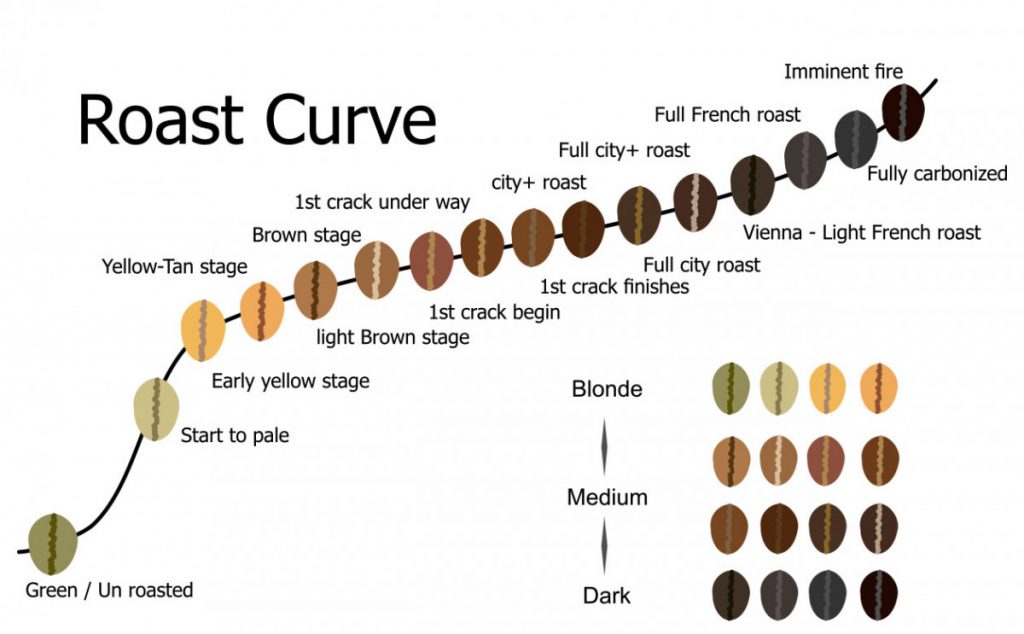
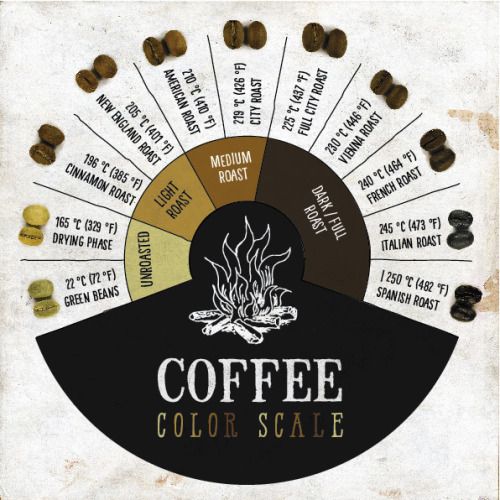
Green coffee beans go through a process called roasting. This is where the green beans transform into the roasted beans, we use to brew coffee.
This is done by bringing the coffee to a specific internal temperature or level of development, done through the careful application of heat and close observation.
Heat not only caramelizes the sugars in the beans, but it also browns the beans during roasting.
https://knowyourgrinder.com/best-home-coffee-bean-roasters-reviews/
Lighter roast profiles tend to emphasize more of the unique characteristics of the coffee, whereas darker roasts tend to emphasize more of the roasting characters.
https://counterculturecoffee.com/blog/coffee-basics-roasting
#3d: Case Study Tasting Research: Coffee
Coffee Cupping with Bob Benck of Batdorf and Bronson
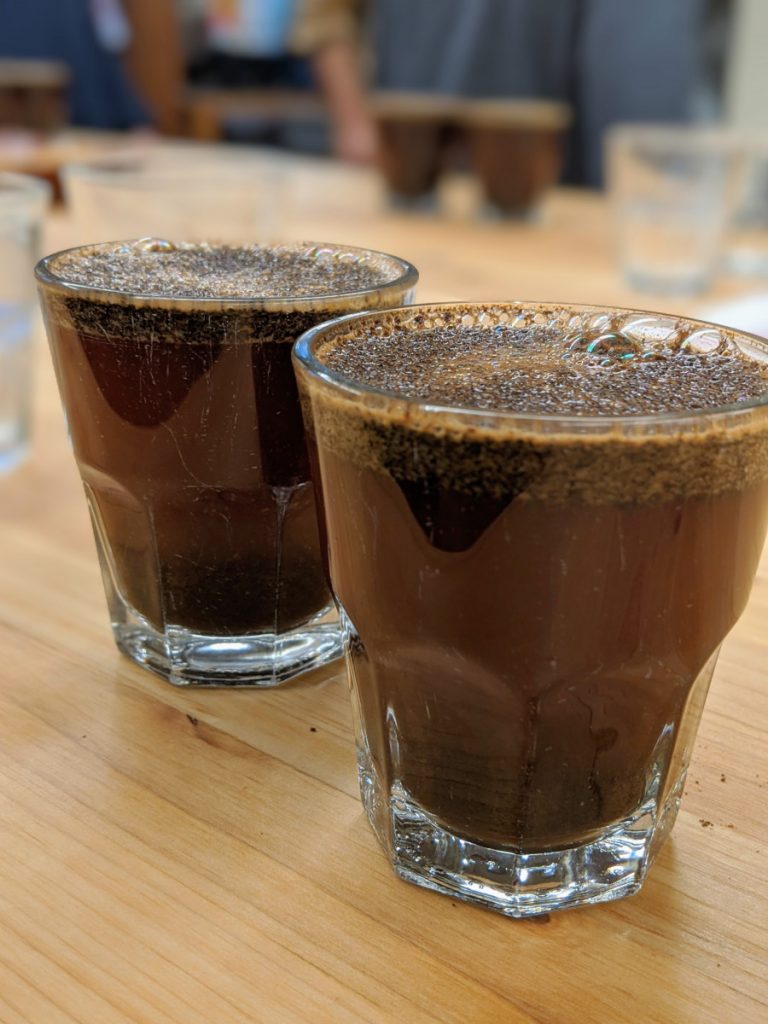
2019 Eating in Translation Batdor & Bronson tour and tasting
Video by Val
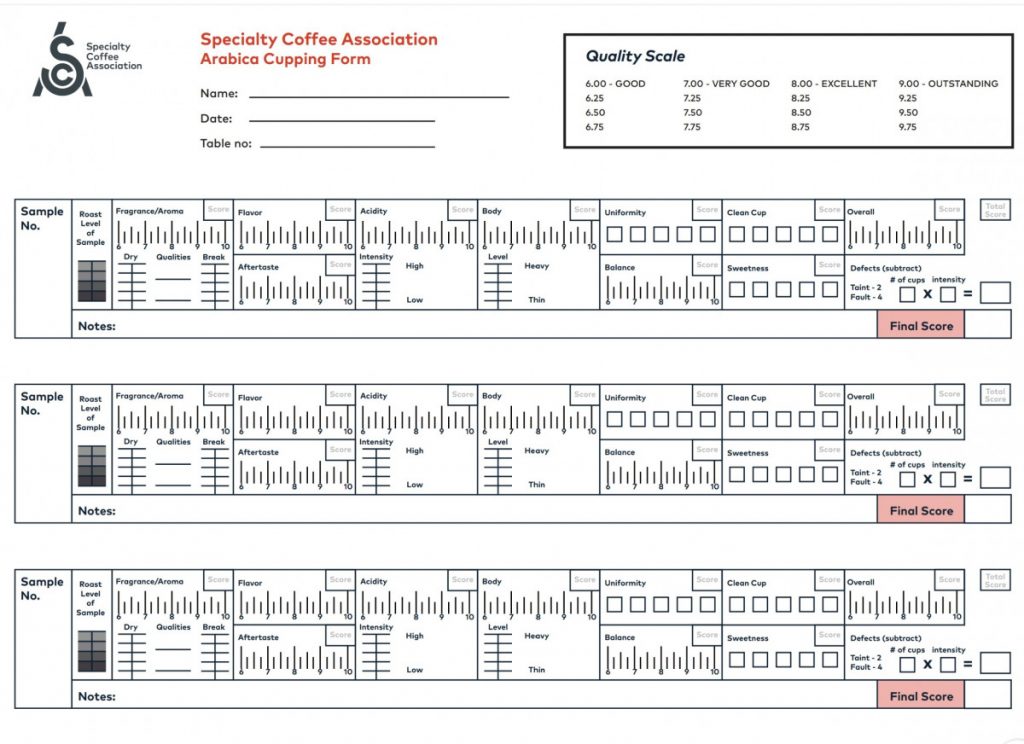
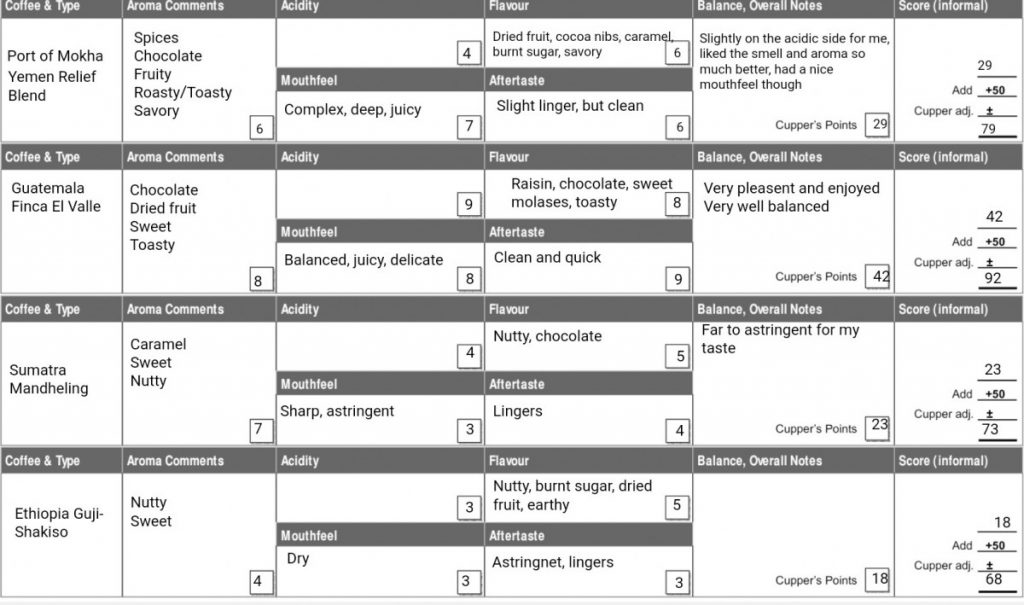
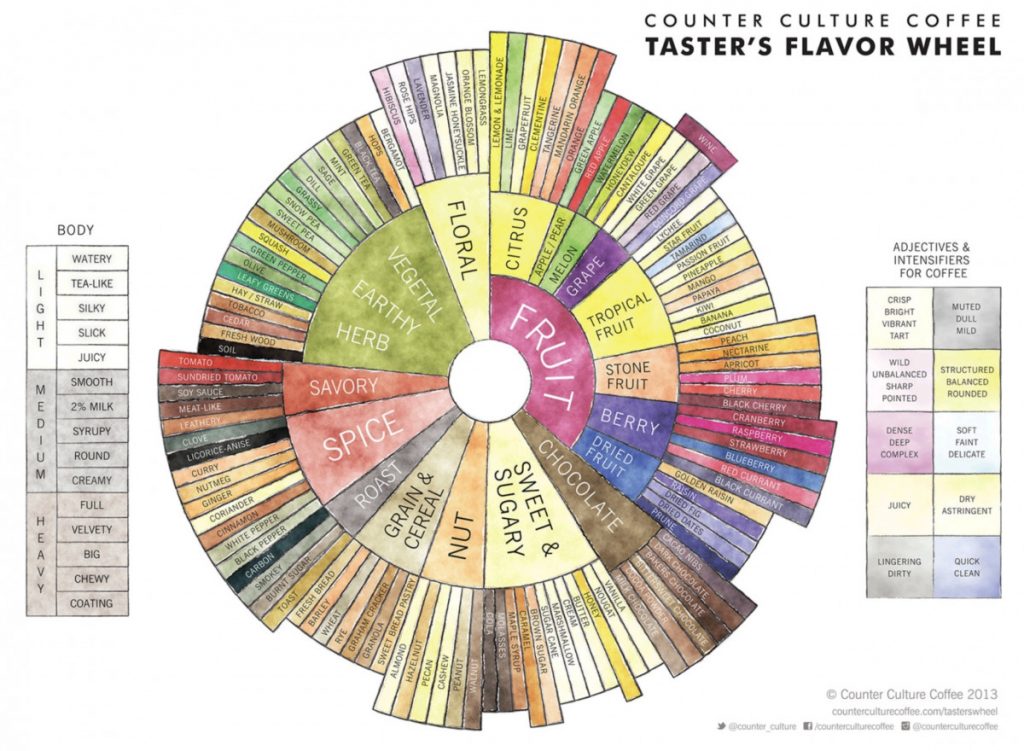
What does a coffee cupping form look like?
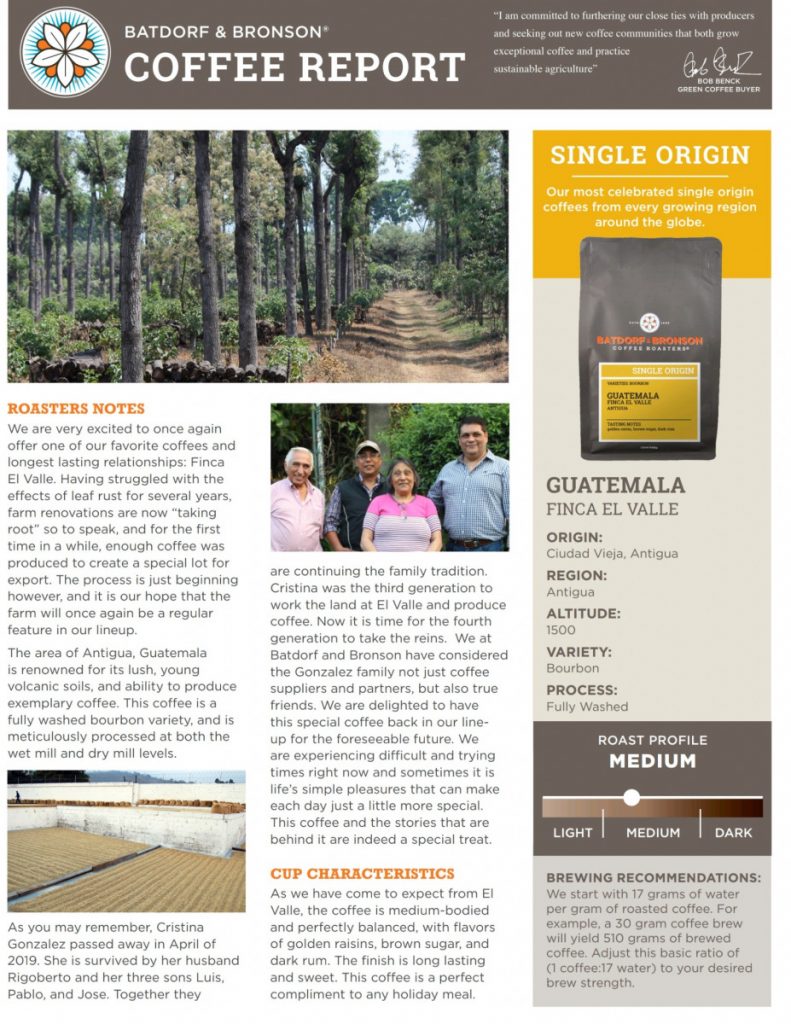
Batdor & Bronson Coffee Roasters
https://www.batdorfcoffee.com/guatemala-el-valle.html
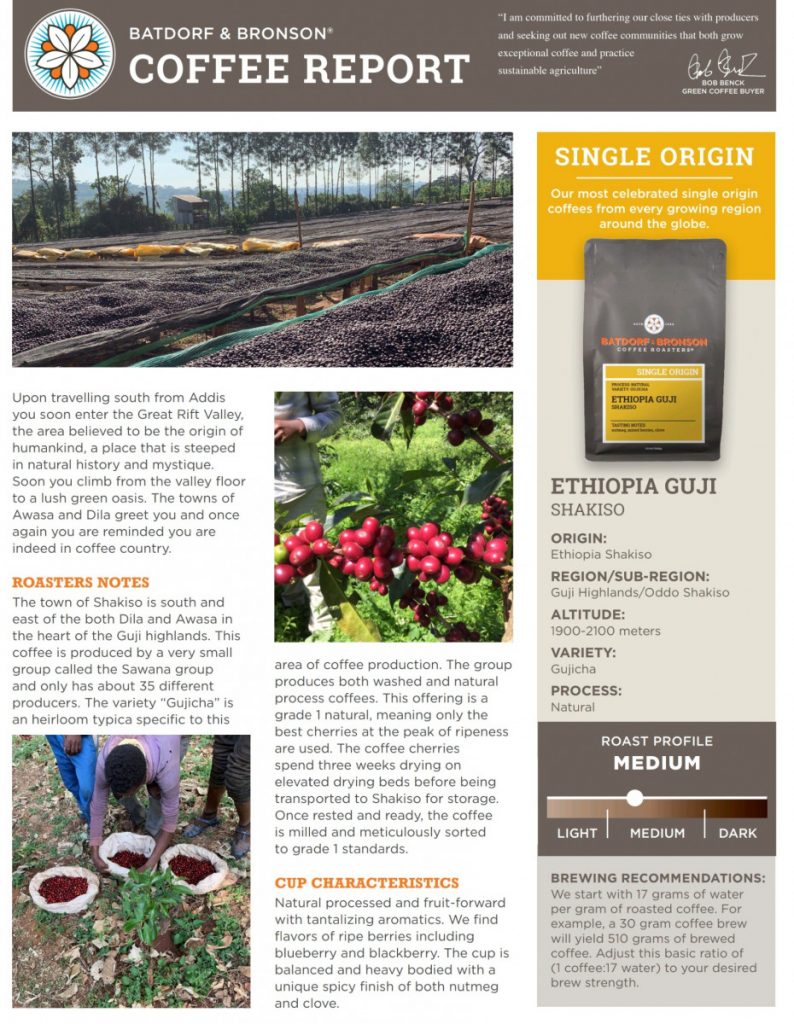
Batdor & Bronson Coffee Roasters
https://www.batdorfcoffee.com/ethiopia-shakiso-guji.html
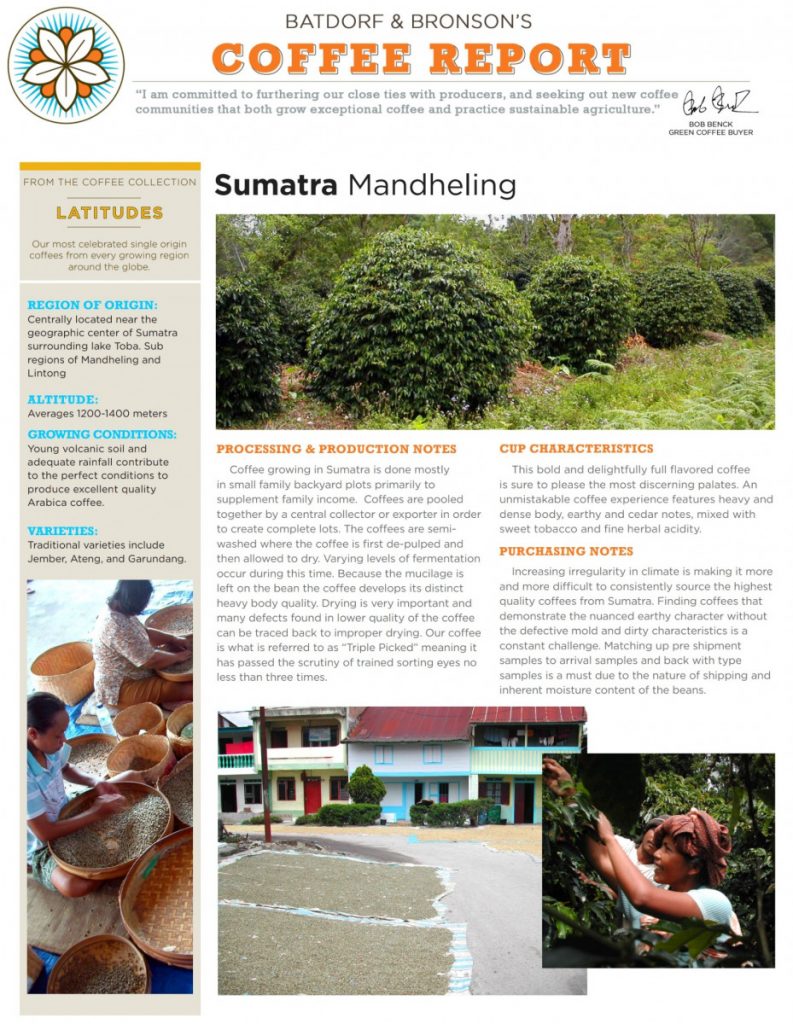
Batdor & Bronson Coffee Roasters
https://www.batdorfcoffee.com/sumatra-mandheling.html
#3e: Stuckey’s Taste Book Experiments
Week 6 – Experiment Guide Question/Answer Form
Week 6 – Sight and Sound Chapters Q/A
(pp 113, 114 & 131)
1) What snacks did you choose to bring to the experiments and why?
Doritos, mini original triscuits, twizlers
2) What beverages did you bring to the experiments and why?
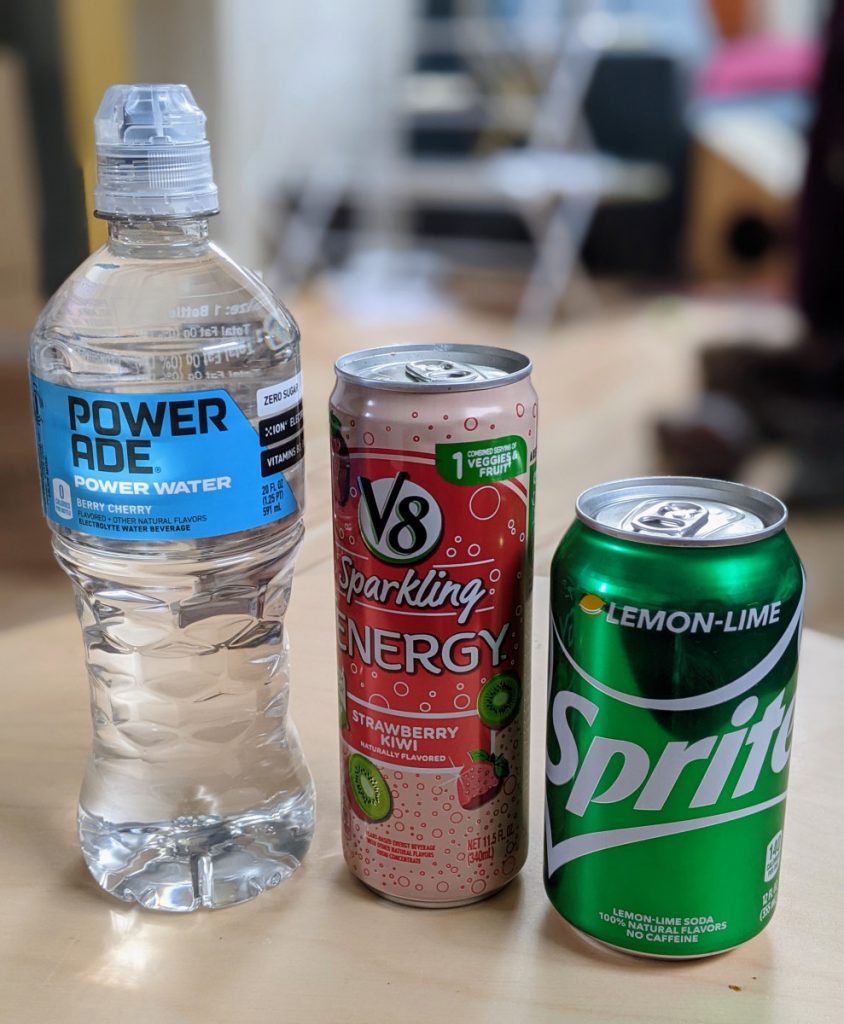
Sprit, powerade berry cherry, v8 sparkling energy strawberry kiwi
3) What is your favorite snack food? From your own perspective, what is the story of how your favorite snack made it to your hands?
Brie, it’s my love of cheese. It’s the best warmed up with a little apricot jam and some crostoni.

1st Experiment Questions:
4) Please reflect on your experience through this experiment; did you notice any difference in how your mind prepared and received a drink of a strange color? Why do you think that you experienced it this way?
Sprit: green- sweet no snappiness, smelled like sprit but doesn’t taste like sprit
powerade berry cherry: red- cherry smell is very strong
v8 sparkling energy strawberry kiwi: yellow- sweeter than usual but doesn’t have the usual sourness
5) Why do you think some farmers grow different colors of the same vegetable?
It gives them a variety within the same species of plants.
6) Do you have an example from your own life where the appearance of a food affected your decision of whether or not to buy it?
I can’t deal with pate or anything of the sort, it gives off an awful smell. I avoid it with everything that I can.
7) If you were to cook and eat an entire meal while being blindfolded for the whole experience, what meal would you choose? Why?
Definitely spinach lasagna. I don’t even use a recipe for it any more, it’s all based on taste, a pinch of this, handful of that, etc.

2nd Experiment Questions:
8) Please reflect on your experience through this experiment; did you find it difficult to guess the snacks purely on the sound they make when being chewed?
Yesss, it was pretty hard to figure out what it was, we had a problem with being able to hear the sound over zoom. I bet it would probably be different if it was in person.
9) Is there a certain food that you particularly enjoy the sound of (eating, cooking, drying, boiling, etc.)?
I’m gonna have to go with brie again, I just absolutely love the feeling of the warm melty salty cheese in my mouth, then a little crunch from the crostoni and sweetness from the apricot jam.
Bonus Question:
10) If you had to choose one of your five senses (sight, smell, hearing, tasting, or touch) to give up every time you ate a meal, which would you choose? Why?
Hearing, I can deal with out the sound of my food, but I gotta see it, smell it, and taste it!
#3f: Sustainable Entrepreneurship
Cooperatives
7 Cooperative Principles
- Voluntary and open membership
- Democratic member control
- Member’s economic participation
- Autonomy and independence
- Education, training, and information
- Cooperation among cooperatives
- Concern for community
Things to be considered when creating a Co-Op
- What primary activity is the co-op for
- How to admit new members
- Whether to charge fees for breaking the rules
- What is needed to do to keep active membership
- What is needed to qualify to become a director
- What procedures are used to run meetings
- How funds will be raised
- How accounts, shares, and fundraising will be handled
- When and how financial reports will be audited/reviewed
Types of Cooperatives
- Consumer: Owned by the consumers who buy goods/ services from the cooperative
- Producer: Owned by the producers of the commodities/craft who have joined forces to process and/or market their products
- Worker: Owned and democratically governed by employees who become cooperative members
- Purchasing: Owned by independent businesses or municipalities to improve purchasing power
- Hybrid: A combination of cooperative types, where people with common interest band together
Sometimes Co-ops fail due to reasons such as; shareholders are not properly incentivized, centralized power, lack of support, or succession shortage.
Climate Change, Sustainability, and Food/Agriculture Systems model
Now more than ever farmers are having to adapt to changing and unpredictable growing conditions due to climate change.
Apple growers are facing warmer winters in northern states that keep apple trees from going into a type of hibernation, causing the trees to blooms too early and susceptible to freezing.
While snow can insulate the apple tree roots in colder climate, not having enough snow can be harmful to the root system. Extreme temperature swings put stress on the trees and unpredictable extreme weather can damage yields.
87% of corn farmers and 66% of coffee farmers in Central America have reported that climate change has negatively affected their crops. Only 46% of these farmers have adjusted or changed their farming practices to account for climate change.
50% of the earths habitable land is used for agriculture and about 70% of that land is used for livestock raising.
This massive land use results in lack of biodiversity; this negatively impacts plant and soil health.
70% of all rainforest deforestation is caused by agriculture, mainly beef, soy, and palm oil.
The equivalent of 40 football fields of rainforest is cleared every minute due to agriculture.
Currently agriculture is responsible for 23% of all total greenhouse gas emissions.
About a 1/3 of all crops are already lost to insect pests, pathogens, and/or weeds.
Rising temperatures boots the rate at which insects can digest food.
Extreme weather and chaining weather patterns make it difficult to predict infection potential and development.
Climate change will likely lead to the increased use of pesticides.
Biodiversity is the best climate insuracne.
#3h: Foodoir: Your Story of Tasting Place
“That early spring I met a young servant in northern Burgundy who was almost fanatical about food, like a medieval woman possessed by the devil. Her obsession engulfed even my appreciation of the dishes she served, until I grew uncomfortable.”
-The Gastronomical Me p. 139
Since growing older and becoming more aware of myself, I have noticed I have some issues with food. I have recently been doing some researching into women and ADHD and Autism. One of my findings is some have food fixations. I never knew this was a thing and now it makes so much sense. When I was younger, I would eat the same foods over and over, never even minding. I just kinda thought It just was because I was picky and they were pretty much the only things I would eat, grilled cheese, fries, chicken tenders. The past several years I have noticed that I tend to eat one item all the time. For a couple years, until very recently after they went bankrupt, I used to eat the frozen four cheese California Kitchen pizzas for almost every dinner. It’s all I wanted and all I thought about for dinner. While in Seville I found this amazing Mexican restaurant and it’s all I wanted, I could eat there every day if I was able to. I thought about it and talked about it nonstop, in hopes that my friends would want to come with me for dinner. Since being back in Wisconsin, I have become so fixated on Culvers, I blame it on not being around a Culvers for 7 years, but deep down I know that’s not the real reason. I can eat, and eat, and eat at Culvers and never get bored of it. I specifically lean towards the cheese curds, grilled cheese, and crispy chicken sandwich. I got really sad when the seasonal pretzel bits went away, because I got them every time I went. This food fixation, is just one of the many things that makes me wonder if I might actually be on the spectrum. I am hoping to be able to talk about it and find a place to get tested once I can get in to see a therapist here in Wisconsin. I feel like having an actual diagnosis might just ease some of the what ifs and answer many questions about myself.





Photo and video by Val
Leave a Reply