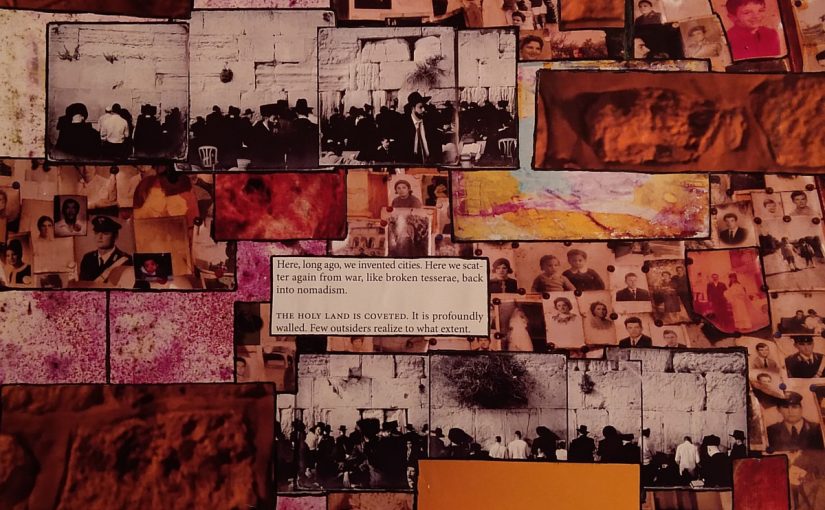
“God created man because God loves stories.”
Elie Wiesel
A Storytelling Animal
Every culture has its stories. Almost certainly, the tradition goes back to the days when our ancestors were hunter-gatherers telling stories around the campfire at night. Cognitive psychologist Jerome Bruner has argued that narrative is central to the construction of meaning, and meaning is what makes the human condition human. There is an inherent link between narrative and identity.
In the words of philosopher Alasdair MacIntyre, “man is in his actions and practice, as well as in his fictions, essentially a story-telling animal.” We begin to know ourselves by discovering of which stories we are a part. Cultures are shaped by stories to which they give rise. Some of these stories have a special role in shaping the self-understanding of those who tell them: master-narratives. They are about large, ongoing groups of people: the tribe, the nation, the civilization. They hold the group together across space and time, giving it a shared identity handed on across the generations. Passing on stories, individually and as a people, has always been one of the cornerstones of Jewish tradition and culture.
In her paper “One generation tells another: The transmission of Jewish values through storytelling”, Peninnah Schram states, “The Jews are a storytelling people. From antiquity into the present, the Jewish People have been referred to as the People of the Book. Jews are also a people of the spoken word. Therein lies a tale, for all persons carry within themselves an entire tribe with a complete history of legends, songs, and movements, in addition to a whole repitoire of voices, tastes, smells, memories, and hopes. The particular system that the Jews use to celebrate their sensory and mental memories is the telling of stories.” In another paper, “Where Are Our Storytellers Today”, Schram adds: “In the telling we create mental images in our listeners that might normally be produced only by the memory of events as recorded and integrated by the sensory and perceptual systems of the brain.”
I find myself on solid ground by first offering a story, or multiple interpretations of the same story, as an intoduction to my own research. How better to untangle the history, religion, and cultural history of a people than to examine it’s stories?
B’reishit
It seems fitting to begin with the ‘first’ story, B’reishit, otherwise known in the Western world as Genesis; the series of commentaries below offer insight into the first verse and words of the Torah and their meaning. The first explanation comes from Reform Rabbi Jeff Goldwasser, “Bereshit: In the Beginning of What?”. To paraphrase:
The first three words of the Torah are, “בראשית ברא אלהים” (B’reishit bara Elohim), commonly translated as, “In the beginning, God created…” However, the very first word, and the very first letter, contains what may be called a grammatical “mistake.”
Because the word b’reishit is in the construct state, it should be translated as “In the beginning of.” If the writer of the text had wanted to say, “In the beginning, God created,” there would have been a straightforward way of saying that by changing the grammatical phrasing.
The form of the word b’reishit can only mean “in the beginning of…” Every other place in the Tanakh that contains the word b’reishit clearly has this meaning. And the word that follows it should be a noun that answers the question, “in the beginning of what?”
The problem is that the word following b’reishit is not a noun. The next word is bara, a verb that means, “He created.” A word-by-word translation of the whole phrase, b’reishit bara Elohim, would have to be something like: “In the beginning of God created.”
How then do we understand the first three words of the Torah? Why does it begin with a phrase that is un-translatable, a grammatical mess? The unusual grammar of the first word of the Torah, then, must have some intentional significance.
When did God create the world? It was in the beginning of God created the world. While this makes no grammatical sense or temporal sense, it makes great spiritual sense. “The world was created, but it never stopped being created. The world has a beginning, but it is a beginning that has never ceased.”
The Torah begins by telling us that it does not exist in time the way other stories do, that it exists in a suspended moment that cannot be pinpointed on a timeline. “B’reishit bara Elohim.” In the beginning of the beginning that is always beginning, God created the creation that is still.
—Rabbi Jeff Goldwasser
Offering a slightly different interpretation, “Shabbat B’reishit” by Reform Rabbi Rachel Heaps continues the discussion of grammar and meaning within the verse.
“In the beginning, God created the heavens and the earth.”
It’s become a famous line. It is the source of thousands of years of inspiration and theology, as well as conflict and confusion. It is humanity, and most of western religions, the first introduction to divine power and presence in our world. And yet, we barely understand our creation and the creation of our universe.
Would it surprise you to know that we don’t even really understand this first line of Torah? Or even, the first word?
The word we tend to translate as “in the beginning” is B’reishit – בראשית. At its root is a word that is familiar, ראש/rosh meaning head. We know it from Rosh HaShanah, the beginning of our new year, and many other “first” or “beginning holidays. But the grammar of the word is odd. If it truly meant “in the beginning,” this word should have had a different root – החל/heychal.
If B’reishit doesn’t mean “beginning,” what could it mean. Rashi suggests that it might point more to the order of God’s creative process. Before God began to work, the world was tohu va’vohu, in complete chaos. God institutes order not only by the act of creation but also by the process. Rashi says we shouldn’t read the word as B’reishit, but rather as ba’rishon – “at first.” Using Rashi’s understanding, this first sentence becomes “At the beginning of God’s creating of the heavens and the earth…”
With this translation, not only do we start our Torah with an incomplete sentence, but the nature of the separation between human and divine changes. God didn’t “live in heaven” and then decide to create our human world. God created our human world by creating BOTH heaven and earth, and every act of creation described in Genesis 1, is a part of making both the “ideal” and the “real” exist in the same space at the same time.
As God goes on to create oceans, land, animals, and humans each one has access to heaven and earth, each step of creation is a part of both. How powerful an idea, that nature, humankind, and everything around us has both parts built into us – the light and the dark, our highest and lowest selves, our potential and our baggage. All of it is a part of our human experience. Our universe was created to embody dichotomy and given the eternal privilege and challenge of finding balance.
— Rabbi Rachel Heaps
Another commentary on the grammar of B’reishet comes from Robert Harris, professor of Bible and Ancient Semitic Languagues at the Jewish Theological Seminary (JTS), a Consevative Jewish instituation. In his article, humerously titled “The Torah and Its Clearly Ambiguous Message or In the Beginning, There Were…Commentaries!”, Harris utilizes the teachings of Rashi.
Shlomo Yitzchaki, generally known by the acronym Rashi, was a medieval French rabbi and author of a comprehensive commentary on the Talmud and the Tanakh. Acclaimed for his ability to present the basic meaning of the text in a concise and lucid fashion, Rashi’s works remain a centerpiece of contemporary Jewish study. His commentary on the Talmud has been included in every edition of the Talmud since its first printing in the 1520s. His commentary on Tanakh, especially on the Chumash or “Five Books of Moses”, serves as the basis for more than 300 “supercommentaries” which analyze Rashi’s choice of language and citations, penned by some of the greatest names in rabbinic literature.
The rule is not that one can discover “the” meaning of Scripture. Rather, the rule is that the Torah is always ambiguous, and one’s job as a reader is to determine the range of potentially reasonable interpretations, or “meanings” of Scripture. I could give you dozens of perfectly fine examples of this rule, however, one case should suffice for now. B’reishit bara: This text says nothing other than “explain me”! This is as our Rabbis have taught: For the sake of the Torah, which is called ‘the beginning of his way’ and for the sake of Israel, which is called ‘the first of his produce’.
Now, that made it all clear, no?
Well, of course, not. What we need to do is to “unpack” Rashi. As the question popularized by the late Nehama Leibowitz would put it, “Mah kasheh le Rashi?” Literally, this question asks, “What is difficult for Rashi?,” but a more expansive way of understanding it is, “what is the difficulty that Rashi perceives to be at play in the biblical text, and that prompts his comment?”
The difficulty lies in the way the first two words of the Torah (b’reishit and bara) interact: if, as seems likely, the word b’reishit means not “in the beginning” but “in the beginning of,” then it seems strange that it comes right before the second word, bara, which seems to mean “(He) created”. This would yield a literal translation of “In the beginning of . . . (He) created, God (did)”—hardly sounding like the classic we all think it is!
So, Rashi says, as it were, since I see this apparently unsolvable grammatical problem, I am going to use the tools of midrash to help explain it for me: “This text says nothing other than ‘explain me’!” First, the (relatively) easy part: look at the letter bet at the beginning of the word b’reishit. Usually, this letter means in or with something; however, here, Rashi claims (with some justification) that it should be understood according to one of its lesser-known meanings, for the sake of something.
Perfectly legitimate, and now let us move on to the harder part. As we continue to “unpack” Rashi, he contends that the word reishit refers to something God created “at the beginning of His way.” This generally is taken to be the concept ofhokhmah, or “wisdom”: God created wisdom at the beginning of God’s own way. However, for the Rabbis, ain hokhmah elah Torah, “Wisdom means nothing other than Torah.” Thus, in a rabbinic tautology, Reishit=wisdom=Torah.
Since the methodology of midrash permits him to do so, Rashi then takes this last value, and “plugs” it back into the Creation narrative: b’reishit, “for the sake of reishit,” that is, “for the sake of the Torah, God created the heavens and the earth.” Creative, no? The word b’reishit means neither “In the beginning” nor “In the beginning of” but rather “for the sake of Torah, (God created the heavens and the earth).”
So, Rashi says, when we wish to read the Torah contextually, we should acknowledge that the word b’reishit should be considered as in construct relationship with the following word, bara—or more simply put, the two words together do mean “in the beginning of God’s creating . . .” Of course, that is not a sentence. it is just the beginning of a sentence, a series of subordinate clauses.
But what are the implications of what we have just learned? They are, I believe, profound. The main point is this: because of the grammatical problem identified by Rashi (and others), we can see that the Torah essentially begins with a sentence that is ambiguous. Or put differently, the Torah begins with a text that requires our involvement and intervention in order to achieve some meaning. And we can only achieve some meaning by controlling the text through some active participation (in Rashi’s case, he did so either by “changing” the words b’reishit or bara. God’s Torah requires human involvement in order to achieve its meaning: it is incomplete without the participation of humankind.
— Robert Harris
Yet another interpretation of B’reishit comes from the teachings of Rabbi Shimon bar Yochai, with translation & commentary by Rabbi Moshe Miller. Rabbi Shimon bar Yochai, also know by the acronym “Rashbi,” lived in Israel in the 2nd century C.E. Rashbi played a key role in the transmission of Torah, both as an important Talmudic sage and as author of the Zohar, the most fundamental work of Kabbalah.
“In the beginning G‑d created the heaven and the earth.”
Our Sages explain that the world was created with ten utterances expressed over the period of the six days of Creation. Although there appear to be only nine utterances, the Sages conclude that the word “b’reishit” (meaning “in the beginning”) is also an utterance, even though it is not preceded explicitly by the words “and G‑d said…”
All nine utterances, spread over the six days of Creation, are included in the first utterance, “B’reishit” – “In the beginning.” At this stage, Creation is not yet manifest as material being. However, when the Holy One blessed be He, brought Creation into manifest existence, he emanated the six. The beginning is in concealment, meaning the Higher World…
The six days of creation during which physical creation came about. Then each of the nine utterances through which Creation came about is preceded by the phrase “And G‑d said”. But, since the Higher World is concealed, and everything that is associated with it is also concealed, the verse [merely] states “B’reshit…”, meaning: “bara -” Hebrew for “He created” and – sheet” meaning “six”. This implies the creation of six supernal days.
The opening word “b’reishit” is not preceded by the phrase “And G‑d said”. That all the six days of Creation are contained in the word “b’reishit” can be seen from this word itself, which can be broken down into two component words, which mean: “He created – six.” Nevertheless, while the six days of Creation are still contained within the word “b’reishit” the verse does not mention who created them, because this refers to the concealed Higher World. This concealed Higher World remains hidden from the created beings of the lower worlds and therefore, “b’reishit“, is not preceded by “And G‑d said”.
Afterwards, when He revealed and articulated the remaining nine utterances through which the world was created, the verse states: “G‑d [Elo-him] created the heaven and the earth”. And not just the simple more ambiguous “created” shown above, but rather “Elo-him created”, for the name “Elo-him” refers to the revealed. Therefore, the verse utilizes the divine name “Elo-him”, for this name signifies the attribute of limiting and diminishing the Infinite Light so that a physical world can exist. The beginning is in concealment, meaning the Higher World. The Lower World is revealed….
This is alluded to in the word “B’reishit“, which precedes material Creation. Who created it is not specified, because it refers to the concealed Higher World. This is the mystery of the Holy Name which is both hidden and revealed. The intention is to show that everything in the revealed world is preceded by, and depends on, the higher world, their source.
— Rabbi Moshe Miller
A Tale With Many Storytellers, A Song With Many Voices
The four preceeding commentaries offer very different interpretations of the same first word of the Torah, and together they weave a story that is at times seemingly at odds with itself and at others is deep beyond true comprehension. Moreover, dozens if not hundreds of comentaries on the subject of B’reishit exist, creating additional layers of complexity. How can these interpretations coexist and what do these small pieces of Torah learning teach us about the Jewish people and their law? A few insights come to mind:
Ambiguities in the Torah are abundant: translations can easily be metaphorical or straightforward or both. This makes meaningful study of the Torah difficult, and beginning to understand the deeper contexts at play requires innumerable hours of research and study. Language is important, and grammar has significance. And, without taking into account the context surrounding those words, only a shallow understanding of the material can be had. It brings to mind a Yiddish saying: ‘Rashi iz nit meshuge‘ or ‘Rashi isn’t crazy’. The meaning is roughly, “There must be some sense to it, even if one doesn’t understand it.”
Multiple interpretations are at play in any given verse, phrase or word. Study of Torah puts one into conversation with generations of scholars, reaching back to antiquity. The four commentaries above–concerned only with a single word–connect us to an ancient priest, a medieval scholar, and some of the foremost voices from three branches of modern Judaism – Reform, Conservative and Orthodox (Chabad-Lubavitch). Following the melody, harmonizing, and falling into practiced discord, these voices rise in the Jewish wisdom of machloket l’shem shamayim, meaning “argument for the sake of heaven.”
Heavenly contention is a foundation of Judaism. The Talmud, one of Judaism’s core religious texts, is largely structured as an anthology of arguments, with rabbis from different schools of thought disagreeing, sometimes vehemently. Two major early rabbinic schools of thought in the Talmud – the School of Hillel and the School of Shammai – disagree on nearly every issue, and yet both of their arguments are included in the Talmud to this day. Hillel and Shammai had profound, irreconcilable differences, yet they did not argue to win or to destroy the other side, but rather to discover the truth. Furthermore, both of their views are studied and taught together because, paradoxically, Hillel and Shammai’s conflicting beliefs are both considered by the Sages to be the “words of the living God”.
The Sages drew a fundamental distinction between two kinds of conflict: argument for the sake of truth and argument for the sake of victory. Judaism not only tolerates differences in interpretation, but actually lauds earnest, humble argument with our intellectual “others” as a mechanism through which divine truth is revealed.
Is This My Story, Is This My Song?
“If you don’t know who you are, society will tell you, and then you are lost.”
— Emilio Guerrera
My research has presented several challenges in terms of both academic meaning making and personal identity. Barriers of language, culture, and orthodoxical argument permiate the body of my research. If a single word carries so much meaning, how much more meaning will I find in the laws of Kashrut or the Zohar, which delves into the deeper mystical secrets of Torah? The complexities of a single word of Torah are so great that I cannot innumerate them here–this is the lesson that I will apply to my research of the Ashkenazi people as I move forward. Complexity abounds! Contention will be found at every turn, and that is to be celebrated.
What does it mean to be Jewish? Ashkenazi?
Am I a Jew? Is this my story, too?
Who am I in this story of beginnings that never end?
I hope to answer these questions as I continue my research, utilizing the works of both Michael Twitty and David Dean to explore race, identity, genealogy, culture, and food. By exploring my own roots and family history, I hope to bridge the barriers present in my understanding of the research and myself. In his work “Roots Deeper than Whiteness: Remembering who we are for the well-being of all”, Dean states:
Like my ancestors and me, many of these later immigrants and their descendants also forgot, in large part, where they came from, their earlier ways of life, and their centuries-long resistance to oppression. But we now have the opportunity to remember.
I have found that learning this history of my ancestors is a process of remembering that I am in fact a human being. Though it is in many ways a tragic one, their story brought me a sense of wholeness that I never knew I was missing. I felt connected to a people, to a culture, and to a home. I realized that I do not simply come from a white cultural void but that I have roots deeper than whiteness. This revelation gives me the opportunity to begin to reclaim them and to honor those that were kept alive; to turn ancestral stories of traditional ways of life and the long struggle to maintain them into family stories that I hold dear and share with future children; and to deepen my connection to these ancestors’ values that prioritized relationships, family, community, celebration, and reverence for the natural world over productivity.
— David Dean
What were my Ashkenazi ancestors’ values? Who were they? Where did they come from, where did they go, and how did they get there? How did they interact with the land? What did they eat to sustain themselves, what did they eat in celebration, how was their food prepared, and who prepared it? What were their feelings and practices on gender? Age? Infirmity? What sorts of communities did they build?
Before the 18th century, religion dominated virtually all aspects of Jewish life, and infused culture. Since the advent of secularization, a wholly secular Jewish culture has emerged as well. Which elements of Jewish culture come from within Judaism, which come from the interaction of Jews with host populations, and which others from the inner social and cultural dynamics of the community?
By exploring these questions in my own bloodline, I can reach deep into the heart of Ashkenazi culture and hopefully gain a better understanding of the written and oral law that formed the basis of Ashkenazi Jewish life. I provides both roots in the material and a jumping-off-point for examining what I don’t know.
Why Food and Religion
In the introduction to Feasting and Fasting: the History and Ethics of Jewish Food, Aaron S. Gross explores the links between food and religion, nature and culture.
What are the advantages of attempting to understand a religion through the apparent detour of food? One reason is that food’s location at the intersection of nature and culture invites us to think about religion from the perspective of multiple disciplines and in a more integrated way. Food is most obviously a necessity fixed by both biological requirements and cravings, but it is simply wrong to imagine that food is only a vehicle to provide nutrients to the body and satisfy appetites…
…Whatever material impacts food may have on the world–by providing nutrients, influencing immune systems, effecting longevity, shaping the lived-in environment, setting up particular human-animal interactions, and more–are invariably altered, slowed, amplified, or even obfuscated to generate diverse systems that construct identity and meaning. Food also provides a wieldy symbolic field that is called upon to construct sex and gender, social status, radicalized identities, and even the line that distinguishes humans from other animals.
This book explores food in Jewish communities and texts while also attending to these more universal features of food as a vehicle for human meaning making–that is , food as a vehicle for religion. Food is not important only to some cultures; food is important to all cultures. The kind of creature we humans are simply requires that food be a vehicle for meaning making…
…Religion and food are always intermixed, and examining this intermixture in any one tradition, Judaism in the case of this book, can provide some insights into a more or less universal human process of meaning making via culinaria.
— Aaron S. Gross
Introduction, Feasting and Fasting: the History and Ethics of Jewish Food
“Meaning making via culinaria.” Storytelling through food.
Judaism itself is not simply a faith-based religion, but an orthopraxy: pertaining to deed and practice. By handling the ingredients with care, elevating them through cooking, and eating them with the intention to do good deeds, I come a bit closer to understanding the spirituality and power at play within the scape of Jewish food. By preparing food I am practicing a mitzvah: a commandment and a good deed. Preparing the traditional food of the Ashkenazi adds a layer of complexity: It feels like an ancestral mitzvah is also at play, a command and blessing to elevate the story of my family through the medium that I love and understand best: a good meal.
Credit: YIVO Institute for Jewish Research