Women in Judaism
Debates about the role of women in religious life have raged across the Jewish denominations for the last 100 years, and questions regarding the possibility of increased inclusion of women within the Jewish public sphere continue to be discussed in modern rabbinic responsa literature. Jewish feminists are critical of the exclusion of women from Judaism’s most sacred rituals, which is rooted in the belief that Judaism is a patriarchy that reflects male experiences and voices, and in which women are “other.” Orthodox Jews argue that the role of women in traditional Judaism has been shamefully misrepresented, and that women are seen as separate but equal. Within Orthodox faith, the obligations and responsibilities of women differ from those of men, but they are described as no less important. They are wife, mother, and keeper of the household. Because women play a diminished role in the synagogue, many people perceive that they have no role in Jewish religious life. Orthodox Jews, however, contend that it is the home, not the synagogue, around which Jewish life revolves, and that within that sphere women have equal, if not more, power than men.
Ancient or Biblical Era
The Tanakh is a compilation of thoughts written over several centuries, and thus does not represent a single view of women. The first creation story in Genesis 1, for example, paints an egalitarian portrait of man and woman as being created at the same time and sharing equally in the divine image. Genesis 2, however, depicts a second creation story in which women are a secondary conception, unalterably “other” from men, and further removed from the divine. In biblical law, women were subordinate to either father or husband. While women had no property rights, it is worth mentioning that a woman with no brothers could inherit her father’s land (A rule established after the daughters of Zelophehad successfully petitioned Moses in Numbers 27). Attitudes toward women varied throughout the biblical period. Some women held positions of respect in the Talmud and played pivotal roles in the scriptural narrative; Miriam was a liberator of the Hebrews along with her brothers, a woman named Deborah was one of the Judges, and seven of the fifty-five prophets were women. According to feminist biblical scholar Carol Meyers, women and their traditional roles were valued less once the monarchy was established, when religious life was shifted to the Temple cult and society was no longer centered on agriculture and the home.
Early Rabbis and Sages
The basic rabbinic convention concerning gender is that “women are a people unto themselves.” (Talmud, Shabbat 62a) The male sages who produced rabbinic literature accordingly apportioned separate spheres and responsibilities to women and men, confining women (and their activities) to the private realms of the family. It is interesting to note that these obligations included economic activities that would benefit the household, and women worked in many productive enterprises and crafts, as well as conducting public and private trade. However, women were excluded from most communal and public activities; because these pursuits were mostly geared toward participation in religious service, including the communal study of religious text and the execution of judgments under Jewish law, women were isolated from both access to public authority and the communal spiritual and intellectual education available to men. In fact, as the Babylonian Talmud Berakhot 17a relates, women earn merit “by sending their children to learn in the synagogue, and their husbands to study in the schools of the rabbis, and by waiting for their husbands until they return from the schools of the rabbis.” Women who satisfied male expectations in their assigned roles were revered and honored for enhancing the lives of their families and particularly for enabling their male relatives to fulfill their religious obligations.
Often, the secondary creation of women is cited as explaining their inferior or disagreeable traits:
Rabbi Yehoshua of Sichnin said in the name of Rabbi Levi: “And He built” is written; He contemplated from where to create her. He said: I will not create her from the head, lest she be haughty; I will not create her from the eye, lest she be coquettish; I will not create her from the ear, lest she be an eavesdropper; I will not create her from the mouth, lest she be a chatter-box; I will not create her from the heart, lest she be jealous; I will not create her from the hand, lest she be a thief; I will not create her from the leg, lest she be a run-about; rather, I will create create her from the most modest place on a person, as even when a person stands naked this place is covered. And as He created each and every limb of the woman, He would say to her: be a modest woman, be a modest woman!
Nevertheless, “And they have disregarded all of my counsel” (Proverbs 1:25). I did not create her from the head, and yet she is haughty, as it says: “And they walk with stretched-forth necks” (Isaiah 3:16). And not from the eye, yet she is coquettish, as it says: “and with wanton eyes” (ibid.). And not from the ear, and yet she is an eavesdropper, as it says: “And Sarah listened from the entrance of the tent” (Genesis 18:10). And not from the heart, and yet she is jealous, as it says: “And Rachel was jealous of her sister” (Genesis 30:1). And not from the hand, and yet she is a thief, as it says: “And Rachel stole the idols” (Genesis 31:19). And not from the leg, and yet she is a run-about, as it says: “And Dinah went out…” (Genesis 34:1).
Bereishit Rabbah 18:2
Elsewhere in rabbinic literature, Eve’s culpability in introducing death and sin into the world accounts for women’s disabilities in comparison to male advantages:
The basic difference between man the species and woman his mate who were not initially created as two separate individuals as opposed to all the other living creatures, is to distinguish him favourably from all those other creatures. It draws attention to the fact that man is made from superior raw materials, and that as opposed to the other creatures among whom the male does not enjoy an advantage over the female, man, i.e. the male of the human species, does enjoy such an advantage. The male of the human species enjoys a position of authority vis a vis his female counterpart. The reason that he enjoys this right is the fact that woman is –after all- one of his own original limbs, and a person does have control over the various parts of his body. Seeing that the male of the human species had been the principal creation, woman became an adjunct to him, so that it is logical that man possesses superior strength to woman, and that also the power of his intellect is more manifest than that of his female counterpart.
Radak on Genesis 2:18, 4
The otherness of women, and their less desirable status, are repeated throughout the rabbinic literature. Women are credited with an inherent link to witchcraft (Mishnah, Avot 2:7; Sanhedrin 67a), as well as propensities toward licentiousness (Mishnah, Kings and Wars 3) and foolishness (Mishnah, Sotah 3:4). At turns, rabbis describe women as lazy, jealous, vain, gluttonous, and prone to gossip. The rabbis taught that a woman’s voice and body are indecent, but also that a man should respect his wife more than himself. The Sages also said, “Any man without a wife is not a man” (Yevamot 63a); and “Any man without a wife lives without joy, without blessing, without goodness, without Torah, without fortification, and without peace”. (Yevamot 62b:19)
Medieval Jewish Views on Women
Jewish attitudes toward women in the Middle Ages built on rabbinic models, but also reflected the sociocultural of individual Jewish communities. In Sephardic sources originating in Muslim conrolled lands, we find more restrictive attitudes toward women. For example, Maimonides said, “There is nothing more beautiful for a wife than sitting in the corner of her house.” In addition, Maimonides deemed it acceptable for a husband to beat his wife if she consistently refused to fulfill wifely duties, such as washing his hands and feet. In contrast, Abraham ben David of Posquieres, a French scholar, noted that he had, “never heard that it is permitted to raise a rod against a woman.”
The medieval kabbahistic mystics generally believed that the primary purpose of women was the facilitation of men’s religious life. The Zohar, the most important medieval Jewish mystical work, relates that the halls of the afterlife are presided over by women who gave birth to or aided great men. Interestingly, within kabbalah, some of God’s ten attributes are female; the sefirah called Malkhut or Shekhinah is the primary female manifestation of God, making femaleness somewhat praiseworthy. However, the female attributes of God were considered secondary, subservient, and passive, receiving power from the primary male attributes.
Orthodox Views on Women
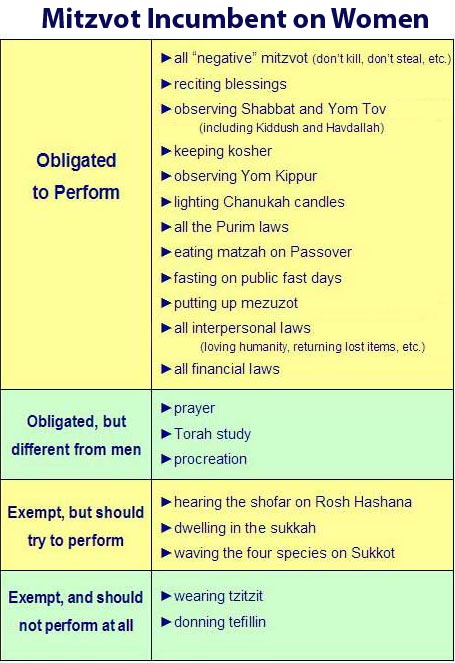
Image Credit: AISH.com
Within rabbinic law, women have fewer religious responsibilities than men and are thus exempt from the obligations of certain time-bound mitzvot (commandments).
As a general rule, they are exempt from positive time-bound commandments, such as fixed prayer at particular times of the day.
Traditional or Orthodox Judaism argues that it is not because of any difference in in the level of sanctity between men and women that these mitzvah are exempt, but that the preservation of the family structure, and by extension the overall health of society, depends on men and women fullfilling different roles. Within this structure, a woman’s primary role is that of a homemaker, and they are discouraged from pursuing higher education or spiritual scholarship; this seems to be primarily because women who engage in such pursuits might neglect their primary duties as wives and mothers, and in preserving Jewish identity and values. It is notable that Orthodox Jews attribute Jewish lineage soley through the female line. In the traditional view, the child of a gentile mother and Jewish father is not a Jew, which places a huge significance on women as being “keepers” of the home, of traditions, of cuisine, and of Jewishness itself.
Scholar Judith Hauptman believes that this distinction reflects female subordination, and in her essay “Women and the Conservative Synagogue”, she argues that, “if a woman were compelled to perform ritual acts at specific times, it would lessen her husband’s dominance over her because she would have to cease temporarily from serving him, and instead serve God.”
Another catagory of mitzvah not mentioned in the chart above are the three in which women are specifically granted priority: Hadlakat ha-ner (lighting Yom Tov and Shabbat Candles), Nidda (observing the laws of family purity and the mikvah), and Challah (seperating the first portion of dough).
Taking Challah and Making Challah
The most common usage of the word challah is for a type of bread, or sometimes as the word fot the two loaves baked for the shabbat meal. The early halakic meaning of the word challah is the piece of dough that is traditionally separated, consecrated to God, and given to the priestly class every time a significant amount of bread was baked. In post-Temple times, the rabbis ordained that a portion must be separated from the dough and burned.
While both men and women are required by Jewish law to take challah when breadmaking, traditionally, seperating challah has been entrusted to Jewish women because of their central role within the home. Notably, the kosher laws are also considered part of a woman’s mitzvot by extension of the tradition of challah, and women are entrusted with ensuring that these laws are properly kept. Rabbis teach that the home is like a minature version of the holy Temple, and the woman in her home is like the priest in the Temple of Jerusalem. Taking challah expresses the belief that sustenance comes to us through God, and that whatever we are given is not for our use alone; everything must be put towards a spiritual purpose. Challah represents the idea of taking something physical and elevating it to the spiritual, not only providing physical nourishment to those who eat, but spiritual nourishment provided by the thoughts and blessings imbued in the dough when the challah is made. The separated dough is a gift to God that reminds the baker to suffuse the world with holy intent.
Taking Challah
Speak to the Israelite people and say to them: When you enter the land to which I am taking you
and you eat of the bread of the land, you shall set some aside as a gift to G-d:
as the first yield of your baking, you shall set aside a loaf as a gift; you shall set it aside as a gift like the gift from the threshing floor.
You shall make a gift to God from the first yield of your baking, throughout the ages.
Numbers 15: 18-21
In order to take challah, a series of specification and requirements must be met by the baker. The dough must be made of one of five grains (wheat, barley, rye, oat, and spelt), and in order to recite the blassing, challah must contain some amount of water. Additionally, the dough should contain at least 59 ounces of flour to seperate the challah and recite a blassing. If the amount of flour is between 43 and 59 ounces, challah should be separated without a blessing. Challah is not separated if the dough contains less than 43 ounces of flour.
Challah is separated after the flour and liquid are mixed together and before it has been divided and shaped into loaves. If the conditions for reciting the blessing are met, the baker recites the following words over the dough:
Blessed are You, L-rd our G‑d, King of the Universe, who has sanctified us with His commandments and commanded us to separate challah.
A small piece of dough is separated from the batch, approximately one ounce or the sized of a medium olive. The baker then announces:
“This is challah.”
The challah is then burned by wrapping it in a piece of silver foil and placing it in the oven for an exrended period alone. The challah may also be thrown away.
Making Challah
It wasn’t until the late 15th century that shabbot breads are described as challah in a Jewish text. In the Leket Yosher, written by Rav Yosef ben Moshe, one passage describes some of his Rabbi’s Shabbot customs:
“I recall that every erev Shabbos they would make him three thin challahs, kneaded with eggs and oil and a little bit of water. At night, he would put the mid-sized challah in the middle of his table, which was square, on a cloth in the center of the table. Under the challah was a large uncut loaf, even though it [the large uncut loaf] was made of black bread, rather than on a small roll of white bread called zeml. In the morning, the large challah and a large loaf were put on the table, like at night. For the third meal, he used the small challah and a whole loaf.”
It was in the middle ages that the name challah was applied to a type bread in South Germany; during the 1400s century, braided breads using white flour became popular, perhaps because braiding the dough helps to keep the bread fresh a bit longer. These breads were called berchisbrod, and they started to appear on the shabbot table. This is possibly because the German word bercht (braid) sounds very similar to the Hebrew word brochos (blessing). This type of challah was known as barches or berches, a name that is still used today in some eastern European traditions.
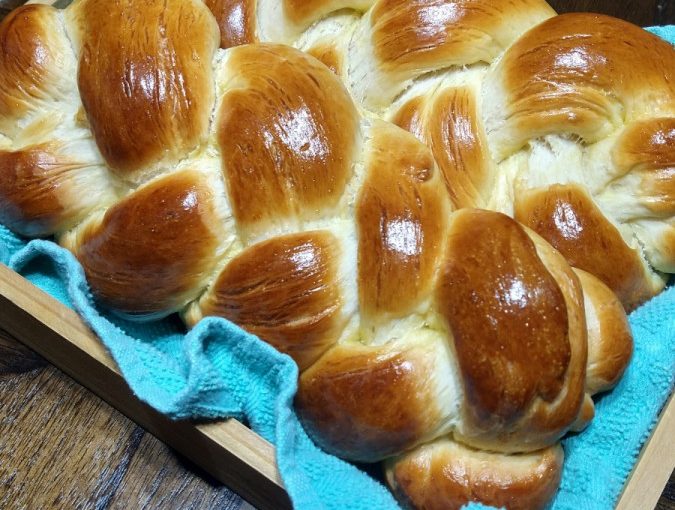
In modern times, challah is most well known as a braided loaf of eggy, shiny, slightly sweet bread prepared for Jewish holidays and on Fridays for Shabbat. On the eve of Shabbat, two loaves are placed on the table to represent the double portion of manna alloted to the Hebrews in the desert on Fridays that lasted through the Sabbath day. The most common shape of challah is a three-stranded braid; the braided strands form twelve bumps which are said to represent the twelve ceremonial loaves or “showbread” kept in the Temple in Jerusalem for the twelve tribes of Israel. The loaves are then covered on the table by a decorative challah cover or a white cloth, which represents the dew that collected on the manna in the morning.
Challah is made in various shapes and sizes, all of which have a meaning. Braided challahs, which may have three, four, or six strands, are the most common. Three braids symbolize truth, peace, and justice; , because they look like arms intertwined, three stranded braids are also said to symbolize love. Round or sprial loaves are baked for Rosh Hashanah to symbolize continuity, the wheel of the seasons, or a spiral of upward progress. Ladder and hand shaped loaves are sometimes served at the meal before the fast of Yom Kippur; the ladder signifies ascending to great heights and the hand symbolizes being inscribed for a good year. On Purim, small triangular loaves are baked to symbolize Haman’s ears. Two oblongs are baked for Shavout and placed side by side to represent the Tablets of the Law. Sweet challahs with honey or raisins are baked during the festive season to bring joy and happiness. The poppy and sesame seeds sometimes sprinkled on the bread symbolize the manna that fell from heaven.
My Challah
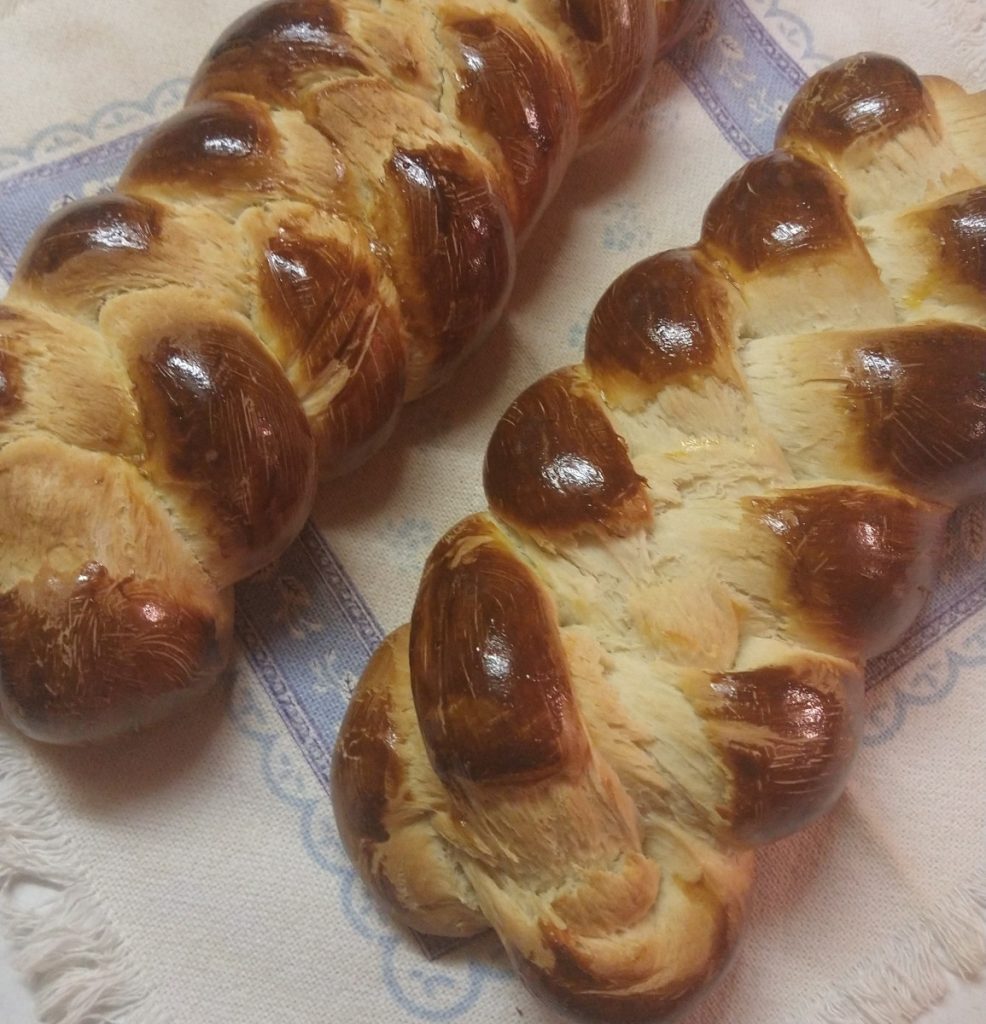
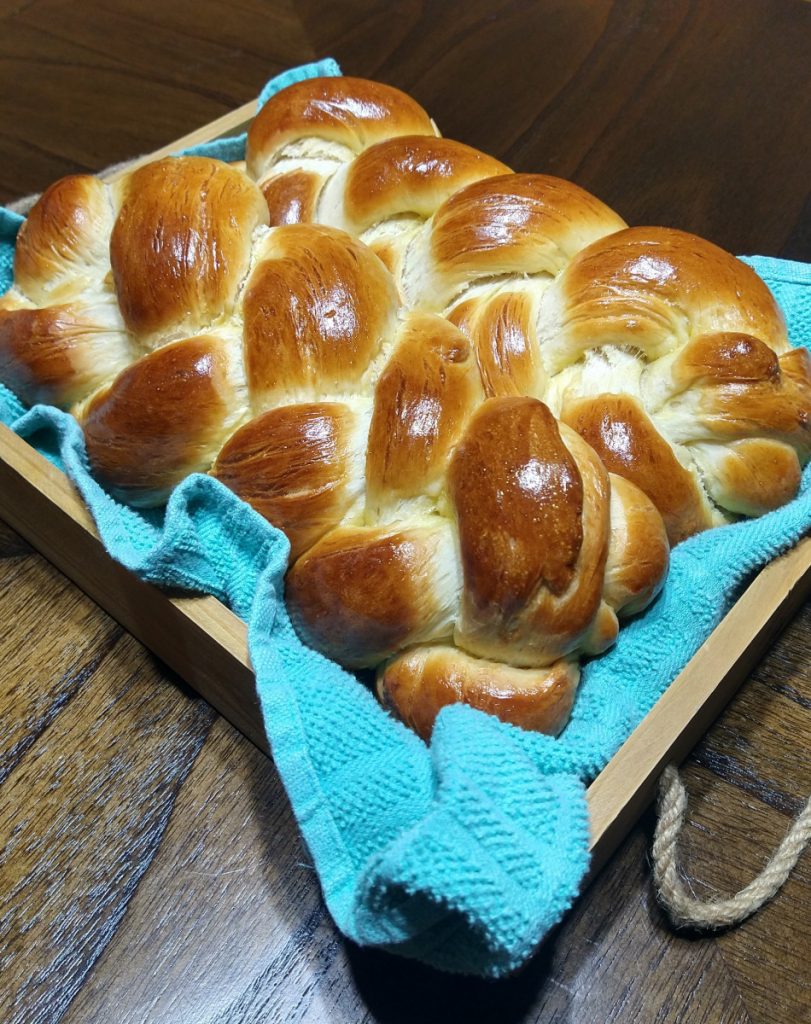
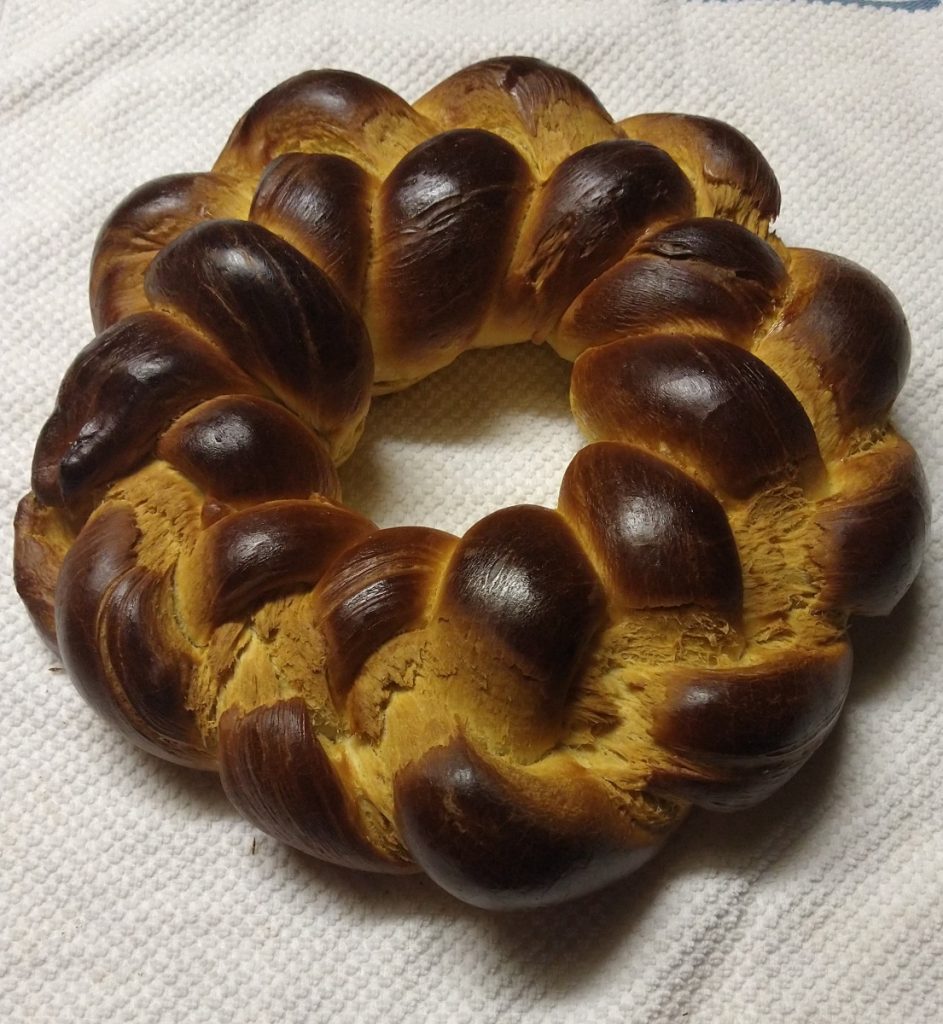
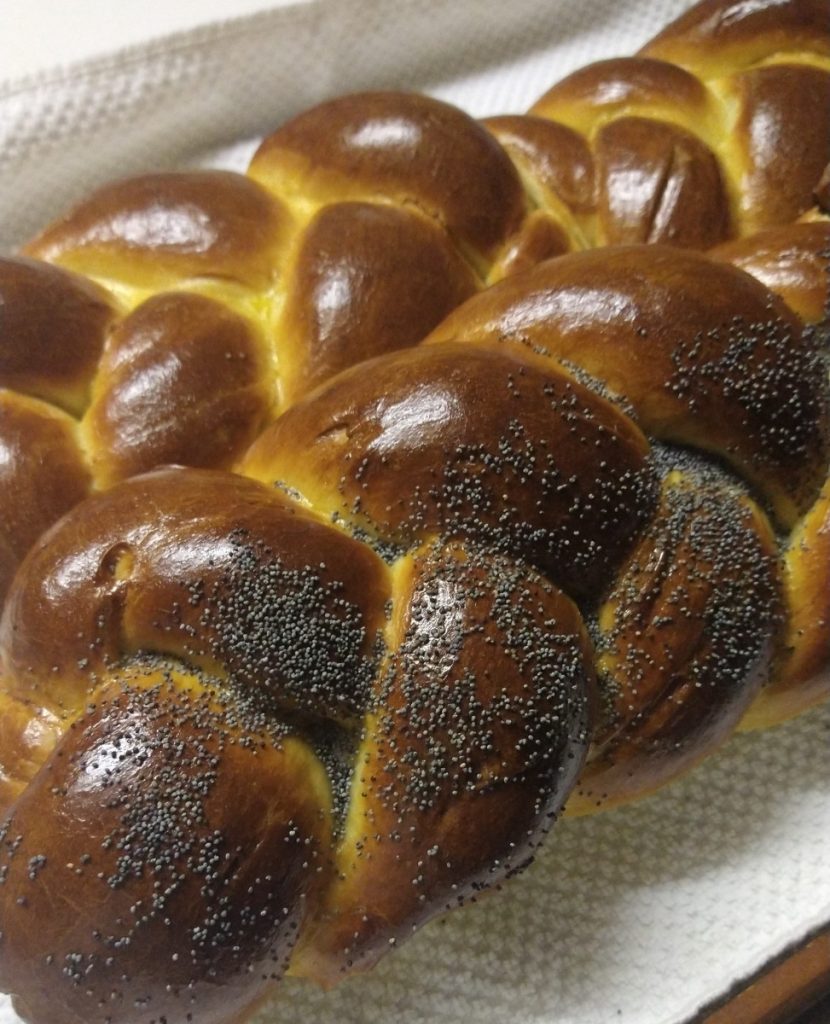
Image credit: Sarah Dyer
For my first foray into challah, and to keep in line with the theme of exploring traditional Ashkenazi food, I wanted to work with a very basic recipe. While challah recipes can offer diverse and unexpected flavors, traditional Ashkenazi challah is a fairly basic recipe. Traditional challah also generally has limited additions and toppings if any at all, so I limited my study to recipes that met those criteria. Such extra ingredients include honey, raisins, saffron, nigella seeds, sesame seeds, and poppy seeds, and I did utilize these eventually. The basic Ashkenazi challah contains water, sugar (or honey), yeast, oil, flour, salt, and eggs; it is the combination of ratios and timing that changes the nature of of the bread between different recipes. So, after trying out several extant recipes, I was able to create my own recipe for challah.
Sarah’s Challah Recipe
- 2 tablespoons Active Dry Yeast
- 2 cups lukewarm water
- 1/2 cup sugar, plus 1 tablespoon
- 1/2 cup honey
- 1/2 cup vegetable oil, plus more for greasing bowl and pan
- 5 large eggs, room temperature
- 1 tablespoon salt
- 9 – 9 1/2 cups all-purpose flour
- In a small bowl, dissolve yeast and 1 tablespoon of the sugar together in the lukewarm water and set aside until foamy, about 10 minutes.
- Grease a large bowl and 2 large baking sheets with oil and set aside.
- Using a whisk or fork, beat together 4 of the eggs in another large bowl. Beat in salt, remaining sugar, honey, and 1/2 cup oil.
- Add yeast mixture and beat until well combined.
- Gradually add the flour, stirring until dough is stiff. It is importatnt to note here that because each batch of flour is different, each batch of challah will use a slightly different amount of flour. As the dough begins to stiffen, it is imperitive to go by feel. All the liquid should be absorbed, but the dough should not be so dry that it is falling apart.
- Turn the dough out onto a lightly floured surface and knead until smooth, about 10-15 minutes, then shape the dough into a ball and transfer to the oiled bowl. Cover with a damp kitchen towel or plastic wrap and set aside, and let it rise until it has doubled in bulk, about 1–2 hours.
- Turn the dough out onto a lightly floured surface and divide it into 6 equal pieces, and shape each into a rope about 18″ long
- To make the three-strand braided loaves, line up 3 of the ropes lengthwise and join ends of the ropes by pinching them together. Braid each loaf in a standard plat, joining the ends of the ropes together by pinching. The ends are then tucked under on both ends of loaves. Loosely cover the loaves with a damp kitchen towel or plastic wrap and let rise for another hour.
- Preheat the oven to 350 degrees F.
- Beat the remaining egg and 1 tsp.water together in a small bowl. Brush the tops of the unbaked loaves with some of the egg wash and sprinkle with nigella, poppy, or sesame seeds if using.
- Bake the loaves until they are a deep golden brown and sound hollow when tapped, about 30-50 minutes.
- Set loaves aside on rack to cool.
The House of Rashi
In writing about the genealogical research I’ve conducted on my own Ashkenazi heritage, I found it best to begin with my oldest concrete ancestor and work my way forward to the present even though the research process is done in the opposit way (tracing from the modern day back.) While this may seem counterintuitive, it allows us to look at geneaology in a different way: as a narrative as opposed to a just a list of names and places. It allows for historical and cultural context that isn’t obviously apparent when tracing backwards from the present.
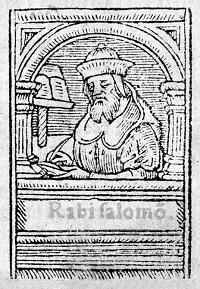
Rabbi Shlomo Yitzhaki, better known by the acronym Rashi, is my earliest ‘concrete’ ancestor, meaning that compelling documentation exists which places me in descent from his line. Genealogies from this time period are sparse in general, but particularly so for the Jewish community. Gaps exhist in genealogical information throughout the ‘darkest’ periods of the Diaspora, including the Crusades, which began at the end of Rashi’s life. In all probability, it is only Rashi’s lasting impression on Jewish culture and spirituality (and that of his children and grandchildren) that allowed me to trace my lineage so far into the past.
Apocryphally, Rashi is a decendent of King David and the Tribe of Judah. On his father Yitzchak’s side, he was reportedly the thirty-third generation descendant of Rabbi Yochanan Hasandlar, who was a fourth generation descendent of Gamaliel the Elder, who himself reputedly descended from the fifth son of King David. However, no written documentation exists for these relationships, and Rashi never claimed that heritage for himself. Like so many other moments in Rashi’s life, legend and truth often meet and blur, becoming obscured. In telling the story of his life, I hope to give voice to both the man and the legend, creating some sense of why Rashi’s name holds so much power even today.
Very little is known about Rashi’s father, Yitzchak Ben Shlomo Tzarfati, or his mother, Miriam Leah. Interestingly, though, they are at the center of several legends concerning Rashi that occured before he was born.
The first legend is about Isaac, Rashi’s father, who is described in the story as a dealer in precious stones. Isaac once possessed a very special jewel which was desired by the local bishop to adorn a figure of the Virgin Mary in his church. The cleric sent his agents to buy the stone from Isaac, but when the latter learned of the purpose for which it was intended he refused to sell the jewel, thinking that to do so would be an act of disloyalty to his own faith. The church messengers offered more money, but Isaac remained firm on his refusal to sell. Finally, the bishop’s men departed to report their failure. On receiving their disappointing report, the bishop decided that, having failed to obtain the jewel fairly, he would take it by foul means. So a few days later he sent other men with the story that there was a wealthy merchant on the other side of the river who was interested in buying the stone. The men looked genuine enough, so Isaac took the jewel and went with them into their boat to meet the ‘customer’. When they were in the middle of the river the men pounced on him and demanded that he surrender the jewel to be delivered to the church. Seeing that he had been tricked, Isaac took the jewel out of his pocket and dropped it overboard, where it immediately sank and was lost for ever [sic]. The legend concludes that Isaac then heard a heavenly voice which announced, ‘Isaac, because you have sacrificed a precious jewel for the honor of your faith, you will be granted a son whose brilliance will illuminate Jewish life and thought for all time.’ Isaac and his wife had been childless for ten years, and within that year Rashi was born.
A second legend tells of an incident involving Rashi’s mother, who was then in an advanced stage of pregnancy. One day, while she was walking down a narrow lane in Troyes, the driver of a cart lost control of the horse, which galloped furiously towards the spot where Rashi’s mother was. At the last moment, and just before the uncontrolled animal could run her down, the frightened woman pressed herself against the wall which miraculously gave way to allow her to remain safely in the niche until the vehicle had passed her. The legend goes on to tell that the same niche could be seen for many years afterwards as a visible testimony to the miraculous intervention of the Divine Providence in the Birth of the Rashi.
In the same genre of fantastic stories we may note the tradition that, years later, a butcher set up his shop in the house where Rashi was born. Strange to tell, it is reported, no fly ever appeared in that shop. The story is, of course, reminiscent of a similar legend about the Temple butchery area which was also free of flies.
Taken from Chapter II of The Rashi by Chaim Pearl
An interesting note here is that there are variations on each of these legends. Some variations call Rashi’s father a vintner rather than a jewel merchant, a likely prospect as Rashi pursued a career in wine later in life. In some tellings of the niche in the wall legend, Rashi’s mother is run down by a Crusader rather than an unconrolled horse, which is interesting given the Crusades had yet to begin when Rashi was born. These differences in legend say something about the historical experience of the Jews and the nature of oral storytelling, and it is easy to surmise how these variations came to be.
Not much is known of Rashi’s youth. He was born on February 22, 1040 in Troyes, Champagne, Northern France. At the time of Rashi’s birth, France was divided into twelve provinces, each ruled independently by a local noble. Troyes was the capital of Champagne and a main trade route connecting Italy with France and then the North Sea. The Jewish community of Troyes was small, only about one hundred families; most Jews worked as merchants and artisans, but some were landowners and all were afforded a fair degree of protection from ruler of the time, Theobald I.
While the certainty of Rashi’s patrilineal line is somewhat a mystery, we believe that his early education was handled by his father and that Yitzhak died in Rashi’s youth. We also know that his mother came from a scholarly family, and that her brother was Simeon ben Yitzhak the Elder, rabbi of Mainz and author of liturgical poetry. Between the ages of seventeen and ninteen, he married a woman named Rivkah. Soon after this, Rashi went to learn in the yeshivas of his relatives Rabbi Yaakov ben Yakar and Rabbi Isaac ben Eliezer Halevi in Worms, where he came home to his wife only three times a year.
He then went to Mainz, where he studied under another relative, Rabbi Yitzhak ben Judah, the rabbinic head of Mainz. It is interesting to note that Rashi’s teachers were themselves students of Rabbeinu Gershom and Rabbi Eliezer Hagadol, two leading talmudists of the previous generation; it was Gershom, in fact, who is still known today for placing the rabbinic ban on Jewish polygamy. Rashi learned not only the oral traditions pertaining to the Talmud from his teachers, but also an understanding of the Talmud’s unique form of argument and sense of logic. Contributing to his learning, his fellow yeshiva students brought knowledge of business, commodities, farming, craftsmanship, sailing, soldiering, and a number of other areas. Rashi took concise and copious notes on subjects mundane and spiritual, incorporating this material into his later commentaries.
He returned to Troyes at the age of 25 and began a life of Torah scholarship and teaching. He was appointed to the Beth din, or rabbinical court, and began writing responsa to halakic law. In about 1070, he founded his own yeshiva in Troyes, were he became a reknowed teacher. Because the role of rabbi at that time was an unpayed position, it is thought by many that Rashi supplemented his living as a vintner because his writing showed an extensive knowledge of its processes and tools. Additionally, Rashi continued his own studies and produced a body of work that defines his life and the lives of Jews in the modern world.
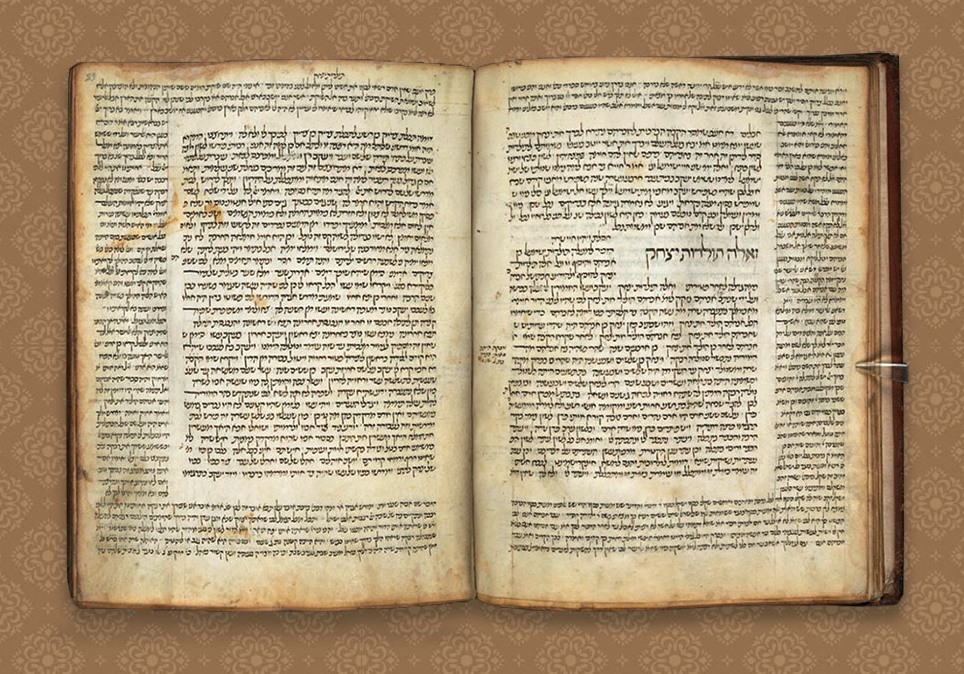
Image Credit: MS 11566, ff 22v-23r. British Library
Rashi’s midrash, two enormous commentaries on the Tanakh and Talmud that took him a lifetime to complete, are used today to teach scripture and can be found in the margin of almost any printed version of the Torah. Rashi’s commentary is, in fact, often used to teach children because his massage is so clear and because it does not paraphrase or exclude any part of the text. Often Rashi’s work provides punctuation in the unpunctuated text and explains context in the writing, saying for example for example, “This is a question”, or, “He repeats this in agreement”, etc. Additionally, Rashi frequently revealed the meaning of the text by using analogies to the professions, crafts, and entertainments of his time and translated difficult Hebrew and Aramaic words into the style of medieval French spoken at the time. In some texts, we can easily deduce what led to Rashi’s explanation, and in a others, Rashi actually explains his own thought process. It is a commonly accepted position amoung modern traditional Jews that it is always appropriate, and at times necessary, to ask the question, “What’s bothering Rashi (about the way the biblical text was written)?”
The end of Rashi’s life was unfortunately shadowed by the first Crusade when it swept through the Rhine in 1096; an estimated 12,000 Jews were murdered and whole Jewish communities were destroyed. Troyes itself was physically untouched, but the events in other cities of the Rhineland affected the entire Jewish population of the area, living in fear that their time would come. Rashi wrote several penitential poems, called selichot, mourning the slaughter and the destruction of the region’s great yeshivot. Seven of these poems still exist, and are recited today on days of penitance and prayer. He also composed a liturgical poem called Titnem Leherpa, cursing those responsible for the destruction:
Make them a mockery, a curse, a disgrace.
Heap upon them a furious wrath and hateful vengeance;
Cast fear and panic upon them; send angels of destruction against them.
And cut them down to the last man.
Another legend involving Rashi developed concerning the events of the Crusades is taken from Shalshelet ha-Kabbalah (The Chain of Tradition) by Gedaliah ibn Yahya (1526-1587), and is roughly titled “Rashi and the Crusader”. It should be noted that it is doubtful that Godfrey of Bouillon, a leader of the First Crusade in 1096 and the first Crusader ruler of Jerusalem, ever met Rashi (though he did travel through the Rhineland on his way to Jerusalem). This version of a legend imagines not only that they met, but that Rashi was the victor in their confrontation:
I saw it written that there was a certain noble in France named Gottfried in the Greek tongue [Godfrey of Bouillon]. He was a brave soldier, cruel, and a man of destruction. The wisdom of Rashi was known even among the nations, for all nations came to seek him out. [Godfrey] sent for him from the city of Lemrina [Le Mans?], but Rashi refused to go, for he knew about the man. The noble was furious, and he rode with his entire guard to the house of Rashi. He arrived at his study hall and found all the gates open, and all the books open, but nobody was to be seen. He called out loudly, “Solomon! Solomon!” Rashi answered, “What does my master wish?” The noble responded, “Where are you?” Rashi answered, “Here I am!” and they went through this several times. By then the noble was quite amazed. He left the study hall and asked, “Has there been a Jew here?” One of the students appeared before him, and the noble said to him, “Tell your master that he should come to me, and I guarantee him by my head that he will suffer no hurt.”
With this Rashi came down to the noble and bowed before him. The noble bid him rise and said to him, “Now I have seen your wisdom. It is therefore my desire that you advise me concerning a great matter that I must undertake, and it is this. I have prepared 100,000 knights and 200 great ships, for it is my desire to capture Jerusalem. I also have 7,000 other knights in the city of Acre, and I have faith in God that I will overcome the Ishmaelites [Muslims] who live there, for they do not possess the knowledge of military technique. Therefore, tell me what you think and do not fear.”
Then Rashi responded with only a few words. “You will go and capture Jerusalem, and you will rule over it for three days, but on the fourth day the Ishmaelites will evict you, and you will run away. You will return to this city with three horses.” The noble was very bitter. He responded, “What you say may come true, but if I return with even four horses, I will feed your flesh to the dogs and kill every Jew in France.”
… [Godfrey] returned with three horses in addition to his own, following the many wars that he conducted—for it continued four years. He remembered the words of Rashi, and he intended to harm him. God, however, thwarted his plan, for when he entered the gate of the city, a stone fell from the gate’s lintel and killed one of his companions together with the horse on which he rode. The noble was deeply shocked and admitted that the words of the Jew had come true. He came to Rashi to bow before him before he returned to his home, but he discovered that [Rashi] had passed away. He mourned over him very much.
From Shalshelet ha-Kabbalah (The Chain of Tradition) by Gedaliah ibn Yahya
Rashi became a spiritual pillar of the Jewish communities ravaged by the crusade, and he returned to help rebuild the destroyed Jewish community of Worms and rededicated the synagogue there. He continued working as a teacher and head of the Beth din at Troyes until his health began to fail him in old age. No longer able to write, it is believed that one of his daughters acted as his secretary, though conservative tradition states that it was his grandson who acted as a scribe. Rashi died at the age of 65, on July 13, 1105, and was buried in Troyes.
Rashi’s Daughters
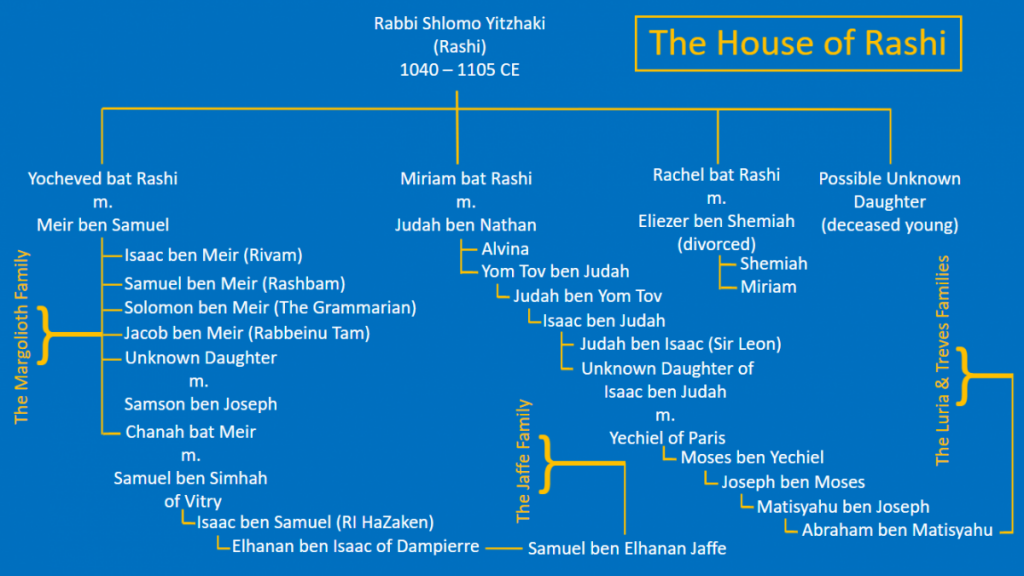
Rashi had three (possibly four) daughters, but no sons. It is unknown whether he had a fourth daughter, but writing from the time alludes to both her existence and early death. The daughters who are named are Jocheved, Miriam, and Rachel; each married their father’s finest students and became mothers to the leaders of the next generation of French Talmudic scholars. Almost every Ashkenazi rabbinic dynasty traces its ancestry back to either Yocheved or Miriam, and I can trace my own ancestry to both of them. While they were all born in Troyes, France, their descendants lived in Germany, France, and Italy between the eleventh and fifteenth centuries, with the majority later moving on to Eastern Europe.
There are a few tales surrounding Rashi’s daughters, all suggesting that they possessed unusual piety and scholarship, but in a far less metaphysical light than the legends surrounding Rashi’s youth. The best known of these stories, and the most likely to be true, recounts that they were learned in Torah and Talmud in a time when women were forbidden from religious study. This is extremely plausible, given that these women grew up with a yehshiva in there home. Another story that could be true is that one or more of Rashi’s daughters took his dictations. Rashi notes in a responsa that he is too weak to write so he is dictating to his daughter, indicating that she would be capable of understanding and writing complicated legal issues in Hebrew.
Argument arises on this subject because there are two versions of this responsa, the other stating that Rashi was dictating to the “son of my daughter” instead of just “my daughter.” Scholars have noted, however, that it is unlikely that Rashi would use the awkward expression, “son of my daughter” instead of, “my grandson,” and that it is likely that “son of” was added in at a later date. Most controversial of these legends is that Rashi’s daughters wore tefillin, the philacteries worn during ritual prayer. While some medieval Ashkenazi women did wear tefillin, there is no evidence that Rashi’s daughters did or did not do so. However, it is interesting to note that Rashi’s grandson, the tosafist Rabbeinu Tam, ruled that a woman doing any mitzvah that she is not obligated to, including wearing tefillin, must make the appropriate blessing.
There is also strong evidence that Rashi’s daughters and granddaughters taught Torah to local women and served as models for the proper performance of Jewish rituals. Yocheved’s daughter, Chanah, was a teacher of laws and customs relevant to women, and Miriam’s daughter Alvina was known as a learned woman whose customs served as the basis for later halakhic decisions.
The Tosafists
After Rashi’s death began the era of the Tosafists, which lasted for about 200 years. Tosafot means “additions,” and refers to the commentaries being composed by Rashi’s students and successors as “additions” to those of their great teacher. These scholars where disciples of Rashi, adding and further clarifying certain passages which their teacher had explained very briefly or that they found to be unclear. The tosafists introduced a new method of discussion of the Talmud, which compares similar Talmudic discussion in different parts of the Talmud, pointing first to an apparent disagreement, and then proceeding to iron out the differences. This sometimes leads the tosfist to interpret certain passages differently from Rashi. Eventually, this gave rise to Talmudic scholars attempting to iron out the differences between Rashi and the tosafists, continuing a line of Midrashic commentary on the Talmud that continues to this day.