
A Calendar to Balance the Sun and Moon
Since ancient times, various astronomical phenomena have been used to establish unique definitions for the day and its hours, the months and the year. The ancient Jews relied on direct observation of the New Moon, astronomical data, the seasons, sunrise, and sunset, the most important of these calculations being used to mark the beginning of each shabbat. In the centuries after the Temple’s destruction in 70 C.E. when oppression and persecution threatened the continued existence of the Court and the Jewish people, The Sanhedrin (Jewish High Court) established the first recorded Jewish calendar. Like the original system of observation, it is based on a Luni-Solar principle and applies rules by which complex astronomical calculations are combined with the religious requirements into an amazingly precise system.
The lunar calendar is eleven days shorter than the solar calendar. According to this math, every year the festivals should occur eleven days earlier in the season than they did the previous year, essentially “floating” around the seasonal calendar. How, then, does Passover always occur in the spring, Sukkot in the fall, and Chanukah in winter? The calendar is adjusted every few years to ensure that it coincides with the solar calendar, ensuring that the Jewish festivals fall in their correct seasons. This proves that the link between the festivals and the seasons is deliberate. But how, and for what purpose?
The Seasonality of Pilgrimage Festivals
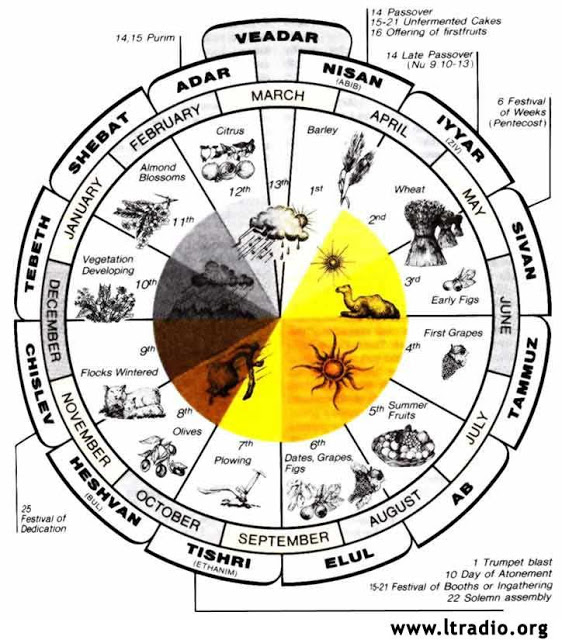
On the surface, the connection between Jewish festivals and the seasons might appear tenuous. The festivals celebrate miraculous events, while the seasons in which they happen to fall appear to be coincidental. However, the Torah emphasizes this link and goes as far as manipulating the Jewish calendar to ensure that the holidays are always celebrated in the proper corresponding seasonal phases of the harvest cycle. Passover, Shavuot, and Sukkot, for example, fall into a category of Jewish holidays known as the pilgrimage festivals. Described in the Tanakh as celebrating both agricultural festivals and historical events in the timeline of the Jewish people, these three holidays were set aside in biblical times for people to travel to the ancient Temple in Jerusalem.
Observe the month of Abib and offer a passover sacrifice to your God, for it was in the month of Abib, at night, that your God freed you from Egypt.
You shall slaughter the passover sacrifice for your God, from the flock and the herd, in the place where will choose to establish the divine name.
You shall not eat anything leavened with it; for seven days thereafter you shall eat unleavened bread, bread of distress—for you departed from the land of Egypt hurriedly—so that you may remember the day of your departure from the land of Egypt as long as you live.
For seven days no leaven shall be found with you in all your territory, and none of the flesh of what you slaughter on the evening of the first day shall be left until morning.
You are not permitted to slaughter the passover sacrifice in any of the settlements that your God is giving you;
but at the place where your God will choose to establish the divine name, there alone shall you slaughter the passover sacrifice, in the evening, at sundown, the time of day when you departed from Egypt.
You shall cook and eat it at the place that your God will choose; and in the morning you may start back on your journey home.
After eating unleavened bread six days, you shall hold a solemn gathering for your God on the seventh day: you shall do no work.
You shall count off seven weeks; start to count the seven weeks when the sickle is first put to the standing grain.
Then you shall observe the Feast of Weeks for your God offering your freewill contribution according as your God has blessed you.
You shall rejoice before your God with your son and daughter, your male and female slave, the Levite in your communities, and the stranger, the fatherless, and the widow in your midst, at the place where your God will choose to establish the divine name.
Bear in mind that you were slaves in Egypt, and take care to obey these laws.
After the ingathering from your threshing floor and your vat, you shall hold the Feast of Booths for seven days.
You shall rejoice in your festival, with your son and daughter, your male and female slave, the Levite, the stranger, the fatherless, and the widow in your communities.
You shall hold a festival for your God seven days, in the place that God will choose; for your God will bless all your crops and all your undertakings, and you shall have nothing but joy.
Three times a year—on the Feast of Unleavened Bread, on the Feast of Weeks, and on the Feast of Booths—all your males shall appear before your God in the place that God will choose. They shall not appear before God empty-handed,
but each with his own gift, according to the blessing that your God has bestowed upon you.
Deuteronomy 16:1-17
The Torah commands the Israelites: “Three times a year—on the Feast of Unleavened Bread, on the Feast of Weeks, and on the Feast of Booths—all your males shall appear before your God in the place that God will choose”, presumably referring to the Temple in Jerusalem. Futhermore, each man “shall not appear before God empty-handed, but each with his own gift” according to the blessing that God has bestowed on him. In this passage, God expresses a desire for all of the male Israelites to travel to Jerusalem and offer the animal sacrifice that was incumbent on each of them. In terms of calendar timing, religious leaders would determine the date for Passover each spring by seeing if the roads were dry enough for pilgrims to travel and if the lambs were ready for slaughter.
The Miraculous and the Mundane: Festivity, Agriculture, and Creating Divinity on Earth
The Jewish festivals celebrate miracles and are named for the miraculous acts they commemorate. Passover, the Feast of Unlevened Bread, celebrates the Exodus from Egypt. Shavuot, the Feast of Weeks, celebrates the giving of the Ten Commandments at Mount Sinai. Sukkot, The Feast of Booths, celebrates the miracles that the Hebrews experienced during their journey through the desert after the Exodus. In addition, these festivals have been given names that reflect the seasons in which they fall. Passover is called the Festival of Ripeness because it falls in the early spring as the crops begin to ripen. Shavuot is called the Festival of the Harvest because it falls in the late spring during the harvest. Sukkot is called the Festival of Gathering because it is celebrated in the fall when the later crops are gathered.
Another point made in the Torah is that feasting was expected to occur alongside sacrifice at these pilgrimage festivals, with egalitarian sharing of bounty amoung all Jews reguardless of social status. Specific harvesting activities are mentioned in the Torah which link directly to the timing of the festival calendar, presumably to insure that enough food would be available to properly observe the holidays. These sorts of commandments could not be performed were it not for the alignment of the Jewish calendar to the agricultural seasons, signaling Judaism as a faith filled with deep agricultural understanding and seasonal meaning.
To begin to understand the mystical, Kabbalistic interpretations at play here, it is useful to emember first Judaism is fairly orthopraxic, meaning concern with “right practice” or “proper conduct” is encouraged if not required. Judaism is not just about worshiping God, but also making the world a holier place. Kabbalists maintain that the Torah itself is not just a set of laws, but a literal blueprint of the creation. Actions which might be viewed with a level of mundanity by the secular world are actually the underpinnings of creating divinity on earth. Rabbi Lazer Gurkow put this into context beautifully, saying:
G‑d’s greatest hope is not just that we absorb the message and sanctity of Torah, but that we allow it to seep into the world around us. A Jewish farmer prepares for Passover by checking that his crop has blossomed. He harvests his crop to prepare for Shavuot. Gathering in his crop fills his mind with Sukkot. The harvest is a living part of the festival. The holiness of the festival seeps into the harvest.
Similarly, we don’t go shopping just to fill our cupboards. We go shopping to fulfill the mitzvah of keeping kosher. We don’t just clean our homes for ourselves, we clean our homes to honor Shabbat. We don’t just learn to read and write, we do it to help us study Torah. In every activity, in every event, we incorporate G‑d. Every object in a Jewish home becomes a funnel for holiness, a vehicle for a mitzvah. Every moment in a Jewish day is suffused with G‑dliness. Every day in a Jewish life is sanctified.
“Why Are Jewish Holidays Pegged to the Agricultural Cycle?”
Beyond these simple views of the significance of a few festival days, the Jewish holidays are a tremendously subject to tackle. While this research will go on to cover several of the major Jewish holidays, it would be impossible to cover them all in detail within the time allotted. The link below is a good reference list of festival dates, as well as brief decriptions.
The Shmita Year
The current Hebrew year is 5782, corresponding to 2021-2022 on the Gregorian calendar, and is both a leap year and a shmita year. The shmita, literally “seventh”, year is the seventh year of the seven-year agricultural cycle mandated by the Torah, and is sometimes called the “Sabbath of the Land”. Focusing on the first verses of Leviticus 25, which articulate the full extent of shmita law, offers a pathway to also understanding its deeper meaning.
God spoke to Moses on Mount Sinai:
Speak to the Israelite people and say to them:When you enter the land that I assign to you, the land shall observe a sabbath of God.
Six years you may sow your field and six years you may prune your vineyard and gather in the yield.
But in the seventh year the land shall have a sabbath of complete rest, a sabbath of God: you shall not sow your field or prune your vineyard.
You shall not reap the aftergrowth of your harvest or gather the grapes of your untrimmed vines; it shall be a year of complete rest for the land.
But you may eat whatever the land during its sabbath will produce—you, your male and female slaves, the hired and bound laborers who live with you,
and your cattle and the beasts in your land may eat all its yield.
You shall count off seven weeks of years—seven times seven years—so that the period of seven weeks of years gives you a total of forty-nine years.
Then you shall sound the horn loud; in the seventh month, on the tenth day of the month—the Day of Atonement—you shall have the horn sounded throughout your land
and you shall hallow the fiftieth year. You shall proclaim release throughout the land for all its inhabitants. It shall be a jubilee for you: each of you shall return to your holding and each of you shall return to your family.
That fiftieth year shall be a jubilee for you: you shall not sow, neither shall you reap the aftergrowth or harvest the untrimmed vines,
for it is a jubilee. It shall be holy to you: you may only eat the growth direct from the field.
In this year of jubilee, each of you shall return to your holding.
When you sell property to your neighbor, or buy any from your neighbor, you shall not wrong one another.
In buying from your neighbor, you shall deduct only for the number of years since the jubilee; and in selling to you, that person shall charge you only for the remaining crop years:
the more such years, the higher the price you pay; the fewer such years, the lower the price; for what is being sold to you is a number of harvests.
Do not wrong one another, but fear your God; for I am your God.
You shall observe My laws and faithfully keep My rules, that you may live upon the land in security;
the land shall yield its fruit and you shall eat your fill, and you shall live upon it in security.
And should you ask, “What are we to eat in the seventh year, if we may neither sow nor gather in our crops?”
I will ordain My blessing for you in the sixth year, so that it shall yield a crop sufficient for three years.
When you sow in the eighth year, you will still be eating old grain of that crop; you will be eating the old until the ninth year, until its crops come in.
Leviticus 25:1-22
The principles at play in these verses maintain that during shmita, the land of Israel is left to lie fallow and all agricultural activity must cease until the end of that year; no plowing or planting may take place and no improvements may be made to the growth of trees or other plants. However, any fruits, vegetables, or herbs which grow of their own accord and are untended are deemed hefker (“ownerless”) and may be consumed by anyone. Additionally, all debts between Jews are supposed to be forgiven, helping to close the gap between the wealthy and the destitute. In ancient times, any Jewish slaves were freed, and upon release, those freed slaves would be compensated for their labor
According to the laws of shmita, land owned by Jews in the Land of Israel is left unfarmed, though the law does not apply to land in the Diaspora or land owned by non-Jews. Jews who own land are required to make their land available during the Shmita to anyone who wants to harvest, and if the land is fenced or closed-off the gates must be left open, both creating access for people and an opportunity for an ecological rewilding. These rules apply to all outdoor agriculture, including private gardens; however, plants inside a building (like a greenhouse) are exempt. Fruits of trees that grow by themselves, as well as vegetables and herbs that are not normally cultivated are especially important and connected to the Shmita year.
Produce of the seventh year that is subject to the laws of shmita is called sheviit and has a sanctity which merits special rules for its use. It can only be consumed for personal enjoyment, and cannot be bought, sold, or wasted. Produce must be used in its “best” manner so as to ensure fullest enjoyment; for example, fruits that are normally eaten whole cannot be juiced. Additionally, shevitt can only be stored so long as naturally-growing plants of that given species can be eaten by animals in the fields.
Once a particular species is no longer available in the field, that food may no longer be eaten, and Jews observant of shmita law must rid one’s house of it through a process known as biur, a ritual destruction of the material. Once a species is no longer available in the land, shmita law requires that it be “made ownerless” and then available to anyone who wishes to take it through a procedure called biur. The contemporary application of the rules of biur can be described as follows:
On the appointed day, one must remove all the relevant produce, and all products containing such produce, from his home and take it to a public area such as a sidewalk. Once there, the individual declares the produce in front of three people who do not live with him. He then waits to give the witnesses a chance to claim the produce. Once they have taken what they want, he is permitted to reclaim whatever remains. It is permissible to choose three people whom one knows will not claim the produce for themselves, even though they are legally entitled to.
Mordechai Kuber, “Shmittah for the Clueless”
Otzar Beit Din and Community Food Security
Also of note is the ancient Hebrew idea of otzar beit din or “storehouse of the rabbinical court”. Under an otzar beit din, a community rabbinical court supervises harvesting by hiring workers to harvest, store, and distribute food to the community. Because the land cannot be sown but existing plants can be tended and harvested, this approach is applied to orchards, vineyards, and other perennial crops. Under the otzar beit din, a legal arrangement is created whereby the crops themselves are never bought or sold, but rather people are merely paid for their labor and expenses in providing certain services. In his article, “Shmittah for the Clueless”, Mordechai Kuber explains otzar beit din in greater detail.
To some, the modern-day otzar might seem to be nothing more than a legal sleight of hand. All the regular players are still in place, and distribution rolls along as usual. However, in reality, it is identical only in appearance as prices are controlled, and may correspond only to expenses, with no profit allowed. In addition, the otzar beit din does not own the produce. Since it is simply a mechanism for open distribution, any individual is still entitled to collect produce from a field or orchard on his own. Furthermore, all agents of the beit din are appointed only if they commit to distributing the produce in accordance with the restrictions that result from its sanctity.
Mordechai Kuber, “Shmittah for the Clueless”
The Gifted Economy
From shmita’s first mention as a concept in the Torah, its agricultural and social justice aspects are linked. Not only is the land allowed to rest, but it also serves those most in need (instead of landholders in least need) during that time. Shmita also meant a rest period for more than the land; in agricultural societies such as the one from which the Jews developed, to not work the fields for a year may have meant not working at all. Shmita was a year off of work, a year for both farmers and the land to rest.
And at the same time that farmers are prohibited from working the land, the public is restricted to predominantly eating food from plants that grow wildly, food from perennial plants, and food preserved from previous seasons. While people can gather such food for their own immeadiate use or for gifting to others, they are not permitted to commercialize the land by taking more from the harvest than they need, as that would effectively put the land to work. The end result is a decommodified food, people, and land: an assurance that the needs of all are met, and not exclusively those of the very rich. Shmita creates a public agricultural commons with a locally consumed harvest. In a sense this represents a return to Eden, a utopic place where Jewish tradition holds that mankind had no unmet needs. Rabbi Nina Beth Cardin, founder of the Baltimore Jewish Environmental Network, posits that this decommodification can lead to the “gifted economy”, a form of gift economy:
…based on the primordial vision that the earth and all its bounty are gifts from God that are to be used by us all but not otherwise possessed, amassed, or hoarded by just some of us. It is a time when the work of the marketplace is held in check, when the dominant economy is one of enoughness and delight as opposed to ever-more and constant desire.
Shmita and Shabbat
Another of the Torah passages that mentions shmita, Exodus 23:10-12, developes a link betwenn shmita and Shabbat.
Six years you shall sow your land and gather in its yield;
but in the seventh you shall let it rest and lie fallow. Let the needy among your people eat of it, and what they leave let the wild beasts eat. You shall do the same with your vineyards and your olive groves.
Six days you shall do your work, but on the seventh day you shall cease from labor, in order that your ox and your ass may rest, and that your home-born slave and the stranger may be refreshed.
The verse ties shmita and Shabbat together: shmita, Shabbat, and a return to Eden are all connected. According to Rabbi Cardin, Shabbat and shmita are all about,
a return, albeit temporarily, to idyllic Eden.
A Pregnant Year
Hebrew year 5782 is a leap year, also called a “pregnant year”, which occurs seven times in a nineteen year cycle in order to balance the lunar and solar dates of the Jewish calendar. This results in a year with thirteen months as opposed to the common twelve months in the year. Oddly, before the establishment of the perpetual calendar in the 4th century C.E., the rabbinical court engaged in the ad hoc declaration of leap years.
The circumstances surrounding these declarations include the astronomical, the seasonal, and the mundane. A primary factor which overrode all others was the spring equinox. If it were to fall later than the first half of Nissan, then the year was automatically declared a leap year. Spring-like conditions also needed to be evidenced: if the barley had not yet ripened and the trees were not yet blossoming it was a sufficient reason to delay Nissan by adding a second month of Adar. The Sanhedrin also considered tangible factors. For example, if roads or bridges were in disrepair due to the winter rainy season, the travel of pilgrims to Jerusalem for Passover would be impeded. Thus, declaring a leap year would give crews time to repair any infrastructure before any major use of affected road systems.
Every “pregnant” year has an Adar I and an Adar II. Adar, which contains the festival of Purim, is the official lucky month of the Jewish people. This concept is even built into Jewish law, in which it is recommended that litigation with a non-Jew should be scheduled for Adar: “Adar” means “exalted”, “praised”, “power”, and “strength”. It is the official “happy” month, and it is written in the Talmud,
As soon as Adar begins, increase in joy!
Why does the Talmud say that joy increases in Adar? When Haman cast lots (purim) to determine the most auspicious day for annihilating the Jewish people, the lots indicated
the twelfth month, which is the month of Adar.
Esther 3:7
The month of Adar, in that moment, was destined to become a month commemorating national tragedy. If Haman’s plan to carry out a genocide against the Jewish people had succeeded, we would fast and mourn in the twelfth month. Joy would decrease in Adar. However, because of God’s intervention through Esther and Mordechai,
the month [of Adar] … turned for them from sorrow into gladness and from mourning into a holiday; that they should make them days of feasting and gladness.
Esther 9:22
Interestingly, these words are almost identical to a prophecy in Zechariah that says the fast of the month of Av commemorating the destruction of the Temple
shall become [an] occasion for joy and gladness, happy festivals for the House of Judah.
Zechariah 8:19
Joy is increased in Adar because the month of Adar provides us with a glimpse of redemption. It offers evidence that, no matter how bad things may seem to be, they are going to get better. As God transformed Adar from a month of mourning into a month of joy, so may sorrows be transmuted into joys. Things will get better. Joy will increase. The leap year offers two full months of all that Adar implies, and for sixty days it is a commandment to be extra joyous!