Jewish Eating and the Elevation of Creation
When the Holy Temple was in existence, the Altar atoned for Israel; today, a person’s table atones for him.
Talmud, Berachot 55a
Before one can grasp the significance of kashrut law, there is a salient need to understand the Jewish approach to eating and life itself. Jews believe that they are here to transform the physical realm into a holy place, in line with the will and design of Hashem.
In terms of eating, there are several aspects relating to this service to holiness. In order to serve G-d, one must be healthy and strong, and eating is a part of that service. As Maimonides put it:
“…keeping the body healthy is part of serving G‑d.”
Additionally, Jews are endowed with the ability to actually elevate the food by eating it with the proper intention. For example, let’s think about a beautiful persimmon. A g-dly spark was invested in the persimmon: its ‘soul’ or ‘vitality’. The spark is trapped in the physical form of the persimmon. However, when one eats the persimmon with an intention toward holiness, the spark is released. The spark or ‘soul of the persimmon unites with the person’s intention to serve G‑d, and when this spiritual energy in the food is realized it adds to the eater’s spiritual awareness.
Eating within the Jewish faith is not just a matter of pleasing the palate, or even a matter of keeping the physical body alive. It is a spiritual service that requires focus and direction. Jews remember this every time they eat. Eating is for a specific purpose and thus requires a specific diet. Therefore, looking at eating as an end in itself is not holy, and is considered a shallow approach. The concept of holiness through kashrut is that eating becomes a means to an end. By utilizing the seemingly mundane in this way, man can elevate the rest of creation.
Within the Jewish worldview, every aspect of creation becomes incorporated into the level above it. Minerals and water sustain plants, plants sustain animals, and all three levels sustain man. Although man’s soul ascends to heaven, his body returns to dust. Therefore, in the capacity as an elevator of g-dly sparks, if a person does nothing with their existence, they bring all of creation back to dust (the lowest level). Conversely, man has the ability to elevate his eating habits to a level of Divinity. By understanding of the philosophies at play in Jewish eating, we can also begin to understand why certain foods are forbidden.
The Basics of Kashrut
Throughout the history of the Jewish people, a defining characteristic of Jewish identity has been the keeping of kashrut law. The Hebrew word kasher means ‘fit’, permissible’, or ‘acceptable’ according to Jewish law. Treif, a Hebrew word literally meaning “torn,” referring to an animal that met an unnatural death other than shechitah, but has been extended to mean any food that is not fit to eat. Kashrut law is a mitzvah (divine commandment or connection), given by God to Moses in the Sinai and given to the people in Leviticus 11 and Deuteronomy 14.
Additional laws from the “spoken Torah” were handed down through the generations and eventually written down in the Mishnah and Talmud. Over the centuries, rabbinical authorities have codified and interpreted these biblical laws. Though the fundamental Talmudic kosher food laws are unchanging, rabbinic experts still continue to consider and interpret the meaning and practical application of the Jewish dietary laws in response to new developments in food processing even today. Though the details of kashrut are extensive and complex, the laws derive from a set of fairly straightforward rules
- Certain animals may not be eaten at all. This restriction includes the flesh, organs, eggs and milk of the forbidden animals.
- Of the animals that may be eaten, the birds and mammals must be killed in accordance with Jewish law.
- All blood must be drained from meat and poultry or broiled out of it before it is eaten.
- Certain parts of permitted animals may not be eaten.
- Fruits and vegetables are permitted, but must be inspected for bugs, most of which cannot be eaten.
- The flesh of birds and mammals cannot be eaten with dairy. Fish, eggs, fruits, vegetables and grains can be eaten with either meat or dairy. However, according to some views, fish may not be eaten with meat.
- Utensils, including pots and pans and other cooking surfaces, that have come into contact with meat may not be used with dairy, and vice versa. Utensils that have come into contact with non-kosher food may not be used with kosher food. This applies only where the contact occurred while the food was hot.
- Grape products made by non-Jews may not be eaten.
- There are a few other rules that are not universal.
Meat and Poultry
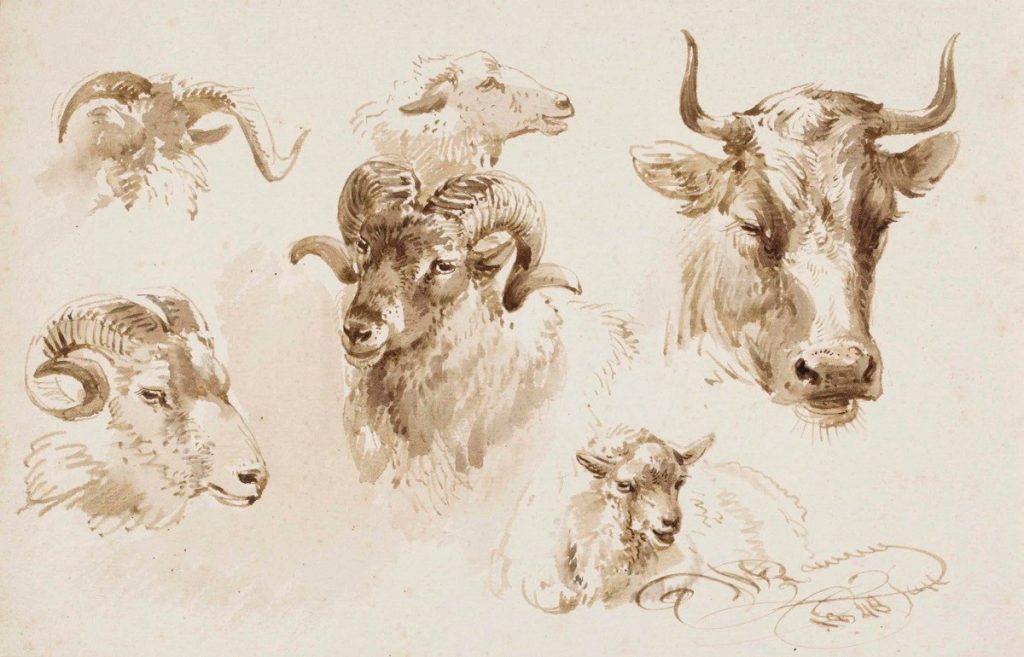
Image credit: Christies.com
The Torah states that kosher mammals are ruminants (those that “chew their cud”) and are cloven-hoofed. Any land mammal that does not have both of these qualities is forbidden. Lev. 11:3; Deut. 14:6. Some of the animal species among those considered to be kosher are antelope, bison, cow, deer, gazelle, giraffe, goat, and sheep.
For birds, the criteria is less clear. While the Torah does not identify characteristics to distinguish permitted and forbidden birds, it enumerates 24 forbidden species of fowl. Lev. 11:13-19; Deut. 14:11-18. All other birds are considered to be kosher. In practice, some traditional Jews eat only those birds which have an established tradition that the species is kosher. In the United States, the only poultry accepted by mainstream kashrut organizations as kosher are chicken, turkey, duck and goose.
The eggs (or other by-products) of non-kosher birds are not kosher. Eggs of kosher fowl that contain a blood spots must be discarded, and therefore eggs should be checked before use.
Slaughter and Blood
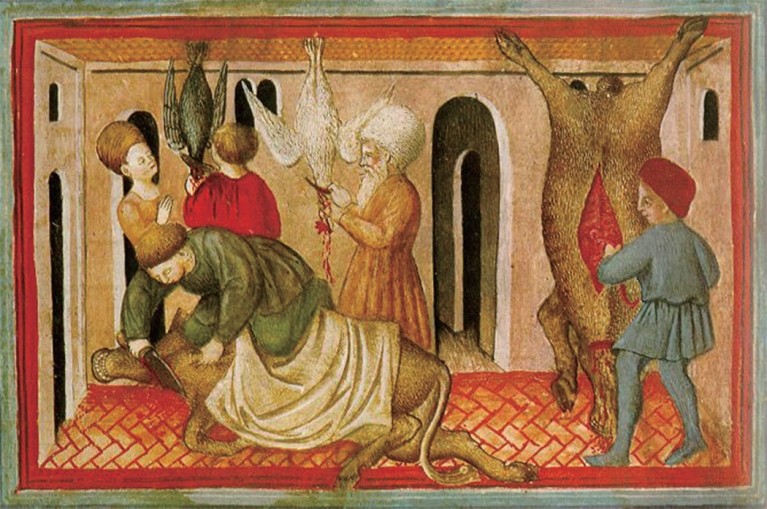
Image credit: wikipedia commons
The Torah requires that meat and poultry be slaughtered in a prescribed manner known as shechita. Deut. 12:21. The trachea and esophagus of the animal are severed with a special razor-sharp, perfectly smooth blade, with the aim of causing instantaneous death with no pain to the animal. Only a trained kosher slaughterer, called a shochet, whose piety and expertise have been attested to by rabbinic authorities, is qualified to slaughter an animal for kosher consumption. If an animal dies or is killed by any other means it is not kosher. Animals that died of natural causes Deut. 14:21 or that were killed by other animals are forbidden. Additionally, it is strictly forbidden to eat flesh removed from an animal while it is alive
After the animal has been properly slaughtered, a trained inspector, or bodek, inspects the internal organs for any physiological abnormalities that may render the animal non-kosher. The lungs, in particular, are examined in order to determine that there are no adhesions, or sirchot. If an adhesion is found, the bodek must further examine it carefully to determine its kosher status. Though not all adhesions render an animal non-kosher, some Jewish communities or individuals only eat meat of an animal that has been found to be free of all adhesions on its lungs. The term “Glatt” literally means “smooth” and indicates that the meat comes from an animal whose lungs have been found to be free of all adhesions. Recently, the term “glatt kosher” is increasingly used more broadly as a generic phrase, implying that the product is kosher without question.
Some blood vessels, nerves and and types of fat are forbidden in kashrut law and must be removed. There are special cutting procedures for beef, veal and lamb known as nikkur, literally “excising” in Hebrew, which must be performed by a specially trained individual.
Additionally, The Torah forbids the consumption of blood. Lev. 7:26-27; Lev. 17:10-14. This is the only dietary law that has a reason specified in Torah: Jews do not eat blood because the life of the animal, its soul, is contained in the blood. This applies only to the blood of birds and mammals, not to fish blood. Thus, it is necessary to remove all blood from the flesh of kosher animals.
The two accepted methods of extracting from meat, a process referred to as “kashering”, are either salting or broiling. According to Jewish law, meat must be kashered within 72 hours after slaughter so as not to allow the blood to congeal. Because meat cooked prior to kashering cannot be made kosher, meat should not be placed in warm water before it has been kashered.
Another means of “kashering” meat is through broiling. Liver may only be kashered through broiling, because of the large amounts of blood in it. Both the liver and meat must first be thoroughly washed to remove all surface blood and then salted on all sides. They are broiled specifically on a designated liver-broiling perforated grate, which draws out the internal blood. When kashering liver, slits must be made in the liver prior to broiling to help ensure that the blood is fully evaporated from the meat. The meat or liver must be broiled on both sides until the outer surface appears to be dry and brown. After broiling, the meat or the liver is rinsed off.
Fish and Seafood
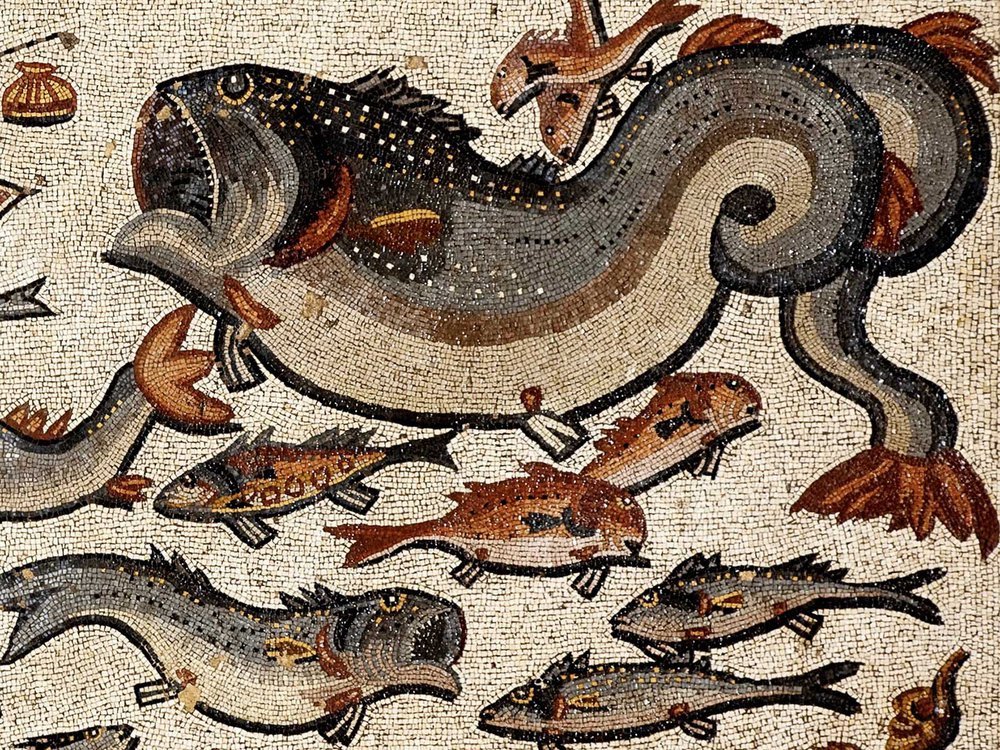
Image credit: Wikimedia Commons
The Torah establishes two criteria to determine which fish are kosher. The fish must have fins and scales. Lev. 11:9; Deut. 14:9. The scales must be easily removable without damaging the skin. Generally, scales on kosher fish are either thin, rounded and smooth-edged (cycloid) or narrow segments that are similar to teeth of a comb (ctenoid). All shellfish, crustaceans, and water mammals are prohibited, as are catfish, sharks, swordfish, and eels.
Unlike meat and poultry, fish requires no special preparation. Nonetheless, the fish scales must be visible to the consumer in order to establish the kosher status of the fish. Therefore, filleted or ground fish should not be purchased unless it has been properly supervised, or the fillet should have a skin tab with scales attached to the flesh.
Some Jews feel that fish and meat may not be eaten together, but they may be consumed as one course after the other, even at the same meal. To avoid eating them together, the dishes or cutlery are washed to clean them between one course and the next. Some rabbinic authorities suggest eating solid food and drinking water or another beverage in between the two to cleanse the mouth.
The eggs (or other by-products) of non-kosher fish are not kosher. Caviar, therefore, must come from a kosher fish and this requires reliable supervision.
Rodents, Reptiles, Amphibians, and Insects
Of the “winged swarming things” (winged insects), a few are specifically permitted. Lev. 11:22. However, rabbinic authorities are no longer certain which ones they are, so all have been forbidden. There are communities that have a tradition about what species are permitted, and in those communities some insects are eaten. Rodents, reptiles, amphibians, and insects (except as mentioned above) are all forbidden. Lev. 11:29-30, 42-43.
Fleishig, Milchig, and Pareve
On three separate occasions, the Torah commands the Jews not to “boil a kid in its mother’s milk.” Ex. 23:19; Ex. 34:26; Deut. 14:21. The Torah forbids cooking meat and milk together in any form, eating such cooked products, or even deriving benefit from them. The Rabbis extended this prohibition to disallow the eating of meat and dairy products at the same meal or preparing them on the same utensils. Furthermore, milk products cannot be consumed after eating meat for a period of time. There are different traditions for how long to wait between meat and dairy, but the most prevalent custom is to wait six hours.
Meat may be eaten following dairy products with the one exception of hard cheese that is aged 6 months or more, which requires the same waiting time as that of dairy after meat. Prior to eating meat after dairy, one must eat a solid food, either drink a liquid or thoroughly rinse one’s mouth, and check the cleanliness of ones hands so as not to combine the two.
All cheeses require kosher certification, including hard and soft cheeses. Rennet, processed from the stomachs of unweaned calves, is often used in the production of hard cheese as a curdling and coagulating agent. Kosher hard cheese is produced with microbial rennet, which is derived from kosher sources. Because hard cheese is typically made with animal rennet, the Rabbinic sages decreed that even when animal rennet is not used, a full-time supervisor must be present to guarantee the kosher integrity of the product. Hard cheese produced with kosher ingredients and a full-time supervisor is known as gevinat yisroel, Jewish cheese.
Rabbinic law requires that there be supervision during the milking process to ensure that the source of the milk is from a kosher animal. Following the opinion of many rabbinic authorities, the Department of Agriculture’s regulations and controls are sufficiently stringent to ensure that only cow’s milk is sold commercially. These government requirements fulfill the Rabbinical requirement for supervision. However, some individuals are more stringent and only consume milk that was produced with full-time supervision. This is known as cholov yisroel: Jewish milk.
Pareve means that the food item does not contain dairy or meat ingredients, and it was not processed with heat on dairy or meat equipment. Pareve foods are neutral and may be eaten with meat or dairy foods. Eggs are pareve, as are all fruits, vegetables and grains. Pareve foods can be mixed with and eaten together with either meat or dairy. Fruits, vegetables and grains are basically always kosher, but must be insect free.
Wine
Wine, more than any other food or drink, represents the holiness and separateness of the Jewish people. It is used for the sanctification of Shabbat and Yom Tov and at Jewish simchot. When the Temple stood, wine was poured upon the altar together with the sacrifice. However, since wine was and still is used in many forms of idolatrous worship, it has a unique status in Jewish law, which places extra restrictions on the making and handling of wine. This includes wine used for non-ceremonial purposes.
All grape juice, grape wines or brandies must be prepared under strict rabbinic supervision. Once fermented, the kosher wine is “cooked” to render it kosher; such products are generally labeled “mevushal”. Yayin mevushal is not considered “sacramental wine” and is therefore not included in the prohibition against being handled by non-Jews.
Grape jam (produced from grape pulp) as well as all varieties of jam and jelly require supervision because they may be processed on non-kosher equipment and may contain non-kosher additives. Grape jelly is produced from grape juice and can be used only when produced from kosher grape juice under proper supervision. Liqueurs require supervision because of the flavorings used in these products, and because the alcohol base may be wine derived.
Bread
It is Rabbinically prohibited to produce bread utilizing dairy ingredients. Since bread is frequently eaten at all meals, the Rabbis were concerned that one might inadvertently eat dairy bread with a meat meal. There are two exceptions – if the bread is baked in an unusual shape or design indicating that it is dairy, or if the loaf is so small that it would be consumed at one meal.
Jewish law requires that a portion of batter or finished baked product be set aside for what is known as “challah”’. While any size portion is adequate for challah, it is customary to separate a portion the size of an olive. After separation, the challah is burned. This ritual is obligatory only when the owner of the dough at the time of its preparation is Jewish, and the dough is made from flour of any of the following five grains: wheat, oats, rye, spelt, and barley.
In addition, there is no requirement to separate challah if the batter contains less than 2-1/2 pounds of flour. If the batter contains at least 5 pounds of flour, a blessing is recited before separating challah. If this mitzvah has not been performed in the bakery, it may be performed in the home by placing all the baked goods in one room, breaking open all sealed packaged material, and taking a small piece from any of the baked goods and burning it.
The prohibition of eating non-Jewish bread applies to home-baked bread, not to bread prepared in a commercial bakery. Nevertheless, it is the custom of many communities to use only pas Yisrael, Jewish bread.
Bishul Yisrael – Jewish Cooking
The prohibition of eating food cooked by a non-Jew applies only if it is a food that cannot be eaten raw, or it is a respectable food, “fit to be served at a king’s table.” If a Jew is involved in any part of the baking or cooking process, the baked or cooked food is permitted. Even foods that do not fall under these categories must contain only kosher ingredients, be prepared on kosher dishes, and comply to all other kosher laws.
Dishes and Utensils
Even a small trace of a non-kosher substance—as little as 1/60th (1.66 percent) of the food’s volume, and in certain cases, even less than that—will render an otherwise kosher food not kosher. By the same token, utensils that come in contact with hot food will absorb its “taste” and subsequently impart it to other food.
It is for this reason that separate utensils are used for meat and milk: even the slightest residue or “taste” of a non-kosher substance will render a food not kosher. So it’s not enough to buy only kosher food. The kitchen, too, must be “kosher,” meaning that all cooking utensils and food preparation surfaces are used exclusively for kosher food, and that separate stoves, pots, cutlery, dishes, counter surfaces and table coverings are used for meat and dairy.
Unless meat is totally excluded from the kitchen, a kosher kitchen must have two different sets of utensils: one for meat and poultry and the other for dairy foods. For washing dishes, it is ideal to have two kitchen sinks, one for meat and the other for dairy. If this is not feasible, and one uses one sink for both meat and dairy, dishes and utensils are washed on a rack, so as not to touch the sink. Separate racks are to be used for meat and dairy use. Care must be taken to make sure that the water should not be allowed to rise to reach the level of the rack, and dishes cannot be soaked in a sink used for both dairy and meat.
A general rule of thumb is that any time hot food comes in contact with another food or a utensil, the food or utensil will absorb its “taste.” Also cold foods and utensils will, under certain circumstances (such as when the food is spicy or salty, is cut with a knife, or sits in the utensil for an extended period of time), transmit their “taste.” So food prepared in a kitchen will invariably become non-kosher as well, unless the embedded taste is first extracted from the utensils in a special koshering process.
Exploring the Deeper Meaning of Kashrut Law
As unified as traditional Jews have been in adhering to the Torah’s dietary distinctions between permitted and forbidden creatures, they have been equally as diverse in explaining the meaning of kashrut. Over the centuries a wide array of explanations has been offered, due in large part to the fact that the Torah, in distinguishing between permitted and forbidden animals, gives no explicit explanation for the rules.
The Theories of Hygiene
The most common motive attributed to the Jewish dietary laws is hygiene. The dietary laws are most often thought of as health measures dictated by the conditions of the ancient world. The hygienic theory is proposed by both ancient and contemporary Judaic and secular scholars and had its greatest popularity at the beginning of this century with the great advances in medical knowledge.
One of the most vocal proponents of the hygienic theory is Maimonides, the more common name of Moses ben Maimon, the celebrated medieval Spanish rabbi, philosopher and physician. Arguing that forbidden foods are unwholesome, Maimonides states:
“I say, then, that to eat any of the various kinds of food that the Law has forbidden us is blameworthy. Among all those forbidden to us, only pork and fat may be imagined not to be harmful. But this is not so, for pork is more humid than is proper and contains much superfluous matter. The major reason why the Law abhors it is its being very dirty and feeding on dirty things. You know to what extent the Law insists upon the need to remove filth out of sight, even in the field and in a military camp, and all the more within cities. Now if swine were used for food, marketplaces and even houses would have been dirtier than latrines, as may be seen at present in the country of the Franks.”
Maimonides
Additionally, Maimonides gives an explanation solely based on hygienic considerations for the prohibition against consuming the sacrificial fat:
“The fat of the intestines is prohibited because it fattens and destroys the abdomen and creates cold and clammy blood.”
Maimonides
Concerning the prohibition against mixing milk and meat, Maimonides states that
“meat boiled in milk is undoubtedly gross food, and makes a person feel overfull.”
Maimonides
Many other scholars share Maimonides’ view that the Jewish dietary laws were essentially a hygienic code. Rabbi Samuel Meir, a medieval Biblical and Talmudic commentator and prominent disciple of the Rashi, declared that
“all cattle, wild beasts, fowl, fish and various kinds of locusts and reptiles which God had forbidden to Israel are indeed loathsome and harmful to the body, and for this reason they are called unclean.”
Rabbi Samuel Meir
Another interpretation comes from Nachmanides, a medieval Spanish commentator, historian, pioneer of Jewish mysticism, states that it is only permissible to eat fish that have fins and scales because
“those without fins and scales usually live in the lower muddy strata which are exceedingly moist and where there is no heat. They breed in musty swamps and eating them can be injurious to health.”
Nachmanides
While various aspects of the Jewish dietary laws support the hygienic theory, a more complete analysis reveals several difficulties. The hygienic theory fails to explain two of the most fundamental aspects of the Jewish dietray laws: ritual slaughter and the prohibiton against consuming blood. With respect to permissible and prohibited animals, it is unproven that all animals declared unclean are harmful to health. To the best of our modern scientific knowledge, there is no reason why camel or rabbit meat (both treif) are any less healthy than cow or goat meat. Conversely, animals deemed kosher can be injurious to health: sheep can transmit tape worm, cows have liver worms, and most of the clean fish in fresh water have tape worms. Additionally, one of the standard certification authorities withhold certification for reasons of health, so it is perfectly possible for kosher slaughterers to fail ordinary sanitary inspections and kosher meat is just as likely to come from factory farms or be loaded with hormones, antibiotics and pesticides as non-kosher meat. So, while observance of dietary laws may well have a secondary positive effect on the heath and longevity of the Jewish people, it is unlikely that hygene is the primary motivation underlying kashrut law.
The Theories of Humane Animal Treatment
Jewish law contains both general commandments to treat animals respectfully and specific regulations of the conditions under which farm animals are to be raised and worked. These laws are binding on Jews today. For example:
- It is prohibited to cause pain to animals. – Tza’ar Ba’alei Chayim – Talmud B.M. 32a.
- A person is required to feed his animals before himself. Deut 11:15.
- Animals are to rest on the Sabbath since work is forbidden. Ex 20:10 and Deut 5:14.
- It is prohibited to sever a limb from a live animal and eat it. Gen 9:4.
- One is obligated to relieve an animal’s suffering. Deut 22:4.
- It is forbidden to kill a cow and her calf on the same day. Lev 22:28.
- An animal threshing corn must not be muzzled. Deut 25:4.
- An ox and donkey must not be harnessed together. Deut 22:10.
From these biblical injunctions flow numerous laws for animal care and relief of animal suffering. Blood sports have always been forbidden to Jews. Jewish teaching only permits the taking of an animal’s life in order to fulfill the human need for food. Kosher slaughtering is often justified as the quickest and most painless way to kill meat animals.
However, rabbinic authorities have not kept the law up-to-date as farming techniques have changed. Kashrut law, at least as interpreted by kosher certification agencies, has no restrictions on modern factory farming. Kosher meat is just as likely as any other meat to come from animals that have been raised in constrained stalls and without access to sunlight or exercise, and fed an entirely processed diet.
Daniel Greenwood, in his piece “Kashrut: Keeping Kosher” succinctly lays out his criticsm of kosher law being a function of humaine treatment of animals in the modern age:
“Moreover, many modern kosher slaughterhouses are fully automated and, arguably, even less humane than their non-kosher competitors. In modern automated slaughterhouses, the animals are suspended upside-down on an assembly line before being killed and butchered. Standard practice in non-kosher slaughterhouses is to stun the animals before lifting them, and then to execute them automatically with a metal bolt that penetrates the skull and brain. Kosher slaughterhouses do not stun the animals, and therefore they are still conscious when lifted. They are then executed by the shochet using the traditional method of slicing an artery in the neck and allowing the blood to drain out as quickly as possible. Presumably, the practice of lifting the animals while still conscious adds a few seconds of extra terror prior to death. Whether these distinctions are material is a difficult question. However, the traditional justification for kosher slaughtering, that it is the quickest and most humane method available, no longer seems correct.”
The Theories of Environmental Ethics
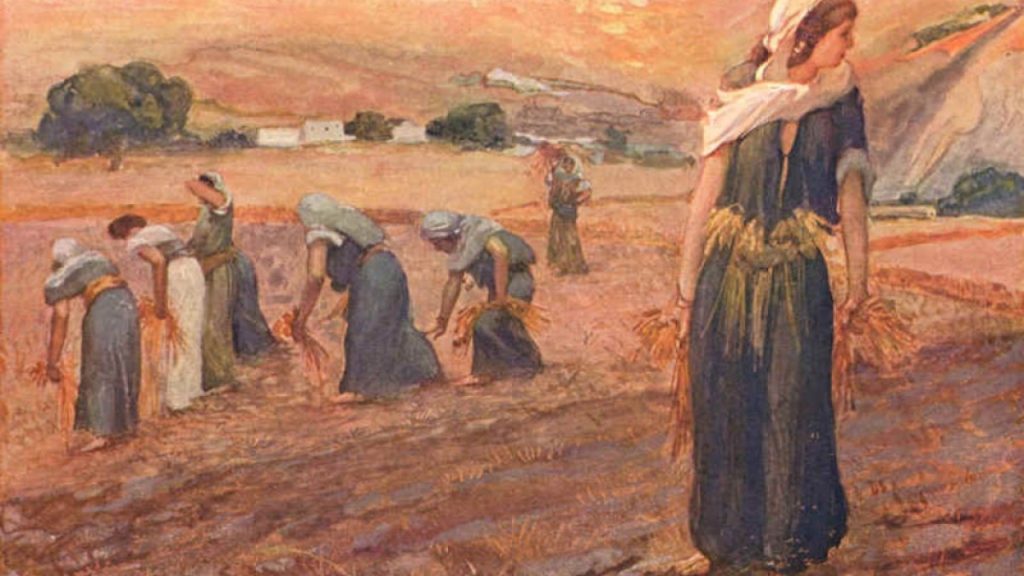
Image credit: The Jewish News of Northern California
There is a classic Midrash from Ecclesiastes that describes the time when God created Adam. God led him around the Garden of Eden and said:
“Look at My works! How beautiful and praiseworthy they are. Everything that I have created, I created for you. Take care not to damage and destroy My world, for if you destroy it, there is no one to repair it after you.”
Midrash Kohelet Rabbah 7:13
Written in a time when no one could imagine destroying the world, this Midrash has now become an unsettling precautionary imperitive. The expression tikkun olam, which is first found in the Mishnah, is the key term for the idea of healing and restoring the world. It means continuing the work that Adam set out to do at creation. Tikkun olam fits perfectly within the context of caring for the environment: when we care for the earth, we are continuing Adam’s work of guarding and keeping the creation, and undoing and repairing some of the damage that fallen man has already inflicted upon it. As Rabbi Arthur O. Waskow beautifully phrases in his article “Eco-Kashrut: Standards for What and How We Eat”:
“In the deepest origins of Jewish life, the most sacred relationship was the relationship with the earth. For shepherds, farmers, orchard-keepers, food was the nexus between adamah, the earth, and its closest relative, adam, the human. So ancient Jews got in touch with God by bringing food to the Temple. With our bodies we affirmed: This food comes from a Unity of which we also are a part: from earth, rain, sun, seed, and our own work. It came from the Unity of Life; so we give back some of it to that great Unity.”
Another of the central commandments that teaches Jews about caring for the earth is the mitzvah of bal tashchit — “you shall not destroy.”
When in your war against a city you have to besiege it a long time in order to capture it, you must not destroy its trees, wielding the ax against them. You may eat of them, but you must not cut them down. Are trees of the field human to withdraw before you into the besieged city?
Only trees that you know do not yield food may be destroyed; you may cut them down for constructing siegeworks against the city that is waging war on you, until it has been reduced.
Deuteronomy 20:19-20
This passage refers specifically to fruiting trees in a time of war, but the sages extracted from it a larger principle that taught against the needless destruction of anything. In early rabbinic law however, the bal tashchit principle is understood to include other forms of senseless damage or waste. For instance, the Babylonian Talmud applies the principle to prevent the wasting of lamp oil, the tearing of clothing, the chopping up of furniture for firewood, or the killing of animals. The logic behind this principle is that if even in a time of war one could not destroy fruit trees, all the more so should one not destroy or waste anything under normal circumstances. However, destruction is condoned when the cause or need is adequate. For example, the law as codified determined that if one could profit more from cutting down a fruit tree and selling its wood than from leaving it standing and harvesting its fruit, this did not count as wasting.
It is permitted to cut down a non-fruit-bearing tree even if the tree itself is not needed. Similarly, an old fruit-bear tree which only produces a small yield and is not worth the effort to maintain can be cut down. And how much olive yield must an olive tree produce for it not to be cut down? A quarter of a Kav of olives. A palm tree which produces a Kav of dates may not be cut down. And not only regarding trees, but even one who destructively breaks vessels or rips up clothing or tears down a building or seals up a spring or wastes food violates the Negative Commandment of “Do not destroy”…
Mishneh Torah, Kings and Wars 6:9-10
In contemporary studies of the ethics of Judaism and ecology, advocates often point to bal tashchit as an environmental principle. Jewish vegetarians will sometimes also point to bal tashchit as one justification for a plant based diet, arguing that eating meat in general is wasteful. And although bal tashchit may be broadly applied to environmental ethics, its limitation in the case where one may profit through a destructive act makes the application of the principle to environmental issues complicated.
Rabbi Aryeh Levin tells a story about going on an afternoon walk with Rabbi Abraham Isaac Kook, the first chief rabbi of modern Israel. Along the way Rabbi Levin casually plucked a branch as they were talking. Rabbi Kook gently rebuked him:
Believe me: In all my days I have taken care never to pluck a blade of grass or flower needlessly, when it had the ability to grow or blossom. You know the teaching of our Sages that there is not a single blade of grass below, here on earth, which does not have a heavenly force above telling it, Grow! Every sprout and leaf of grass says something, conveys some meaning. Every stone whispers some inner, hidden message in the silence. Every creation utters its song.
This article from Scientific American titled “Is Keeping Kosher Good for the Environment?” does the math on the carbon footprint of kashrut.
The Theories of Separation
Another theory maintains that the dietary laws were a means of both symbolizing and maintaining Israel’s status as the chosen people.
The oldest rabbinic interpretation of Leviticus, known as Sifra, offers a simple statement at the start of its commentary on Parashat Kedoshim:
“Be holy” – be separate.
In other words, Jews are to distinguish themselves from foreigners. More important than the symbolic representations of the dietary restrictions was the laws’ operation to effectively prevent Jews from interacting socially with Gentiles. Social interaction almost always involves food and drink. The dietary restrictions prevented Jews from from eating with Gentile neighbors. Jews were essentially placed in social isolation: set apart. Wenham goes on to point out that dietary laws prevented Jews from hiding their Judaism:
Circumcision was a private matter, but the food laws made one’s Jewish faith a public affair. Observance of the food laws was one of the outward marks of a practising Jew, and this in turn enhanced Jewish attachment to them as a reminder of their special status.
However, one might argue that while keeping kosher may well have reminded Israelites of their distinctiveness in the eyes of God, it did little to actually distinguish Israelites from others who lived in Canaan’s central hill country. The diets of Israelites and their neighbors were largely identical. The potential to separate its Jews from others who eat differently only truly manifested during the Hellenistic period that followed Alexander the Great’s conquest of Judea in 332 B.C.E., well after the composition of the Torah.
In fact, rather than endorsing separation when it comes to food, the Torah contains numerous instances in which its patriarchs nonchalantly share meals with foreigners or eat the food that foreigners prepare: in the Torah alone, these include Abram [Gen 14:18], Isaac [Gen 26:30], and Jacob [Gen 31:46-54], as well as Moses, Aaron, and the elders of Israel [Ex 18:12].
It isn’t until the book of Book of Daniel, chronologically the latest work incorporated within the canon, that the protagonist abstains from the food provided by a gentile king, even when that food contains no biblically forbidden meat:
Daniel resolved not to defile himself with the king’s food or the wine he drank, so he sought permission of the chief officer not to defile himself.
Daniel 1:8
Daniel is one of several works composed during the Hellenistic period whose protagonists make a point of not eating gentile food. An expansion to the Book of Esther, the heroine pointedly asserts that she,
…has neither dined at Haman’s table nor drunk the wine of libations.
In the pseudepigraphic Book of Jubilees, written between 160–150 B.C.E., Abraham instructs Jacob,
Separate thyself from the nations, And eat not with them: And do not according to their works, And become not their associate; For their works are unclean, And all their ways are a pollution and an abomination and uncleanness.
[Book of Jubilees 22:16]
These Hellenistic texts express a norm that would have been unrecognizable to the progenitive authors of the Torah. Dietary seperation is not so much adherence to the dietary laws of Leviticus, but rather a desire to separate Jews from gentiles. This movement emerged during the Hellenistic era precisely because it was possible for Jews to effectively become Greek through the adoption of Hellenistic cultural norms, including food practices. The permeability of the border separating the People of Israel from other nations prompted rabbis to invent new food restrictions and reinterpret old ones so as to reinforce a sense of Jewish distinctiveness. Prior to the Hellenistic era, kashrut law did not entail segregating the Israelite community from its rivals.
It can be argued that because keeping kosher is not inherently about seperation, then neither is holiness. Holiness sometimes entails self-segregation, but not always. Rashi seems to recognize this in his commentaries:
“Be holy” – be separate in matters of sexuality and sinfulness.
Where the Sifra explains the instruction as a command to “be separate” in all respects, Rashi limits that interpretation to specific spheres of human behavior.
The Theory of Moral Freedom
Some scholars have proposed that the underlying aim of kashrut is to teach man to master his emotions and desires. The moral freedom theory supports the idea that people who are not bound by law are not free at all. Such individuals are slaves to their own instincts, desires and impulses. Therefore, voluntary submission to the law emancipates man rather than enslaving him.
The moral freedom theory is based on the belief that the constraint of law, in general, is the beginning of human freedom. When the laws in question regulate one of the most fundamental of human desires, the freedom gained is the highest level of personal sovereignty. The craving for food, along with sexual impulses, are probably the most vehement of man’s instincts.
In this view, man’s desire to eat can lead to gluttony, obesity and a general lack of self control in not properly constrained. Kashrut’s goal is to transfigure the instinct for food into self-discipline and restraint. Imposing rules on what can and can’t be eaten ingrains that kind of self control, requiring adherents of kashrut law to learn to control their most basic, primal instincts.
The Theories of Symbolism
Symbolism is extremely prevelant in the scope of Jewish cuisine. In his essay “The Theology of Unclean Food,” Gordon J. Wenham proposes this theory:
The divisions within the animal kingdom express in elaborate symbolism [of] the divisions among men, the most important of these being that between Israel and the Gentiles. The laws reminded Israel what sort of behaviour was expected of her, that she had been chosen to be holy in an unclean world.”
The premise of symbolic theory within Jewish dietary laws is that abstract ideas are not always the best means of influencing human behavior. A visible sign or symbol representing an idea is a better way of influencing the conduct of a people than concepts that are unreflected in any tangible form.
The dietary laws are symbolic of proper conduct and obeying the laws condition man to act in that manner. While many rabbinic scholars adhere to this theory, they often differ on what they believe to be the underlying message of the symbols.
In reguards to unclean meat, Rabbi Samson Raphael Hirsch, 19th century German leader and philosopher, felt that we become what we eat. He stated:
The human body is destined to be the instrument of the soul and to implement its aims of holiness and moral freedom. Hence, the more passive and submissive the body is, the more it will yield to the dictates of the soul as man’s higher nature.
The Torah imposes dietary laws which represent these ideals in order to condition man to be passive and submissive. This is to maximize the adherent’s sensitivity to the impulses of morality.
In Hirsch’s view, fruits and vegetables are all permissible because they are the most passive substances. With respect to animals, those creatures which are herbivorous are certainly more passive than the more aggressive carnivores. Animals that chew their cud and have split hooves, such as the sheep, the goat and the ox, are generally herbivorous and relatively docile and passive. Thus, they are permissible to eat. Carnivores, in general, do not possess the characteristics of kosher animals and may not be eaten. Likewise, birds of prey, which are aggressive and carnivorous, may not be eaten. Nachmanides, the 12th century sage and kabbalist, also speaks to the symbolism at play in kashrut.
The birds and many of the mammals forbidden by the Torah are predators, while the permitted animals are not; we are instructed not to eat those animals, so that we should not absorb these qualities into ourselves.
Philo of Alexandria, a Jewish thinker who lived in Alexandria in the first half of the first century BCE, embraced the symbolic approach to explaining the dietary laws in his treatise De Specialibus Legibus. He explained the requirement that permissible domesticated animals, beasts and fowl be ruminants by stating that chewing the cud symbolizes the effective learning process of repetition and memorization. With respect to the split hoof characteristic, Philo said this symbolized that
The way of life is twofold, one branch leads to vice, [the] other to virtue…
While the symbolic approach to explaining the dietary laws is intriguing, the symbolism discovered seems to be largely dependent on the interpreter’s imagination. Gordon J. Wenham, in “A Theology of Unclean Food”, offers a clear statement on the practice.
Unless greater discipline can be introduced into symbolist interpretation, it will always be more liable to represent the whims of the commentator than the purpose of the law.
The Theories of Mysticism
A final approach to explaining the Jewish dietary laws is the mystical approach, in which the principal purpose of divine laws like kashrut is not to provide a course in moral discipline. Rather, Jewish mystics say the main importance in God’s commandments lies in their effect on the universe as a whole and on man as the center of that universe. With respect to the dietary laws, mystics maintain that prohibited food has a damaging effect on a man’s soul.
Returning to the earlier discussion on the philosophy of observant eating, Jewish mysticism explains a reality called klipah or ‘husk’; this husk conceals the divine spark that gives life to every creature. The husk renders the spark inaccessible, and this is considered evil, as the inherent G‑dliness is trapped in this shell and is unable to express itself or rise to a higher level.
The Hebrew word for forbidden is asur which literally means ‘bound up’. The spark of food that is not kosher is bound to the husk and cannot be elevated. Since the point of eating is to elevate the food, and non-kosher food cannot be elevated, it is forbidden to eat it. Non-kosher foods have a divine spark in them as well, but their G‑dly spark is bound up with the husk and it cannot be elevated through ingestion. This spark remains trapped in the physical without the possibility of ascent.
Additionally, eating non-kosher food results in another problem. The unprocessed spark in the non-kosher food acts like any foreign element in the body. Energy is meant to be metabolized, and this applies to spiritual energy as well. Since the spark cannot be processed by elevation, it causes a spiritual blockage that restricts the ability to relate to holiness.
Isaac ben Moses Arama, a Spanish rabbi and philosopher who settled in Naples after the expulsion of the Jews from Spain in 1492, stated:
“The reason behind all the dietary prohibitions is not that any harm may be caused to the body, but that these foods defile and pollute the soul…
In contrast, mutar, the Hebrew word for permissible, literally means ‘unbound’. The energy of permissible foods is not bound to the klipah and thus can be elevated through having the proper intentions and using the energy for a good purpose.
The mystics maintain that the scope of the dietary laws applies not only the human body, but to the whole human personality. The defilement of the soul resulting from a consumption of forbidden foods is known as tumah, which is derived from the word tamei, the term used to characterize prohibited animals. While tamei is usually translated as “unclean,” mystics feel the translation is misleading because it suggests a physical, material quality when, in fact, twnah is a metaphysical state of being. The mystical theory stresses that the term tamei is used in the Torah not only to describe prohibited food but to also describe moral and religious offences.
The thirteenth century Jewish mysticist, Menahem Recanati, in his book, Taamei Hamitzvot, analyzes the mental make-up of man and tries to show how it is influenced by food. According to him, the human body is an instrument of the soul and the means by which the soul can discharge its task in this world. Because the body is the intermediary between the soul and the world, it matters a great deal whether or not this instrument is a willing servant of the soul. Recanati wrote:
Even as a craftsman cannot do his work without proper tools, so the soul cannot fulfill its task without a coopearting body; and as it makes a great deal of difference for any precision work whether a craftsman possesses fine tools or not, so it is of great importance for the human soul whether the body consists of fine or of coarse material. Ever the light shines the brighter through a good lamp, and the same trees yield different fruit according to the soil in which they are planted.
Recanati maintains that initially all souls are of equal holiness, and the degree of holiness they are able to attain in this world depends largely on the particular body the soul inhabits. Forbidden food makes the body coarse and increases the power of evil inclination, ultimately providing a very poor intermediary between the soul and the outside world. Menahem Recanati summerizes the mystical position as follows:
With all the dietary laws it says ‘Be Holy unto Me’ in order to purify the soul which draws its sustenance from the food in accordance with its refinement and purity.
The Theories of Inexplicable Laws
My rules alone shall you observe, and faithfully follow My laws: I the LORD am your God.
Leviticus 18:4
Commenting on Leviticus 18:4, Rashi distinguishes between two kinds of divine commands: “ordinances,” self-evidently just commands, and “laws,” whose rationale cannot be discerned by the human intellect. The former category includes the commandments that any fair society would institute, such as the prohibitions against murder and theft; the latter category constitutes what Rashi calls “the decrees of a King,” rules no society would think to institute unless the commands came from on high.
My ordinances you shall do – These matters are mentioned in the Torah with regard to justice; were they not mentioned, it would have been worthwhile to mention them.
My laws you shall observe – matters which are a King’s decree. The evil inclination objects to them [saying], “why should we observe them?” Also, the nations of the world object to them. For example, eating pork, wearing forbidden mixtures, and the purification waters [of the red heifer]. Therefore, “I am the LORD” is said, [as if to say,] I have decreed [them] upon you; you may not be exempted.
Rashi’s commentary on the Torah
Leviticus 18:4
What makes the dietary “decrees of the King” so interesting is that by not providing a rationale, Jews of every generation are bound to understand such laws on their own terms: to determine what each might mean to a particular Jew in a particular time and place. At the same, the absence of any rationale reminds Jews that the only response to the “decrees of the King” that prove timeless, applying to all Jews, in all times, and in all places, is the act of obedience on the grounds that “I am the LORD your God.”