I started this week off by winding my plied yarn onto my niddy noddy. I admit this is my least favorite part of the process. Winding onto a niddy noddy is important not just because it creates a skein – there are other ways of doing that – but using a niddy noddy allows me to make a very good estimate of how many yards of yarn I have. Every wrap around it is about 72 inches; if I count how many times I wound my yarn around the niddy noddy, I can multiply it my 72 and now how many inches I have, then divide by 36 to know the yardage.
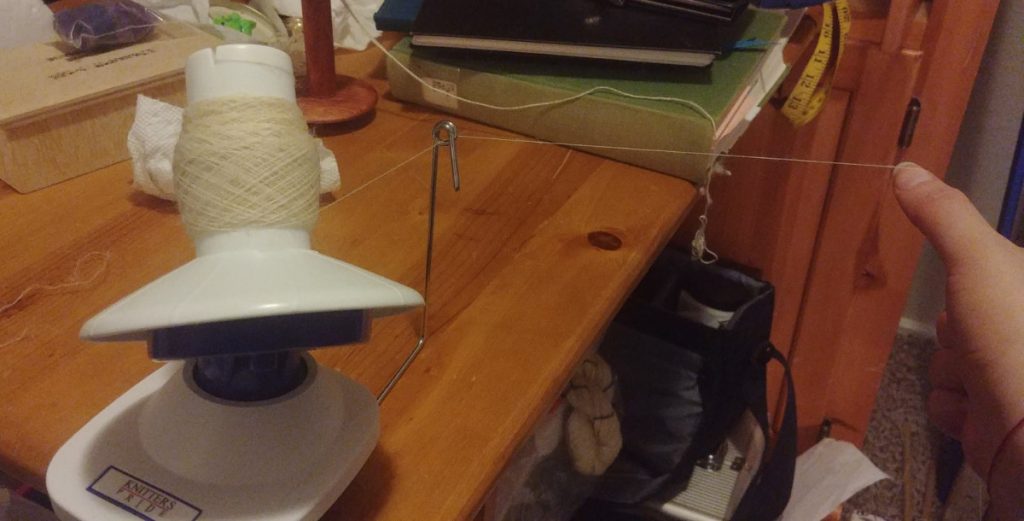
It’s just…very tedious. This last skein was wrapped around nearly 250 times. And I have to count them. It takes a while, as you can imagine. Winding onto the niddy noddy and counting the yardage took me an hour. It’s necessary, but just so very tedious and not particularly fun. Though, I suppose people would finding spinning tedious or doing all of the math not very fun at all, and I do.
I also read a bit. I’m supposed to write a post/essay on natural dyes (that I’m late with doing, sigh) and I also need to figure out with what I’m going to dye my yarn. I’d like to stick with dyestuffs that were used in the Archaic and Classical periods of Greece, but I’ll also probably use some of what I have on hand; I have an old dye bath of cochineal that I’ve been saving and perhaps I’ll use it for this project (dye baths can be saved and reused until the pigment is exhausted). There was a chapter about dye establishments in the book I checked out via Interlibrary loan, but it focused more how to ascertain if an area was possibly a place where large-scale dyeing took place and didn’t talk about the actual dyes themselves. I also read the chapter on dyes from Prehistoric Textiles, which was a bit more helpful.