I have a week 3 post written but the images are not working. I also have Instagram posts embedded in the Image Gallery but they, too, are not working. I’ve sent in a support ticket and hopefully I’ll hear back soon. I’ll put up the week 3 post on Monday night if I don’t hear back or fix it all myself.
Fall 2020 – Week 2 Summary
My life is wool. Not literally, but only barely. I’ve spent most of my time combing wool again last week. This part of the process is taking longer than I had hoped. I might see how much of the fleece I get through this week and start spinning next week even if I’m not done. I don’t actually need all four pounds of the fleece, so spinning and combing at the same time instead of combing all of the wool before spinning may work better.
I started reading Overdressed: The Shockingly High Price of Fast Fashion by Elizabeth L. Cline. I haven’t gotten far into the book, but I’m shocked at some of the statistics I’ve read. It was written in 2010 and it stated that a person in the US will purchase on average 64 pieces of clothing a year. It’s an average and I’d be curious to see the actual data, but still. I thought about how many pieces of clothing I’ve bought this year, including underwear, and it’s maybe 20. Maybe. Half of that number are the tights I wear every day. Granted, my clothing is probably part of fast fashion, though on the pricier side of it as I wear plus sizes. I wonder if Cline will touch upon the plus size fashion industry in regards to fast fashion. If not, I think I’d like to look into it.
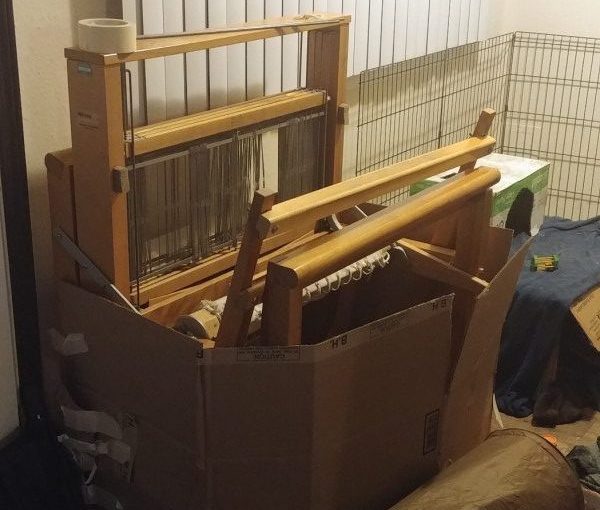
I also picked up the loom I will be using from the Fiber Arts Studio that’s part of the Indigenous Arts campus at Evergreen on Friday. My sister-in-law drove down from Tacoma so I could use her minivan to bring it home and my fiance came with me to help move it. The loom is over 100 pounds and moving it wiped me out for not just the rest of the day but the entire weekend as well. I decided for Saturday and Sunday to separate locks from the fleece but not comb them to give my arms some rest; I have chronic pain in my arms and shoulders that I’m currently going to physical therapy for. It sort of makes you wonder why I decided to do such physically intensive activities for my studies this quarter, to which I can only respond: I have a passion. I don’t always think clearly when it comes to my passions. And while combing wool is tedious, I’m enjoying it. Though I’m going to force myself to read more this week; I have several books waiting for me to go through.
Fall 2020 – Week 1 Summary
The first week of the quarter was an odd one. I wouldn’t be on campus much anyways since I’m doing independent work, but I would still be spending time in the library. It’s strange needing to phone the circulation desk when I need to pick ups books, meeting someone in front of the library building, and never going in or even seeing other people. It’s going to be interesting looking back on this time in few years, to say the least.
Anyways, I spent pretty much all of my time combing wool. I bought a fleece during the summer and washed it before the quarter started; I wanted to take advantage of the summer sun and heat and dry the fleece outside. The apartment I share with my fiance isn’t terribly small, but as it’s filled with books there isn’t much room to leave the fleece to dry where it wouldn’t get in the way (or be put it in danger of being nibbled on by my rabbits).
Combing wool is deceptively hard work. My body aches in ways I was not expecting. My arms hurt from holding the combs and passing the wool between them. My back hurts from sitting and supporting my arms. I’ve made myself bleed a few times, as the tools I’m using are quite sharp. This is not easy work. Yet people used to do this all the time in order to have wool for clothing. Preparing wool for spinning was necessary work.
I’m torn between needing to read and research and needing to work on the fiber side of things. I have a fear that I won’t finish the textile work by the end of the quarter. On the other hand, I can’t just work with fiber the entire time. I need to and want to do research. I suppose my challenge for this quarter will be time management.
Washing Wool
Washing a wool fleece is no easy task, but it’s good to do before you card, comb, or spin from the lock. A fleece fresh off the sheep will feel greasy to the touch; it’s covered in lanolin, which is sort of analogous to sebum. Lanolin keeps the sheep’s skin moisturized and protects it, along with the wool. It’s quite effective, enough that we use it in skincare products and various ointments. Some sheep breeds produce little lanolin, like Navajo-Churro, and others produce quite a bit, like Merino. Along with the lanolin, there may be dirt, vegetable matter (VM), and fecal matter in the fleece as well; it depends on if the sheep was kept covered (known as coating the sheep) until it was sheared and how attentive the owner of the sheep was.
But even if the sheep was coated, you may still want to get the lanolin out, though there are people who prefer to spin wool with the lanolin in, known as spinning in the grease. For my project I do not want the lanolin getting all over my spinning wheel, so washing was a necessity. I’ve never washed a fleece before, so I read a few different articles about it, sifted through Facebook fiber arts groups to see what others did, and watched a couple of YouTube videos. I took all of what I learned and did my best.
An important fact to know is that lanolin melts at 140 degrees Fahrenheit. When trying to get lanolin out of a fleece, the water should be at least this temperature and shouldn’t fall terribly lower than that, otherwise the lanolin will continue to stick to your wool. Many people will have a large pot and wash the fleece on a stove. You also want some sort of cleansing agent such as washing soda, dish detergent, or specialized wool scour. I don’t have a large pot, so I did my washing in a plastic tub I placed in my bathtub. I ran my water as hot as I could and added to it about two quarts of boiling water. If I ever decide to wash my own fleece again, I am definitely investing in a large pot.
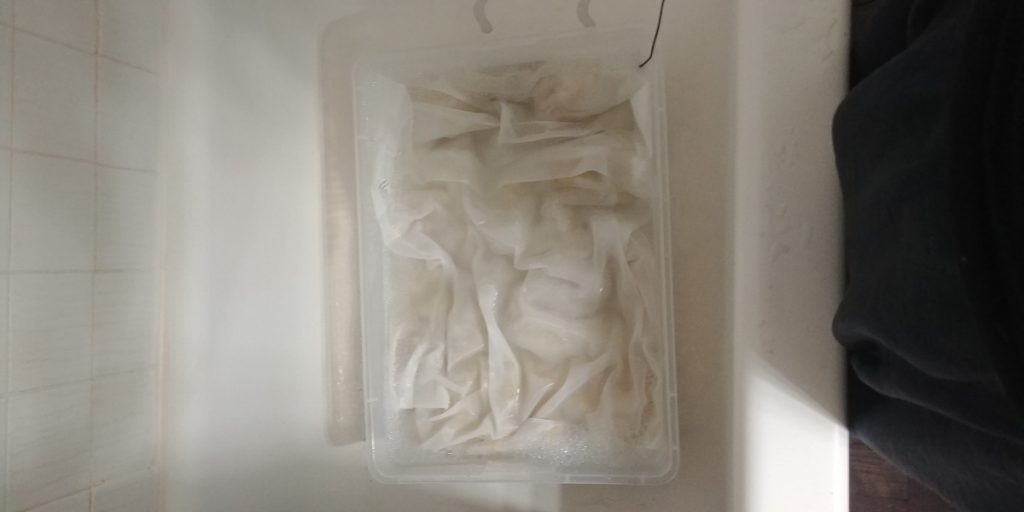
The other important thing to know is that agitating the wool too much in hot soapy water will felt it. I decided to place my wool into a large mesh laundry bag (the kind you would use to wash delicates). This kept the wool together and allowed me to easily move the wool around without actually agitating it much. I could only fit about a pound of wool in the mesh bag, so I did the following process four times over two days.
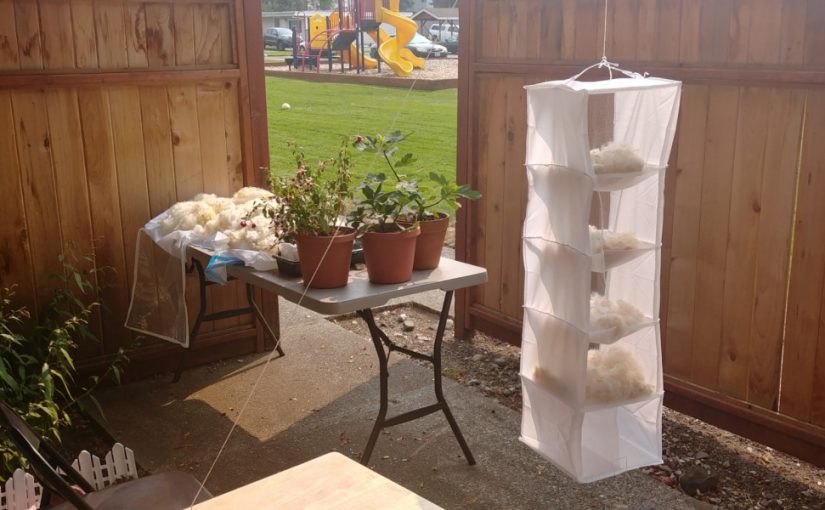
First, I filled my plastic tub with hot water and some Dawn detergent. I then placed the mesh bag full of wool into the tub carefully and let it sit for about 20-30 minutes. I covered the tub with a lid and shut my bathroom door in an attempt to keep the water from cooling too much; I’m not sure if it worked as my thermometer, it turned out, was defective. While the wool was sitting, I boiled more water for the next step, which was to take out the wool, empty the soapy water out of the tub, and replace it with more hot water but no soap. Again, I let it soak for 20-30 minutes. Afterwards, I emptied the tub once again and did my best to squeeze out the excess water from the wool without actually wringing it, which would result in felting. I took the wool outside and let it dry in a vertical storage thing made of fine mesh that you would hang in a closet. I wanted something that would let air circulate. I also placed wool on the table outside. Every half hour or so I would move the wool around so the dampest parts would be exposed to air and sun. Ideally I would have had some sort of setup where the wool could sit on mesh and and be allowed dry without my help.
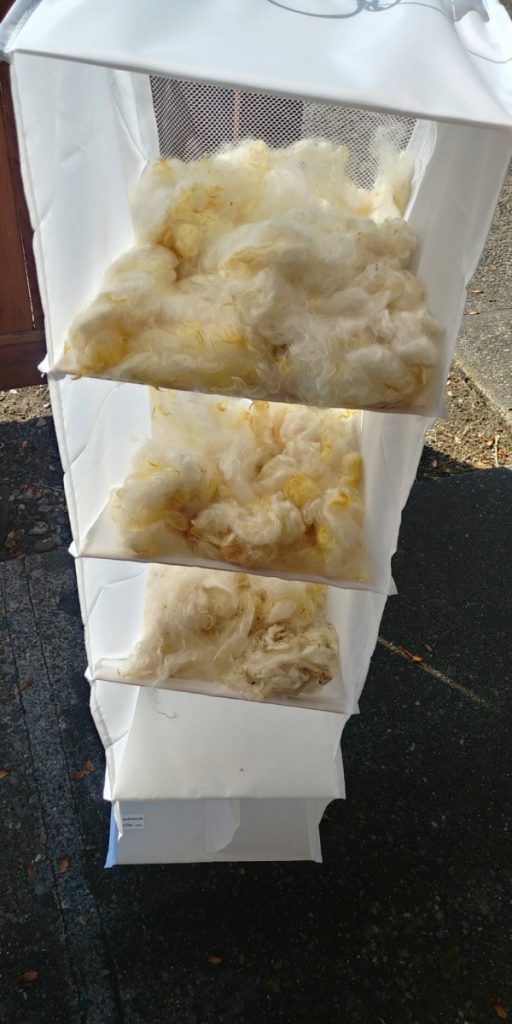
I used quite a bit of water for this and I probably should have used more, as I didn’t get all of the lanolin out. I chose not to wash the fleece again, as it was only a little lanolin and, to be honest, I didn’t want to run back and forth from my kitchen to my bathroom with boiling pots of water again. The fleece cost me $60 plus shipping. I would have liked to buy something local; my plan had been to attend the Oregon Flock and Fiber Festival at the end of September, where many farms have fleeces for sale. The event was cancelled though, due to the pandemic. I did buy the fleece directly from someone who is a fiber artist and raises their own sheep. I even know the name of the sheep my fleece came from: June.
June is a Blue-faced Leicester (BFL) cross, meaning she is a BFL crossed with another cross – California Variegated Mutant (CVM) and Lincoln/Corriedale. Knowing the breeds can be helpful, especially when buying wool without touching it first, because it can tell you the nature of the wool. BFL is very crimped and stretchy with a long staple (staple is the length of the fiber). It’s also very lustrous. CVM also has a long staple, and both breeds have a low micron count. Micron count is the average width of a single fiber. Anything under 28 or so microns is usually considered soft enough for next–to-skin application; micron counts of over 35 or so are usually too prickly to be next to to the skin. All of this information is important to me. The chiton I plan on weaving is going to touch my skin, but it needs to be not so delicate that it can’t withstand wear and tear; the micron count of the breeds I mentioned are around 21-28 and are usually in the higher range; this means it will be soft but not as delicate as, say, Merino. The long staple will give my yarn strength, enough to withstand being under tension on a loom. It will also be beautiful when dyed due to the luster.
Ekarius, Carol, and Deborah Robson. 2011. The Fleece and Fiber Sourcebook. Storey Publishing.