Week seven continued to be filled with mostly spinning and some combing of wool. I didn’t have much energy to do more than that this week (or the week before, or the following week) to be honest. There’s nothing like having health problems interfering with your ability to function, no?
But spinning is a low energy activity that doesn’t involve too much thought in the actual physicality of it. Though, I suppose that isn’t 100% true; it’s just that I’ve been spinning long enough that it’s mostly second nature to me. The only part that is difficult is drafting the wool: drawing out an amount of fiber for twist to enter into, which transforms the fiber from roving to yarn. Drafting on a spinning wheel is a little different than drafting on a spindle, and I have a lot of little neps (little balls of wool made of very short fibers that have squished together). They’re quite small and if I was spinning a thicker yarn they wouldn’t be an issue, but I’m spinning a quite fine yarn, so when they get drafted in, they become rather obvious. I either have to carefully pull them out if they make it into my yarn, or catch them in the roving and pull the out before they’re drafted in. It’s annoying and it’s shown me that I should have combed my wool more. I usually did about four passes with the combs and I know I was careful, so the neps aren’t from me tearing the fiber. I just didn’t comb enough. At least I know this for the rest of the fleece that I still have to comb.
The little white spot between my fingers is a nep. It’s a small nep to be sure, but it’s still the bane of my existence.
I checked out another book from the library: Ariadne’s Threads: The Construction and Significance of Clothes in the Aegean Bronze Age by Bernice R. Jones. While the garment I’m creating isn’t covered in this book – the chiton was probably a foreign garment adopted in the Bronze Age but started being worn by Athenian women in the Archaic period (about 8th to 5th centuries BCE) – the author is doing something similar to what I’m doing, just on a much larger scale and with much more research. The author is also using modern materials, though they do not state if they’re using modern methods. At least, I couldn’t find any place in the book where they discussed their methods for creating their garments. I want to assume they did it by hand because that makes the most sense to me, but it’s never a good idea to assume. It seems odd to engage in experimental archaeology and use a sewing machine. All of this has really gotten me thinking; I sort of wish I had time to construct my own warp-weighted loom, the kind that would have been used in ancient Greece, and taught myself how to use it. I love the idea of recreating textiles to the best of our abilities in order to understand ancient garments, but I feel making the fabric for those garments is half of the story.
Ariadne’s Threads goes over the garments of the Minoan civilization of Bronze Age Crete. I have to admit, if this book was more specific on patterns I would have become more inclined to teach myself how to sew. Minoan clothing has always looked so comfy yet elegant to me.
{5675634:WWVGYBCP}defaultascno163
Lee, Mireille M. 2015. Body, Dress, and Identity in Ancient Greece. Cambridge University Press.
I spent most of this week spinning and reading the book Women’s Work: The First 20,000 Years – Women, Cloth, and Society in Early Times. I found the book interesting in how it focused on how fiber arts shaped gender roles and culture. It didn’t focus on any specific place in the world, it mostly covered all over Europe. The author also has the hypothesis that weaving is such an intricate and complex idea that it may have only been invented once and was spread throughout the globe, which I find very limiting and something from a western mindset. But, I could be wrong. The author is held in high regard in the textile archeology community it seems. But it never hurts to question, no?
An interesting book, but I feel that the author went on some odd tangents.
I should have read more. I have a book from the library, Greek and Roman Dress From A To Z, that would go well with the other book I have about ancient Greek clothing: Body, Dress and Identity in Ancient Greece. Week 5 and 6 have been some of the hardest weeks this year in my personal life. I ended up escaping from my anxiety and stress by spinning, which at least is still a school activity.
I have a week 3 post written but the images are not working. I also have Instagram posts embedded in the Image Gallery but they, too, are not working. I’ve sent in a support ticket and hopefully I’ll hear back soon. I’ll put up the week 3 post on Monday night if I don’t hear back or fix it all myself.
Washing a wool fleece is no easy task, but it’s good to do before you card, comb, or spin from the lock. A fleece fresh off the sheep will feel greasy to the touch; it’s covered in lanolin, which is sort of analogous to sebum. Lanolin keeps the sheep’s skin moisturized and protects it, along with the wool. It’s quite effective, enough that we use it in skincare products and various ointments. Some sheep breeds produce little lanolin, like Navajo-Churro, and others produce quite a bit, like Merino. Along with the lanolin, there may be dirt, vegetable matter (VM), and fecal matter in the fleece as well; it depends on if the sheep was kept covered (known as coating the sheep) until it was sheared and how attentive the owner of the sheep was.
But even if the sheep was coated, you may still want to get the lanolin out, though there are people who prefer to spin wool with the lanolin in, known as spinning in the grease. For my project I do not want the lanolin getting all over my spinning wheel, so washing was a necessity. I’ve never washed a fleece before, so I read a few different articles about it, sifted through Facebook fiber arts groups to see what others did, and watched a couple of YouTube videos. I took all of what I learned and did my best.
An important fact to know is that lanolin melts at 140 degrees Fahrenheit. When trying to get lanolin out of a fleece, the water should be at least this temperature and shouldn’t fall terribly lower than that, otherwise the lanolin will continue to stick to your wool. Many people will have a large pot and wash the fleece on a stove. You also want some sort of cleansing agent such as washing soda, dish detergent, or specialized wool scour. I don’t have a large pot, so I did my washing in a plastic tub I placed in my bathtub. I ran my water as hot as I could and added to it about two quarts of boiling water. If I ever decide to wash my own fleece again, I am definitely investing in a large pot.
The other important thing to know is that agitating the wool too much in hot soapy water will felt it. I decided to place my wool into a large mesh laundry bag (the kind you would use to wash delicates). This kept the wool together and allowed me to easily move the wool around without actually agitating it much. I could only fit about a pound of wool in the mesh bag, so I did the following process four times over two days.
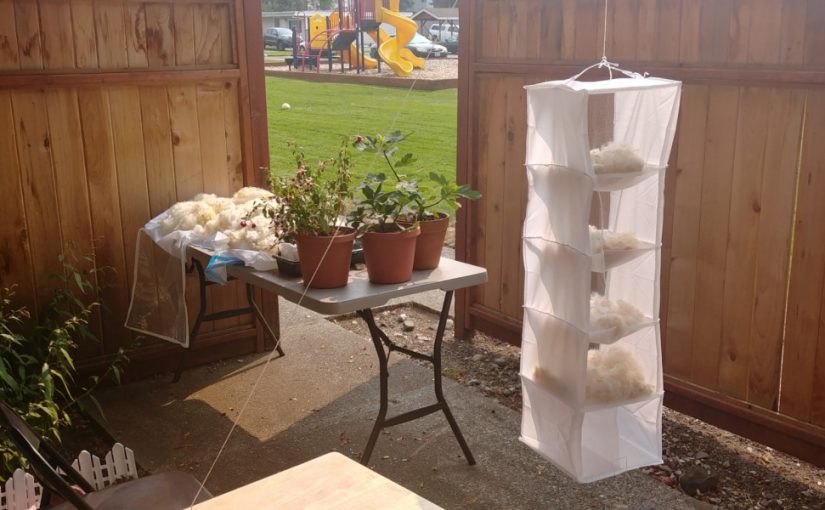
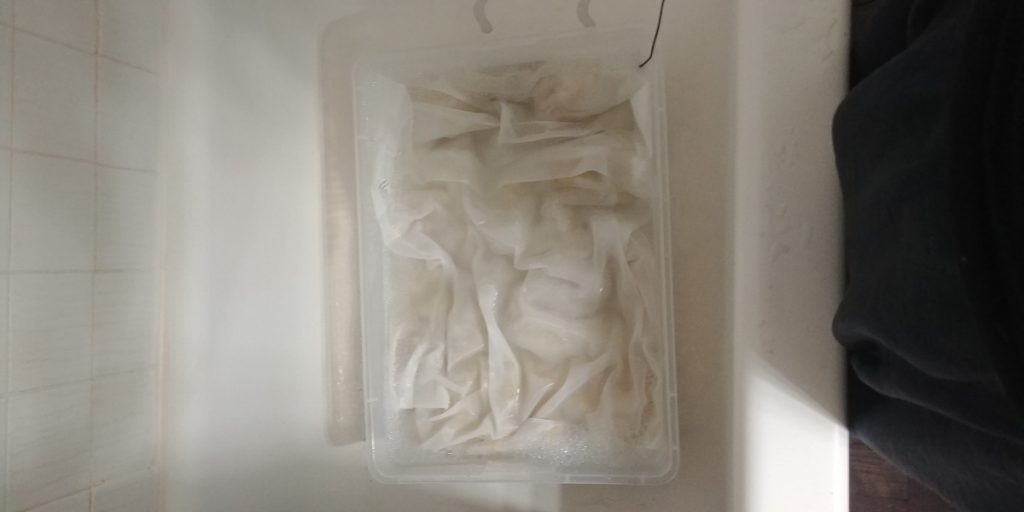
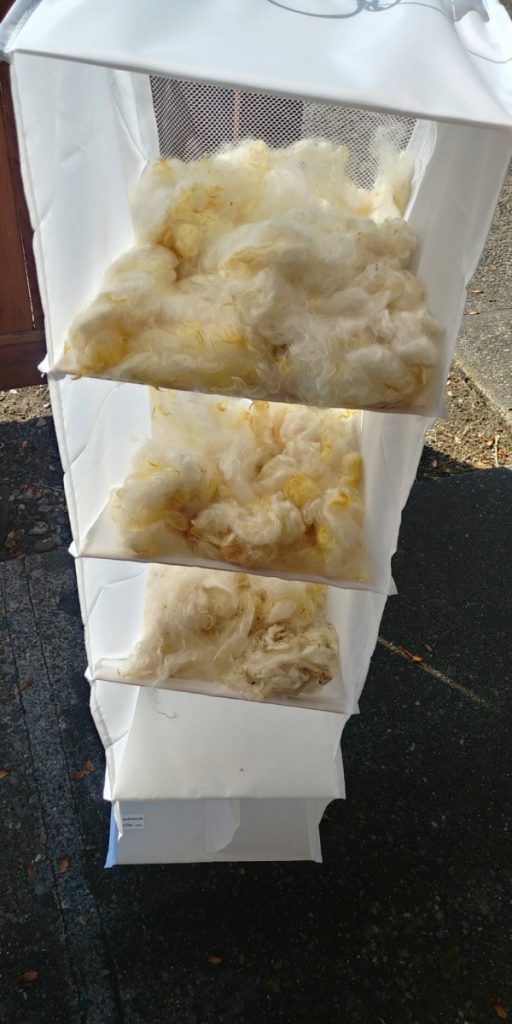
First, I filled my plastic tub with hot water and some Dawn detergent. I then placed the mesh bag full of wool into the tub carefully and let it sit for about 20-30 minutes. I covered the tub with a lid and shut my bathroom door in an attempt to keep the water from cooling too much; I’m not sure if it worked as my thermometer, it turned out, was defective. While the wool was sitting, I boiled more water for the next step, which was to take out the wool, empty the soapy water out of the tub, and replace it with more hot water but no soap. Again, I let it soak for 20-30 minutes. Afterwards, I emptied the tub once again and did my best to squeeze out the excess water from the wool without actually wringing it, which would result in felting. I took the wool outside and let it dry in a vertical storage thing made of fine mesh that you would hang in a closet. I wanted something that would let air circulate. I also placed wool on the table outside. Every half hour or so I would move the wool around so the dampest parts would be exposed to air and sun. Ideally I would have had some sort of setup where the wool could sit on mesh and and be allowed dry without my help.
Here is the mesh bag filled with wool in soapy water.Freshly washed wool drying in the sun and 90F heat.
I used quite a bit of water for this and I probably should have used more, as I didn’t get all of the lanolin out. I chose not to wash the fleece again, as it was only a little lanolin and, to be honest, I didn’t want to run back and forth from my kitchen to my bathroom with boiling pots of water again. The fleece cost me $60 plus shipping. I would have liked to buy something local; my plan had been to attend the Oregon Flock and Fiber Festival at the end of September, where many farms have fleeces for sale. The event was cancelled though, due to the pandemic. I did buy the fleece directly from someone who is a fiber artist and raises their own sheep. I even know the name of the sheep my fleece came from: June.
June is a Blue-faced Leicester (BFL) cross, meaning she is a BFL crossed with another cross – California Variegated Mutant (CVM) and Lincoln/Corriedale. Knowing the breeds can be helpful, especially when buying wool without touching it first, because it can tell you the nature of the wool. BFL is very crimped and stretchy with a long staple (staple is the length of the fiber). It’s also very lustrous. CVM also has a long staple, and both breeds have a low micron count. Micron count is the average width of a single fiber. Anything under 28 or so microns is usually considered soft enough for next–to-skin application; micron counts of over 35 or so are usually too prickly to be next to to the skin. All of this information is important to me. The chiton I plan on weaving is going to touch my skin, but it needs to be not so delicate that it can’t withstand wear and tear; the micron count of the breeds I mentioned are around 21-28 and are usually in the higher range; this means it will be soft but not as delicate as, say, Merino. The long staple will give my yarn strength, enough to withstand being under tension on a loom. It will also be beautiful when dyed due to the luster.