I read a lot this week. I finished up Greek and Roman Dress From A to Z by Liza Cleland, Glenys Davies, and Lloyd Llewellyn-Jones and found Cleland’s dissertation online to read as well. The title is Colorin Ancient Greek Clothing, which was able to tell me more about what would have been used as dye. There’s several useful tables on possible and confirmed sources of natural dyestuffs that I found fascinating; I had been considering researching the native flora of Greece to look for anything that could be dyed with – but someone else did it for me! Dyestuffs that had definitely been used for dye and had a word for it in ancient Greek were specified. Most, like madder and kermes weren’t surprising, but I learned a couple of new ones such as turnsole, Chrozophora tinctoria, and orchil, Roccella tinctoria.
Though I didn’t know it at the time, I finished spinning up the last skein of yarn that I’ll complete for this project. I still haven’t calculated the yardage, but it should be at least 400 yards. That means I spun more than 1700 yards, which is enough for the weft but not the warp. I’ve run out of time to spin yarn and I’ve come to accept this. I’ll have to buy the rest, but the fact that I spun at least the weft yarn myself is pretty amazing to be honest. I’ve learned that this is not easy work. It is not quick work. Making fabric by hand takes time and pain. Spinning for hours every day is exhausting; my legs are constantly treadling and my hands are constantly moving and making repetitive movements. My back would hurt and it was painful to move afterwards. And even after all of those hours of treadling and moving and hunching over my spinning wheel, I still didn’t spin enough for a single garment. The cost of this chiton in labor hours alone is enormous, and though I know most modern yarn and fabric is created with machine, I still wonder how in the world can people buy a dress for thirty dollars?
I started to catch up my weekly posts in week seven. My depression has not done me any favors in terms of school work, but I started getting treatment again for it this week (side note: it’s helping!). I realize it may be weird to discussion my mental health issues in my ePortfolio, but I believe it’s relevant to how I approach my work, and I also try to be very open about this subject in order to alleviate the stigma around mental health.
Anyways, I did some more spinning and reading. I got lost down a bit of a rabbit hole in Prehistoric Textiles about weaving patterns and textile motifs possibly being the inspiration for many of the patterns painted on pottery. It did hurt my head a little, but I love that people have actually studied such niche things (the author, Barber, was talking about how the patterns that were perhaps woven onto Minoan textiles were used for decorating the walls of ancient Egyptian tombs). I’m unsure if I’ll weave any patterns onto my chiton – it’s going to be a whole ordeal warping the floor loom, as I’ve never done that before.
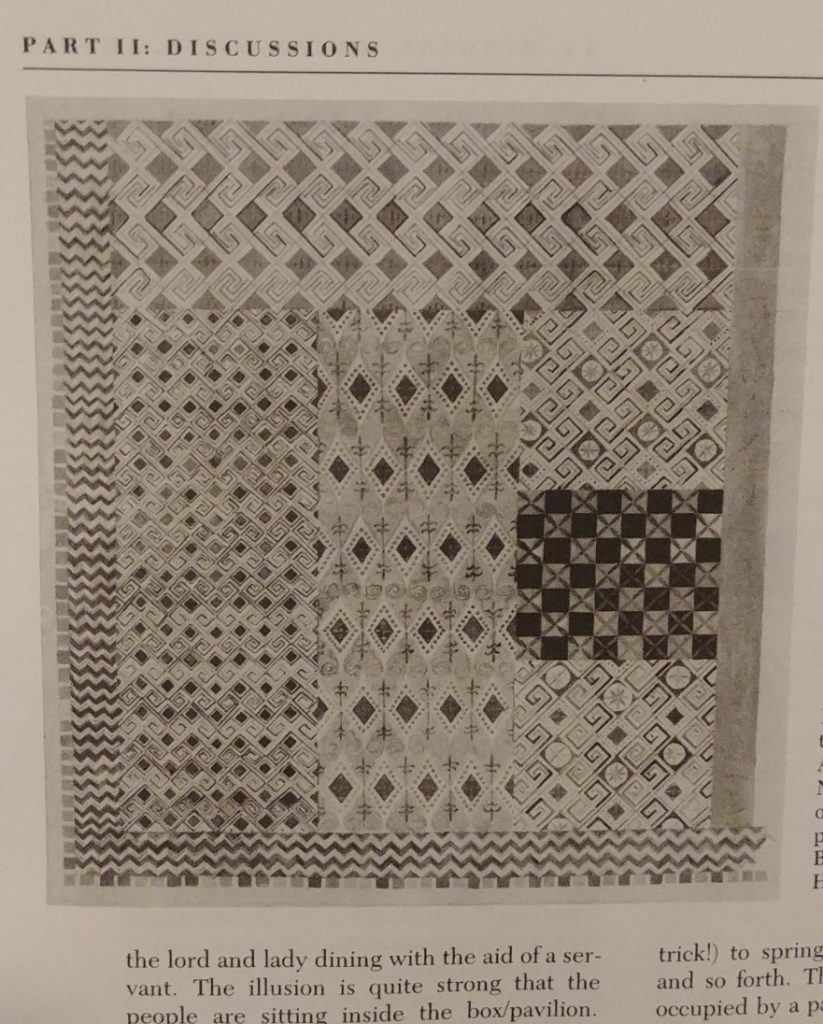
This is part of the ceiling in a 12th Dynasty in Asyut, Egypt; it dates to the early 2nd millennium BCE. In the book that this is in, Prehistoric Textiles, the author discussed how the designs in this and other contemporary Egyptian tombs have similar motifs painted on the murals inside, and that these designs can be found in ancient Minoan frescoes. The designs were mostly likely used on textiles as well as murals and pottery.
I also read the majority of Greek and Roman Dress From A To Z. Though, saying I “read” the whole thing is slightly misleading: I skimmed it for any and all words dealing with color and dyeing and took notes on those parts. It was interesting and it led to me to look into the etymology for indikòn, the Greek word for indigo. I wanted to know in what period did indigo started being used in ancient Greece, and I figured that if I could find out the earliest usage of the word indikòn, that might give me a good idea (or at least allow me to make an educated guess). Spoiler: the earliest usage was the first century CE, so the earliest period was probably the Hellenistic period, which is a bit later than the periods I’ve been trying to limit myself to studying. I’m so grateful for having friends who have degrees in Classics – without them I wouldn’t have been able to figure this out on my own.
This is also the week where I started noticing how much by body ached from spinning so much. My legs are constantly treadling my spinning wheel. Even though the treadling isn’t as intensive as being on an exercise bike, over time the repeated use of the same muscles day in and day out takes a toll. Luckily, I can take a break for a few days but I wonder about people in the past who couldn’t take a break, who needed to spin every day otherwise there would be no clothes or linens. I wonder about how much they ached or if they became used to it after a while. Perhaps, as they probably started spinning in childhood, they never ached all that much. I do not know and I wish I had a time machine so I could ask the spinners of the past myself.
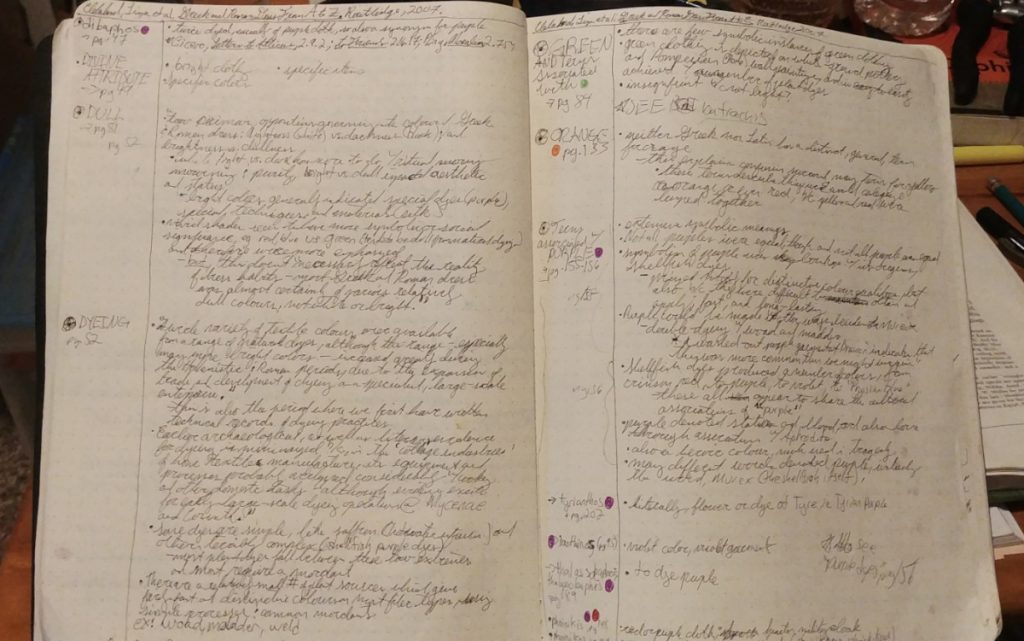
This is random, but I wanted to share my notes. Most of the time I take reading is writing these notes. I’ve filled half of my notebook with notes like these. I kind of have to – there’s just so much information.
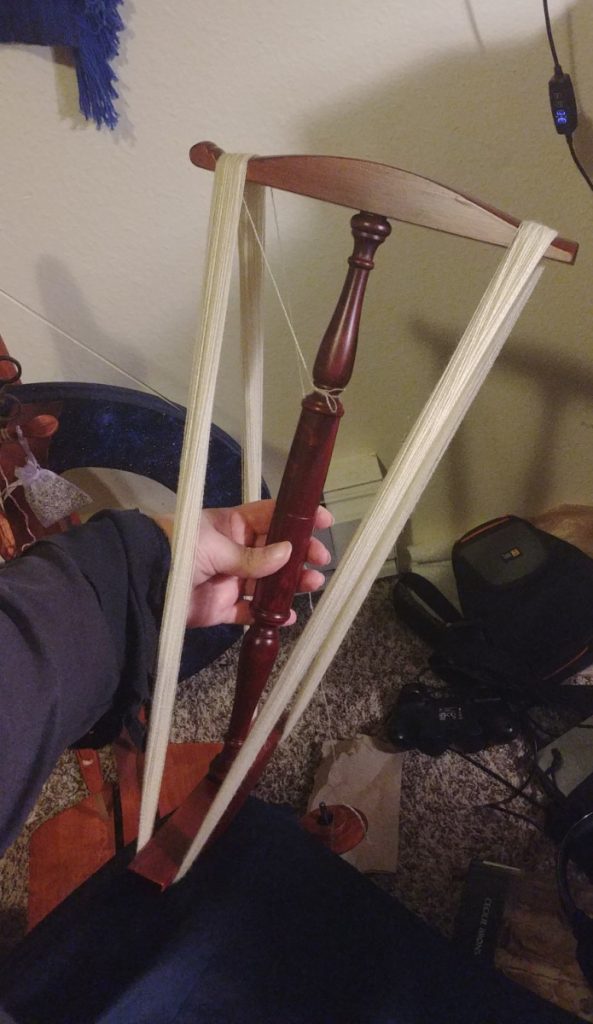
I started this week off by winding my plied yarn onto my niddy noddy. I admit this is my least favorite part of the process. Winding onto a niddy noddy is important not just because it creates a skein – there are other ways of doing that – but using a niddy noddy allows me to make a very good estimate of how many yards of yarn I have. Every wrap around it is about 72 inches; if I count how many times I wound my yarn around the niddy noddy, I can multiply it my 72 and now how many inches I have, then divide by 36 to know the yardage.
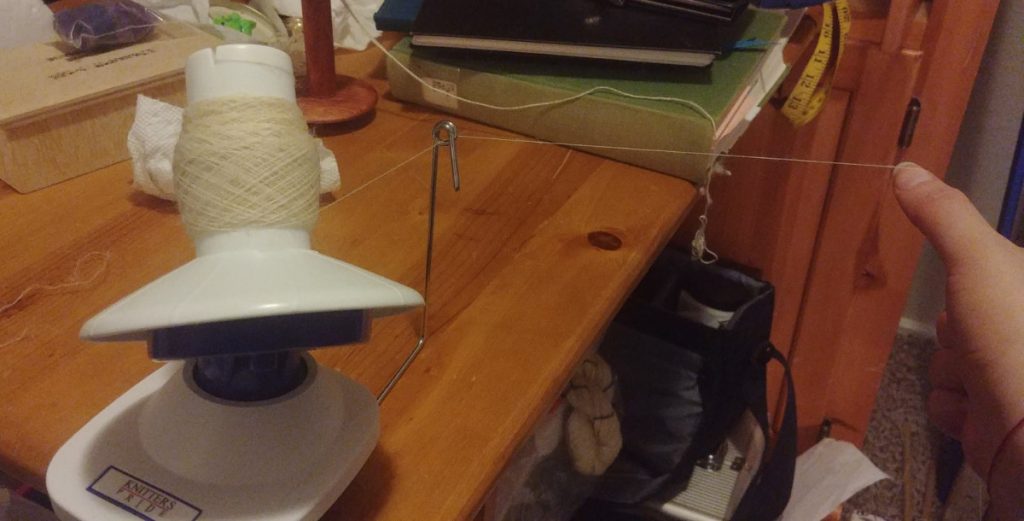
I didn’t do this step this week, but I thought I’d share. This is the first step for me in plying yarn: creating a center-pull yarn ball. On the edge of the ball winder is a handle that I turn to wind the yarn single onto the contraption (unfortunately the handle didn’t make it into the photo). The upper platform spins on a tilt, which allows the yarn single to wind on in an even and orderly fashion. When all of the yarn single is wound on, I’ll have the end that I’ll be holding, but I’ll also have the other end sticking out of the center of the ball. By pulling from the center end and unwinding from the outer end, I can ply my yarn onto itself. Just doing this step takes me 45 minutes to an hour.
It’s just…very tedious. This last skein was wrapped around nearly 250 times. And I have to count them. It takes a while, as you can imagine. Winding onto the niddy noddy and counting the yardage took me an hour. It’s necessary, but just so very tedious and not particularly fun. Though, I suppose people would finding spinning tedious or doing all of the math not very fun at all, and I do.
I also read a bit. I’m supposed to write a post/essay on natural dyes (that I’m late with doing, sigh) and I also need to figure out with what I’m going to dye my yarn. I’d like to stick with dyestuffs that were used in the Archaic and Classical periods of Greece, but I’ll also probably use some of what I have on hand; I have an old dye bath of cochineal that I’ve been saving and perhaps I’ll use it for this project (dye baths can be saved and reused until the pigment is exhausted). There was a chapter about dye establishments in the book I checked out via Interlibrary loan, but it focused more how to ascertain if an area was possibly a place where large-scale dyeing took place and didn’t talk about the actual dyes themselves. I also read the chapter on dyes from Prehistoric Textiles, which was a bit more helpful.
In week five I did a random assortment of things. I, of course, spun. I finished up another half-bobbin and plied it together. I never paid attention, but after logging my hours I realized it took me six hours to ply. It never seems like it’s that long and for some reason my brain never sees plying as a large endeavor, but it really is. Not only do I have to wind nearly 1,000 yards of yarn into a center-pull ball, I also have to spin the two ends the ball creates together; controlling the tension of each string and keeping a consistent amount of twist for all of it. It’s kind of intense and not nearly as relaxing as just spinning. But, plying makes the yarn stronger, which is important for warp.
I also spoke a bit about my work in a class my sponsor, Dr. Sarah Williams, teaches. I was pleasantly surprised that people found what I’m doing fascinating. I mean, I find it all terribly interesting, but that’s me. The purpose of me speaking was to help inspire her students for their own individual projects and I hope that I did indeed inspire.
I also received my Murex care package! Inside are Murex shells, dried glands, dyed fiber and fabric samples, and some of the pigment itself. I could use it to dye the smallest bit of yarn…but I kind of just want to keep it as a curiosity- how many people have Murex dye? The person who sent it, Mohammed Ghassen Nouira (here is an article about him and his work and here is the Facebook group where he shares his ongoing dye experiments) also sent me extra dyed wool fiber so I can spin it. It’s not a great amount, but it’s enough to create an adequate amount of embroidery floss. I’m not sure what I’ll use it for, but it will be for something very special.
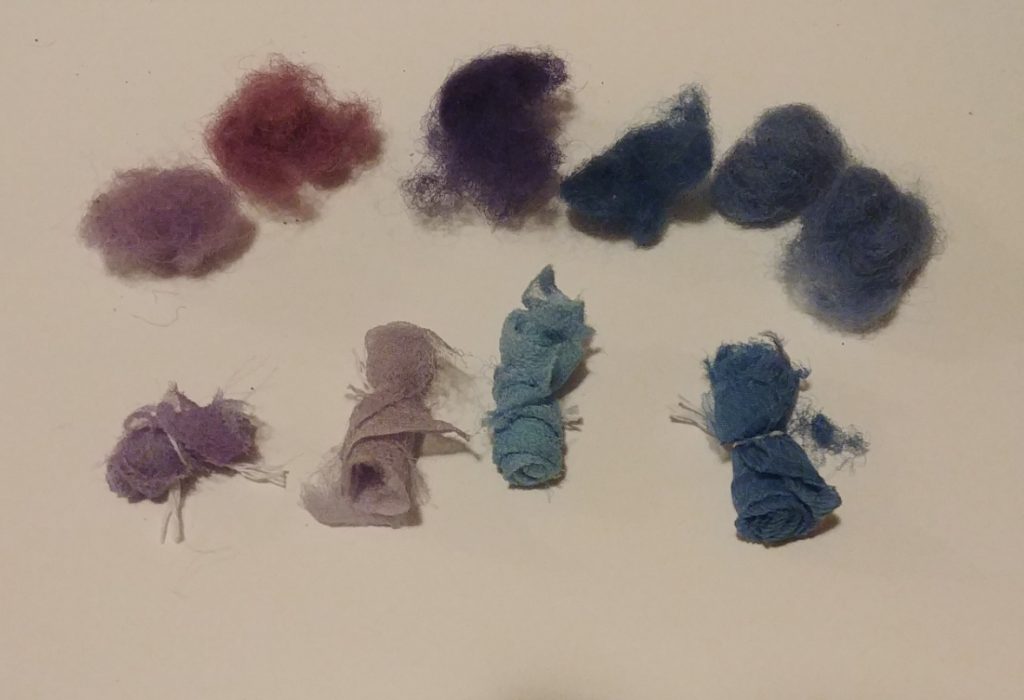
There is a lot going on here. The three shells are Murex shells, You can also see inside the box the fiber and fabric samples. In the front on the left are the dried glands that are the source of the purple dye, and on the right in the glass jar is the smallest amount of the pigment itself.So many colors! The range of colors are all produced from Murex dye. It all depends on how you process it.
I’ve once again fallen behind on my weekly posts. I think living through a pandemic is finally catch up to me and my mental health is taking a hit. It’s hard to focus on school when the world is…well, what it is right now. Nevertheless, I will do my best to get things done in regards to school. It’s also difficult to complete these posts because what I have spent most of my time for the last two weeks doing is spinning. Looking back at my log, for week four I spent over twenty hours spinning and less than seven hours doing non-fiber related things. Of course, I can talk about what I did in those seven hours, but I’m unsure what else I can talk about when it comes to spinning (except for the random trains of thought I have when spinning. Spinning gives you time to think). Or perhaps I’m being very negative right now because of depression.
In week four, I caught up with updating this ePortfolio with my weekly summaries for weeks two and three. I hadn’t realized I had fallen behind; it’s hard for me to keep track of time these days. It was good to get that done. I was also finally able to pick up the library book I requested through Interlibrary Loan! That was exciting.
The book that I jumped through so many hoops to attain: Archéologie des textiles : des origines au Ve siècle : actes du colloque de Lattes, octobre 1999
Hilariously, the chapter I wanted to read wasn’t quite what I thought it was, but it was still utterly interesting to me. The chapter, “Women’s Work: Spinning and Weaving in the Greek Home,” by K. Carr talked about the logistics of how much cloth a family could produce in one year if only the women in the household were doing the work. It also discussed a bit on how women were viewed in Greek society; it was almost as if they were dangerous and liminal creatures who needed to be watched at all times and kept very busy. The ideal of femininity was a woman who was industrious and skilled in spinning and weaving…except that it could be argued that those activities were also “dangerous”. There are at least a couple of instances in Greek mythology and lore where a woven textile was a dangerous weapon, and spinning was associated with the Moirai – the Fates, which suggests that spinning, in some subconscious way, was not seen as just a harmless activity.
This is a painting by John Melhuish Strudwick titled A Golden Thread from 1885. It depicts the Morai – the Fates, a trio of goddesses that determine the length of each person’s life. The figure on the left is Clotho, “the Spinner”, who spins the thread of life; on the right is Lachesis, “the Alloter”, who measures the length of each life; and in the center is Atropos, “She Who Cannot Be Turned”, who cuts each thread, and therefore life, short. There doesn’t seem to be many ancient depictions of them, which makes sense to me. All beings – including the gods themselves – were subject to the Moirai, and that’s just a bit terrifying. Source of photo is Wikipedia
Also, in preparation of starting research into natural dyes that were used in Archaic and Classical Greece, I contacted the owner of a Facebook group who has spent twelve years researching and experimenting with the pigment found in Murex sea snails (though the main species of snails used for dye are no longer categorized in the genus Murex anymore, they are still in the Murex family). The glands of snails in the Murex family are the source of the famous Tyrian, or Phoenician, purple dye used in ancient times, but there is evidence that Murex has been used for purple dye in the Aegean since the time of the Minoans . Anyways, the person sells kits comprised of two or three shells, a dried gland, some small samples of fiber and fabric he’s dyed, and some of the pigment itself. The pigment is expensive – a company, Kremer, sells it for about $2,600 a gram. The person I talked to sells it for about half. I only bought the tiniest of amounts – 0.2 grams – mostly just to have it and share it here! I wasn’t planning to spend much time devoted to Murex purple – I’m more interested in dyes that the average person could obtain – but I also couldn’t pass up actually having samples of the stuff for my very own.
Militello, Pietro. 2007. “Textile Production and Minoan Palaces.” In Ancient Textiles: Production, Craft, and Society : Proceedings of the First International Conference on Ancient Textiles, Held at Lund, Sweden, and Copenhagen, Denmark, an March 19-23, 2003, edited by Carole Gillis and Marie-Louise B. Nosch. Ancient Textiles 1. Oxbow Books.
This week I…did more spinning! I also finished an essay of sorts that I started last quarter about what, exactly, is a chiton. I keep mentioning it and that I’m making one, but I haven’t actually explained what it is. Better late than never, though, right? There was a lot of information to go through, though. Turns out, if you’re an archaeologist/scholar studying the clothing of an ancient people, it’s very very difficult to definitively say anything about the subject as all of their clothing decomposed centuries ago. All we have to go on is visual and literary evidence, and the problem with visual evidence is that we don’t know how closely sculpture and vase paintings resembled contemporary life. That isn’t to say we cant say anything definitively, just that it is complicated subject. Even the meaning of words become confusing. In one of my books, the author stated that the word amorgos probably meant silk. Another author says that a similar word, amorginon, means very fine linen. And, in another book it states it could mean both. I realized that if I pursued researching the words for fabrics I would quickly go down a rabbit hole and lose several hours, if not days, trying to make sense of it all.
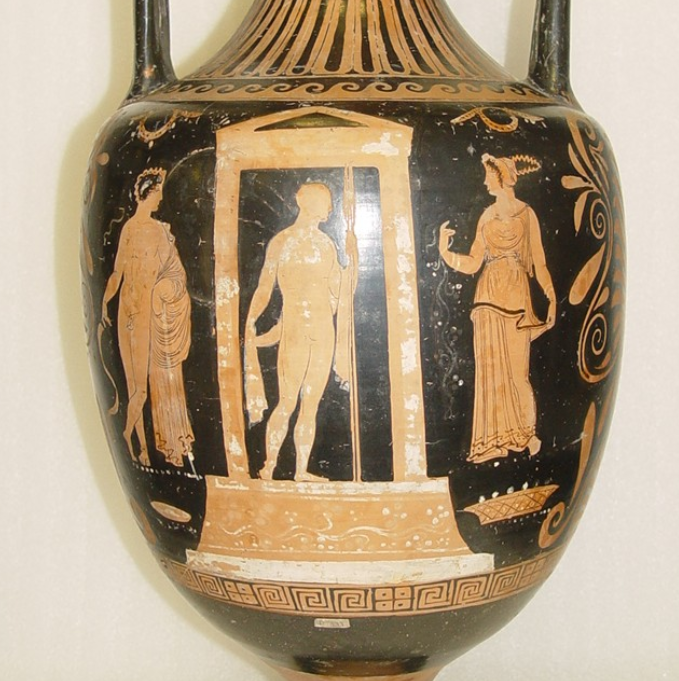
Also, I have a rant. The British Museum states that the figure on the right is wearing a chiton. That, my friend, is not a chiton. A chiton does not have an overfold, the apoptygma. That is a feature of a peplos. Not all peploi have an overfold, but if a garment has an overfold, it’s a peplos. Do you know how many images the British Museum states have chitones portrayed in them and they’re actually peploi? Let me tell you: a lot.
I also got my Teeswater wool! I bought 28 ounces of roving and I am slightly overwhelmed with the amount I have to spin in the next few weeks, I must admit. I guess it’s a good thing I enjoy spinning. It was also nice timing that I was able to wind up my plied yarn onto the niddy noddy the night before my wool was delivered. Two skeins finished! They total almost 1,000 yards. Now just 3,200 to go. I…should probably go spin now.
This is a niddy noddy. By winding my yarn on it, I can create a skein and also estimate fairly well how much yardage I have by counting how many times I wrapped my yarn around it.
Week two had a little bit everything in it, though it was still mostly spinning. I started by updating this website – besides the obvious change in color scheme, I added photos to the image gallery, added categories and reorganized my posts to easier differentiate between fall quarter and winter quarter. I also played around with the Map widget, though I’m not sure I did it correctly? I mean, I know I added locations that can be seen on the “Map” page, but I think it would be nice to see individual maps on posts that I mark locations. But, I seem to only be able to mark one location for single posts, which isn’t what I want, and I don’t have the energy to figure out how to make it work at the moment.
I also had to do some thinking about my wool situation. In my sleep-deprived state last quarter, it did not occur to me that while the loom I’ll be using may be 36 inches wide, that is not how wide the weaving area is. It finally occurred to me to check and the widest textile I can weave is 28 inches, which isn’t nearly wide enough. I’ve decided to weave four panels of fabric, sewing two together to make the front and the two to make the back. To minimize yarn waste I’ll weave two panels on one warp, but I still had to recalculate how much yarn I have to spin. Luckily, it isn’t too much of an increase: I now need about 4,200 yards instead of 3,800 yards. It’s about an extra skein of yarn.
That is still a lot of yarn though, and I had planned on buying different roving. It took me a bit of time to find something that would still work for what I wanted – a wool that wasn’t too coarse and would be okay to lay next to the skin, white so I could dye it, and ready more or less for me to spin – while still trying to be as ethical and sustainable as possible. I decided to look for a conservation sheep breed. I remembered that there’s something called the Shave ‘Em To Save ‘Em program by the Livestock Conservancy that connects fiber artists with farms and shepherds that raise endangered breeds of sheep; many times the fleece of these sheep will just be composted, but there are many people (like me) who are willing to pay money for the wool and support the people who care for these animals. In this way we can hopefully save the sheep breeds from extinction.
I looked through the Fleece and Fiber Sourcebook for what sheep breed I might want to look for and I decided on Teeswater. One of the things I love about my current wool is how lustrous it is, which is because one of the sheep’s parents is a Blue Face Leicester (BFL for short). BFL are known for lustrous springy locks, but they aren’t endangered. Other breeds that are related to BFL are endangered, but their wool tends to have a higher micron count. This doesn’t always translate to coarseness, but I’ve never worked with any of their wool, so I don’t actually know what they feel like. Teeswater also has a higher micron count that normally wouldn’t be considered next-to-skin soft, but I’ve worked with Teeswater before and it tends to have a silkiness to it regardless. It’s also terribly lustrous.
Between looking though the Livestock Conservancy’s directory and inputting, “SE2SE” into the Etsy search engine, I found a farm near Portland, OR, called Lawrence Cottage (link to Etsy store here). The owner, Staci, raises both Teeswater and Gotland sheep and did a lot of work with the American Teeswater Sheep Association to get the sheep breed listed as critically endangered with the Livestock Conservancy. Lawrence Cottage also has an Instagram, where pictures of Staci’s adorable and obviously happy sheep can be found. Teeswater are a longwool breed (they have been in Britain since the first century CE when Romans brought an ancestor sheep over) and their long lustrous curls are hard to miss.
Teeswater sheep. Look at those locks! Photography credits to Lawrence Cottage
Finally, I started plying another bobbin of yarn. I’ve learned that my ball winder, which I use to make a center-pull ball with which I ply, can only hold about 3-4 ounces of fiber and with how fine I’m spinning, that ends up being about half of one of my bobbins. So when I say I’m plying a bobbin of yarn, I mean half a bobbin. Plying seems like it should be easier, but for whatever reason, it isn’t for me. I have to concentrate more about what I’m doing, I suppose. I have to hold both ends of the yarn with equal tension, otherwise the yarn will come out uneven. I believe there are times when you would ply unevenly on purpose if you’re making an art yarn…but I’ve never been interested in making that kind of yarn. I’m the type who wants to see how finely I can spin and how perfect can I make my yarn. I’m not a perfectionist…not at all!
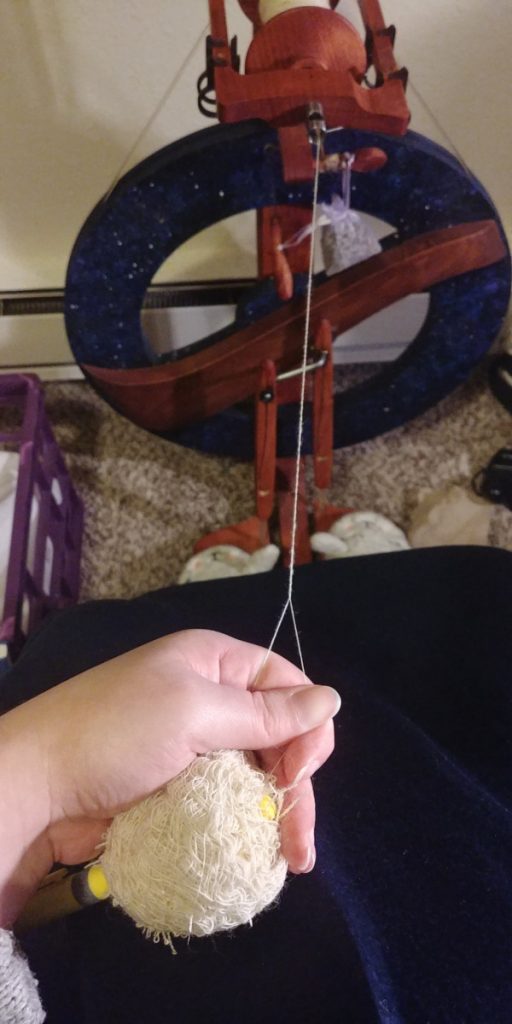
Plying from a center pull ball. A center pull ball is a ball of yarn where instead of unrolling your ball for more yarn, you pull from the center. It keeps it from rolling around and is overall easier to work with. It’s also a great way to ply if you don’t have enough bobbins.
After spending the winter break mostly sleeping as I was quite sleep deprived for most of the fall quarter, I started off the first week of the quarter refreshed and ready to spin my heart out. By the end of the fall quarter, I had filled one bobbin up with yarn and after plying half of it (the other half inexplicably became such a tangled mess that it had to be scrapped) I had a skein of about 445 yards. Considering that I need about 4,000 yards to create my chiton, I have my work cut out for me.
This is pretty much my life this quarter. I can’t complain too much.
It seems fitting that my winter quarter be preoccupied with spinning. Winter is a time for staying inside, whether or not there is a pandemic going on. It’s a time for hibernation, to be home with loved ones where it’s warm and dry, and focusing on hobbies and chores until the sun comes back and the daffodils bloom to herald spring. Fiber arts, such as spinning, would have been one of those hobbies/chores.
Unfortunately, it seems that my wool has some issues that I never picked up on because of my health issues last fall. Seriously, sleep deprivation really messes with a person. I’ve only started to notice now that some of my wool is quite weak. Wool should have some stretch, similar to, though not necessarily as much as, a human hair. If I pull on on a few fibers, they should stretch a bit and then break. Some parts of my wool do this, and other parts just break and with very little effort. The weak wool fibers are bad enough that even if I have a good amount in my hand twisted together and I pull, they rip even though I’m not trying very hard. This is not good.
This is some of my wool I pulled from the roving I combed.
This is that same wool after I pulled the ends with very little force. Wool is normally stronger than that.
The yarn produced from this fleece will have weak sections that I don’t trust to handle tension. It’s perfectly fine for weft, but the idea of using it for warp is nerve-wracking. It might be fine, or I might have multiple warp threads breaking while I’m weaving. I’ve decided I’d rather be safe than sorry and buy different wool. I don’t have time to process another fleece, so I’m hoping to by roving from a farm – the sheep will have been raised there and the fleece will have been processed by the farm owners and/or a local mill. In this way I can still execute my project in an ethical manner.
Besides wool, I was finally able to successfully request a book through the Interlibrary Loan successfully. Last quarter, I tried to request the book Archéologie des textiles : des origines au Ve siècle : actes du colloque de Lattes, octobre 1999.It’s a collection of conference papers about textile archaeology, and it contains two chapters that have been referenced in several things I have read. One of the chapters is about spinning in the home in ancient Greece (this is the one I am incredibly interested in) and the other talks about natural dye establishments. I can’t find these chapters in JSTOR or any databases and the book isn’t available through the Evergreen library or Summit. As I mentioned earlier, I tried to request the book in the fall, but there was some miscommunication regarding the fact that it’s mostly in French and it was assumed I wanted an English translation, which isn’t available in any libraries in the US. The chapters I want are in English and – fun fact about me – my French skills aren’t too shabby. But, the pandemic has made everything chaotic and my request was lost. I tried again last week and after some back and forth (because of the pandemic, many libraries aren’t willing to lend physical items) and hard work from the Interlibrary Loan librarian, she found a library that would lend me the book. This feels like a good omen to me for the quarter.
This week was a bit different, in that I didn’t do as much spinning. I read a great deal, instead. Or, it felt like it. The amount of pages wasn’t that much, but I was taking an extensive amount of notes. I like taking Cornell notes and writing down the page numbers while reading. It makes finding the information I want and creating citations much easier. I usually don’t have to flip through the book again once I have my notes. It does make getting through the book somewhat of a slow process, though.
I could write several deeply researched essays just on the dozen pages that I read in the “Garments” chapter. Before launching into discussions about specific garments, the author talks about the fibers used, decoration and color, and the value of garments. The author, Lee, discusses how silk was imported and worn in Greece, but that there was the possibility that silk clothing may have been purchased and then painstakingly unraveled and rewoven into fabric that was more in line with Greek preferences . Even more mind-blowing (for me) is that ancient Greece may have had its own native silk on the island of Cos.
There is also the discussion of colors and dyes, which is one of my favorite topics. There is a good amount of evidence that a range of colors were used in textiles. Textile fragments from Kerameikos, an area of Athens, Greece, included pieces with red stripes, embroidery with red thread, and a skein of red thread. Yellow produced from saffron dye has been known since the Bronze age. The color prized above all, it seems, was purple and the best dye source was the murex shellfish . I don’t know how many articles and book chapters I’ve seen that have focused on purple dye, even if it says it’s going to cover a range of ancient dyes. It’s kind of frustrating, to be honest. I think I may start resenting purple, ha! But seriously: you may have noticed I mentioned red thread earlier, but the author said nothing about the dye. It’s oddly difficult to find authors willing to discuss what made red, blue, and other colors. I realize it may be that nobody ever bothered to write the information down, which is definitely possible. It makes me want to study what native plants of Greece may have dye potential, obtain them, and do dye experiments with the plants. That, though, is way more work than I’m willing to do at the moment.
During the Thanksgiving break, I did my best to try and catch up on work. I didn’t get nearly the amount that I wanted done; this was the week that the medication for my chronic headaches decided it didn’t want to do its job. I increased the dosage but it takes about a week to take effect, so there went my week. But, let’s focus on the positive. What did I get done?
Of course, I did more spinning. Spinning is one of the few things I can do when I have headaches. While I do tend to have a bright light on, which doesn’t help with the pain, I don’t need to focus my eyes intensely on what I’m doing when I spin. A lot of it is by feel and muscle memory. I’ve even spun in the moonlight during a power outage. Related to fiber work, I also bought myself a niddy noddy. A niddy noddy is a tool that allows you to create a skein of yarn by wrapping yarn around it; it also allows you to estimate how much yarn you have by counting how many times you went around the niddy noddy with the yarn.
I also did some reading and writing. It felt good to be visibly productive. I caught up on a couple of the week summaries and I started writing a post about combing wool. It’s a bit challenging trying to describe combing wool. I wanted to make a video showing what it looks like, but I realized that making a video was a bit more complicated than I thought it would be. I also continued reading Body, Dress, and Identity in Ancient Greece. Looking back at my notes, I’m remembering that I wanted to look into the textile tool, the epinetron. Epinetra are half cylinder pottery pieces that women placed over their thighs to protect them from combing wool . This doesn’t make any sense to me. When I comb wool, the combs aren’t anywhere near my legs; protection is not needed. If I was carding wool, perhaps I might want to protect my legs depending on how I was doing it. Perhaps this is one of those moments where researchers/archaeologists don’t realize that combing and carding are very different methods and are not interchangeable terms. This sort of thing happens often, it turns out. When people who know nothing about fiber arts study textile archaeology, they sometimes come to inaccurate conclusions because they don’t actually understand the craft. This is something that the author of Women’s Work, Elizabeth Wayland Barber, brings up that makes me wonder how textile archaeology would change if people were required to be proficient at various fiber arts.