Week 6

On Friday, Aria and I set up the germination chamber trial.

Method

  1. Count each seed quantity and label the edge of petri dishes with a variety/replication code, using tape and sharpie. 4 repetitions for each variety, total of 20 petri dishes.
  2. Place a filter paper piece in the bottom of each petri dish. Each filter paper should cover the bottom surface area of the dish. With a pencil, label 1-20 for each seed.
  3. Dampen each filter paper by pouring deionized H20 in each petri dish. Swirl each dish so water is evenly coated and let sit to absorb for a few seconds, Pour out any excess standing water by gently tipping the dish.
  4. Place 20 samples of seeds in the designated petri dish, making sure there is no overlapping. 
  5. Every third day, moisten specimens with DI water as needed & record data.
  6. Record BBCH code data for all 20 seeds in each sample. Afterward, count and record frequency per code.
  7. When radicle is present, measure radicle length in mm – from the initial protrusion on the seed to the tip of the root. 
  8. Take a photo and/or draw each code stage.

I formatted BBCH Germination Data Collection Sheets using Excel.

These are intended to be printed and used for real-time data collection. While the following excel document is intended for synthesizing data in excel.

Yield Data

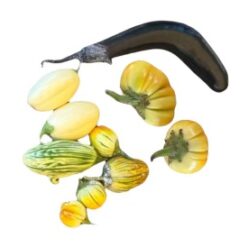
Harvest completed by Sarah D. on 08/01/2024.

Week 4

As the quarter progresses, I am shifting gears from field work, to lab work, written documentation and analysis. On Friday, I joined a zoom call with Marilyn, from WSU extension, for lessons on educational materials. Marilyn shared a variety of helpful resources and examples that have been used to market vegetables and farm shares. Afterwards, the student group met to collaboratively work on our WordPress sites, as well as update each other on our individual work.

Germination trial supplies from the Science Support Center.

Additionally, I was able to pick up materials for the germination chamber trial from the Science Support Center on campus: 20 glass petri dishes, mm. rulers, and filter paper.

Also, I finally got around to planting the extra Solanum aethiopicum varieties at my personal farm-site, in East Olympia. Eggplants were planted 18 inches apart on 07/14/2024 in a high tunnel environment. Interestingly, these eggplant have done remarkably well in their 4 inch pots from the original transplant in spring. I did do a foliar spray with a fish emulsion fertilizer during week 1. Even during multi-day heat waves 88 °F weather, plants appeared have wilting leaves, yet persisted to fruit and set new growth in the following days, without increased watering.

Solanum aethiopicum var. Zebra.

Also, professor Ben implemented biological control on Friday, July 19, with nematodes. This is a preventative for pest control.

Nematodes used on 07/19/2024

Week 3

This week we met twice, Wednesday with faculty sponsors, and Friday for field work. Flea beetles were observed in early July, and Surround WP was applied as a preventative and protective barrier against pest damage and infestation.

Pests have the potential to spread disease, damage plants, and decrease harvest yields.

The plants were trellised using the basket-weave method. Stakes were placed and string was reinforced at every four plants; then, twine was weaved at height 6 inches from the soil.

Resources

Nitzsche, Peter, et al. “The Stake and Weave Training System for Tomatoes in the Home Garden.” FS1102: The Stake and Weave Training System for Tomatoes in the Home Garden (Rutgers NJAES), Rutgers, New Jersey agriculture Experimentation, Aug. 2009, njaes.rutgers.edu/FS1102/. 

Week 2

This week, we had a group meeting on Friday to check in about our specialized projects. There are a variety of student interests including: germination variety trials, culinary arts, education, ethnobotany, illustration, nutritional analysis and statistical analysis.

I’ve also spent time formulating more resources and filling in the new research members about the field plan. Upcoming field plans include: pest & disease monitoring, weeding, pruning, trellising, and harvest.

I was inspired by reading other studies like : A review on post-harvest technology of an underutilized vegetable bitter tomato (Solanum aethiopicum L cv. gilo) of Northeastern region of India (Jamir, et al.) to make a graphic communicating the methods in a procedure. In this graphic, field management is defined by the time in between planting and harvest.

Harvest planning

We also discussed harvest procedures. For experimental purposes, it will be necessary to keep individual replication yields separate. I am predicting that we can use flat crates and separate 3-4 varieties in each crate. Each replication will need to be individually weighed and then documented a cull (total weight of all replications per variety). Unmarketable crops will need to be set aside prior to weighing.

Infographic depicting post-harvest care practices from a study based in Northeastern India. A review on post-harvest technology of an underutilized vegetable bitter tomato (Solanum aethiopicum L cv. gilo) of Northeastern region of India (Jamir, et al.)

Resources

Jamir, Satemmenla, et al. “Bio-Conferences.” Amity Institute of Horticulture Studies and Research, Amity University, 2024, www.bio-conferences.org/articles/bioconf/pdf/2021/11/bioconf_mtsitvw2021_02006.pdf. 

Week 1

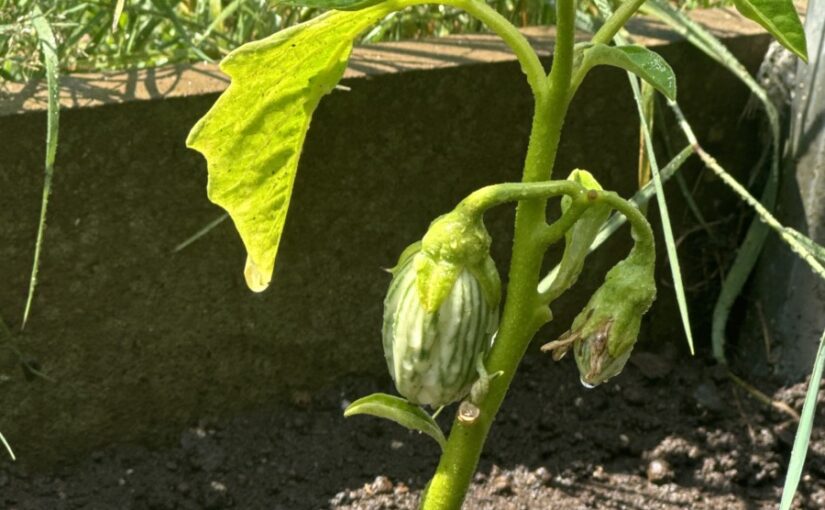
Fruit beginning to form! Observed on 06/28/2024

Communications & Planning

This week, we met on Monday to discuss potential plans for the summer quarter. This quarter there is a team of six, including myself, working with the Solanum aethiopicum variety trial. Two of my main focuses this summer will be statistical analysis and scientific writing for the yield and germination data. Also, field observation and facilitating group meetings.

In order to stay on track for the data analysis, I started the process of reserving space for the germination study this week. I hope to connect with the Science Support Center on campus during week 2 and begin the two-week study ASAP.

I also compiled a list of potentially relevant resources for the group to review throughout the quarter.