
#1a: Film Series: Program Questions in Scenes
Wk 1:
- Gather (Sanjay Rawal, dir.; 75 min; 2020) Kanopy (Evergreen Library streaming service)
- This Earth is Mine–‘Rock Hudson in Napa Valley Archival Stock Footage,” (Henry King, dir; 1 min; 1959). You Tube video link: https://www.youtube.com/watch?v=lJ6CvUpYof4For historical context browse: AFI History: http://catalog.afi.com/Catalog/MovieDetails/53045
- The Rocks in Walla Walla with Geologist Kevin Pogue (Wine Spectator, 4 min.) https://www.winespectator.com/video/play/id/sF1ZdD23/title/The+Rocks+in+Walla+Walla+with+Geologist+Kevin+Pogue For more information about Dr. Pogue’s academic and wine consulting work click these links.
Viewing Prompt: Compare and contrast the terroir (and meroir) of Gather (2020), This Earth is Mine (1969) and The Rocks in Walla Walla (ND) in relationship to a key program question–or an answer to it. Suggestion: Browse the Napa Valley case study in the the Marketing chapter of our Wine and Place text for context re: This Earth is Mine (pp 244-256).
Wk 2: Wine
- The Wine Wars (53 min. Marathon International, 2003) Films on Demand (Evergreen Library streaming service: https://fod-infobase-com.evergreen.idm.oclc.org/p_ViewVideo.aspx?xtid=36438&tScript=0 )
- Red Obsession (David Roach, Warwick Ross, directors; 78 min; 2013). You Tube: https://www.youtube.com/watch?v=FAv-lkxhOmA
After posting your film assignments for each week of each case study to canvas, curate one to post here. See canvas for details.
#1b: (un)Natural Histories
#1c: Regenerative Agriculture
#1d: Case Study Tasting Research: Wine
Wine with Luke Bradford, COR Cellars, Lyle WA
Link to conversation with Luke Bradford, Greener! (Copy and paste directly into your browser)
#1e: Stuckey’s Taste Book Experiments
Taste Book Experiment Guide #1
Week 2 – Taste Chapter
(pgs 30, 40, 52, 53, 54)
Caleb Poppe; popcal18@evergreen.edu
The experiments done in this lab are all taken from Barb Stuckey’s book, Taste.
In this lab we will be walking through 4 experiments that focus on our own personal perception of how we taste the foods that we enjoy. Knowing that we all come from different cultures, heritages, and backgrounds, we too must know that these have a powerful effect on how our individual mind and body interact with the food we use to fuel them. With that being said, we all share common ancestors, and our bodies may have a lot more in common than we at first bel
Today’s Experiments:
- “Taste What You’re Missing: 5 Minute Raisin d’etre” – page 347
- “Taste what you’re missing: Your Taster Type” – page 30
- “Taste What You’re Missing: Separating Taste from Smell” – Page 52&53
- “Taste What You’re Missing: Sour all Over” – page 53&54
Throughout these labs try and reflect on your own experience and perceptions, doing this will help you to answer the questions that coincide with this guide. It may help to have the answer sheet open so that you can record your thoughts and reflections while they are fresh in your mind. Above all, have fun.
1st: Taste What You’re Missing: 5 Minute Raisin d’etre – page 347
As Stuckey says at the beginning of this section: “we often take meals for granted…”, often rushing through the process of eating a meal and seldom slowing to eat at such a pace that allows us to stop and fully contemplate the meal and its entire story of how it made it to our mouths. In this experiment we are going to go to the other extreme and go super slow-mo through the act of eating only 3 raisins:
Inspect each raisin and think about how it came to look like that having once been a plump and juicy grape.
Once you put the raisin in your mouth, hold it there awhile and think about where it came from (Cailfornia soil).
Try and make all 3 raisins last 5 whole minutes!
2nd: Taste what You’re missing: Your Taster Type – page 30
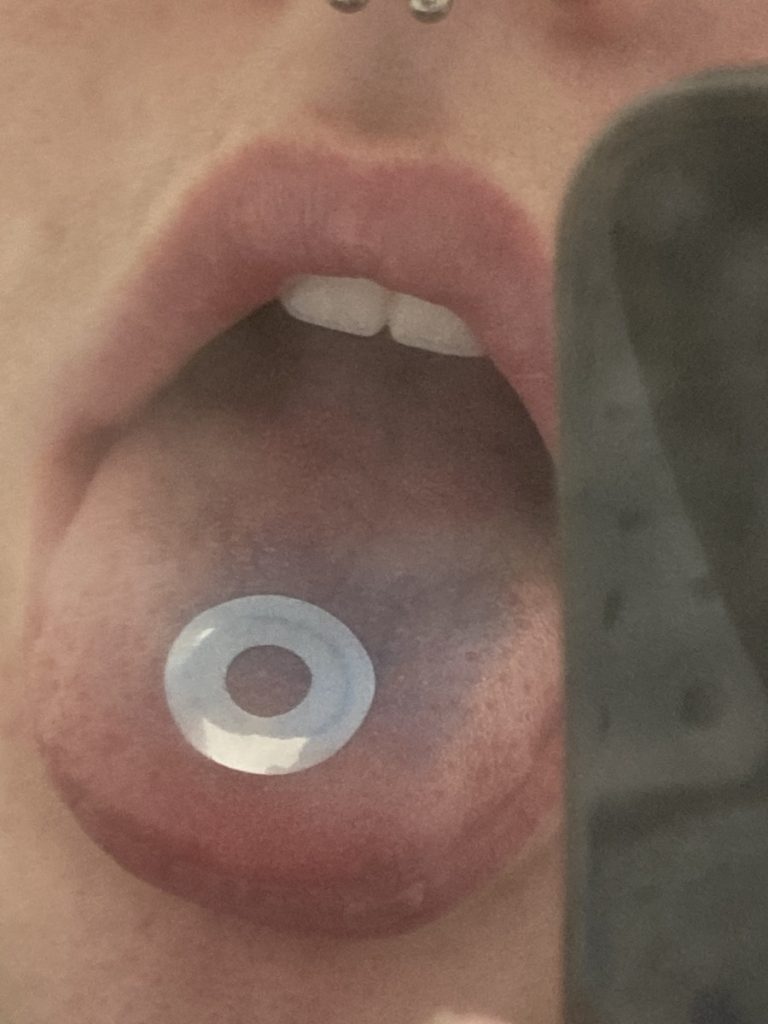
In this experiment, we are going to try to better understand the topography of our tongue. It is safe to say that a whole range of factors attribute to how many tastebuds our individual tongues have, and while tastebuds only play a small role in our perception of taste, they are no doubt vital. Using the quetips that were provided to you, dip them into the blue dye, coating the entire cotton swab so that it is saturated, and dab an area on your tongue about the size of a nickel and place the binder saver ring on the dyed area of your tongue. Using your phone or a magnifying glass, try and count the number of taste buds that fit inside of the binger saver ring. *It may be best to do this in front of a mirror so that you can see what you are doing*
In the book, we are given a key as to how we interpret the number of tastebuds we count in the binder ring – in its important to remember that these numbers are subjective AND there is no way to know if the binder savers we are using are they same width as the ones used in the book.
3rd: Taste What You’re Missing: Separating Taste from Smell – Page 52&53
We may all remember hearing at some point the line “…plug your nose, it’ll go down easier” maybe in reference to taking cough syrup as a child or eating overpowering, stinky foods. As we learned last quarter, the majority of how we perceive taste lies within the aromas that we inhale as we eat a meal; holding our noses closed greatly reduces the amount of aromas that travel into our nasal passage, the location where aromas are detected. In this experiment we are going to try and pick out what we are tasting when we eat very flavorful foods with our eyes and noses closed. Jellybeans are sweet, colorful, and packed with flavor, but how much of the jellybean are we tasting with our mouths and how much are we tasting with our eyes and nose?
I feel like especially with colorful candy like jelly beans, we taste the most with our eyes and nose. Before unplugging my nose, it just felt like chewing on wax.
From the jellybeans that we provided, and with your eyes closed and your nose plugged, pick a random jellybean, put it in your mouth and give it a couple chews to release the flavor – then unplug your nose and take a steady breath in, paying close attention to how this changes your perception of the jellybean. Could you tell what flavor jellybean you had chosen before you unplugged your nose? What specific senses of taste were being triggered?
Cleanse your palate and repeat a few times.
There was a huge bloom of flavor once I unplugged my nose. I couldn’t tell what jelly bean I had before I unplugged my nose and after I felt sort of overwhelmed by flavor and just tasted sweet, not necessarily any specific flavor.
4th: Taste What You’re Missing: Sour all Over – page 53&54
While some may argue that certain parts of our tongue are better equipped to identify certain types of taste (sweet, sour, etc.), it is rather easy to prove we can experience each of the 5 basic tastes on all parts of our tongue. In this experiment, we are going to do just that. With the quetip and the vinegar, a highly sour/acidic substance, swab your tongue in different locations and pay attention to where the sour flavor is most and least heightened. Do you recognize any correspondence with your vinegar swabbing and the map of the tongue on page 54?
I found that the sides and tip of my tongue are switched, the tip tasting sour better and the sides picking up more sweet.
That’s it!
Don’t forget to fill out the question/answer form that goes along with this lab!
Tasting Experiment Guide and Question Form:
Week 2 – Experiment Guide Question/Answer Form
Week 2 – Taste Chapter Q/A
(pp 347, 30, 40, 52, 53, 54)
1st Experiment Questions: (p 347)
- Reflection: What were your thoughts and feelings during these 5 minutes? Was it pleasant? Was it tough? What did you appreciate?
When I was smelling and feeling the raisins between my fingers I found myself thinking about the texture of it and how it would feel when I bit down on it. I was really only thinking about the texture of it, and it’s not a texture I necessarily enjoy. I always find myself comparing grapes to eyeballs and I sort of imagined that the raisin was a dried up eyeball.
- What senses and tastes were being triggered for you while eating these raisins?
Raisins really triggered a lot of childhood memories for me even though I wouldn’t really say that raisins were a big part of my upbringing. It tasted sticky sweet and almost fleshy. I appreciated the texture of the small seeds.
- Summarize the life you saw for the raisin before you watched the California Raisins ad.
- Describe the life you see for the raisins that are now part of you in relation to “American” labor, branding, and advertising/entertainment.
2nd Experiment Questions: (p 30)
- How many tastebuds did you count within the binder ring?
I only counted seven!
- Circle the result that applies to your count and reflect on how this count does or does not correspond with your experience of your taste sensitivity.
**Remember that we are not certain if the binder saver holes that we are using were the same size as the ones Stuckey used.
**Remember that we are not certain if the binder saver holes that we are using were the same size as the ones Stuckey used.
16-39 = Taster
40 or more = HyperTaster
- What are your thoughts on the role that tastebuds play in your tasting experience? (You may have a more informed answer for this if you wait to answer until the end of this lab, having played around with our sense of taste a bit! )
I thought it was really cool to be able to see them! I saw that there was higher concentration at the front of my tongue. I really didn’t expect myself to be like some supertaster so I’m not surprised.
3rd Experiment Questions:
- What are the five basic tastes? Draw them onto your own version of Stuckey’s tasting star (image on first page of each chapter).
Five basic tastes: Sweet, salty, sour, bitter, umami
- What senses were triggered before and after plugging your nose?
Before it was just mouthfeel and texture and after there was a total bloom of flavor and the entire experience changed.
- Could you tell what flavor jellybean you had chosen before you unplugged your nose? What flavors did you get? (Here’s the link for identifying the flavors of the JellyBelly beans you were provided: https://www.costco.com/kirkland-signature-jelly-belly%2C-variety-pack%2C-64-oz.product.100333880.html)
I thought I picked peach but when I unplugged my nose I knew it was buttered popcorn.
- What went through your head at the moment of unplugging your nose?
I thought it was crazy just how much flavor came out when I unplugged my nose.
4th Experiment Questions:
- What did you find out about the map of your own tongue, in relation to the controversial histories of the supposed map of the tongue’s taste areas?
I found that it was pretty inaccurate for me, the sides of my tongue tasting sweet better and the tip picking up sour more sharply.
- Did you experience different intensities in different areas?
I experienced more intensity of flavor on the tip of my tongue, I would say a normal amount of taste on the sides of my tongue and very little on the back.
Overall Reflection:
- What have you learned from these 4 experiments? How might your learning relate to any/all of the TM program questions regarding the taste of place?
I thought it was very interesting how many taste buds I counted. There is definitely a chance that I counted wrong but I really did not have that many tastebuds. However, I do feel like I have a really good nose for flavor and felt that a lot in the jellybean experiment.
Taste Experiment Materials:
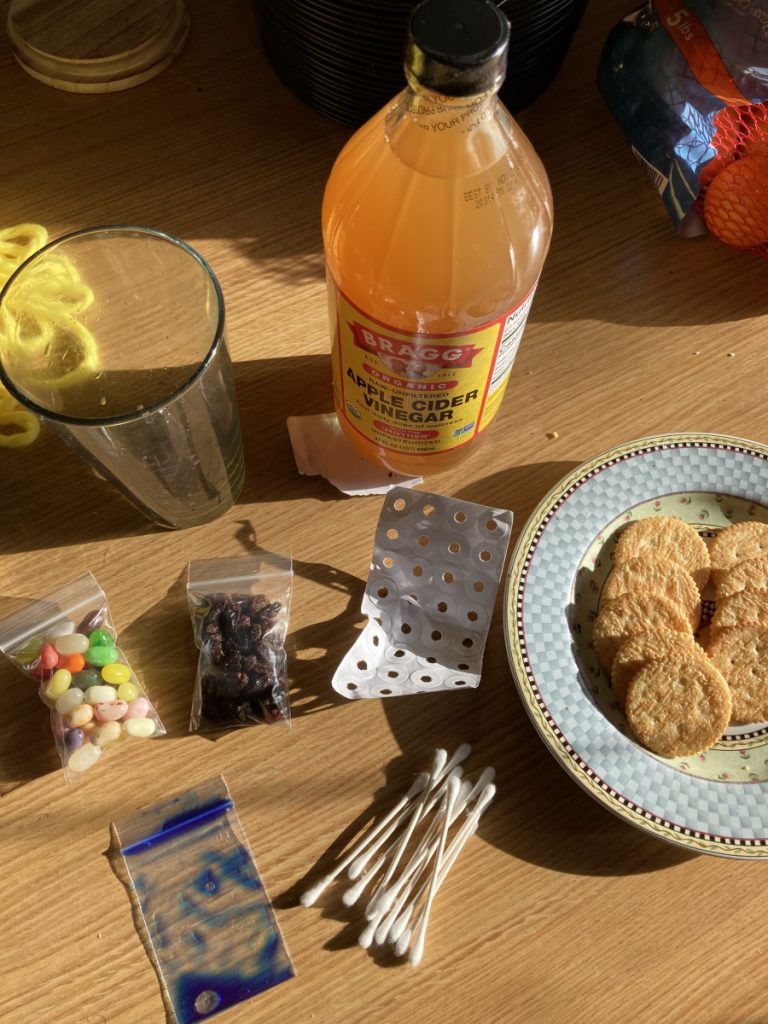
This week we used:
Blue food dye
Jelly Beans
Binder Hole Savers
Raisins
Quetipstm
Clear Glass Cup
Vinegar
Palate Cleanser (e.g, crackers, water, bread)
#1f: Sustainable Entrepreneurship
#1g: Climate Justice and Resilience Event Series
Not available this week
#1h: Foodoir: Your Story of Tasting Place
Quotes from fall quarter’s weeks 1&9 reading from The Cooking Gene
MICHAEL TWITTY
“The Old South is a place where people use food to tell themselves who they are, to tell others who they are, and to tell stories about where they’ve been (xii).
The Old South is a place where food tells me where I am. The Old South is a place where food tells me who I am. The Old South is where food tells me where we have been. The Old South is where the story of our food might just tell America where it’s going (xvii).
’We need a blueprint as individual and as a people’ (11).
‘What’s the best thing you ever cooked?’ I asked my mother.
‘A little black boy named Michael; I cooked him long and slow,’ she replied (13).
The disruption of the black family, the interruption of an important community-driven ethnic economy, the engendering of a poor diet, an urgent desire to suppress learning and education, and a culture of unrelenting violence–these and all the dependency, instability, and toxic thinking that wen along with them were the fruits of King Cotton, none of which black America has been able to fully purge from its system. (358)
Little bits of stories mixed with recipes and techniques, treats, and tips come out as she rehearses the family dead in her mind: how to wash collards, sorting through field peas, the right way to chew sorghum and sugarcane …. (360).
Our food was never just food. (365)
MICHAEL TWITTY
“Our food was never just food” (Twitty, 365)
I like using this quote for the first post of the year because I feel it sums up my feelings on food as well as the message of this class to me. Food is never just food. It’s layers and layers of earth, of working hands, of different cultures and practices, its love letters and apologies, it’s a way to reach out, to give comfort to others as well as yourself. My own personal experiences with food have also been multilayered. Our relationship ever fluctuating, between love and hate, between bounty and wanting. In my in program ILC this quarter, I am cataloguing this relationship through a historical Jewish lens. For Jews food has always represented something bigger, this sentiment carried into my own sort of personal dogma on food and eating. Food is a way to tell stories, both personal and one’s of an entire peoples. This quarter I hope to share the ways that food is not just food to both myself and those that came before me.
#1i: Bibliography
Your are required to learn and use a standard reference style such as APA or MLA as demonstrated here at the Online Writing Lab (OWL).
Leave a Reply