
As a part of my ILC this quarter, I have chosen to take on the role of Student Coordinator for the Medieval Herb Garden at the Evergreen Organic Farm. This will involve tending to the garden as well as collaborating with students from Terroir/Meroir and the Practice of Organic Farming program in order to leave the garden better than we found it, and create a sustainable plan for future management and student tending.
From the Evergreen Teaching Gardens Blog:
“The European Medicinal Herb Garden at the Organic Farm provides hands-on learning opportunities for students to learn how to grow, tend, harvest, process, use, and market medicinal herbs.
Students installed this ethnobotanical garden in 2004 with a four-square design that mimics a Persian-inspired garden layout common during the Renaissance. A traditional yew hedge encloses the paths and parterres (geometric planting beds). The herbs were originally labeled according to the humoral system which was central to medieval and Renaissance healing practices in Europe.
The garden’s primary goal of promoting increased self-reliance for treating common health problems like colds, indigestion, and stress is carried out through student participation in herbalism focused Independent Learning Contracts and the Practice of Organic Farming program. It is also used as a demonstration garden by the campus Herbal Medicine Club.
In 2017, students created monographs on each plant in the garden into a resource binder. You can request the binder for a self-guided tour of the garden’s rich medicinal content at the Organic Farm office.”
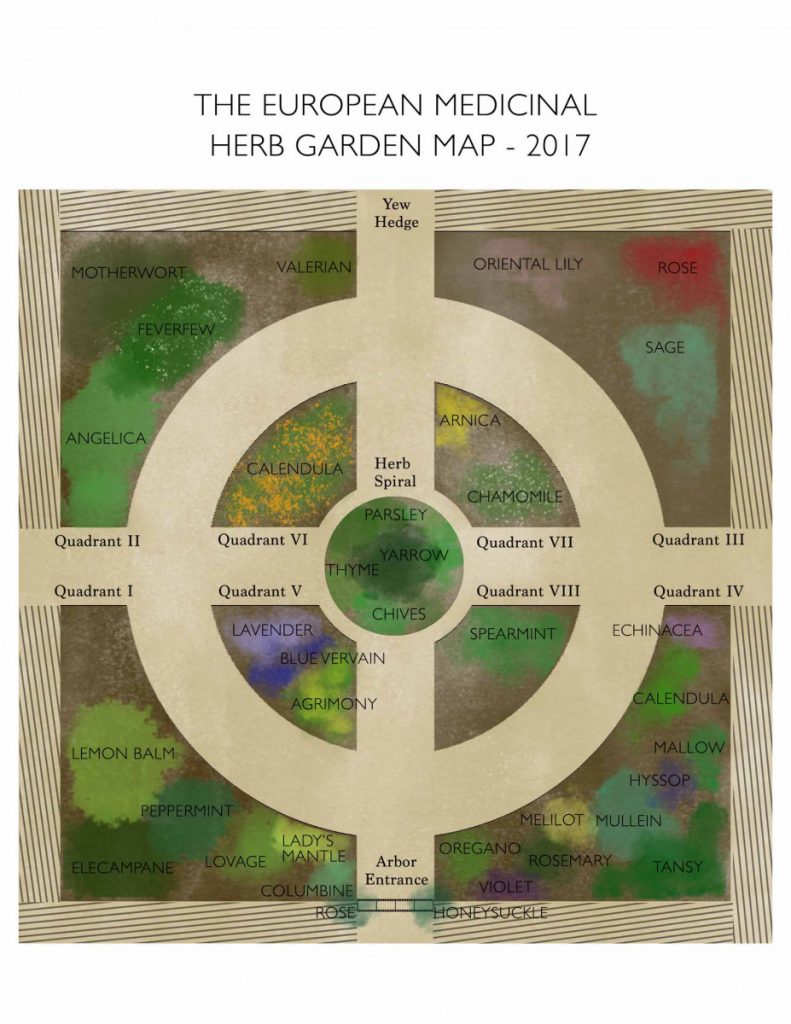
Moving forward there are some things that must be addressed:
- New map
- Updating the signage
- Weeding
- Hedge trimming and upkeep
- Construction of a new arbor
- Planting of herbs that are no longer there
It is my goal to continue the original vision of the herb garden and turn it into a viable learning space for those interested in herbal medicine and alternative healing, as well as self-reliance and autonomy of body, mind, and spirit.