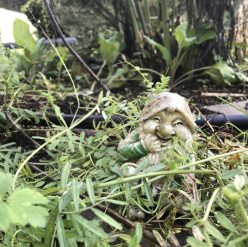
Weekly Tasks: Introduction to the Herb Garden and Organic Farm
Reading: Chapter 4 “Restoring Degraded Land” – Farming While Black
Welcome to our first week in the herb garden! Today, we will be reacquainting ourselves with the garden and hearing from Beth, the Organic Farm manager, as she gives us an overview of work to be done today and in future weeks. Come prepared to work in the rain and mud!
Monday, 1/10

Today was a wonderful introduction to our winter quarter on the Organic Farm. There was minimal, if any, rain, which allowed for a grand tour of the entire farm, starting with the herb garden (which I, of course, forgot to photograph). According to Beth, our main focus for winter in the herb garden is the continuation of weeding, as well as laying down compost and beginning any seeding or cuttings of herbs we might want to plant in the spring. This opens up a conversation for the class if there are any specific herbs anyone would like to see in the herb garden, whether it be herbs for future use or just a favorite herb that appears to be missing.
Beth then continued our tour through the rest of the farm, showing us the mischievous chickens, the brassica beds, fruit trees, and eventually the radicchio beds our class is taking over for winter. The snow and frost had done a fair amount of damage to the plants; it looked like a radicchio graveyard when first walking up to them. But upon peeling back the outer damaged leaves, it was clear that some of the radicchio had made it through the worst of the winter and would hopefully still be enjoyable for a second radicchio tasting closer to the end of the quarter. However, a lot of the radicchio was still greatly damaged by the frost and snow, as well as mice that had burrowed in the dirt to eat the bottoms of the plants. It was very interesting to see how the different varieties of this winter vegetable reacted to the harsh winter weather.

Radicchio graveyard? 
Still alive! 
Frost damage
Finally, it was really cool to make connections between the Organic Farm and our weekly reading from Farming While Black on the regeneration of degraded lands. Winter is a time of reset, a time to make plans and preparations for the upcoming growing season. Beth was able to show us some of the examples for soil prep from our reading in person, including cover cropping and the use of tarps to prevent weed growth. She explained how the tarp method made the soil ready for use earlier in the season compared to cover crops since there’s no need to grow the crop and then turn it back into the soil and wait for it to be usable. These insights and in-person examples of what our reading talked about were very valuable to see.
Readings
“Herbal medicine is more about a deep relationship with the plants – and ourselves – than it is about a dusty jar of distant leaf that happens to retain enough vitality to serve a specified remedy.”
-NANCY AND MICHAEL PHILLIPS
This week, I began by reading the introductions to my two books, The Herbalist’s Way by Nancy and Michael Phillips and The Evergreen Herbal by Tari Gunstone. Obviously not very information-heavy, these introductions gave me a brief overview of what each text will provide me with over this quarter. The Evergreen Herbal is particularly exciting to me because of its connection specifically with Evergreen and the same herb garden I am working in now, as well as the connection to local herbalists and herb shops around the Olympia area. That being said, it is a student-written book, meaning it will probably not be very dense in herbal knowledge. I think the brief overview of herbalism as a whole in the context of the Evergreen herb garden will be very beneficial though, along with the familiarity of knowing it was written by students like me.
The Herbalist’s Way is written by an actual herbalist, Nancy Phillips, so I am excited for the insight and knowledge from someone with herbal experience. Her way of writing about plants even just in the introduction is beautiful to me, so I am excited to dive in for more.
In order to stay on top of the readings in these two books this quarter, I also created weekly reading schedules for myself this week. The schedule for each book is listed below.
The Evergreen Herbal
- Wk 2 – Intro + Foreword
- Wk 3 – Chapter 5 – Medicine Making
- Wk 4 – Chapter 4 – Herb Gardening
- Wk 5 – Chapter 1 – Developing Relationships with Plants
- Wk 6 – Chapter 6 – Plant Monographs
- Wk 7 – Chapter 2 – Community Herbalism
- Wk 8 – Chapter 3 – Herb Foraging
The Herbalist’s Way
- Wk 2 – Introduction
- Wk 3 – Chapter 3
- Wk 4 – Chapter 6
- Wk 5 – Chapter 5
- Wk 6 – Chapter 2
- Wk 7 – Chapter 4
- Wk 8 – Chapter 7
- Wk 9 – Chapter 1