Ecology & Intersectionality in Theory & Practice
April 23rd, 4:00 – 8:00 pm
During Earth Week in April 2026, the need to center intersections between the environmental sciences and critical perspectives on diversity, equity, inclusivity, and justice is more pressing than ever. The 36th Rachel Carson Forum is bringing presentations by three leading scholars working across these interdisciplinary boundaries to Evergreen and the broader Olympia community. This free event is hosted by the Master of Environmental Studies Student Association at The Evergreen State College, and will offer options for both in-person and virtual attendance via Zoom.
The 2026 Rachel Carson Forum will feature three presentations from the following speakers (more details below):
Dr. Lisa Weasel – Queer by Nature: Intersectional Ecologies in an Age of Invasion
Dr. Shannon Cram – Writing the Body: Narratives of Toxicity, Exposure, and Health
Dr. Cleo Woelfle-Hazard – Pêeshkeesh Yáv Umusahêesh: Ecocultural approaches to fire and river restoration in Karuk Ancestral Territory
Event Details:
- Date/Time: Thursday April 23rd, 4:00 – 8:00 pm Pacific Time
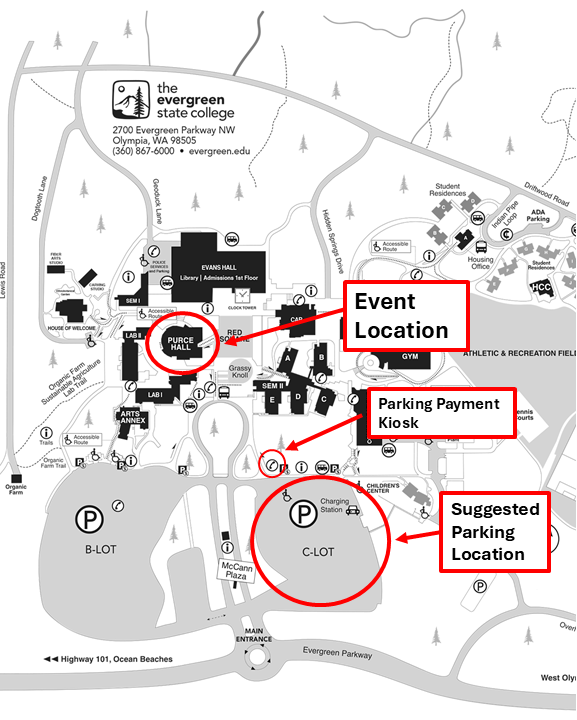
- Location: Evergreen Campus – Purce Hall (west side of Red Square)
- Admission: Free!
- Parking: $6 (try carpool or bus!)
- Light snacks and refreshments provided
Zoom Attendance Link: Meeting Link
Campus Address, Event, and Parking Map:
Event Schedule:
| 3:30 pm | Doors to Purce Hall open |
| 4:00 – 4:20 pm | Welcome and Introduction |
| 4:20 – 5:20 pm | Speaker 1: Dr. Cleo Woelfle-Hazard |
| 5:20 – 5:35 pm | Break |
| 5:35 – 6:35 pm | Speaker 2: Dr. Shannon Cram |
| 6:35 – 6:50 pm | Break |
| 6:50 – 7:50 pm | Speaker 3: Dr. Lisa Weasel |
Speakers and Topics:
Dr. Lisa Weasel – Queer by Nature: Intersectional Ecologies in an Age of Invasion
Abstract: We are living in an age obsessed with “invasions.” From “invasive” pests and plants to the policing of human populations, the question of who belongs in a particular space or place figures prominently in both our science and our politics. Often, this discourse appeals to “nature” and the “natural” to justify who belongs and who is an intruder—but is nature as rigid as we think? Taking a queer approach to unravelling how race, class, gender, sexuality and disability intersect with settler colonial and capitalist legacies in the bodily construction of invaders in science and society, this talk aims to unsettle boundaries and borders that are considered rooted in nature, and indeed the concept of “nature” itself.
Dr. Weasel’s Website: Lisa Weasel | Portland State University
Bio: Dr. Lisa Weasel is a biologist and interdisciplinary scholar whose work seeks to connect science and social justice. Her scholarship and teaching spans feminist science studies, environmental science and policy justice, and food, ethics and sustainability. She is the author of the book Food Fray: Inside the Controversy over Genetically Modified Food, and the co-editor of the anthology Feminist Science Studies: A New Generation. She received an A.B. magna cum laude in Biology from Harvard University, and her Ph.D. in Cell and Molecular Biology from the University of Cambridge. Dr. Weasel is currently Professor of Environmental Science and Management in the School of Earth, Environment and Society, and affiliate faculty in Women, Gender and Sexuality Studies in the School of Gender, Race and Nations at Portland State University in Portland, OR.
Dr. Shannon Cram – Writing the Body: Narratives of Toxicity, Exposure, and Health
Abstract: Feminist scholars have long argued that the body does not “end at the skin,” but is instead constituted of and by histories, standards, and structures of power. This is more than a metaphor: residing on Earth literally means becoming an industrial product, inhaling and absorbing, circulating and secreting toxic conditions. Yet, though we are always already altered by such exposures, we are not wholly defined by them. To be alive is to comprise and exceed life’s social forms, to be both coded and uncontained. What, then, does it mean to write the body? How does the human form comprise and exceed the stories we tell about it? What can we learn from an imperfectly embodied perspective? This talk centers themes of toxicity, exposure, and health with a particular attention to narrative practice. It weaves ethnographic research about nuclear waste, cleanup, and previvorship to consider methodological questions I encounter in my own writing process.
Dr. Cram’s Website: Shannon Cram – School of Interdisciplinary Arts & Sciences
Bio: Dr. Shannon Cram is the author of Unmaking the Bomb: Environmental Cleanup and the Politics of Impossibility, winner of the Ludwik Fleck Prize, the Julian Steward Award, and finalist for the Washington State Book Award. Her research and writing considers the everyday life of environmental contamination, with a particular focus on the body as a site of politics. She is an associate professor of Interdisciplinary Arts and Sciences at the University of Washington Bothell, where she co-directs the Science, Technology, and Society program.
Dr. Cleo Woelfle-Hazard – Pêeshkeesh Yáv Umusahêesh: Ecocultural approaches to fire and river restoration in Karuk Ancestral Territory
Abstract: In the Karuk language, Pêeshkeesh Yáv Umusahêesh means “the river will look good”. Along the Klamath river in Northern California, tribal-led river restoration efforts are improving habitat conditions and offering new models for river restoration. Karuk Tribe managers and their partners are working to remove dams, reconnect floodplains, and reintegrate intentional fire regimes to create multispecies landscapes and riverscapes that are resilient to flooding, drought, and catastrophic wildfire. Building on his 15 years of experience working with the Karuk Tribe first as a researcher, and now as a tribal employee, Dr. Cleo Woelfle-Hazard will describe how his training in feminist and Indigenous science studies informs his approach to building reciprocal relationships with Karuk culture bearers, and how intersecting Indigenous, queer, and trans views of rivers and multispecies relations can be put into practice to enhance habitat processes, cultural resources, and intergenerational learning. This talk will explore the shared questions and understandings that emerged throughout this process, as well as where water and fire worlds intersect and fundamentally diverge, ultimately offering principles to guide future collaborations between researchers, river managers, and place-based communities.
Bio: Dr. Woelfle-Hazard’s research focuses on ecological and social dimensions of human relations to rivers and firescapes and their multi-species inhabitants, and on how queer trans feminist thought can transfigure ecological science as it’s used by Indigenous and non-Native practitioners. His book Underflows: Queer Trans Ecologies and River Justice explores how a queer-trans-feminist approach can ally with Indigenous praxis to renew human-water-fish relations. An activist and artist with formal training in ecology, geomorphology, critical social science, and feminist science and technology studies, he works for the Karuk Tribe Department of Natural Resources as the Habitat Restoration Program Manager.
Information about MESA’s Annual Rachel Carson Forum
MESAs Rachel Carson Forum – Masters of Environmental Studies Association
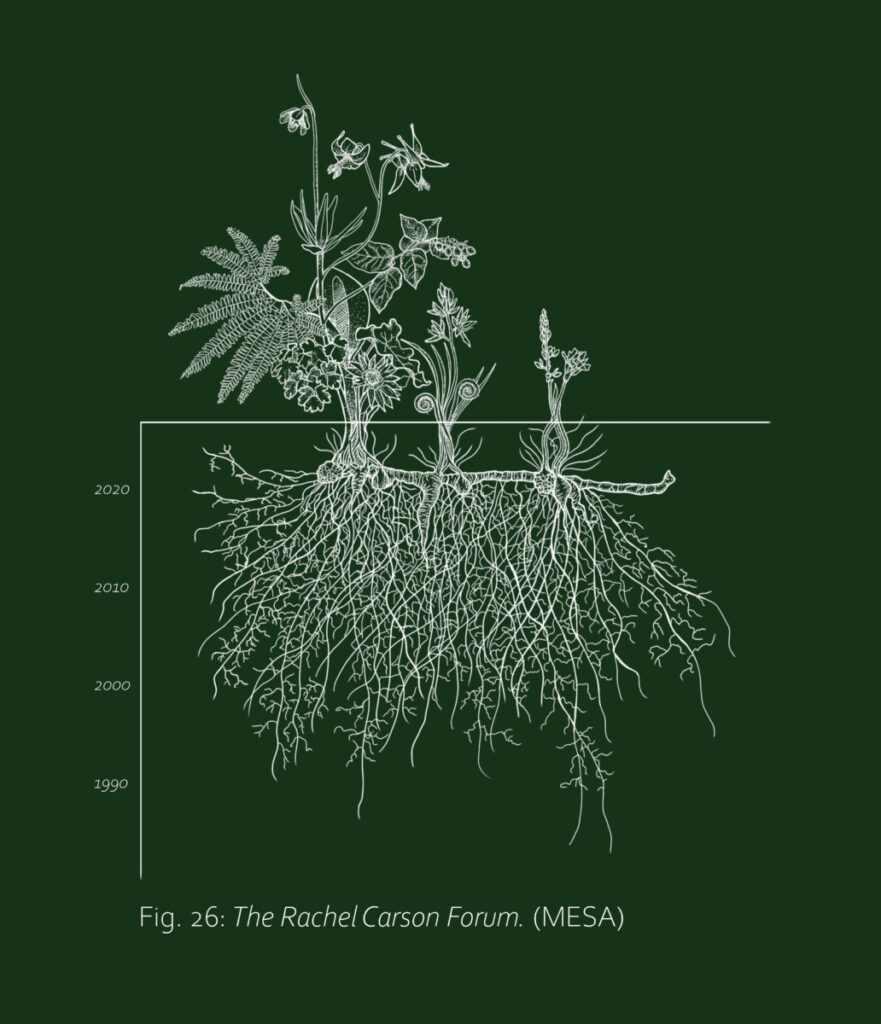
Event art created by local artist Anneke Wilder