Immediately after I was notified of my 2022 research fellowship, I knew that I would conduct replicated variety trials of both early slotted radicchio and overwintering cabbage. My primary personal interest in trialing these two vegetables is seasonal extension; early radicchio should fill in the gap in produce in the fall and overwintering cabbages will theoretically provide a greater selection of produce in the early spring, expanding market possibilities on the organic farm and introducing novel, seasonally appropriate vegetables to the community. I was exceedingly grateful for my collaboration with the Organic Seed Alliance (OSA), and specifically Laurie McKenzie, who supplied seeds for both trials.
The first step in establishing the trials was to identify specific goals for each trial. The information gathered through these trials will be used to help identify the best-performing varieties for this region (both for market garden production and seed production), identify varieties that would be suitable parents for future breeding projects, and build the capacity to conduct on-farm variety trials useful for The Evergreen State College’s food and agriculture path of study. Specific goals for the radicchio trail are to evaluate improved disease resistance to powdery mildew and downy mildew, improved pest resistance to aphids, resistance to bolting, and improved flavor. Cabbages will be evaluated for improved pest resistance to cabbage white caterpillars and aphids, improved resistance to downy mildew and powdery mildew, improved overwintering (resistance to cold damage), and improved flavor.
The hypothesis for this experiment is that the chosen varieties of both cabbage and radicchio which exhibit certain traits will perform better than conventional varieties in organic agriculture systems. These traits relate directly to the goals stated above. Resistance to insects and evaluations of insect pressures will be evaluated by observing damage and setting traps for data collection. Mildew damage will be assessed. Resistance to bolting and cold damage will be monitored, and variety tastings will be held to gather feedback from consumers, focusing on flavor, texture, color, and appearance. This feedback will be evaluated and will inform breeding decisions moving forward.
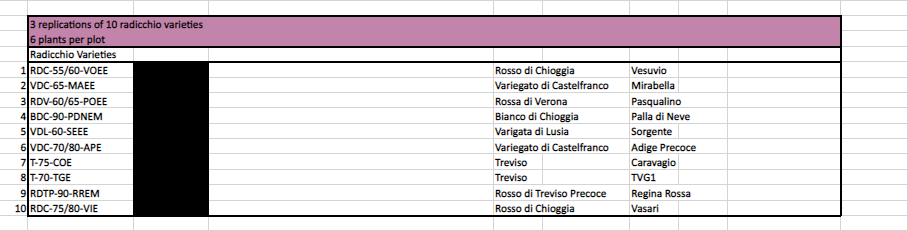
The next step I took in planning my trial was choosing appropriate varieties for my goals and acquiring seeds. I chose varieties based on both the purported suitability of the variety to support the goals listed above and my own interests in seasonal extension for the Organic Farm’s market stand. I researched varieties available through various seed companies and then reached out to Laurie McKenzie at Organic Seed Alliance to facilitate procuring seeds that will meet my needs. I chose to trial ten varieties of early slotted radicchio exhibiting harvest dates ranging from 55-90 days after transplant and representing a variety of morphological variation. All the radicchio seeds are from OSA and are listed as follows: ‘Vesuvio’, ‘Mirabella’, ‘Pasqualino’, ‘Palla di Neve’, ‘Sorgente’, ‘Adige Precoce’, ‘Caravaggio’, ‘TVG1’, ‘Regina Rossa’, and ‘Vasari’.
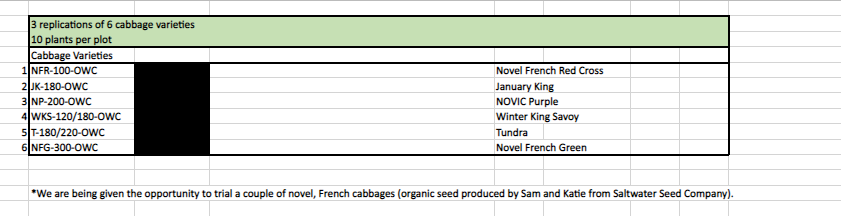
The varieties of cabbage that match my goals are from a variety of sources and represent the work of OSA, Saltwater Seeds, Uprising Organics, Adaptive Seeds, and Territorial Seed Company. From Territorial Seed Co. I chose ‘Tundra’, I selected ‘January King’ from Uprising Organics, and from Adaptive Seed I chose ‘Winter King Savoy’. From Sam and Katie at Saltwater Seed Co., I acquired seed for two novel French cabbages and will be the first farmer to test these varieties in the United States; until I am given a variety name, I am referring to these varieties as ‘French Green’ and ‘French Purple’. From OSA, I have requested that Laurie McKenzie make a personal selection of the final variety for my trial, and the variety name is yet unknown.
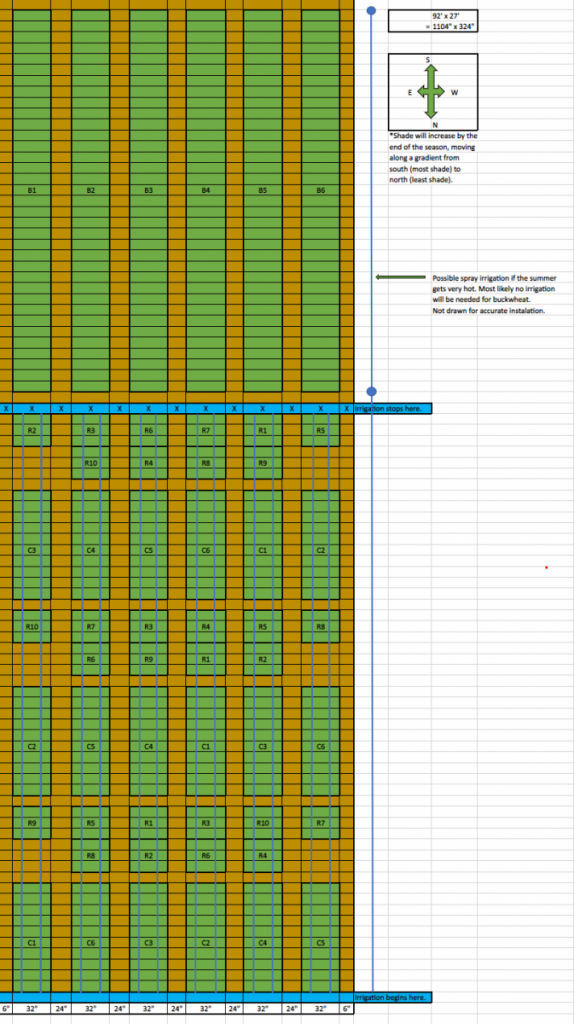
I began setting up my experiment by spading and squaring-off my assigned field at the Evergreen Organic Farm. I measured my beds and paths, and after analyzing the results of the soil test, I harrowed the beds and amended them with feather meal. Each bed was irrigated with two lines that run the length of the field. I applied black plastic mulch to my beds, minimizing weed pressure, after which I applied my variety trial design. During this period of field preparation, I also set my attention to sowing seeds in the greenhouse.
Seeding for both radicchio and cabbage took place on June 22nd. Seeds were initially sown into ¾” plug trays. It is important to note that in radicchio, optimum germination results at soil temperatures of 60-68°F, so it is important to keep soil temperatures cool. I transplanted the cabbages and radicchio into the field one month later between July 20th and July 22nd, but that date can change based on the growth of the seedlings. Before transplanting outdoors, plants should be “hardened” by reducing water and temperature (this is generally done by gradually moving the plants outside).
Three replications of each block of varieties were planted in a design that was made to utilize both a north/south gradient and an east/west gradient. The east/west gradient helps to account for soil variability, wind, and weed pressure, and the north/south gradient accounted for a variation in shade across the field. Variety plots in each replication were randomized to provide the best range of possible variation in environments. Cabbage blocks each contain six variety plots of ten plants each. Rows in each plot were spaced 18” apart in an offset or “chicken foot” pattern. Radicchio blocks each contain 10 variety plots of six plants each. Rows were spaced 18” apart, and plants were spaced 12” apart in-row. These blocks were then each replicated three times each. Irrigation was then be laid appropriately, with two drip lines laid in each bed in line with the rows.
After transplanting starts into the field, I began collecting data. Germination and emergence, pest and disease resistance, susceptibility to bolting, and tolerance to cold will all be measured and recorded in the field. Radicchio will be ready to harvest between the end of September to the beginning of November. Observation of cabbages will continue through the winter until harvest in February and March. Data about yield will be analyzed after harvest. Flavor will be considered through sensory evaluations conducted by consumers, farmers, chefs, and other interested parties that focus on flavor, texture, color, and appearance.
If I were to continue this project as a breeding trial, I would narrow my focus to radicchio. I would evaluate the performance of each variety in each patch, leaving the most resilient, vigorous specimens in the ground to overwinter; as radicchio requires vernalization to produce viable seed, leaving those plants out for the winter will set the biennial plants up for successful seed production in the spring. Radicchio goes to flower, cross pollination will occur, creating incredible genetic variation in the forthcoming seeds. Seed would then be collected and saved until June, when I would sow them and eventually plant them out as a screening trial. I would observe each plant for its success in lining up with my goals, marking plants from which I want to save seed. I would then allow those plants to vernalize and produce seed the following spring. This pattern would continue for between six and eight generations until these new types can be grown with a large degree of standardization and reliability of varietal traits, and with data collection and flavor evaluation occurring throughout the life of the project.