
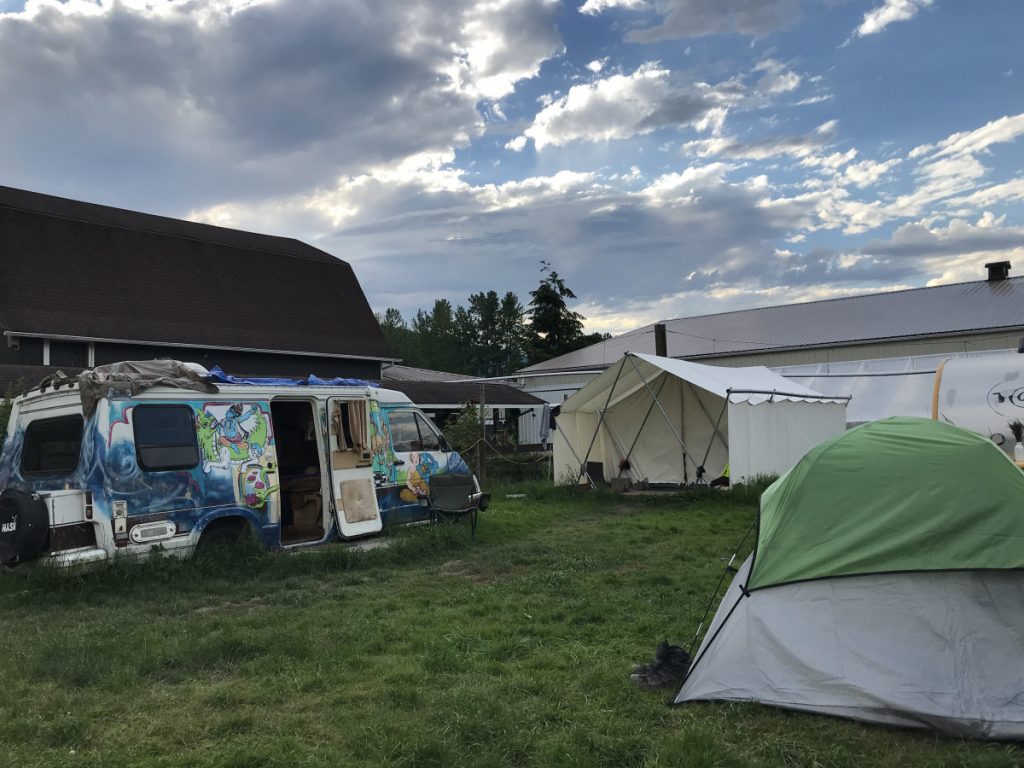
I arrived at Moon Valley Organics on Sunday the 26th of June along with two other new WWOOFers. We were greeted by two current WWOOFers who gave us a brief tour of the property, showing us the pantry and outdoor kitchen, the combined shower and laundry room, and finally, “WWOOF world” where all of us would be sleeping. Within WWOOF world, I would be taking the spot of a girl who was leaving the following day within the LeSharo RV; it’s a cozy space but becomes outrageously warm in the summer’s heat. However, overall, I am quite content with my living arrangements for the rest of the summer.
The owners of Moon Valley, Kim and Aaron, were on vacation until Wednesday so it would be a few days until I was properly introduced to them. With them gone, we pretty much had free reign of the entire property, including using the owner’s kitchen for cooking our meals. Cooking is done communally for the most part, with a weekly sign-up sheet for who is taking the lead on which meals. So far, all of the food has been incredible, there are some wonderful cooks within our group for sure.
Learning Highlights
Since it was my first week on the farm, there was a lot to be learned about working at Moon Valley. First off, it’s the WWOOFers daily responsibility to care for the chickens, ducks, goose, and turkey that reside on the farm. The ducks and goose must be let out of their cage every morning and then herded back inside in the evening. Waters need to be cleaned and refilled and food needs to be refilled daily as well. A daily egg hunt must also occur, as the chicken eggs have been scarce. We’re afraid the hens have found a hidden spot to lay them and there’s a pile of rotten eggs that will be discovered in a week or two (the other WWOOFers have already enlightened me on the horror stories of picking up a rotten egg and having it explode on them, along with cracking open eggs with half-formed chicks inside of them).

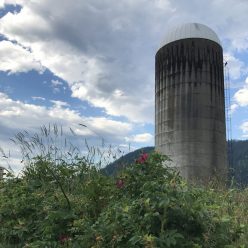
Lots of harvesting occurred this week, starting in the lemon balm fields out by the silo. We were taught to snip the lemon balm at the point where the leaves started to turn brown and spotty; these leaves could be stripped off right away or would be removed later during processing. Once this point on the lemon balm plants was found, it was important to try and trim the rest at about the same point down the row so all of the lemon balm would grow back fairly uniform. It was relaxing to work in the lemon balm fields, a slight drizzle coming down overhead as we filled bin after bin with the harvested plant material. Once a bin was full, it could be taken to the production barn and carried up the stairs to the drying room where all of the plant material was laid out to be dried for use in future body care products.


The drying room has been my favorite part of the job so far. When tasked to work here, WWOOFers have to wear a lab coat, hairnet, and gloves, and are essentially in charge of laying out plant material on mesh screens to be dried and then picking through the fully dried material for any leftover grass or debris that are unwanted in the final products. The room becomes heavily heated in the summer months, with constant air circulation provided by multiple fans. Two finish dryers are also available for faster drying as well; the finish dryers are essentially two large cabinets with dehumidifiers and spaces for fitting in the screens of plant material. The finish dryers aren’t always essential for drying all of the herbs, the room is warm enough to dry most everything, but are highly important for drying calendula as the flower heads hold a lot of moisture.

It has been so meditative to sift through different herbs. Each one is processed a little differently; the chamomile above was a big challenge as the grass and debris blended in quite well, we were never able to fully remove all of it. The lemon balm was easier and just required us to strip off the leaves from the stem and remove any brown leaves from the mix. Once the herb is fully picked through, it is funneled into a giant plastic bag. Then, once the bag is full, desiccant packs are added to remove moisture and the bag is weighed and tied off to be taken down to the production team for product creation. I have really enjoyed working closely with the herbs in the drying room and I am excited for further work up here in the future.


Something I was not expecting upon arrival was the fact that a lot of our work would occur at an incubator farm about 20 minutes away from Moon Valley. The excess rain this year has caused the ground at Moon Valley to be too wet to farm in, so the owners had to improvise and lease land on an incubator farm. An incubator farm is a farm that provides land for other farmers, generally start-up farms that don’t have land of their own yet. Before my arrival, it had been a chaotic couple of weeks as things were moved over to the incubator farm and issues were encountered and worked out. My first few days at the incubator farm included lots of planting of onions, as well as some cauliflower, leeks, basil, and nasturtium. I also had the joy of harvesting a bunch of calendula, a task I greatly enjoyed. When harvesting calendula, look for the flowers that are open and pinch off right below the head. I am already so enamored with this plant, could there be a more wonderful shade of orange?
My final learning highlight from my first week involved the blight-stricken tomatoes in the greenhouse at Moon Valley. These tomato plants were in bad shape, so Aaron, owner of Moon Valley, taught all of us how to remove the blight and properly prune a tomato plant. The first part of pruning a tomato is to find the two lead branches, the stems that the leaves and fruit clusters will grow off of. It’s usually best to select the two tallest as the leads, and then to snip off any other forming leads, which are referred to as suckers. The tomato suckers grow in the notch between a leaf and the main stem, and can easily be pinched or snipped off. This allows the plant to focus its growing energy into the two selected lead branches instead of dividing its energy among a bunch of leads. Along with the suckers, any blight-affected leaves or fruit should be removed; these appear as browned leaves or tomato fruits with rotten ends. Be sure to touch the plant as little as possible when working with blight as the fungus can spread easily to unaffected parts of the plant. Finally, trim off the bottom leaves of the plant and provide support by clipping the main stems to a piece of bamboo. With all of this knowledge in mind and guidance from Aaron, we were able to transform the sad-looking plants into happy-looking tomatoes. I am excited to taste the fruits of our labor later on in the season!

A jam-packed first week of work, I enter the weekend feeling content and satisfied with what I have achieved so far. I am continuing to discover who I am and how I best learn, and I truly believe that learning by doing is best for me, so this experience has been highly valuable even in these first four days of work. I am excited to continue learning and doing and being outside as the summer goes on, discovering more about who I am and who I wish to be in the coming years of my life. Huge appreciation for all of the support so far from the farm managers, Dylan and Eva, from the owners, Kim and Aaron, and of course from all of my fellow WWOOFers. I have entered into a wonderful community of people and I am so excited to draw closer to all of them as the summer continues.

Reading Highlights
With the chaos of my arrival and falling into a new routine in an entirely new location, I did not get very far in my reading of Robin Wall Kimmerer’s Braiding Sweetgrass. However, even the first few chapters have been insanely thought-provoking for me, and pair very nicely with the work I am doing at Moon Valley and all of my prior herbal experiences. I wish to highlight these thoughts and connections here.
Braiding Sweetgrass opens with the Skywoman Creation story. Skywoman fell from the Skyworld, clutching a bundle of seeds in her hands as she was caught on the backs of geese flying up from the dark ocean below. Using mud from the depths of the water to create Turtle Island, a land for Skywoman to live in, Skywoman scattered her seeds and the world turned green, creating the beautiful home we all live in today. This story asks us “in return for this gift of a world on Turtle’s back, what will I give in return?” (8). Skywoman used her gift for good, and in doing so, she passed on the instructions for us to use our gifts and our dreams for good as well. What are my gifts and my dreams? How can I use them for good? These questions reminded me of a conversation I had with a fellow WWOOFer, who was talking about her experiences meeting all of these incredible and unique people in the short two weeks she was at Moon Valley. Each person came to the farm with something different to offer, she wished she had more time to pick each of their brains and connect more deeply. Maybe right now as I continue to grow and discover who I am and what my gifts are, my greatest gift is myself. Offering my time to Moon Valley as I work each day, offering my conversation and my history to my fellow WWOOFers as we grow closer while we are together. I hope for right now, that is enough.

The following chapters furthered my pondering over the idea of gifts, focusing more on the perception of nature and the world as a gift. To explain this, Kimmerer talks of her love of wild strawberries and the relationship she formed with this plant from a young age. Wild strawberries are always a gift to be received and given, never a commodity to be sold. They belong to themselves; they give and in return, teach us how to give back. This relationship is sacred; both entities are transformed through it. Yet in our modern market economy, this relationship is quite non-existent for most, amounting all items to a mere number and severing any deeper connections that could form. “How, in our modern world, can we find our way to understand the earth as a gift again, to make our relations with the world sacred again?…even in a market economy, can we behave ‘as if’ the living world were a gift?” (31). These questions continue to sit with me, and I don’t think I have any one answer, I’m not sure if there IS any one answer. I know for me, I have been able to find a sacred relationship with nature through my time spent in and with nature, learning and growing and giving back. But would this be the case for everyone who spent time in nature? Again, reflecting on my experience at Moon Valley so far, the majority of my fellow WWOOFers are new to agriculture and herbs, and have been transformed through their WWOOF experience. They speak of taking back what they have learned during their time here and using it in their day-to-day life at home. This experience has been a transfer of gifts for them; they gifted their time to the land and in return, the land gifted them new knowledge to be used once they depart. If this relationship can be created for a bunch of random college students through even just a few weeks of work on a small herb farm, I have hope that it could be created for anyone.