Effect of the Internal Size and Thermal Insulation of the Hive on the Bee Colonies strength and productivity
ABD-ELMAWGOOD, B. H., M. A. AL-RAJHI and A. O. EL-ASHHAB – 2015
Abd-Elmawgood, B. E. D. H., Al-Rajh, M. A., & El-Ashhab, A. O. (2015). Effect of the internal size and thermal insulation of the hive on bee colonies strength and productivity. Egyptian Journal of Agricultural Research, 93(1), 185–196. https://doi.org/10.21608/ejar.2015.153324
“Significant increase in hive temperature, honey area, pollen area, sealed brood area was detected when using the lowest internal beehives size and foam insulator.”
A national survey of managed honey bee colony losses in the USA: Results from the Bee Informed Partnership for 2020–21 and 2021–22
Dan Aurell, Selina Bruckner, Mikayla Wilson, Nathalie Steinhauer, and Geoffrey R. Williams – 2023
Aurell, D., Bruckner, S., Wilson, M., Steinhauer, N., & Williams, G. R. (2023). A national survey of managed honey bee colony losses in the USA: Results from the Bee Informed Partnership for 2020–21 and 2021–22. Journal of Apicultural Research, 1–14. https://doi.org/10.1080/00218839.2023.2264601
Seasonal benefits of a natural propolis envelope to honey bee immunity and colony health
Renata S. Borba, Karen K. Klyczek, Kim L. Mogen, and Marla Spivak – 2015
Borba, R. S., Klyczek, K. K., Mogen, K. L., & Spivak, M. (2015). Seasonal benefits of a natural propolis envelope to honey bee immunity and colony health. Journal of Experimental Biology, jeb.127324. https://doi.org/10.1242/jeb.127324
“…a decrease in energetic costs associated with the maintenance of an up-regulated immune system will help bees to allocate their energy to perform vital tasks (e.g. foraging, raring brood) and to maintain higher storage protein levels required for overwintering success.”
Propolis envelope in Apis mellifera colonies supports honey bees against the pathogen, Paenibacillus larvae
Renata S. Borba and Marla Spivak – 2017
Borba, R. S., & Spivak, M. (2017). Propolis envelope in Apis mellifera colonies supports honey bees against the pathogen, Paenibacillus larvae. Scientific Reports, 7(1), 11429. https://doi.org/10.1038/s41598-017-11689-w
“Managing honey bees in man-made hives with smooth interior walls has interfered with a critical, natural defense mechanisms of the honey bee colony: the bees do not construct a natural propolis envelope inside the hive as they do in natural tree cavities. Our results provide additional evidence for the importance of the propolis envelope within the nest, in this case protecting the brood from P. larvae infection, resulting in a lower infection load two months following the challenge.”
Social Immunity
Sylvia Cremer, Sophie A. O. Armitage, and Paul Schmid-Hempel – 2007
Cremer, S., Armitage, S. A. O., & Schmid-Hempel, P. (2007). Social immunity. Current Biology: CB, 17(16), R693-702. https://doi.org/10.1016/j.cub.2007.06.008
Propolis Envelope Promotes Beneficial Bacteria in the Honey Bee (Apis mellifera) Mouthpart Microbiome
Hollie Dalenberg, Patrick Maes, Brendon Mott, Kirk E. Anderson, and Marla Spivak – 2020
Dalenberg, H., Maes, P., Mott, B., Anderson, K. E., & Spivak, M. (2020). Propolis envelope promotes beneficial bacteria in the honey bee (Apis mellifera) mouthpart microbiome. Insects, 11(7), 453. https://doi.org/10.3390/insects11070453
“Because honey bee mouthparts are used for collecting and storing nectar and pollen, grooming and trophallaxis between adults, feeding larvae, and cleaning the colony, they are an important interface between the bees’ external and internal environments and serve as a transmission route for core gut bacteria and pathogens alike…Based on the taxonomic results, the propolis envelope appeared to reduce pathogenic or opportunistic microbes and promote the proliferation of putatively beneficial microbes on the honey bee mouthparts, thus reinforcing the core microbiome of the mouthpart niche.”
Inside Honeybee Hives: Impact of Natural Propolis on the Ectoparasitic Mite Varroa Destructor and Viruses
Nora Drescher, Alaxandra-Maria Klein, Peter Neumann, Orlando Yañez, and Sara D. Leonhardt – 2017
Drescher, N., Klein, A.-M., Neumann, P., Yañez, O., & Leonhardt, S. (2017). Inside honeybee hives: Impact of natural propolis on the ectoparasitic mite varroa destructor and viruses. Insects, 8(1), 15. https://doi.org/10.3390/insects8010015
“…in relation to V. destructor, [Deformed Wing Virus] titers increased significantly less in colonies with added propolis than in propolis-removed colonies, whereas [Sacbrood Virus] titers were similar. Colonies with added propolis were also significantly stronger than propolis-removed colonies.”
Caste development, reproductive strategies, and control of fertility in honey bees and stingless bees
Wolf Engels and Vera L. Imperatriz-Fonseca – 1990
Engels, W., & Imperatriz-Fonseca, V. L. (1990). Caste development, reproductive strategies, and control of fertility in honey bees and stingless bees. In W. Engels (Ed.), Social Insects: An Evolutionary Approach to Castes and Reproduction (pp. 167–230). Springer. https://doi.org/10.1007/978-3-642-74490-7_9
Measuring Beekeepers’ Economic Value Of Contract Enhancements in Almond Pollination
Marieke Fenton, Brittney Goodrich, and Jerrod Penn – 2023
Fenton, M., Goodrich, B., & Penn, J. (2023). Measuring beekeepers’ economic value of contract enhancements in almond pollination [SSRN Scholarly Paper]. https://doi.org/10.2139/ssrn.4580491
“In 2022, California’s 1.3 million almond acres required roughly 2.6 million honey bee colonies, an estimated 89% of all honey bee colonies in the US as of January 2022 (Land IQ, 2022; US Department of Agriculture (USDA) National Agricultural Statistics Service (NASS), 2022a, 2022b). While the demand for almond pollination is currently being met by the US beekeeping industry, Durant and Ponisio (2021) found that over half of surveyed almond growers showed a strong concern about declining bee health and the lack of available honey bee colonies in the future, and 47% showed strong concern about the lack of skilled commercial beekeepers able to provide pollination services in the future.”
Assessing Honey Bee (Hymenoptera: Apidae) Foraging Populations and the Potential Impact of Pesticides on Eight U.S. Crops
Maryann T. Frazier, Chris A. Mullin, Jim L. Frazier, Sara A. Ashcraft, Tim W. Leslie, Eric C. Mussen, and Frank A. Drummond – 2015
Frazier, M. T., Mullin, C. A., Frazier, J. L., Ashcraft, S. A., Leslie, T. W., Mussen, E. C., & Drummond, F. A. (2015). Assessing honey bee (Hymenoptera: Apidae) foraging populations and the potential impact of pesticides on eight u. S. Crops. Journal of Economic Entomology, 108(5), 2141–2152. https://doi.org/10.1093/jee/tov195
“Honey bee colonies, especially those used for crop pollination, are without question being exposed to a diverse array of agrochemicals, especially fungicides and some bee-toxic pesticides as seen here and in other published studies… Brood is particularly vulnerable to impacts from pesticide toxicity…The impacts of in-hive chemicals continue to be a concern given that the amitraz metabolite, DMPF, was found at 5,160 ppb in dead and dying bees near corn.”
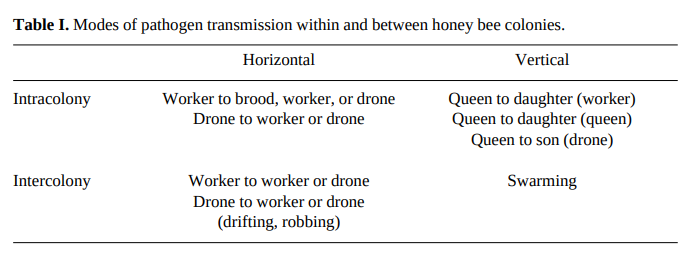
Implications of horizontal and vertical pathogen transmission for honey bee epidemiology
Ingemar Fries and Scott Camazine – 2001
Fries, I., & Camazine, S. (2001). Implications of horizontal and vertical pathogen transmision for honey bee epidemiology. Apidologie, 32(3), 199–214. https://doi.org/10.1051/apido:2001122
Comparing the pollination services of honey bees and wild bees in a watermelon field
Nikos Garantonakis, Kyriaki Varikou, Athanasia Birouraki, Mike Edwards, Voula Kalliakaki, and Fotis Andrinopoulos – 2016
Garantonakis, N., Varikou, K., Birouraki, A., Edwards, M., Kalliakaki, V., & Andrinopoulos, F. (2016). Comparing the pollination services of honey bees and wild bees in a watermelon field. Scientia Horticulturae, 204, 138–144. https://doi.org/10.1016/j.scienta.2016.04.006
Honey Bees (Hymenoptera: Apidae) in the United States That Express Resistane to Varroa jacobsoni (Mesostigmata: Varroidae)
John R. Harbo and Roger A. Hoopingarner – 1997
John R. Harbo, Roger A. Hoopingarner, Honey Bees (Hyntenoptera: Apidae) in the United States That Express Resistance to Varroa jacobsoni (Mesostigmata: Varroidae), Journal of Economic Entomology, Volume 90, Issue 4, 1 August 1997, Pages 893–898, https://doi.org/10.1093/jee/90.4.893
“This study showed that resistance to varroa mites is present in the honey bee population in the United States, nonreproduction of mites was highly correlated with the growth of a mite population, and nonreproduction of mites may be a valuable characteristic for selecting bees for resistance to varroa mites.”
Textured hive interiors increase honey bee (Hymenoptera: Apidae) propolis–hoarding behavior
Cynthis R L Hodges, Keith S Delaplane, and Berry J Brosi – 2018
Hodges, C. R. L., Delaplane, K. S., & Brosi, B. J. (2019). Textured hive interiors increase honey bee (Hymenoptera: Apidae) propolis–hoarding behavior. Journal of Economic Entomology, 112(2), 986–990. https://doi.org/10.1093/jee/toy363
“Pairwise comparisons showed that propolis deposition was not significantly different among the three textural treatments; however, textural treatments interacted with time to show a more consistent benefit from plastic propolis trap material or roughened interior surface over saw kerfs. Although direct health benefits were not measured, this work shows that it is comparatively simple to increase propolis deposition above background levels by increasing textural stimuli in hive interiors.”
The worldwide importance of honey bees as pollinators in natural habitats
Keng-Lou James Hung, Jennifer M. Kingston, Matthias Albrecht, David A. Holway, and Joshua R. Kohn – 2019
Hung, K.-L. J., Kingston, J. M., Albrecht, M., Holway, D. A., & Kohn, J. R. (2018). The worldwide importance of honey bees as pollinators in natural habitats. Proceedings of the Royal Society B: Biological Sciences, 285(1870), 20172140. https://doi.org/10.1098/rspb.2017.2140
“Across 41 networks in which A. Mellifera was present… Apis mellifera was the only documented visitor to 4.48% of plant taxa (median = 0%, range = 0%–66.67%) and contributed the majority (≥50%) of visits to 17.28% of plant taxa (median = 0%, range = 0%–100%).”
The effects of rearing temperature on developmental stability and learning and memory in the honey bee, Apis mellifera
Julia C. Jones, Paul Helliwell, Madeleine Beekman, Ryszard Maleszka, Benjamin P. Oldroyd – 2005
Jones, J. C., Helliwell, P., Beekman, M., Maleszka, R., & Oldroyd, B. P. (2005). The effects of rearing temperature on developmental stability and learning and memory in the honey bee, Apis mellifera. Journal of Comparative Physiology A, 191(12), 1121–1129. https://doi.org/10.1007/s00359-005-0035-z
“The fact that rearing temperature has a considerable
effect on a worker’s ability to associate olfactory cues
with a reward, but no effect on [Fluctuating Asymmetry], strongly implies that the most important consequence of abnormal rearing temperatures are neural deficiencies rather than physical abnormalities.”
Overview of bee pollination and its economic value for crop production
Shaden A. M. Khalifa, Esraa H. Elshafiey, Aya A. Shetaia, Aida A. AbdEl-Wahed, Ahmed F. Algethami, Syed G. Musharraf, Mohamed F. AlAjmi, Chao Zhao, Saad H. D. Masry, Mohamed M. Abdel-Daim, Mohammed F. Halabi, Guoyin Kai, Yahya Al Naggar, Mokhtar Bishr, Mohamed A. M. Diab, and Hesham R. El-Seedi – 2021
Khalifa, S. A. M., Elshafiey, E. H., Shetaia, A. A., El-Wahed, A. A. A., Algethami, A. F., Musharraf, S. G., AlAjmi, M. F., Zhao, C., Masry, S. H. D., Abdel-Daim, M. M., Halabi, M. F., Kai, G., Al Naggar, Y., Bishr, M., Diab, M. A. M., & El-Seedi, H. R. (2021). Overview of bee pollination and its economic value for crop production. Insects, 12(8), 688. https://doi.org/10.3390/insects12080688
The Quest for the Perfect Hive
A History of Innovation in Bee Culture
Gene Kritsky– 2010
Kritsky, G. (2010). The quest for the perfect hive : A history of innovation in bee culture. Oxford University Press, Incorporated.
How Honey Bee Colonies survive in the wild: Testing the importance of small nests and frequent swarming
J. Carter Loftus, Michael L. Smith, Thomas D. Seeley – 2016
Loftus, J., Smith, M., & Thomas, S. (2016). How honey bee colonies survive in the wild: Testing the importance of small nests and frequent swarming. PLoS ONE, 11(3). https://doi.org/i:10.1371/ journal.pone.0150362
“By the end of the second summer of the study, the colonies living in small hives had a mean Varroa infestation rate of adult bees that was only about one third of that found in the colonies living in large hives. Moreover, while none of the small-hive colonies showed signs of disease, seven of the 12 large-hive colonies showed symptoms of high infection with the deformed wing virus (DWV), which is closely associated with a high infestation of Varroa.”
Museum samples reveal rapid evolution by wild honey bees exposed to a novel parasite
Alexander S. Mikheyev, Mandy M. Y. Tin, Jatin Arora, and Thomas D. Seeley – 2015
Mikheyev, A. S., Tin, M. M. Y., Arora, J., & Seeley, T. D. (2015). Museum samples reveal rapid evolution by wild honey bees exposed to a novel parasite. Nature Communications, 6(1), 7991. https://doi.org/10.1038/ncomms8991
Selection of Nest Cavity Volume and entrance size by honey bees in florida
Roger A. Morse, James N. Layne, P. Kirk Visscher, Francis Ratnieks – 1993
Morse, R. A., Layne, J. N., Visscher, P. K., & Ratnieks, F. (1993). Selection of nest cavity volume and entrance size by honey bees in florida. Florida Scientist, 56(3), 163–167. https://www.jstor.org/stable/24320554
“The observations show unequivocably that the bees preferred small-hole boxes and indicate that the threshold of their ability to discriminate between hole sizes lies somewhere between 7.9 and 31 cm2. This marked responsiveness to entrance area is an indication that a small entrance may be significant in the survival of the colony.”
The Value of Honey Bees As pollinators of U.S. Crops in 2000
Roger A. Morse and Nicholas W. Calderone – 2000
Morse, R. A., & Calderone, N. W. (2000). The value of honey bees as pollinators of US crops in 2000. Bee culture, 128(3), 1-15.
Honey Bee Colonies
National Agricultural Statistics Service, (NASS) – 2023
National Agricultural Statistics Service, (NASS). (2023). Honey Bee Colonies (ISSN: 2470-993X). Agricultural Statistics Board, United States Department of Agriculture (USDA). https://usda.library.cornell.edu/concern/publications/rn301137d?locale=en
The Darwin cure for apiculture? Natural selection and managed honeybee health
Peter Neumann and Tjeerd Blacquière – 2017
Neumann, P., & Blacquière, T. (2017). The Darwin cure for apiculture? Natural selection and managed honeybee health. Evolutionary Applications, 10(3), 226–230. https://doi.org/10.1111/eva.12448
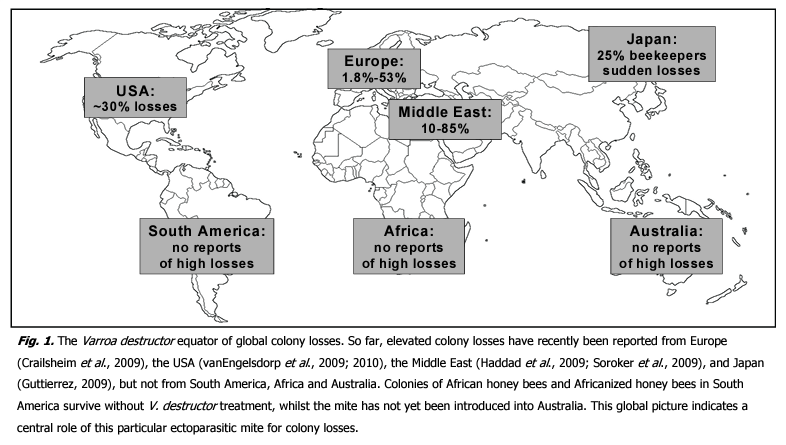
Honey bee colony losses
Peter Neumann and Norman L Carreck – 2010
Neumann, P., & Carreck, N. L. (2010). Honey bee colony losses. Journal of Apicultural Research, 49(1), 1–6. https://doi.org/10.3896/IBRA.1.49.1.01
Effects of hive spacing, entrance orientation, and worker activity on nest relocation by honey bee queens
Juan Antonio Perez-Sato, William O.H. Hughes, Margaret J. Couvillon,
Francis L.W. Ratnieks – 2008
Perez-Sato, J. A., Hughes, W. O. H., Couvillon, M. J., & Ratnieks, F. L. W. (2008). Effects of hive spacing, entrance orientation, and worker activity on nest relocation by honey bee queens. Apidologie, 39(6), 708–713. https://doi.org/10.1051/apido:2008056
Respiration of individual honeybee larvae in relation to age and ambient temperature
Markus Pets, Anton Stabentheiner, and Karl Crailsheim – 2004
Petz, M., Stabentheiner, A., & Crailsheim, K. (2004). Respiration of individual honeybee larvae in relation to age and ambient temperature. Journal of Comparative Physiology B. https://doi.org/10.1007/s00360-004-0439-z
Propolis – A Very Special Substance
Beenature Project
Propolisforschung. (n.d.). Retrieved October 25, 2023, from https://beenature-project.com/Aktuelle-Forschungen/Propolisforschung
Parasites in
Social Insects
Paul Schmid-Hempel – 1998
Schmid-Hempel, P. (1998). Parasites in social insects. Princeton University Press.
Measurement of nest cavity volume by the honey bee (Apis mellifera)
Thomas D. Seeley – 1997
Seeley, T. (1977). Measurement of nest cavity volume by the honey bee(Apis mellifera). Behavioral Ecology and Sociobiology, 2(2), 201–227. https://www.jstor.org/stable/4599130
“A scout bee’s inspection of a nest site spans approximately 40 min.
During this time a scout spends most of her time at the nest site, engaged in numerous brief inspections inside and outside the nest cavity. When inside a cavity, a scout’s principal behavior is rapid walking about the cavity’s inner surfaces.”
Honey bees of the Arnot Forest: a population of feral colonies persisting with Varroa destructor in the northeastern United States
Thomas D. Seeley – 2007
Seeley, T. D. (2007). Honey bees of the Arnot Forest: A population of feral colonies persisting with Varroa destructor in the northeastern United States. Apidologie, 38(1), 19–29. https://doi.org/10.1051/apido:2006055
“…it is now clear that a feral population of these bees, infested with V. destructor, persists in the Arnot Forest in New York State. Indeed, there is many, if not more, feral colonies living in this forest now as when they were censused 24 years earlier in 1978, hence long before the arrival of V. destructor.
Honeybee Democracy
Thomas D. Seeley – 2010
Seeley, T. D. (2010). Honeybee democracy. Princeton, N.J., Princeton University Press.
The Lives of Bees
The Untold Story of the Honey Bee in the Wild
Thomas D. Seeley – 2019
Seeley, T. D. (2019). The lives of bees: The untold story of the honey bee in the wild. Princeton University Press.
The nest of the honey bee (Apis mellifera L.)
Thomas D. Seeley and Roger A. Morse – 1776
Seeley, T. D., & Morse, R. A. (1976). The nest of the honey bee (Apis mellifera L.). Insectes Sociaux, 23(4), 495–512. https://doi.org/10.1007/BF02223477
Crowding Honeybee colonies in apiaries can increase their vulnerability to the deadly ectoparasite Varroa Destructor
Thomas D. Seeley, and Michael L. Smith – 2015
Seeley, T. D., & Smith, M. L. (2015). Crowding honeybee colonies in apiaries can increase their vulnerability to the deadly ectoparasite Varroa destructor. Apidologie, 46(6), 716–727. https://doi.org/10.1007/s13592-015-0361-2
Resin Collection and social immunity in honey bees
Michael Simone, Jay D. Evans, and Marla Spivak – 2009
Simone, M., Evans, J. D., & Spivak, M. (2009). Resin collection and social immunity in honey bees. Evolution, 63(11), 3016–3022. https://doi.org/10.1111/j.1558-5646.2009.00772.x
Migratory management and environmental conditions affect lifespan and oxidative stress in honey bees
Michael Simone-Finstrom, Hongmei Li-Byarlay, Ming H. Huang, Micheline K. Strand, Olav Rueppell, and David R. Tarpy – 2016
Simone-Finstrom, M., Li-Byarlay, H., Huang, M. H., Strand, M. K., Rueppell, O., & Tarpy, D. R. (2016). Migratory management and environmental conditions affect lifespan and oxidative stress in honey bees. Scientific Reports, 6(1), 32023. https://doi.org/10.1038/srep32023
Nest Climate Regulation in Honey Bee Colonies
James Simpson – 1961
“Ventilation of the colony is influenced by the nature of the cavity, the number and position of its openings, and the amount of space the cluster occupies.”
Simpson, J. (1961). Nest Climate Regulation in Honey Bee Colonies. Science, 133(3461), 1327–1333. http://www.jstor.org/stable/1707190
The factor that causes swarming by honeybee colonies in small hives
J. Simpson and Inge B. M. Riedel – 1963
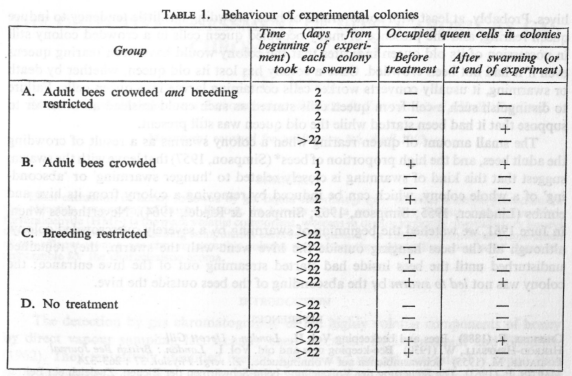
Simpson, J., & Riedel, I. B. M. (1963). The factor that causes swarming by honeybee colonies in small hives. Journal of Apicultural Research, 2(1), 50–54. https://doi.org/10.1080/00218839.1963.11100056
Swarming, defensive and hygienic behaviour in honey bee colonies of different genetic origin in a pan-European experiment
Aleksandar Uzunov, Cecilia Costa, Beata Panasiuk, Marina Meixner, Per Kryger, Fani Hatjina, Maria Bouga, Sreten Andonov, Malgorzata Bienkowska, Yves Le Conte, Jerzy Wilde, Dariusz Gerula, Hrisula Kiprijanovska, Janja Filipi, Plamen Petrov, Lauri Ruottinen, Hermann
Pechhacker, Stefan Berg, Winfried Dyrba, Evgeniya Ivanova, Ralph Büchler – 2014
Uzunov, A., Costa, C., Panasiuk, B., Meixner, M., Kryger, P., Hatjina, F., Bouga, M., Andonov, S., Bienkowska, M., Conte, Y. L., Wilde, J., Gerula, D., Kiprijanovska, H., Filipi, J., Petrov, P., Ruottinen, L., Pechhacker, H., Berg, S., Dyrba, W., … Büchler, R. (2014). Swarming, defensive and hygienic behaviour in honey bee colonies of different genetic origin in a pan-European experiment. Journal of Apicultural Research, 53(2), 248–260. https://doi.org/10.3896/IBRA.1.53.2.06
A survey of managed honey bee colony losses in the USA, fall 2009 to winter 2010
Dennis vanEngelsdorp, Jerry Hayes Jr., Robyn M Underwood, Dewey Caron, and Jeffery Pettis – 2011
vanEngelsdorp, D., Hayes, J., Underwood, R. M., Caron, D., & Pettis, J. (2011). A survey of managed honey bee colony losses in the USA, fall 2009 to winter 2010. Journal of Apicultural Research, 50(1), 1–10. https://doi.org/10.3896/IBRA.1.50.1.01