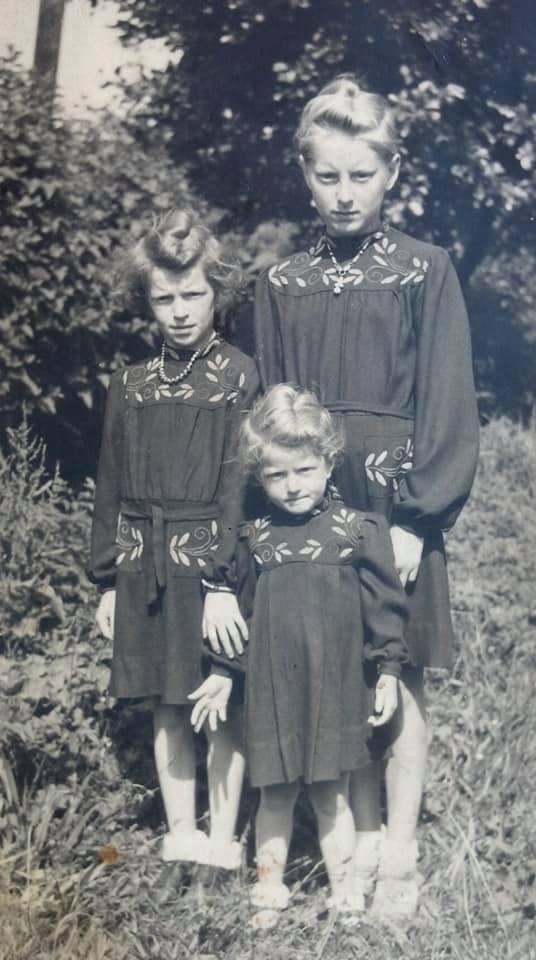
The black and white photo shows three little girls in three little dresses. What the photo does not show is red: the dresses and Hildegard’s hair. The dresses were made from stolen red flags a few years before a man would tell Hilda’s family that they were German, not Czech, and to get on the train, sit on the straw in the cattle cars, and move west. Throughout those years, Hildegard wore a hat to cover her undesirable hair color.
The other children of Berlin didn’t want her there. She was a simple country girl and another mouth to split rations with. The American soldiers didn’t see her as different and gave her oranges and chocolate. It would be an American soldier that would take her out of the hell she thought she was in and into what she thought she deserved.
Like all assholes before him, Earl was an alcoholic. Soon, Hildegard would be having his child on the kitchen table, like all noble women before her.
Earl took her home to South Carolina to learn how to properly cook for a Southern White Man. In the immigration process, she forgot to include her middle name on the paperwork. Her husband told her she was stupid, and she believed him. He saved her from war-torn Germany, and she served him biscuits and gravy.
Time would take them distances. Him, to the bar. Her, to the bobbin-lace making group at the library. And then the whole family with three children and the last accident on the way to Southern California. It was then that she thought she would be an independent woman and learn to drive. She hit every curb, garbage can, cat, and hedge in the neighborhood before it was decided that she would not be an independent woman.
The first few children grew and made mistakes and meth. Their younger brother Timothy watched from afar and chose to be different, but he was unlucky in love the first go-round. Youth had him fall hard for the wrong girl who he thought would take him out of the hell of Southern California. Once custody arrangements were made, it was determined that he would be there until the children were eighteen.
Hildegard’s granddaughter carefully observed everything around her. Katie followed her grandmother as she gardened and put eggshells on the roses. She absorbed everything that was gifted to her, though the toxic soil was filtered through the roots. The fruits of what is delivered to the grandchild don’t speak of the Crown Royal and the women. The pomegranate grown in the front yard is lovingly opened and picked. The tart red brain lobes are pulled out to savor. The damaged lobes are barely mentioned as they are tossed.
Katie came home to Southern California after a decade away with an American soldier that was supposed to save her from hell but only dragged her along through Atlantic City. Despondent, she sought refuge in Grandma, though her brain was saddled with tumors and shrinking due to dementia.
“Swans mate for life. You should give him another chance. You know, Earl had his things and his women, but I stayed with him. We were swans,” Hildegard said.
“This is not the same. He left me. I can’t take him back,” Katie said.
“Was?” Hildegard asked in German, having lost her hearing aids and her English temporarily.
Katie took the driver’s seat and aimed straight. No more detours. No more popped tires on curbs. An independent woman.
She reenrolled in college. This time, she was going to the Source. Where does the sweet chocolate come from? Certainly not from American soldiers.
While studying abroad in Jamaica, in the Blue Mountains, she met the cocoa tree. Katie named the tree she planted after Hildegard, hoping the ancestor would bless and guide the fruit to absorb what it could from the soil and not deliver any whispers of bad.
That night, Hildegard finally broke free. First, through the security screen on her window. Then, into traffic and straight on to the clouds.