Greenhouse Work
07/11/23- The plants have a place to stay! After meeting with Harry from SCARF to talk about the Harvest Festival he was able to get me s space for them in the student garden plots by the soccer fields. I have moved them over there, I decided to leave them in smaller pots for easier transportation and I will re-pot them this week. They have water access over there which is awesome, and if I need to go on vacation or anything Harry says the students who have ownership of that garden can water them for a few days. I spent more time working on the action plan, I want to do the greenhouse clear out this weekend or next week, it has just been so hot out out during the day and I keep getting harassed by security at night.
07/13/23- Just a small note that the plants seem much happier outside! I have done some more organizing in the greenhouse in preparation for the clean-out, and I’m going to talk to Michael about a work party soon. I’m doing some research on general greenhouse projects, success, and food production. I’m honestly wondering if the goal should be related to an ongoing sustainability goal rather than the goal being the food production itself. In a space that small, it’s not going to produce enough food to help more than a few people a season. I’m wondering if it could be used for native plant starts, seeding projects, or green energy production?
Research
Note: I realized in my ILC meeting that I kind of lost the plot when picking out my ILC readings, and I don’t have a very clear theme of what I am researching. I am going to finish my readings for this week and then create a better outline for the next few weeks, I might research into week 6 just to make up for lost time but I have still made pretty good progress as far as actually doing the readings.
Landscapes as living laboratories for sustainable campus planning and stewardship: A scoping review of approaches and practices by Trinity Gomez and Victoria Derr
This journal article highlighted the findings of reading research surrounding living laboratories and sustainable landscaping projects on college campuses. I was reading specifically for discussion of student involvement in these projects, and their integration into other campus systems. This paper in combination with a report I read for another ILC has given me some ideas for the direction I think the greenhouse or any other large-scale sustainable landscape project should take as far as it comes to social sustainability and student retention.
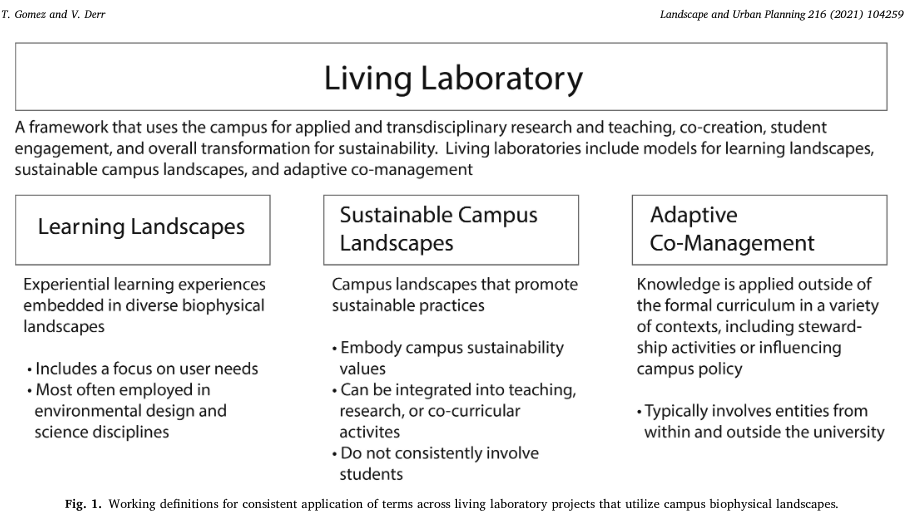
I found this image on page six to be particularly helpful, while they spend quite a while discussing various applied definitions not only does this help streamline a lot of common terms but it also allows for some distinction between them. Evergreen defiantly has the capability to be a living laboratory, and several programs take advantage of our forest and beach, or our learning landscape as it would be referred to.
Adaptive co-management is the systematic goal I am trying to achieve, allowing for student leadership and admin or RAD support. As Gomez and Derr put it “Adaptive co-management most often is a process for creating strong and inclusive policy, setting up the foundation for co-curricular activities and institutionalization of sustainable practices, and ultimately leading to sustainable campus transformation and the engagement of students outside of curriculum” (p.6) However I don’t think it can be reached until we have sustainable practices to keep implemented, how can one utilize the learning landscapes aspect to learn about something you haven’t built yet?
Students’ connection to these living laboratories is a key point of this article, highlighting not only the ways in which they are used as a tool to inspire innovation and learning but also the many benefits they hold for the students that coexist with them. Multiple times the article notes how campus green spaces and living laboratories create a sense of belonging among students, an idea that was a key element in “Food Insecurity at Urban Universities: Perspectives During the COVID-19 Pandemic”, a research paper co-published by the Coalition of Urban Serving Universities and the Association of Public and Land-grant Universities, which I read for an ILC with Sarah Williams. In this report a sense of belonging is identified as a key and necessary element for combatting food insecurity on college campuses, citing the fear of rejection from peers and lack of cultural or nutritious food available in the pantries.
A sense of belonging not only with peers and a sense of trust with the school is what allows students to access the help they need, academic performance improves with improved circumstances and so should campus green spaces, food production, and learning not all go hand in hand?
I very much enjoyed reading about the different living laboratories and ongoing sustainability projects happening at colleges across the country, I thought the University of Kentucky’s tree forest canopy fixing project sounded especially cool, and I started to brainstorm some ways the greenhouse could be used for projects that promote sustainability rather than produce food. From reading this paper and other research I’ve done I really don’t think food production as the main goal is a good option, I want to find a way to make it a usable space for campus growing projects that highlight sustainability and develop a system that not only supports it but allows it to be visible. On page 5 they pull a Bush-Gibson and Rinfret quote in which they say “public demonstration gardens are one of the primary means by which adults learn about environmental concepts and transform their perspective of the environment”, and I want to make sure I am not hiding the work done or the opportunities available.
The Nine Elements of a Sustainable Campus by Mitchell Thomashow
I read a short excerpt from The Nine Elements of a Sustainable Campus by Mitchell Thomashow, it was a very quick read but I was looking for commentary on social sustainability as the book had been referenced in “Landscapes as living laboratories for sustainable campus planning and stewardship: A scoping review of approaches and practices” by Trinity Gomez and Victoria Derr. Since this book was published almost ten years ago I was curious about what the idea of social sustainability looked liked when campus sustainability was relatively new.
This section of the book focuses mainly on the creation of sustainability-based jobs on college campuses and the leadership element that came with the start of these positions and programs. While not immediately applicable to the greenhouse project, I think it was a good read for anyone hoping to lead a sustainability-based project. The following quote in particular encapsulates a key barrier facing leadership action.
“Social behaviors require the most attention. No matter how collaborative or commons-oriented a culture might be, people will usually wonder whether a proposed change will be “good” or “bad” for them as individuals. Change implies uncertainty, unpredictability, and variation. Some individuals thrive in these circumstances. Others (the so-called change averse) find the prospect unnerving and intolerable.”
This is especially true for a project you can’t immediately see, or maybe can’t see with your eyes at all. To see it is to believe it, and if I want to successfully pilot a greenhouse program of some sorts I have to have some kind of product or producible to go with my plan, social proof.
When Students Design Learning Landscapes: Designing for Experiential Learning through Experiential Learning by Gail Hansen
My last reading was a paper from Gail Hansen that follows the activities of her learning landscape design program, giving the reader an outline from which they can teach themselves or their students a similar program. I thought it would be a helpful read not only to help develop the greenhouse project but also to help integrate it into other programs. While the greenhouse project is not really landscape design, this is a detailed breakdown of a class activity surrounding the intentional planning and design of a growing space, and had a lot of good ideas for guiding similar projects.
Hansen starts by demonstrating how her program connects with the experiential learning process, and while I would summarize it for you she put it all in this table as well.
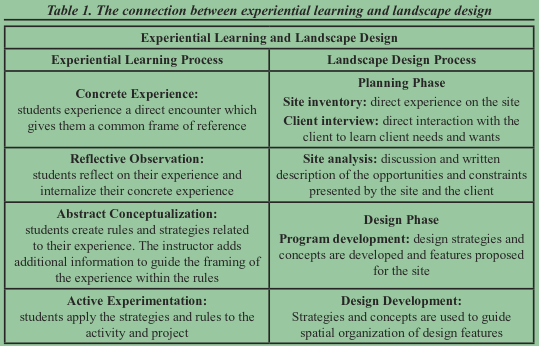
As in “Landscapes as living laboratories for sustainable campus planning and stewardship: A scoping review of approaches and practices” by Trinity Gomez and Victoria Derr, Hansen makes a note of the use of demonstration gardens and landscapes as a tool in education, and discusses its connection to the concrete experience and reflective observation steps in the experimental learning process.
Students in the program had an assigned budget to work through the steps above, working not only within the parameters from the site inventory and the client interview but also local and regional guidelines. Hansen highlighted one of the biggest mistakes made by students was getting ahead of themselves, going to intricate with materials too expensive and exceeding their budget, I am already guilty of getting ahead of myself on this project and I wish I had started it with these steps in mind. Not only do they give you a sense of direction, but they allow for better documentation and live time changes.
Hansen uses another table to identify the key concepts and activities within each step of the process and the reasonings and teaching from the experiential learning process steps.
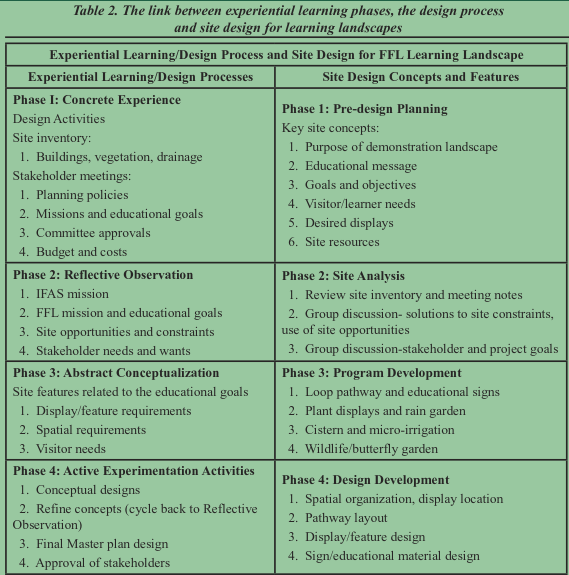
I need to take these steps and apply them to my ILC, and I might need to do it twice. Once may be to develop the new intention behind the greenhouse and the system that surrounds it, and the other for the greenhouse design itself. On top of that, is the greenhouse a potential space for students to do this kind of design work in an ongoing manner? Is there enough physical space, do greenhouses in Washington have that kind of innovation potential? Will the greenhouse adjust to constant change well?
Over the next few days I will be streamlining the theme of my readings and creating a new list of readings for the next few weeks.