Weekly Tasks: More weeding, trimming of perennials
Readings: Chapter 7 “Tools and Technology” – Farming While Black
I really appreciated this week’s reading as preparation for future projects within the herb garden. I think it did a wonderful job of highlighting the necessary tools and materials needed for working on either a small- or large-scale farm, while also highlighting the racial histories of these tools and educating on the connection each tool has to Black farmers. I am now very excited about transplanting the new lavender plants into the herb garden and also fixing the busted irrigation system!

Monday, 2/7
Today was probably my favorite day in the herb garden so far. Not only did we get quite a lot of work done, but I felt like I made more connections with my classmates today than I have in previous weeks.
The morning started off with my usual meeting with Beth, where we decided that (you guessed it!) more weeding was in order. Along with weeding, there was an unidentified perennial that needed trimming down, as well as a pesky thimbleberry and some nettle plants that needed careful removal. Finally, it was time to pull out the dead calendula plants as they had already successfully reseeded their area.
I only had two helpers in the herb garden today, Laura and Casey, but the three of us worked fast and also talked quite a lot as we did. I really appreciated these connections, I felt so disconnected from my classmates last quarter but I have so much hope for what the rest of this and next quarter hold when it comes to community building. I am so excited for classes to be returning to in-person and to create even more connections with the other two Taste programs.
Finally, in honor of our “Tools and Technology” chapter for the week, I wanted to share some appreciation for digging forks, rubber gloves, and wheelbarrows, as these tools have made work in the herb garden so much more manageable and enjoyable. I am thankful for the trust from Beth in letting us use these tools and thankful for their help in making the herb garden a beautiful place.

Upper left quadrant at the end of class 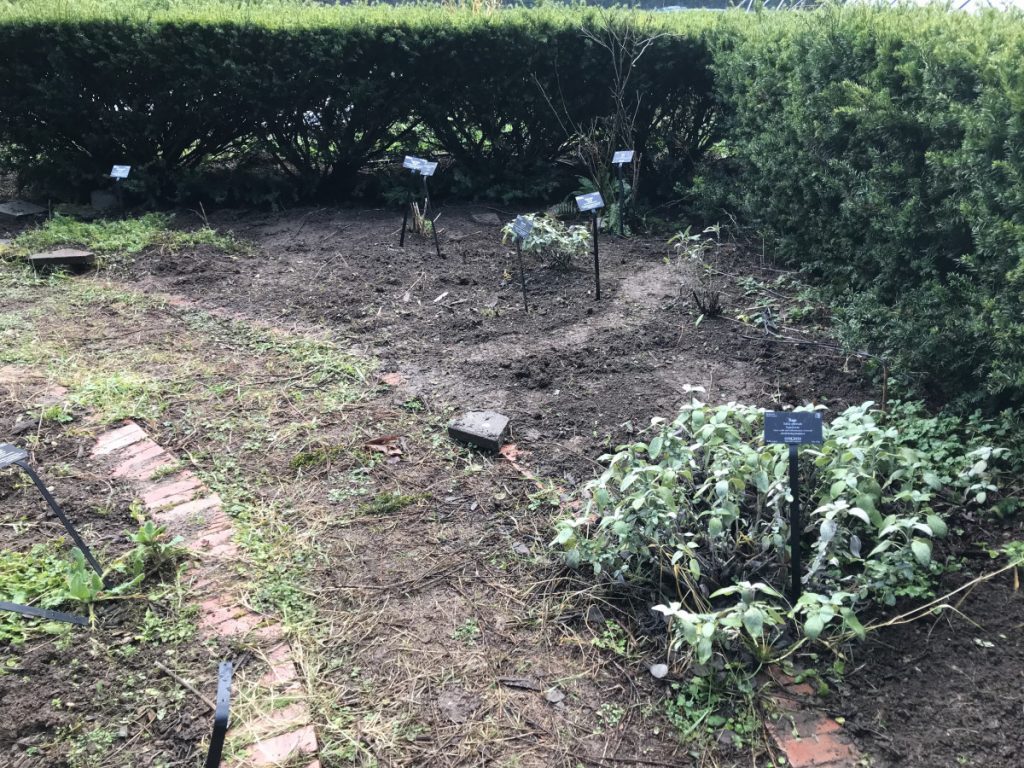
Upper right quadrant at the end of class
Readings

The Evergreen Herbal – Tari Gunstone
Chapter 6 “Plant Monographs”
This chapter was another that I mostly skimmed through, as I had already explored a lot of it last quarter for my personal materia medica. It contains a wonderful collection of monographs on 15 easy-to-grow herbs as well as 10 native herbs that you could probably find in your own backyard.
15 Easy-to-Grow Herbs
- calendula
- chamomile
- feverfew
- lavender
- lemon balm
- mugwort
- mullein
- oregano
- peppermint
- rosemary
- sage
- thyme
- valerian
- violet
- yarrow
10 Native Wild Herbs
- chickweed
- red clover
- blue elderberry
- dandelion
- yellow/curly dock
- horsetail
- stinging nettle
- Nootka rose
- Oregon grape
- self-heal, heal-all
I was especially excited about the list of native, wild herbs because a few of them were plants I had worked with last year for a project on natural dyes. I love these colliding worlds, discovering, and even experimenting, with the many uses of plants that can be naturally found in my own backyard. It makes me very excited for spring to arrive so I can get to know these plants even better.

The Herbalist’s Way – Nancy and Michael Phillips
Chapter 2 “The Gamut of Herbal Possibility”
This chapter was so wonderful, probably my favorite that I have read so far. It covered the different roles and opportunities that come along with being an herbalist, how there is no one path of herbalism and there are different possibilities of work within the title of herbalist. The main opportunities include practitioner, grower, medicine maker, apothecary, and teacher, but oftentimes herbalists combine a few of these or even practice all of them at once (although that can become quite demanding).