Spring 2021 – Week 2 Summary

So, I fell behind on my weekly posts already. To be honest, I didn’t do a lot in week 2. Well, nothing interesting. I was still quite exhausted from the first week; I really cannot emphasize how physical dyeing large quantities of yarn can be. I took it easy this week, mostly because I needed to. While I enjoy what I do and I want to do it all the time, my body just can’t keep up. Oh, the joy of being in my 30s and realizing my body doesn’t bounce back like it used to. I imagine that people who were/are dyers by trade must be sore quite often.

This isn’t to say I didn’t do anything – I did. The first thing was overdyeing my yarn dyed with madder and the yarn dyed with woad that I set aside for the inlay pattern. The madder gave the yarn a very nice pinkish orange color, but I wanted it redder, so I used cochineal to do the job. I truly enjoy working with cochineal. Not only does it give an amazing array of colors, it was important to my ancestors, which is a connection I hold dear. Now, I know how to make pure red with cochineal, but I decided to process it in a way to give more of a magenta – it’s the easiest color to get, and I figured the madder-dyed yarn already had a warm undertone to it and adding more of that wouldn’t make much of a difference.

And I succeeded! Sort of. It’s a a bit of a subtle difference, but it’s there. I left the yarn overnight in the cochineal bath in order for the yarn to soak up as much pigment as possible, which it did with the inlay yarn but not so much the madder-dyed yarn. I have a feeling that if I mordanted the yarn again it would soak of more of the cochineal, but I didn’t really want to keep subjecting the yarn to high temperatures. Also, while the color wasn’t quite what I wanted originally, I’ve grown to quite like it.

The other major thing I did was wind ALL of the yarn into balls. This…took a while. For some reason, the warp yarn felted a bit when I was dyeing it with woad. I honestly don’t know why – the woad bath wasn’t heated nor did I agitate the yarn at all. I had to separate the strands of yarn from each other before I could wind it up. I also decided at the last minute to buy a yarn swift. A yarn swift holds a skein of yarn and spins. Without it, I would have had to ask my partner to help me by holding the skeins while I wound it. The yarn swift was a bit pricey, but worth every cent. I thought winding the yarn into balls would be a quick task, but it really wasn’t. I feel like that right there is the theme of this whole project: I thought x would take a certain amount of time, but actually takes a great deal more of time than I thought.
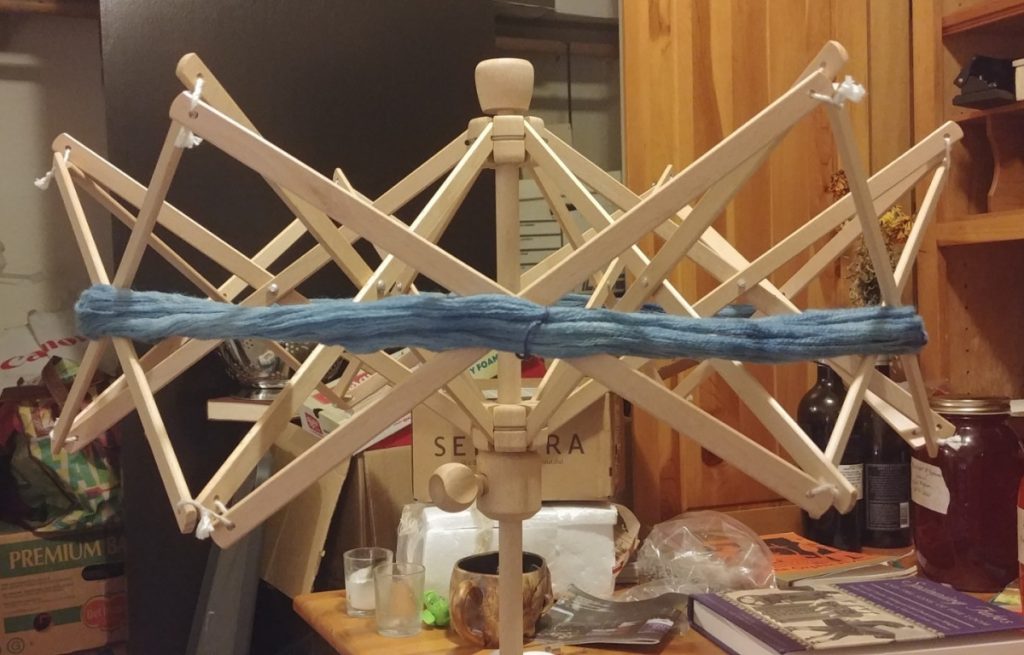
My yarn swift. I think the picture explains what it is better than I can. As you can see, the swift holds the skein under a bit of tension, and will spin as I wind on the yarn into a ball.

Spring 2021 – Week 1 Summary

The first week of the spring quarter was busy, exhausting, and honestly a lot of fun. I decided to get all of my dyeing done in the first week, and I accomplished that goal, more or less (I had some over-dyeing I did in the second week). The first thing I had to do was measure out my warp. I wasn’t able to spin all of the yarn necessary to weave my chiton, so I went to a yarn shop in Tacoma, Fibers Etc., and bought an entire cone of laceweight yarn – this one is about 30 wraps per inch, which is a bit finer than what I want, but I can work with it. Did I have to buy the entire nearly 3 lb. cone? No. Did I want to sit in the shop for over an hour unwinding what I needed? Also no. It’s not like I won’t find a use for it! I still had to unwind what I needed, but I was able to do that in the comfort of my home.

I also needed to allot some of the weft for the stripes of red and yellow, as they obviously need to be dyed separately. I also decided to weave in a purple pattern in the yellow stripe using supplementary weft/inlay, which I’m going to let Wikipedia define for me: “An extra set of threads are woven into the weft between two regular weft threads to create an ornamental pattern in addition to the ground weave.” I tried to find a pattern online for what I wanted – a Greek key/meander pattern – but I couldn’t find anything. So, I had to figure it out myself and let me tell you, was that challenging. I’ll let the picture speak for itself:

It was difficult creating a pattern that would only be about an inch tall, but that would still be bold enough to be noticeable. Also, I didn’t want the pattern to suddenly be cut off at the edge, so I had to make sure it would fit within the amount of warp strings I plan on having.

Once all of the yarn was measured and sorted, I was now ready to start the dyeing process. First step: scouring. I believe I’ve talked about scouring before when I was starting with my fleece. It’s a good idea to clean yarn before dyeing it, as any dirt and especially oils will prevent the yarn from absorbing the pigments. Once all of the yarn was scoured (which had to be done in two batches – I have so much yarn!), I could then move to mordanting. To mordant fiber means to treat it with a substance that allows the molecules of the pigment to attach to the molecules of the fiber. The best known mordants are metal salts, such as aluminum, iron, and copper. Different mordants will effect the end result in different ways: copper gives more yellow tones, iron “saddens” – dulls the color, and aluminum tends to brighten. There are a couple of options with aluminum and probably the most popular is alum, potassium aluminum sulfate. Alum is also usually considered the safest one to use in your kitchen, which is where most of my dyeing activities take place.

Scouring isn’t the most interesting process, but it’s one of the most important.

Once all of that was done, it was time for the fun part: dyeing! I used madder and cochineal for red, saffron for yellow, woad for blue, and woad with an over-dye of cochineal for purple. I started the process on Wednesday evening by soaking the madder overnight in water. Thursday was actually heating the madder, straining, and barely simmering on the stove with the yarn in the dye bath; I repeated this process with the saffron, minus soaking overnight. Later Thursday evening I started the woad vat. Woad and indigo are dyestuffs that need to be used in conjunction with a fermentation vat in order to dye textiles. I think I might do separate write-ups for woad, madder, and saffron each in order to go more in-depth into what I did for each one.

Friday I attempted to dye my warp yarn with the woad vat, but was only able to do one dip; to obtain deeper colors, it’s usually necessary to do multiple dips in the woad vat. After the first dip, the vat went out of balance I think, as the yarn didn’t get any darker after a second dip; meaning, either the vat became not alkaline enough or too much oxygen was incorporated after the initial dip. So I took the vat inside and reinvigorated it for the next day. Saturday was much more successful, and I was able to finish dyeing the warp, the weft, and the supplementary weft. Sunday I slept all day, because pretty much every muscle in my body ached. I stood a lot in front of the stove, watching the temperature of the pots of yarn and dye. I lifted and carried pots heavy with liquid. I squeezed and washed a lot of yarn. And the yarn is not light, either, especially when wet. But, I really do love natural dyeing. I love how nature gives us so many colors if we know how to unlock her secrets.

All of the yarn I will be using to create my chiton. It’s a bit surreal to see it all together, ready to be made into yarn balls and woven.